
















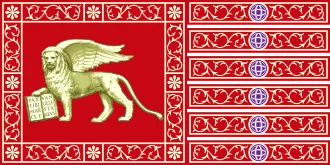
The islands of the Venetian Lagoon in the 7th century, after having experienced a period of substantial increase in population, were organized into Maritime Venice, a Byzantine duchy dependent on the Exarchate of Ravenna. With the fall of the Exarchate and the weakening of Byzantine power, the Duchy of Venice arose, led by a doge and established on the island of Rialto; it prospered from maritime trade with the Byzantine Empire and other eastern states.
To safeguard the trade routes, between the 9th and 11th centuries the Duchy waged several wars, which ensured its complete dominion over the Adriatic. Owing to its participation in the Crusades, Venice increasingly penetrated into eastern markets and, between the 12th and 13th centuries, managed to extend its power into numerous eastern emporiums and commercial ports.
The supremacy over the Mediterranean Sea led the Republic to the clash with Genoa, which lasted until the 14th century, when, after having risked complete collapse during the War of Chioggia (with the Genoese army and fleet in the lagoon for a long period), Venice quickly managed to recover from the territorial losses suffered with the Treaty of Turin of 1381 and begin expansion on the mainland.
Venetian expansion, however, led to the coalition of the Habsburg monarchy, Spain and France in the League of Cambrai, which in 1509 defeated the Republic of Venice in the Battle of Agnadello. While maintaining most of its mainland possessions, Venice was defeated, and the attempt to expand the eastern dominions caused a long series of wars against the Ottoman Empire, which ended only in the 18th century with the Treaty of Passarowitz of 1718 and which caused the loss of all possessions in the Aegean.
Although still a thriving cultural centre, the Republic of Venice was occupied by Napoleon's French troops and its territories were divided with the Habsburg monarchy following the ratification of the Treaty of Campo Formio.
Throughout its history, the Republic of Venice was characterized by its political order. Inherited from the previous Byzantine administrative structures, its head of state was the doge, a position which became elective from the end of the 9th century. In addition to the doge, the administration of the Republic was directed by various assemblies: the Great Council, with legislative functions, which was supported by the Minor Council, the Council of Forty and the Council of Ten, responsible for judicial matters, and the Senate.
Etymology
During its long history, the Republic of Venice took on various names, all closely linked to the titles attributed to the doge. During the 8th century, when Venice still depended on the Byzantine Empire, the doge was called in Latin Dux Venetiarum Provinciae ('Doge of the Province of Venice'), and then, starting from 840, Dux Veneticorum ('Doge of the Venetians'), following the signing of the Pactum Lotharii.
This commercial agreement between the Duchy of Venice (Ducatum Venetiae) and the Carolingian Empire de facto ratified the independence of Venice from the Byzantine Empire.
In the following century, references to Venice as a Byzantine dominion disappeared, and in a document from 976 there is a mention of the most glorious Domino Venetiarum ('Lord of Venice'), where the 'most glorious' appellative had already been used for the first time in the Pactum Lotharii and where the appellative "lord" refers to the fact that the doge was still considered like a king, even if elected by the popular assembly.
Gaining independence, Venice also began to expand on the coasts of the Adriatic Sea, and so starting from 1109, following the conquest of Dalmatia and the Croatian coast, the doge formally received the title of Venetiae Dalmatiae atque Chroatiae Dux ('Doge of Venice, Dalmatia and Croatia'), a name that continued to be used until the 18th century.
Starting from the 15th century, the documents written in Latin were joined by those in the Venetian language, and in parallel with the events in Italy, the Duchy of Venice also changed its name, becoming the Lordship of Venice, which as written in the peace treaty of 1453 with Sultan Mehmed II was fully named the Illustrissima et Excellentissima deta Signoria de Venexia ('The Most Illustrious and Excellent Signoria of Venice').
During the 17th century, monarchical absolutism was made in many countries of continental Europe, radically changing the European political landscape. This change made it possible to more markedly determine the differences between monarchies and republics: while the former had economies governed by strict laws and dominated by agriculture, the latter lived off of commercial affairs and free markets.
Moreover, the monarchies, in addition to being led by a single ruling family, were more prone to war and religious uniformity.[citation needed] This increasingly noticeable difference between monarchy and republic began to be specified also in official documents, and it was hence that names such as the Republic of Genoa or the Republic of the Seven United Provinces were born.
The Lordship of Venice also adapted to this new terminology, becoming the Most Serene Republic of Venice (Italian: Serenissima Repubblica di Venezia; Venetian: Serenìsima Repùblega de Venexia), a name by which it is best known today. Similarly, the doge was also given the nickname of serenissimo or more simply that of His Serenity.
From the 17th century the Republic of Venice took on other more or less official names such as the Venetian State or the Venetian Republic. The republic is often referred to as La Serenissima, in reference to its title as one of the "Most Serene Republics".
History
9th–10th century: The ducal age
The Duchy of Venice was born in the 9th century from the Byzantine territories of Maritime Venice. According to tradition, the first doge was elected in 697, but this figure is of dubious historicity and comparable to that of the exarch Paul, who, similarly to the doge, was assassinated in 727 following a revolt. Father Pietro Antonio of Venetia, in his history of the lagoon city published in 1688, writes: "The precise time in which that family arrived in the Adria is not found, but rather, what already an inhabitant of the islands, by the princes, who welcomed citizens, and supported with the advantage of significant riches, in the year 697 she contributed to the nomination of the first Prince Marco Contarini, one of the 22 Tribunes of the Islands, who made the election".
In 726, Emperor Leo III attempted to extend iconoclasm to the Exarchate of Ravenna, causing numerous revolts throughout the territory. In reaction to the reform, the local populations appointed several duces to replace the Byzantine governors and in particular Venetia appointed Orso as its doge, who governed the lagoon for a decade.
Following his death, the Byzantines entrusted the government of the province to the regime of the magistri militum, which lasted until 742 when the emperor granted the people the appointment of a dux. The Venetians elected by acclamation Theodato, son of Orso, who decided to move the capital of the duchy from Heraclia to Metamauco.
The Lombard conquest of Ravenna in 751 and the subsequent conquest of the Lombard kingdom by Charlemagne's Franks in 774, with the creation of the Carolingian Empire in 800, considerably changed the geopolitical context of the lagoon, leading the Venetians to divide into two factions : a pro-Frankish party led by the city of Equilium and a pro-Byzantine party with a stronghold in Heraclia.
After a long series of skirmishes in 805, Doge Obelerio decided to attack both cities simultaneously, deporting their population to the capital. Having taken control of the situation, the doge placed Venezia under Frankish protection, but a Byzantine naval blockade convinced him to renew his loyalty to the Eastern Emperor.
With the intention of conquering Venezia in 810, the Frankish army commanded by Pepin invaded the lagoon, forcing the local population to retreat to Rivoalto, thus starting a siege which ended with the arrival of the Byzantine fleet and the retreat of the Franks. Following the failed Frankish conquest, Doge Obelerio was replaced by the pro-Byzantine nobleman Agnello Participazio who definitively moved the capital to Rivoalto in 812, thus decreeing the birth of the city of Venice.
With his election, Agnello Partecipazio attempted to make the ducal office hereditary by associating an heir, the co-dux, with the throne. The system brought Agnello's two sons, Giustiniano and Giovanni, to the ducal position, who was deposed in 836 due to his inadequacy to counter the Narentine pirates in Dalmatia.
Following the deposition of Giovanni Partecipazio, Pietro Tradonico was elected who, with the promulgation of the Pactum Lotharii, a commercial treaty between Venice and the Carolingian Empire, began the long process of detachment of the province from the Byzantine Empire. After Tradonico was killed following a conspiracy in 864, Orso I Participazio was elected and resumed the fight against piracy, managing to protect the Dogado from attacks by the Saracens and the Patriarchate of Aquileia.
Orso managed to assign the dukedom to his eldest son Giovanni II Participazio who, after conquering Comacchio, a rival city of Venice in the salt trade, decided to abdicate in favor of his brother, at the time patriarch of Grado, who refused. Since there was no heir in 887 the people gathered in the Concio and elected Pietro I Candiano by acclamation.
The Concio managed to elect six doges up to Pietro III Candiano who in 958 assigned the position of co-dux to his son Pietro who became doge the following year. Due to his land holdings, Pietro IV Candiano had a political vision close to that of the Holy Roman Empire and consequently attempted to establish feudalism in Venice as well, causing a revolt in 976 which led to the burning of the capital and the killing of the doge.
These events led the Venetian patriciate to gain a growing influence on the doge's policies and the conflicts that arose following the doge's assassination were resolved only in 991 with the election of Pietro II Orseolo.
11th–12th century: Relations with the Byzantine Empire
Pietro II Orseolo gave a notable boost to Venetian commercial expansion by stipulating new commercial privileges with the Holy Roman Empire and the Byzantine Empire. In addition to diplomacy, the doge resumed the war against the Narentan pirates that began in the 9th century and in the year 1000 he managed to subjugate the coastal cities of Istria and Dalmatia.
The Great Schism of 1054 and the outbreak of the investiture struggle in 1073 marginally involved Venetian politics which instead focused its attention on the arrival of the Normans in southern Italy. The Norman occupation of Durrës and Corfu in 1081 pushed the Byzantine Empire to request the aid of the Venetian fleet which, with the promise of obtaining extensive commercial privileges and reimbursement of military expenses, decided to take part in the Byzantine-Norman wars.
The following year, Emperor Alexios I Komnenos granted Venice the chrysobull, a commercial privilege that allowed Venetian merchants substantial tax exemptions in numerous Byzantine ports and the establishment of a Venetian neighbourhood in Durrës and Constantinople. The war ended in 1085 when, following the death of the leader Robert Guiscard, the Norman army abandoned its positions to return to Puglia.
Having taken office in 1118, Emperor John II Komnenos decided not to renew the chrysobull of 1082, arousing the reaction of Venice which declared war on the Byzantine Empire in 1122. The war ended in 1126 with the victory of Venice which forced the emperor to stipulate a new agreement characterized by even better conditions than the previous ones, threatening to make the Byzantine Empire totally dependent on Venetian trade and protection.
With the intention of weakening the growing Venetian power, the emperor provided substantial commercial support to the maritime republics of Ancona, Genoa and Pisa, making coexistence with Venice, which was now hegemonic on the Adriatic Sea, increasingly difficult, so much so that it was renamed the "Gulf of Venice". In 1171, following the emperor's decision to expel the Venetian merchants from Constantinople, a new war broke out which was resolved with the restoration of the status quo.
At the end of the 12th century, the commercial traffic of Venetian merchants extended throughout the East and they could count on immense and solid capital.
As in the rest of Italy, starting from the 12th century, Venice also underwent the transformations that led to the age of the municipalities. In that century, the doge's power began to decline: initially supported only by a few judges, in 1130 it was decided to place the Consilium Sapientium, which would later become the Great Council of Venice, alongside his power.
In the same period, in addition to the expulsion of the clergy from public life, new assemblies such as the Council of Forty and the Minor Council were established and in his inauguration speech the Doge was forced to declare loyalty to the Republic with the promissione ducale; thus the Commune of Venice, the set of all the assemblies aimed at regulating the power of the doge, began to take shape.
13th–14th century: The Crusades and the rivalry with Genoa
In the 12th century, Venice decided not to participate in the Crusades due to its commercial interests in the East and instead concentrated on maintaining its possessions in Dalmatia which were repeatedly besieged by the Hungarians. The situation changed in 1202 when the Doge Enrico Dandolo decided to exploit the expedition of the Fourth Crusade to conclude the Zara War and the following year, after twenty years of conflict, Venice conquered the city and won the war, regaining control of Dalmatia.
The Venetian crusader fleet, however, did not stop in Dalmatia, but continued towards Constantinople to besiege it in 1204, thus putting an end to the Byzantine Empire and formally making Venice an independent state, severing the last ties with the former Byzantine ruler. The empire was dismembered in the Crusader states and from the division Venice obtained numerous ports in the Morea and several islands in the Aegean Sea including Crete and Euboea, thus giving life to the Stato da Màr.
In addition to the territorial conquests, the doge was awarded the title of Lord of a quarter and a half of the Eastern Roman Empire, thus obtaining the faculty of appointing the Latin Patriarchate of Constantinople and the possibility of sending a Venetian representative to the government of the Eastern Latin Empire.
With the end of the Fourth Crusade, Venice concentrated its efforts on the conquest of Crete, which intensely involved the Venetian army until 1237.
Venice's control over the eastern trade routes became pressing and this caused an increase in conflicts with Genoa which in 1255 exploded into the War of Saint Sabas; on 24 June 1258 the two republics faced each other in the Battle of Acre which ended with an overwhelming Venetian victory. In 1261 the Empire of Nicaea with the help of the Republic of Genoa managed to dissolve the Eastern Latin Empire and re-establish the Byzantine Empire.
The war between Genoa and Venice resumed and after a long series of battles the war ended in 1270 with the Peace of Cremona. In 1281 Venice defeated the Republic of Ancona in battle and in 1293 a new war between Genoa, the Byzantine Empire and Venice broke out, won by the Genoese following the Battle of Curzola and ending in 1299.
During the war, various administrative reforms were implemented in Venice, new assemblies were established to replace popular ones such as the Senate and in the Great Council power began to concentrate in the hands of about ten families. To avoid the birth of a lordship, the Doge decided to increase the number of members of the Maggior Consiglio while leaving the number of families unchanged and so the Serrata del Maggior Consiglio was implemented in 1297.
Following the provision, the power of some of the old houses decreased and in 1310, under the pretext of defeat in the War of Ferrara, these families organized themselves in the Tiepolo conspiracy. Once the coup d'état failed and the establishment of a lordship was averted, Doge Pietro Gradenigo established the Council of Ten, which was assigned the task of repressing any threat to the security of the state.
In the Venetian hinterland, the war waged by Mastino II della Scala caused serious economic losses to Venetian trade, so in 1336 Venice gave birth to the anti-Scaliger league and the Scaliger War. The following year the coalition expanded further and Padua returned to the dominion of the Carraresi. In 1338, Venice conquered Treviso, the first nucleus of the Domini di Terraferma, and in 1339 it signed a peace treaty in which the Scaligeri promised not to interfere in Venetian trade and to recognize the sovereignty of Venice over the Trevisan March.
In 1343 Venice took part in the Smyrniote crusades, but its participation was suspended due to the siege of Zadar by the Hungarians. The Genoese expansion to the east, which caused the Black Death, brought the rivalry between the two republics to resurface and in 1350 they faced each other in the War of the Straits. Following the defeat in the Battle of Sapienza, Doge Marino Faliero attempted to establish a city lordship, but the coup d'état was foiled by the Council of Ten which on 17 April 1355 condemned the Doge to death.
The ensuing political instability convinced Louis I of Hungary to attack Dalmatia which was conquered in 1358 with the signing of the Treaty of Zadar. The weakness of the Republic pushed Crete and Trieste to revolt, but the rebellions were quelled, thus reaffirming Venetian dominion over the Stato da Màr. The skirmishes between the Venetians and the Genoese resumed and in 1378 the two republics faced each other in the War of Chioggia.
Initially the Genoese managed to conquer Chioggia and vast areas of the Venetian Lagoon, but in the end it was the Venetians who prevailed; the war ended definitively on 8 August 1381 with the Treaty of Turin which sanctioned the exit of the Genoese from the competition for dominion over the Mediterranean.
15th century: Territorial expansion
In 1403, the last major battle between Genoa (now under French protection) and Venice was fought at Modon, and the final victory resulted in maritime hegemony and dominance of the eastern trade routes. The latter would soon be contested, however, by the inexorable rise of the Ottoman Empire. Hostilities began after Prince Mehmed I ended the civil war of the Ottoman Interregnum and established himself as sultan.
The conflict escalated until Pietro Loredan won a crushing victory against the Turks off Gallipoli in 1416.[citation needed]
Venice expanded as well along the Dalmatian coast from Istria to Albania, which was acquired from King Ladislaus of Naples during the civil war in Hungary. Ladislaus was about to lose the conflict and had decided to escape to Naples, but before doing so he agreed to sell his now practically forfeit rights on the Dalmatian cities for the reduced sum of 100,000 ducats.
Venice exploited the situation and quickly installed nobility to govern the area, for example, Count Filippo Stipanov in Zara. This move by the Venetians was a response to the threatening expansion of Gian Galeazzo Visconti, Duke of Milan. Control over the northeast main land routes was also a necessity for the safety of the trades.
In the first decade of 15th century Venice employed navy of around 10 war galleys. In 1424 it was increased to 25 galleys.
In 1420-1450, Venice had around 3,345 ships crewed by 36,000 men (45 galleys by 11,000 men, 300 navi ships by 8,000 men, 3000 small ships by 17,000 men), and had taken over most of what is now the Veneto, including the cities of Verona (which swore its loyalty in the Devotion of Verona to Venice in 1405) and Padua.
Slaves were plentiful in the Italian city-states as late as the 15th century. The Venetian slave trade was divided in to the Balkan slave trade and the Black Sea slave trade. Between 1414 and 1423, some 10,000 slaves, imported from Caffa (via the Black Sea slave trade), were sold in Venice.