















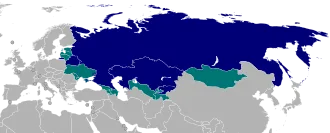
Russian has over 210 million total speakers worldwide. It is the most spoken native language in Europe, the most spoken Slavic language, and the most geographically widespread language of Eurasia. It is the world's seventh-most spoken language by number of native speakers, and the world's eleventh-most spoken language by total number of speakers.
Russian is one of two official languages aboard the International Space Station, one of the six official languages of the United Nations, as well as the seventh most widely used language on the Internet.
Russian is written using the Russian alphabet of the Cyrillic script; it distinguishes between consonant phonemes with palatal secondary articulation and those without, the so-called "soft" and "hard" sounds. Almost every consonant has hard–soft counterparts, and the distinction is a prominent feature of the language, which is usually shown in writing not by a change of the consonant but rather by changing the following vowel.
Another important aspect is the reduction of unstressed vowels. Stress, which is often unpredictable, is not normally indicated orthographically, though an optional acute accent may be used to mark stress, such as to distinguish between homographic words (e.g. замо́к [zamók, 'lock'] and за́мок [zámok, 'castle']), or to indicate the proper pronunciation of uncommon words or proper nouns.
Russian is a typical fusional language, where a single inflectional morpheme at the end of a word is used to denote multiple grammatical features. In addition to inflection for morphology Russian also actively uses prefixes and suffixes for word formation, more so than most other Slavic languages. Also, Russian uses descriptive phrases (like железная дорога, zheleznaya doroga, lit. 'iron road') where other Slavic languages often prefer single-word derivatives (such as Czech železnice).
Name of the language
The linguonym russky yazyk (русский язык) is historically associated with the ethnonym and toponym Rus (Русь), from which the forms russky (русский) and related variants developed. Rus is found in Russian literary monuments of the 11th–14th centuries, while the modern form, Rossiya (Россия), began to appear in Russian writing in the 15th century.
In Russian literary monuments of the 15th–16th centuries, the Byzantine-influenced forms Rosiya (Росия) and Roseya (Росея) emerged.
By the early 17th century, the terms Rosiyskoye tsarstvo (Росийское царство, lit. 'Russian tsardom') and Velikaya Rosiya (Великая Росия, lit. 'Great Russia') became established in Russian usage, alongside the forms rossky (росский) and ross (росс), which arose under Greek influence.
The adjective rossiysky (российский) also came into use as a designation for the language; both russky and rossiysky were treated as synonyms, while the Greek-influenced forms predominated in the "high style" of the language.
By the early 19th century, rossky and ross had come to be perceived as archaic, while russky was revived and gradually displaced rossiysky as the ethnic designation associated with the Russian language. The adjective rossiysky subsequently became associated primarily with state affiliation rather than ethnicity.
Classification
Russian is an East Slavic language of the wider Indo-European family, alongside Belarusian, Rusyn, and Ukrainian. In many places in eastern and southern Ukraine and throughout Belarus, these languages are spoken interchangeably, and in certain areas, traditional bilingualism has resulted in language mixtures such as surzhyk in eastern Ukraine and trasianka in Belarus.
Many speakers do not perceive these as mixtures, but instead as local varieties of Russian or Belarusian/Ukrainian.
Russian also has notable lexical similarities with Bulgarian due to a common Church Slavonic influence on both languages, but because of later developments in the 19th and 20th centuries, modern Bulgarian grammar differs markedly from Russian. The use of Church Slavonic as a literary language in the medieval period gave Russian a large number of borrowings and calques ultimately derived from Greek.
After the fall of Constantinople in 1453, Russian Orthodoxy became more self-contained, and over time, the Russian recension of Church Slavonic came to influence the Bulgarian and Serbian recensions of Church Slavonic. The influence of Church Slavonic on Russian can still be seen in certain aspects of phonology, grammar, and particularly lexis.
The Old Novgorod dialect, a historical variety of Russian with unique northwestern dialectal features, is sometimes considered to have played a significant role in the formation of modern Russian.
Over the course of centuries, the vocabulary and literary style of Russian have also been influenced by Western and Central European languages such as Greek, Latin, Polish, Dutch, German, French, Italian, and English, and to a lesser extent the languages to the south and the east: Uralic, Turkic, Persian, Arabic, and Hebrew.
According to the Defense Language Institute in Monterey, California, Russian is classified as a level III language in terms of learning difficulty for native English speakers, requiring approximately 1,100 hours of immersion instruction to achieve intermediate fluency.
Standard Russian
Feudal divisions and conflicts created obstacles between the Russian principalities before and especially during Mongol rule. This strengthened dialectal differences, and for a while, prevented the emergence of a standardized national language. The formation of the unified and centralized Russian state in the 15th and 16th centuries, and the gradual re-emergence of a common political, economic, and cultural space created the need for a common standard language.
The initial impulse for standardization came from the government bureaucracy for the lack of a reliable tool of communication in administrative, legal, and judicial affairs became an obvious practical problem. The earliest attempts at standardizing Russian were made based on the so-called Moscow official or chancery language, during the 15th to 17th centuries.
However, the use of Church Slavonic by the church meant that Russian had a secondary status. By the 17th century, the idea of expanding the use of Russian had emerged when it became clear that Church Slavonic was ill-suited for use in administrative and business matters. Since then, the trend of language policy in Russia has been standardization in both the restricted sense of reducing dialectical barriers between ethnic Russians, and the broader sense of expanding the use of Russian alongside or in favour of other languages.
The current standard form of Russian is generally regarded as the modern Russian literary language (современный русский литературный язык, sovremennyy russkiy literaturnyy yazyk), or Contemporary Standard Russian.
It arose at the beginning of the 18th century with the modernization reforms of the Russian state under the rule of Peter the Great and developed from the Moscow dialect substratum under some influence of the Russian chancery language. The Moscow dialect had a northern dialectal base, but after Moscow became the center of a unified state, the attraction of southern dialectal speakers led to the emergence of a transitional dialect group.
Peter regarded the standardization of Russian as essential to the development of a modern system of government, education and science, and consequently, to Russia's economic development. By the early 18th century, Russian had replaced Church Slavonic in secular matters. The spread of the Russian literary language was further advanced by a new generation of intellectuals, including Mikhail Lomonosov, who authored the first scientific grammar of Russian and developed a theoretical system of stylistic registers.
In addition, he introduced several new literary genres derived from Western European literary traditions. The re-emergence and standardization of Russian for official, administrative, and commercial use laid the foundations for modern Russian.
Prior to the Bolshevik Revolution, the spoken form of the Russian language was that of the nobility and the urban bourgeoisie. Russian peasants, the great majority of the population, continued to speak in their own dialects. However, the peasants' speech was never systematically studied, as it was generally regarded by philologists as simply a source of folklore and an object of curiosity.
This was acknowledged by the noted Russian dialectologist Nikolai Karinsky, who toward the end of his life wrote: "Scholars of Russian dialects mostly studied phonetics and morphology. Some scholars and collectors compiled local dictionaries. We have almost no studies of lexical material or the syntax of Russian dialects."
After 1917, Marxist linguists had no interest in the multiplicity of peasant dialects and regarded their language as a relic of the rapidly disappearing past that was not worthy of scholarly attention. Nakhimovsky quotes the Soviet academicians A. M. Ivanov and L. P. Yakubinsky, writing in 1930:
The language of peasants has a motley diversity inherited from feudalism. On its way to becoming proletariat peasantry brings to the factory and the industrial plant their local peasant dialects with their phonetics, grammar, and vocabulary, and the very process of recruiting workers from peasants and the mobility of the worker population generate another process: the liquidation of peasant inheritance by way of leveling the particulars of local dialects.
On the ruins of peasant multilingual, in the context of developing heavy industry, a qualitatively new entity can be said to emerge—the general language of the working class... capitalism has the tendency of creating the general urban language of a given society.
Geographic distribution
In 2010, there were 259.8 million speakers of Russian in the world: in Russia – 137.5 million, in the CIS and Baltic countries – 93.7 million, in Eastern Europe – 12.9 million, Western Europe – 7.3 million, Asia – 2.7 million, in the Middle East and North Africa – 1.3 million, Sub-Saharan Africa – 0.1 million, Latin America – 0.2 million, U.S., Canada, Australia, and New Zealand – 4.1 million speakers. Therefore, the Russian language is the seventh-largest in the world by the number of speakers, after English, Mandarin, Hindi-Urdu, Spanish, French, Arabic, and Portuguese.
Russian is one of the six official languages of the United Nations. Education in Russian is still a popular choice for both Russian as a second language (RSL) and native speakers in Russia, and in many former Soviet republics. Russian is still seen as an important language for children to learn in most of the former Soviet republics.
Europe
In Belarus, Russian is a second state language alongside Belarusian per the Constitution of Belarus. 77% of the population was fluent in Russian in 2006, and 67% used it as the main language with family, friends, or at work. According to the 2019 Belarusian census, out of 9,413,446 inhabitants of the country, 5,094,928 (54.1% of the total population) named Belarusian as their native language, with 61.2% of ethnic Belarusians and 54.5% of ethnic Poles declaring Belarusian as their native language.
In everyday life in the Belarusian society the Russian language prevails, so according to the 2019 census 6,718,557 people (71.4% of the total population) stated that they speak Russian at home, for ethnic Belarusians this share is 61.4%, for Russians — 97.2%, for Ukrainians — 89.0%, for Poles — 52.4%, and for Jews — 96.6%; 2,447,764 people (26.0% of the total population) stated that the language they usually speak at home is Belarusian, among ethnic Belarusians this share is 28.5%; the highest share of those who speak Belarusian at home is among ethnic Poles — 46.0%.
In Estonia, Russian is spoken by 29.6% of the population, according to a 2011 estimate from the World Factbook, and is officially considered a foreign language. School education in the Russian language is a very contentious point in Estonian politics, and in 2022, the parliament approved a bill to phase out Russian-language schooling and transition completely to Estonian-medium education in all schools and kindergartens by 2030. The transition to only Estonian-language schools and kindergartens began in the 2024–2025 school year.
In Latvia, Russian is officially considered a foreign language. 55% of the population was fluent in Russian in 2006, and 26% used it as the main language with family, friends, or at work. On 18 February 2012, Latvia held a constitutional referendum on whether to adopt Russian as a second official language. According to the Central Election Commission, 74.8% voted against, 24.9% voted for and the voter turnout was 71.1%.
Starting in 2019, instruction in Russian was gradually discontinued in private colleges and universities in Latvia, and in general instruction in Latvian public high schools. On 29 September 2022, Saeima passed in the final reading amendments that state that all schools and kindergartens in the country are to transition to education in Latvian.
From 2025, all children are taught in Latvian only. On 28 September 2023, Latvian deputies approved The National Security Concept, according to which from 1 January 2026, all content created by Latvian public media (including LSM) should be only in Latvian or a language that "belongs to the European cultural space". The financing of Russian-language content by the state will cease, which the concept says create a "unified information space".
However, one inevitable consequence would be the closure of public media broadcasts in Russian on LTV and Latvian Radio, as well as the closure of LSM's Russian-language service.
In Lithuania, Russian has no official or legal status, but the use of the language has some presence in certain areas. A large part of the population, especially the older generations, can speak Russian as a foreign language. However, English has replaced Russian as a second language in Lithuania and around 80% of young people speak English as their first foreign language.
In contrast to the other two Baltic states, Lithuania has a relatively small Russian-speaking minority (5.0% as of 2008[update]). According to the 2011 Lithuanian census, Russian was the native language for 7.2% of the population.
In Moldova, Russian was considered to be the language of interethnic communication under a Soviet-era law. On 21 January 2021, the Constitutional Court of Moldova declared the law unconstitutional and deprived Russian of the status of language of interethnic communication. 50% of the population was fluent in Russian in 2006, and 19% used it as the main language with family, friends, or at work.
According to the 2014 Moldovan census, Russians accounted for 4.1% of Moldova's population, 9.4% of the population declared Russian as their native language, and 14.5% said they usually spoke Russian.
According to the 2010 census in Russia, Russian language skills were indicated by 138 million people (99.4% of the respondents), while according to the 2002 census – 142.6 million people (99.2% of the respondents).
In Ukraine, Russian is a significant minority language. According to estimates from Demoskop Weekly, in 2004 there were 14,400,000 native speakers of Russian in the country, and 29 million active speakers. 65% of the population was fluent in Russian in 2006, and 38% used it as the main language with family, friends, or at work.
On 5 September 2017, Ukraine's Parliament passed a new education law which requires all schools to teach at least partially in Ukrainian, with provisions that allow indigenous languages and languages of national minorities to be used alongside the national language. The law faced criticism from officials in Russia and Hungary.
The 2019 Law of Ukraine "On protecting the functioning of the Ukrainian language as the state language" gives priority to the Ukrainian language in more than 30 spheres of public life: in particular in public administration, media, education, science, culture, advertising, and services. The law does not regulate private communication.
A poll conducted in March 2022 by RATING in the territory controlled by Ukraine found that 83% of the respondents believe that Ukrainian should be the only state language of Ukraine. This opinion dominates in all macro-regions, age and language groups. On the other hand, before the war, almost a quarter of Ukrainians were in favour of granting Russian the status of the state language, while after the beginning of Russia's invasion the support for the idea dropped to just 7%.
In peacetime, the idea of raising the status of Russian was traditionally supported by residents of the south and east. But even in these regions, only a third of the respondents were in favour, and after the 2022 Russian invasion of Ukraine, their number dropped by almost half. According to the survey carried out by RATING in August 2023 in the territory controlled by Ukraine and among the refugees, almost 60% of the polled usually speak Ukrainian at home, about 30% – Ukrainian and Russian, only 9% – Russian.
Since March 2022, the use of Russian in everyday life has been noticeably decreasing. For 82% of respondents, Ukrainian is their mother tongue, and for 16%, Russian is their mother tongue. IDPs and refugees living abroad are more likely to use both languages for communication or speak Russian. Nevertheless, more than 70% of IDPs and refugees consider Ukrainian to be their native language.
In the 20th century, Russian was a mandatory language taught in the schools of the members of the old Warsaw Pact and in other countries that used to be satellites of the USSR. According to the Eurobarometer 2005 survey, fluency in Russian remains fairly high (20–40%) in some countries, in particular former Warsaw Pact countries.
Caucasus
In Armenia, Russian has no official status, but it is recognized as a minority language under the Framework Convention for the Protection of National Minorities. 30% of the population was fluent in Russian in 2006, and 2% used it as the main language with family, friends, or at work.
In Azerbaijan, Russian has no official status, but is a lingua franca of the country. 26% of the population was fluent in Russian in 2006, and 5% used it as the main language with family, friends, or at work.
In Georgia, Russian has no official status. Georgian is the state language under the Constitution of Georgia, while Abkhaz is also an official language within the Autonomous Republic of Abkhazia. Russian-speaking persons belonging to national minorities are protected under the Council of Europe's Framework Convention for the Protection of National Minorities, although the Convention does not designate Russian as a recognized minority language.
According to the 2024 Population Census, 54,460 people (around 1.4% of the population) reported Russian as their mother tongue. Russian nevertheless remains widely understood as a second language, particularly among older generations educated during the Soviet period. Since Georgia regained independence in 1991, Georgian has become the dominant language of public administration, education, and media, while English has increasingly become the primary foreign language among younger generations.
Russian continues to be used in some business, tourism, and communication with visitors from other post-Soviet countries, but it has no official status and is not a language of government administration.
Asia
In China, Russian has no official status, but it is spoken by the small Russian communities in the northeastern Heilongjiang and the northwestern Xinjiang Uyghur Autonomous Region. Russian was also the main foreign language taught in school in China between 1949 and 1964.
In Kazakhstan, Russian is not a state language, but according to article 7 of the Constitution of Kazakhstan its usage enjoys equal status to that of the Kazakh language in state and local administration. The 2009 census reported that 10,309,500 people, or 84.8% of the population aged 15 and above, could read and write well in Russian, and understand the spoken language.
In October 2023, Kazakhstan drafted a media law aimed at increasing the use of the Kazakh language over Russian; the law stipulates that the share of the state language on television and radio should increase from 50% to 70%, at a rate of 5% per year, starting in 2025.
In Kyrgyzstan, Russian is a co-official language per article 5 of the Constitution of Kyrgyzstan. The 2009 census states that 482,200 people speak Russian as a native language, or 8.99% of the population. Additionally, 1,854,700 residents of Kyrgyzstan aged 15 and above fluently speak Russian as a second language, or 49.6% of the population in the age group.
In Tajikistan, Russian is designated as the language of inter-ethnic communication under the Constitution of Tajikistan and is permitted in official documentation. 28% of the population was fluent in Russian in 2006, and 7% used it as the main language with family, friends or at work. The World Factbook notes that Russian is widely used in government and business.