
















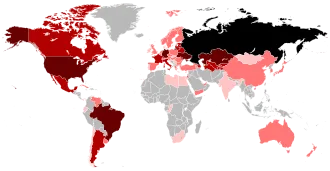
Genetic studies show that Russians are closely related to Poles, Belarusians, Ukrainians, as well as Estonians, Latvians, Lithuanians, and Finns. They were formed from East Slavic tribes, and their cultural ancestry is based in Kievan Rus'. The Russian word for the Russians is derived from the people of Rus' and the territory of Rus'.
Russians share many historical and cultural traits with other European peoples, and especially with other East Slavic ethnic groups, specifically Belarusians and Ukrainians.
The vast majority of Russians live in native Russia, but notable minorities are scattered throughout other post-Soviet states such as Belarus, Kazakhstan, Moldova, Ukraine, and the Baltic states. A large Russian diaspora (sometimes including Russian-speaking non-Russians), estimated at 25 million people, has developed all over the world, with notable numbers in the United States, Germany, Brazil, and Canada.
Ethnonym
There are two Russian words which are commonly translated into English as "Russians". One is русские (russkiye), which in modern Russia most often means "ethnic Russians". The other one is россияне (rossiyane), derived from Россия (Rossiya, Russia), which denotes "people of Russia", regardless of ethnicity or religious affiliation.
In daily usage, those terms are often mixed up, and since Vladimir Putin became president, the ethnic term русские has supplanted the non-ethnic term.
The name of the Russians derives from the early medieval Rus' people, a group of Norse merchants and warriors who relocated from across the Baltic Sea and played an important part in the foundation of the first East Slavic state that later became the Kievan Rus'.
The idea of a single "all-Russian nation" encompassing the East Slavic peoples, or a "triune nation" of three brotherly "Great Russian", "Little Russian" (i.e. Ukrainian), and "White Russian" (i.e. Belarusian) peoples became the official doctrine of the Russian Empire from the beginning of the 19th century onwards.
History
Ancient history
The ancestors of modern Russians are the Slavic tribes, whose original home is thought by some scholars to have been the wooded areas of the Pinsk Marshes, one of the largest wetlands in Europe. The East Slavs gradually settled Western Russia with Moscow included in two waves: one moving from Kiev toward present-day Suzdal and Murom and another from Polotsk toward Novgorod and Rostov.
Prior to the Slavic migration in the 6-7th centuries, the Suzdal-Murom and Novgorod-Rostov areas were populated by Finnic peoples, including the Merya, the Muromians, and the Meshchera.
From the 7th century onwards, the East Slavs slowly assimilated the native Finnic peoples, so that by year 1100, the majority of the population in Western Russia was Slavic-speaking. Recent genetic studies confirm the presence of a Finnic substrate in modern Russian population.
Outside archaeological remains, little is known about the predecessors to Russians in general prior to 859 AD, when the Primary Chronicle starts its records. By 600 AD, the Slavs are believed to have split linguistically into southern, western, and eastern branches.[citation needed]
Medieval history
The Rus' state was established in northern Russia in the year 862, which was ruled by the Varangians. Staraya Ladoga and Novgorod became the first major cities of the new union of immigrants from Scandinavia with the Slavs and Finns. In 882, the prince Oleg seized Kiev, thereby uniting the northern and southern lands of the East Slavs under one authority.
The state adopted Christianity from the Byzantine Empire in 988. Kievan Rus' ultimately disintegrated as a state as a result of in-fighting between members of the princely family that ruled it collectively.
After the 13th century, Moscow became a political and cultural center. Moscow has become a center for the unification of Russian lands. By the end of the 15th century, Moscow united the northeastern and northwestern Russian principalities, overthrew the "Mongol yoke" in 1480, and would be transformed into the Tsardom of Russia after Ivan IV was crowned tsar in 1547.
Modern history
In 1721, Tsar Peter the Great renamed his state as the Russian Empire, hoping to associate it with historical and cultural achievements of ancient Rus' – in contrast to his policies oriented towards Western Europe. The state now extended from the eastern borders of the Polish–Lithuanian Commonwealth to the Pacific Ocean, and became a great power; and one of the most powerful states in Europe after the victory over Napoleon.
Peasant revolts were common, and all were fiercely suppressed. The Emperor Alexander II abolished Russian serfdom in 1861, but the peasants fared poorly and revolutionary pressures grew. In the following decades, reform efforts such as the Stolypin reforms of 1906–1914, the constitution of 1906, and the State Duma (1906–1917) attempted to open and liberalize the economy and political system, but the Emperors refused to relinquish autocratic rule and resisted sharing their power.
A combination of economic breakdown, war-weariness, and discontent with the autocratic system of government triggered revolution in Russia in 1917. The overthrow of the monarchy initially brought into office a coalition of liberals and moderate socialists, but their failed policies led to seizure of power by the communist Bolsheviks on 25 October 1917 (7 November New Style).
In 1922, Soviet Russia, along with Soviet Ukraine, Soviet Belarus, and the Transcaucasian SFSR signed the Treaty on the Creation of the USSR, officially merging all four republics to form the Soviet Union as a country. Between 1922 and 1991, the history of Russia became essentially the history of the Soviet Union, effectively an ideologically based state roughly conterminous with the Russian Empire before the 1918 Treaty of Brest-Litovsk.
From its first years, government in the Soviet Union based itself on the one-party rule of the Communists, as the Bolsheviks called themselves, beginning in March 1918. The approach to the building of socialism, however, varied over different periods in Soviet history: from the mixed economy and diverse society and culture of the 1920s through the command economy and repressions of the Joseph Stalin era to the "era of stagnation" from the 1960s to the 1980s.
The actions of the Soviet government caused the death of millions of citizens in the famine of 1930–1933 and the Great Purge. The attack by Nazi Germany and the ensuing war, together with the Holocaust, again claimed millions of lives. Millions of Russian civilians and prisoners of war were killed or starved to death during Nazi Germany's genocidal policies called the Hunger Plan and the Generalplan Ost, including one million civilian casualties during the Siege of Leningrad.
After the victory of the Soviet Union and the Western Allies, the Soviet Union became a superpower opposing Western countries during the Cold War.
By the mid-1980s, with Soviet economic and political weaknesses becoming acute, Soviet leader Mikhail Gorbachev embarked on major reforms; these culminated in the dissolution of the Soviet Union, leaving Russia again alone and marking the beginning of the post-Soviet Russian period. The Russian Soviet Federative Socialist Republic renamed itself the Russian Federation and became the successor state to the Soviet Union.
One of the negative consequences of the collapse of the Soviet Union was the problem of discrimination against the 25 million ethnic Russians living in a number of post-Soviet states.
Geographic distribution
Ethnic Russians historically migrated within the areas of the former Russian Empire and Soviet Union, though they were sometimes encouraged to re-settle in borderland areas by the Tsarist and later Soviet government. Sometimes ethnic Russian communities, such as the Lipovans who settled in the Danube Delta or the Doukhobors in Canada, emigrated as religious dissidents fleeing the central authority.
There are also small Russian communities in the Balkans — including Lipovans in the Danube delta — Central European nations such as Germany and Poland, as well as Russians settled in China, Japan, South Korea, Mexico, Brazil, Argentina and Australia. These communities identify themselves to varying degrees as Russians, citizens of these countries, or both.[citation needed]
Significant numbers of Russians emigrated to Canada, Australia and the United States. Brighton Beach, Brooklyn and South Beach, Staten Island in New York City are examples of large communities of recent Russian and Russian-Jewish immigrants. Other examples are Sunny Isles Beach, a northern suburb of Miami, and West Hollywood of the Los Angeles area.[citation needed]
After the Russian Revolution in 1917, many Russians who were identified with the White army moved to China — most of them settling in Harbin and Shanghai. By the 1930s, Harbin had 100,000 Russians. Many of these Russians moved back to the Soviet Union after World War II. Today, a large group in northern China still speak Russian as a second language.
Russians (eluosizu) are one of the 56 ethnic groups officially recognized by the People's Republic of China (as the Russ); there are approximately 15,600 Russian Chinese living mostly in northern Xinjiang, and also in Inner Mongolia and Heilongjiang.[citation needed]
According to the 2021 Russian census, the number of ethnic Russians in the Russian Federation decreased by nearly 5.43 million, from roughly 111 million people in 2010 to approximately 105.5 million in 2021.
Ethnographic groups
Among Russians, a number of ethnographic groups stand out, such as: the Northern Russians, the Southern Russians, the Cossacks, the Goryuns, the Kamchadals, the Polekhs, the Pomors, the Russian Chinese, the Siberians (Siberiaks), Starozhily, some groupings of Old Believers (Kamenschiks, Lipovans, Semeiskie), and others.
The main ones are the Northern and Southern Russian groups. At the same time, the proposal of the ethnographer Dmitry Zelenin in his major work of 1927 Russian (East Slavic) Ethnography to consider them as separate East Slavic peoples did not find support in scientific circles.
Russia's Arctic coastline had been explored and settled by Pomors, Russian settlers from Novgorod.
Cossacks inhabited sparsely populated areas in the Don, Terek, and Ural river basins, and played an important role in the historical and cultural development of parts of Russia.
Genetics
In accordance with the 2008 research results of Russian and Estonian geneticists, two groups of Russians are distinguished: the northern and southern populations.
Central and Southern Russians, to which the majority of Russian populations belong, according to Y chromosome R1a, are included in the general "East European" gene cluster with the rest East and West Slavs (Poles, Czechs and Slovaks), as well as the non-Slavic Hungarians and Aromanians. Genetically, East Slavs are quite similar to West Slavs; such genetic similarity is somewhat unusual for genetics with such a wide settlement of the Slavs, especially Russians.
Northern Russians, according to mtDNA, Y chromosome and autosomal marker CCR5de132, are included in the "North European" gene cluster (the Poles, the Balts, Germanic and Baltic Finnic peoples). On top of their closeness to other Slavic peoples, Russians are found to share a significant part of their DNA with speakers of Finno-Ugric languages inhabiting present-day Russia, which indicates a likely scenario of genetic admixture with indigenous populations.
A common origin for all peoples of the Nordic gene pool has been hypothesised, with descendants of a Paleo-European population having remained around the Baltic Sea.
At the same time, according to other scholars, the Russians have close genetic affinities to surrounding Northeast and Eastern European populations. They also display evidence for multiple genetic ancestries and admixture events, and high identity-by-descent sharing with the Finnic peoples.
While modern European populations derive most of their ancestry from three major sources: Western hunter-gatherers, Early European Farmers, and Western Steppe Herders (Yamnaya), this three-way model is insufficient to explain the ethnogenesis of populations from north-eastern Europe such as Saami, Russians, Mordovians, Chuvash, Estonians, Hungarians, and Finns. They carry an additional Siberian/Nganasan-related genetic component and increased allele sharing with modern East Asians.
The most common human Y-chromosome DNA haplogroup is haplogroup R1a (c. 46,7%), followed by haplogroup N-M231 (c. 21,6%), haplogroup I-M170 (c. 17,6%), and haplogroup R1b (c. 5,8%). The remainder (c. 8,3%) are other less frequent haplogroups (E3b, J2, etc.).
Assimilation and immigration
Russians have sometimes found it useful to emphasize their self-perceived ability to assimilate other people to the Russian ethnicity - and as a historic great power with imperial expansionist tendencies the Russian state has sometimes encouraged Russian-centred monoculturalism. Steppe peoples, Tatars, Baltic Germans, Lithuanians and native Siberians in Rus', Muscovy or the Russian Empire could in theory become "Russians" (Russian: русские) simply by accepting Russian Orthodoxy as their faith.
The attitude of ready inclusivity is summed up in the popular phrase (sometimes attributed to Emperor Alexander III of Russia) - Хочешь быть русским - будь им! (transl. You want to be Russian - be that!).
Language
Russian is the official and the predominantly spoken language in Russia. It is the most-spoken native language in Europe, the most geographically widespread language of Eurasia, as well as the world's most widely spoken Slavic language. Russian is the third-most used language on the Internet after English and Spanish, and is one of two official languages aboard the International Space Station, as well as one of the six official languages of the United Nations.