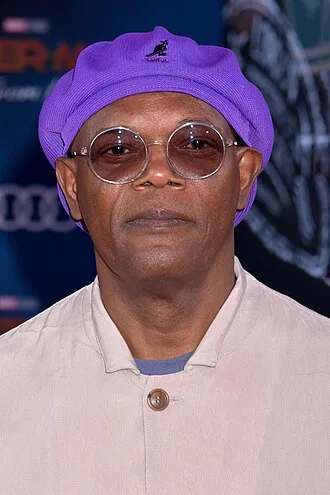
Samuel L. Jackson
Jackson made his professional theater debut in Mother Courage and Her Children in 1980 at The Public Theater in New York City. From 1981 to 1983, he originated the role of Private Louis Henderson in Charles Fuller's A Soldier's Play off-Broadway. He also originated the role of Boy Willie in August Wilson's The Piano Lesson in 1987 at the Yale Repertory Theatre.
He portrayed Martin Luther King Jr. in the Broadway play The Mountaintop (2011). He returned to Broadway in the 2022 revival of The Piano Lesson playing Doaker Charles, for which he received a Tony Award for Best Featured Actor in a Play nomination.
Jackson's early film roles include Coming to America (1988), Juice (1992), True Romance (1993), Jurassic Park (1993), Menace II Society (1993), and Fresh (1994). His early collaborations with Spike Lee led to greater prominence with films such as School Daze (1988), Do the Right Thing (1989), Mo' Better Blues (1990), and Jungle Fever (1991).
Jackson's breakout performance was as Jules Winnfield in Quentin Tarantino's crime drama Pulp Fiction (1994), for which he won the BAFTA Award for Best Actor in a Supporting Role and received a nomination for the Academy Award for Best Supporting Actor. He has continued to collaborate with Lee (Oldboy in 2013, Chi-Raq in 2015, and Highest 2 Lowest in 2025) and Tarantino, with the latter including prominent roles in Jackie Brown (1997), Kill Bill: Volume 2 (2004), Django Unchained (2012), and The Hateful Eight (2015).
He also gained widespread recognition as the Jedi Mace Windu in the Star Wars prequel trilogy (1999–2005), and Nick Fury in 11 Marvel Cinematic Universe films, beginning with Iron Man (2008), as well as in the Disney+ series Secret Invasion (2023) and What If...? (2021–2024) and guest-starring in the ABC series Agents of S.H.I.E.L.D. (2013–2014).
Jackson has provided his voice for Lucius Best / Frozone in the Pixar films The Incredibles (2004) and Incredibles 2 (2018). He has also acted in a number of big-budget films, including Die Hard with a Vengeance (1995), A Time to Kill (1996), Unbreakable (2000), Shaft (2000) and its reboot (2019), XXX (2002–2017), Coach Carter (2005), Snakes on a Plane (2006), Kingsman: The Secret Service (2014), Kong: Skull Island (2017), and Glass (2019).
Early life and education
Jackson was born on December 21, 1948, in Washington, D.C., the only child of Elizabeth Harriett (née Montgomery) and Roy Henry Jackson. He grew up in Chattanooga, Tennessee. His father lived away from the family in Kansas City, Missouri, and later died of alcoholism. Jackson met him only twice during his life.
He was raised by his mother, a factory worker and later a supplies buyer for a psychiatric hospital; he was also raised by his maternal grandparents, Edgar and Pearl Montgomery, as well as extended family. According to DNA tests, Jackson partially descends from the Benga people of Gabon, and he became a naturalized citizen of Gabon in 2019.
He developed a stutter during childhood and learned to "pretend to be other people who didn't stutter". On a 2012 episode of Finding Your Roots, Samuel L. Jackson discovered that Judge Joel Branham was his 3rd great-grandfather. Branham was a white, English-ancestry slaveholder in Georgia who had children with Matilda Branham, one of his enslaved people, who is the actor's great-great-great-grandmother. Through Branham, Jackson is a descendant of Edward I of England.
Jackson attended several segregated schools and graduated from Riverside High School in Chattanooga. He played the French horn, piccolo, trumpet, and flute in the school orchestra. Initially intent on pursuing a degree in marine biology, he attended Morehouse College in Atlanta, Georgia, where he was a cheerleader. After joining a local acting group to earn extra points in a class, he found an interest in acting and switched his major. Before graduating in 1972, he co-founded the Just Us Theatre.
After Martin Luther King Jr.'s assassination in 1968, Jackson attended King's funeral in Atlanta as an usher. He then traveled to Memphis, Tennessee, to join an equal rights protest march. In a 2005 Parade interview, he said, "I was angry about the assassination, but I wasn't shocked by it. I knew that change was going to take something different—not sit-ins, not peaceful coexistence." In 1969, Jackson and several other students held hostage the members of the Morehouse College Board of Trustees (including Martin Luther King Sr.) on the campus, demanding reform in the school's curriculum and governance.
The college eventually agreed to change its policy, but Jackson was charged with and eventually convicted of unlawful confinement, a second-degree felony. He was suspended for two years for his criminal record and his actions. He would later return to the college to earn a BA in drama in 1972.
While he was suspended, he worked as a social worker in Los Angeles. He decided to return to Atlanta, where he met with Stokely Carmichael, H. Rap Brown, and others active in the black power movement. He began to feel empowered with his involvement in the movement, especially when the group began buying guns. However, before he could become involved with any significant armed confrontations, his mother sent him to Los Angeles after the Federal Bureau of Investigation (FBI) warned her that he would die within a year if he remained with the group. In a 2018 interview with Vogue, he denied having been a member of the Black Panther Party.
Career
1972–1987: Early roles and theater work
Casting black actors is still strange for Hollywood. Denzel gets the offer first. Then it's Danny Glover, Forest Whitaker, and Wesley Snipes. Right now, I'm the next one on the list.
Jackson initially majored in marine biology at Morehouse College before switching to architecture. He later settled on drama after taking a public speaking class and appearing in a version of The Threepenny Opera. Jackson began acting on the stage, including Home and A Soldier's Play, which was the inspiration for the 1984 film A Soldier's Story.
He appeared in several television films, and made his feature film debut in the blaxploitation independent film Together for Days (1972). After these initial roles, Jackson moved from Atlanta to New York City in 1976, and spent the next decade appearing in stage productions, including Geva Theatre's 1977-1978 production of A Raisin in the Sun, as well as the premieres of The Piano Lesson and Two Trains Running at the Yale Repertory Theater.
To supplement his income while auditioning, he worked at the Manhattan Plaza apartment complex as an overnight security guard. Jackson developed addictions to alcohol and cocaine, which prevented him from proceeding with the two plays to Broadway (actors Charles S. Dutton and Anthony Chisholm took his place).
1988–1993: Rise to prominence
After a 1981 performance in the play A Soldier's Play, Jackson was introduced to director Spike Lee, who cast him for small roles in School Daze (1988) and Do the Right Thing (1989). He also worked for three years as a stand-in for Bill Cosby on The Cosby Show. Throughout his early film career, mainly in minimal roles in films such as Coming to America (1988) and various television films, Jackson was mentored by Morgan Freeman.
Jackson played a minor role in the 1990 Martin Scorsese film Goodfellas, as real-life Mafia associate Stacks Edwards. Having overdosed on heroin several times, he switched to cocaine. His family entered him into a New York rehabilitation clinic. After he completed rehabilitation, he appeared in Jungle Fever as a crack cocaine addict.
Jackson said that the role was cathartic, commenting, "It was a funny kind of thing. By the time I was out of rehab, about a week or so later I was on set and we were ready to start shooting." His performance was so acclaimed that the jury of 1991 Cannes Film Festival added a special "Supporting Actor" award just for him.
Following this role, Jackson became involved with the comedy Strictly Business and dramas Juice and Patriot Games. He then moved on to two other comedies: National Lampoon's Loaded Weapon 1 (his first starring role) and Amos & Andrew. Jackson worked with the director Steven Spielberg in 1993's Jurassic Park.
1994–1998: Career breakthrough
After a turn as the criminal Big Don in 1993's True Romance—written by Quentin Tarantino and directed by Tony Scott—Tarantino asked Jackson to play Jules Winnfield in Pulp Fiction (1994). Jackson was surprised to learn that the part had been specifically written for him: "To know that somebody had written something like Jules for me.
I was overwhelmed, thankful, arrogant—this whole combination of things that you could be, knowing that somebody's going to give you an opportunity like that." Pulp Fiction, Jackson's thirtieth film, made him internationally recognized and he received praise from critics. Entertainment Weekly wrote: "As superb as Travolta, Willis, and Keitel are, the actor who reigns over Pulp Fiction is Samuel L.
Jackson. He just about lights fires with his gremlin eyes and he transforms his speeches into hypnotic bebop soliloquies." For the Academy Awards, Miramax Films pushed for, and received, the Best Supporting Actor nomination for Jackson. He also received a Golden Globe nomination and won the BAFTA Award for Best Supporting Role.
After Pulp Fiction, Jackson received multiple scripts to review: "I could easily have made a career out of playing Jules over the years. Everybody's always sending me the script they think is the new Pulp Fiction." With a succession of poor-performing films such as Kiss of Death, The Great White Hype, and Losing Isaiah, Jackson began to receive poor reviews from critics who had praised his performance in Pulp Fiction.
This ended with his involvement in two box-office successes: Die Hard with a Vengeance, in which he starred alongside Bruce Willis in the third installment of the Die Hard series; and A Time to Kill, where he played a father put on trial for killing two men who raped his daughter. For A Time to Kill, Jackson earned an NAACP Image for Best Supporting Actor in a Motion Picture and a Golden Globe nomination for a Best Supporting Actor.
Quickly becoming a box office star, Jackson continued with three starring roles in 1997. In 187 he played a dedicated teacher striving to leave an impact on his students. He received an Independent Spirit award for Best First Feature alongside first-time writer/director Kasi Lemmons in the drama Eve's Bayou, for which he also served as executive producer.
He worked again with Tarantino on Jackie Brown and received the Silver Bear for Best Actor at the Berlin Film Festival and a fourth Golden Globe nomination for his portrayal of the arms merchant Ordell Robbie. In 1998, he worked with established actors: Sharon Stone and Dustin Hoffman in Sphere, and Kevin Spacey in The Negotiator, playing a hostage negotiator who resorts to taking hostages himself when he is falsely accused of murder and embezzlement.
In 1999, Jackson starred in the horror film Deep Blue Sea, and as Jedi Master Mace Windu in George Lucas' Star Wars: Episode I – The Phantom Menace. In an interview, Jackson claimed that he did not have a chance to read the script for the film and did not learn he was playing the character Mace Windu until he was fitted for his costume (though he later said that he was eager to accept any role, just for the chance to be a part of the Star Wars saga).
1999–2007: Established actor
On June 13, 2000, Jackson was honored with a star on the Hollywood Walk of Fame at 7018 Hollywood Blvd. He began the next decade of his film career playing a Marine colonel put on trial in Rules of Engagement, co-starred with Bruce Willis for a third time in the supernatural thriller Unbreakable, and starred in the 2000 remake of the 1971 film Shaft.
He reprised both of the latter roles in 2019, his Unbreakable character Mr. Glass in Glass and Shaft in another film titled Shaft. Jackson's sole film in 2001 was The Caveman's Valentine, a murder thriller directed by Lemmons in which he played a homeless musician. In 2002, he played a recovering alcoholic, attempting to keep custody of his kids while fighting a battle of wits in Changing Lanes, co-starring Ben Affleck.
He returned for Star Wars: Episode II – Attack of the Clones, seeing his minor supporting role develop into a major character. Mace Windu's purple lightsaber in the film was the result of Jackson's suggestion; he wanted to be sure that his character would stand out in a crowded battle scene. Jackson then acted as an NSA agent, alongside Vin Diesel in XXX, and as a kilt-wearing drug dealer in The 51st State.
In 2003, Jackson again worked with John Travolta in Basic and then as a police sergeant alongside Colin Farrell in the television show remake S.W.A.T. A song within the soundtrack was named after him, entitled "Sammy L. Jackson" by Hot Action Cop. Jackson also appeared in HBO's documentary Unchained Memories, as a narrator along many other stars like Angela Bassett and Whoopi Goldberg.
Based on reviews gathered by Rotten Tomatoes, in 2004 Jackson starred in both his lowest and highest ranked films in his career. In the thriller Twisted, Jackson played a mentor to Ashley Judd. The film garnered a 2% approval rating on the website, with reviewers calling his performance "lackluster" and "wasted".
He then lent his voice to the animated film The Incredibles as the superhero Frozone. The film received a 97% approval rating, and Jackson's performance earned him an Annie Award nomination for Best Voice Acting. He made a cameo in another Quentin Tarantino film, Kill Bill: Volume 2.
In 2005, he starred in the sports drama Coach Carter, where he played a coach (based on the actual coach Ken Carter) dedicated to teaching his players that education is more important than basketball. Although the film received mixed reviews, Jackson's performance was praised despite the film's storyline. Bob Townsend of the Atlanta Journal-Constitution commended Jackson's performance, "He takes what could have been a cardboard cliché role and puts flesh on it with his flamboyant intelligence." Jackson also returned for two sequels: XXX: State of the Union, this time commanding Ice Cube, and the final Star Wars prequel film, Star Wars: Episode III – Revenge of the Sith.
His last film for 2005 was The Man alongside comedian Eugene Levy. On November 4, 2005, he was presented with the Hawaii International Film Festival Achievement in Acting Award.
On January 30, 2006, Jackson was honored with a hand and footprint ceremony at Grauman's Chinese Theatre; he is the seventh African American and 191st actor to be recognized in this manner. In an interview that year, he said that he chooses roles that are "exciting to watch" and have an "interesting character inside of a story", and that in his roles he wanted to "do things [he hasn't] done, things [he] saw as a kid and wanted to do and now [has] an opportunity to do".
He next starred opposite actress Julianne Moore in the box-office bomb Freedomland, where he depicted a police detective attempting to help a mother find her abducted child while quelling a citywide race riot. Jackson's second film of the year, Snakes on a Plane, gained cult film status months before it was released based on its title and cast.
Jackson's decision to star in the film was solely based on the title. To build anticipation for the film, he also cameoed in the 2006 music video "Snakes on a Plane (Bring It)" by Cobra Starship. On December 2, 2006, Jackson won the German Bambi Award for International Film, based on his many film contributions. In December 2006, Jackson starred in Home of the Brave, as a doctor returning home from the Iraq War.
📚 Source: Wikipedia