The Kingdom of Scotland emerged as a sovereign state in the 9th century. Independence from England was maintained partly through an alliance with France. In 1603, James VI succeeded to the thrones of England and Ireland, forming a personal union of the three kingdoms. On 1 May 1707, Scotland and England combined to create the new Kingdom of Great Britain, with the Parliament of Scotland subsumed into the Parliament of Great Britain.
In 1999, a Scottish Parliament was re-established, and has devolved authority over many areas of domestic policy. The country has its own distinct legal system, education system and religious history, which have all contributed to the continuation of Scottish society, Scottish culture and national identity. Scottish English and Scots are the most widely spoken languages in the country, existing on a dialect continuum with each other.
Scottish Gaelic speakers can be found all over Scotland, but the language is largely spoken natively by communities within the Hebrides; Gaelic speakers now constitute less than 2% of the total population, although state-sponsored revitalisation attempts have led to a growing community of second language speakers.
The mainland of Scotland is broadly divided into three regions: the Highlands, a mountainous region in the north and north-west; the Lowlands, a flatter plain across the centre of the country; and the Southern Uplands, a hilly region along the southern border. The Highlands are the most mountainous region of the British Isles and contain its highest peak, Ben Nevis, at 4,413 feet (1,345 m).
The region also contains many lakes, called lochs; the term is also applied to the many saltwater inlets along the country's deeply indented western coastline. The geography of the many islands is varied. Some, such as Mull and Skye, are noted for their mountainous terrain, while Tiree and Coll are flatter.
Etymology
Scotland comes from Scoti, the Latin name for the Gaels. Philip Freeman has speculated on the likelihood of a group of raiders adopting a name from an Indo-European root, *skot, citing the parallel in Greek skotos (σκότος), meaning 'darkness, gloom'.
The Late Latin word Scotia ("land of the Gaels") was initially used to refer to Ireland, and likewise in early Old English Scotland was used for Ireland. By the 11th century at the latest, Scotia was being used to refer to (Gaelic-speaking) Scotland north of the River Forth, alongside Albania or Albany, both derived from the Gaelic Alba.
The use of the words Scots and Scotland to encompass all of what is now Scotland became common in the Late Middle Ages.
History
Prehistory
The earliest known evidence of human presence in Scotland is Hamburgian culture stone tools produced by late Upper Paleolithic hunter gatherers who arrived in Scotland during the Bølling–Allerød Interstadial warm period at the end of the last ice age, around 14,500 to 14,000 years ago, shortly following the retreat of the ice sheet that had previously covered Scotland.
Neolithic farmers arrived in Scotland around 6000 years ago. The well-preserved village of Skara Brae on the mainland of Orkney dates from this period. Neolithic habitation, burial, and ritual sites are particularly common and well preserved in the Northern Isles and Western Isles, where a lack of trees led to most structures being built of local stone.
Evidence of sophisticated pre-Christian belief systems is demonstrated by sites such as the Callanish Stones on Lewis, and the Maes Howe on Orkney, which were built in the third millennium BC.
Early history
The first written reference to Scotland was in 320 BC by Greek sailor Pytheas, who called the northern tip of Britain "Orcas", the source of the name of the Orkney islands.
Most of modern Scotland was not incorporated into the Roman Empire, and Roman control over parts of the area fluctuated over a rather short period. The first Roman incursion into Scotland was in 79 AD, when Agricola invaded Scotland; he defeated a Caledonian army at the Battle of Mons Graupius in 83 AD. After the Roman victory, Roman forts were briefly set along the Gask Ridge close to the Highland line, but by three years after the battle, the Roman armies had withdrawn to the Southern Uplands.
Remains of Roman forts established in the 1st century have been found as far north as the Moray Firth. By the reign of the Roman emperor Trajan (r. 98–117), Roman control had lapsed to Britain south of a line between the River Tyne and the Solway Firth.
Along this line, Trajan's successor Hadrian (r. 117–138) erected Hadrian's Wall in northern England and the Limes Britannicus became the northern border of the Roman Empire. The Roman influence on the southern part of the country was considerable, and they introduced Christianity to Scotland.
The Antonine Wall was built from 142 at the order of Hadrian's successor Antoninus Pius (r. 138–161), defending the Roman part of Scotland from the unadministered part of the island, north of a line between the Firth of Clyde and the Firth of Forth.
The Roman invasion of Caledonia 208–210 was undertaken by emperors of the imperial Severan dynasty in response to the breaking of a treaty by the Caledonians in 197, but permanent conquest of the whole of Great Britain was forestalled by Roman forces becoming bogged down in punishing guerrilla warfare and the death of the senior emperor Septimius Severus (r. 193–211) at Eboracum (York) after he was taken ill while on campaign.
Although forts erected by the Roman army in the Severan campaign were placed near those established by Agricola and were clustered at the mouths of the glens in the Highlands, the Caledonians were again in revolt in 210–211 and these were overrun.
To the Roman historians Tacitus and Cassius Dio, the Scottish Highlands and the area north of the River Forth was called Caledonia. According to Cassius Dio, the inhabitants of Caledonia were the Caledonians and the Maeatae. Other ancient authors used the adjective "Caledonian" to mean anywhere in northern or inland Britain, often mentioning the region's people and animals, its cold climate, its pearls, and a noteworthy region of wooded hills (Latin: saltus) which the 2nd century AD Roman philosopher Ptolemy, in his Geography, described as being south-west of the Beauly Firth. The name Caledonia is echoed in the place names of Dunkeld, Rohallion, and Schiehallion.
The Great Conspiracy constituted a seemingly coordinated invasion against Roman rule in Britain in the later 4th century, which included the participation of the Gaelic Scoti and the Caledonians, who were then known as Picts by the Romans. This was defeated by the comes Theodosius; but Roman military government was withdrawn from the island altogether by the early 5th century, resulting in the Anglo-Saxon settlement of Britain and the immigration of the Saxons to southeastern Scotland and the rest of eastern Great Britain.
Kingdom of Scotland
Beginning in the sixth century, the area that is now Scotland was divided into four areas: Pictland, a patchwork of small lordships in central Scotland; the Anglo-Saxon Kingdom of Northumbria, which had conquered southeastern Scotland; Northern Brittonic territory likely centred on Alt Clut (Dumbarton Rock) and the Clyde valley; and Dál Riata, which included territory in western Scotland and northern Ireland, and spread Gaelic language and culture into Scotland.
These societies were based on the family unit and had sharp divisions in wealth, although the vast majority were poor and worked full-time in subsistence agriculture. The Picts kept slaves (mostly captured in war) through the ninth century.
Gaelic influence over Pictland and Northumbria was facilitated by the large number of Gaelic-speaking clerics working as missionaries. Operating in the sixth century on the island of Iona, Saint Columba was one of the earliest and best-known missionaries. The Vikings began to raid Scotland in the eighth century. Although the raiders sought slaves and luxury items, their main motivation was to acquire land.
The oldest Norse settlements were in northwest Scotland, but they eventually conquered many areas along the coast. Old Norse entirely displaced Pictish in the Northern Isles.
In the ninth century, the Norse threat allowed a Gael named Kenneth I (Cináed mac Ailpín) to seize power over Pictland, establishing a royal dynasty to which the modern monarchs trace their lineage, and marking the beginning of the end of Pictish culture. The kingdom of Cináed and his descendants, called Alba, was Gaelic in character but existed on the same area as Pictland.
By the end of the tenth century, the Pictish language went extinct as its speakers shifted to Gaelic. From a base in eastern Scotland north of the River Forth and south of the River Spey, the kingdom expanded first southwards, into the former Northumbrian lands, and northwards into Moray. Around the turn of the millennium, there was a centralization in agricultural lands and the first towns began to be established.
In the twelfth and thirteenth centuries, much of Scotland was under the control of a single ruler. Initially, Gaelic culture predominated, but immigrants from France, England and Flanders steadily created a more diverse society, with the Gaelic language starting to be replaced by Scots; and a modern nation-state emerged from this.
At the end of this period, war against England started the growth of a Scottish national consciousness. David I (1124–1153) and his successors centralised royal power and united mainland Scotland, capturing regions such as Moray, Galloway, and Caithness, although he could not extend his power over the Hebrides, which had been ruled by various Scottish clans following the death of Somerled in 1164.
In 1266, Scotland fought the short but consequential Scottish-Norwegian War which saw the reclamation of the Hebrides after the strong defeat of King Haakon IV and his forces at the Battle of Largs. Up until that point, the Hebrides had been under Norwegian Viking control for roughly 400 years and had developed a distinctive Norse–Gaelic culture that saw many Old Norse loanwords enter the Scottish Gaelic spoken by islanders, and through successive generations the Norse would become almost completely assimilated into Gaelic culture and the Scottish clan system.
After the conflict, Scotland had to affirm Norwegian sovereignty of the Northern Isles, but they were later integrated into Scotland in the 15th century. Scandinavian culture in the form of the Norn language survived for a lot longer than in the Hebrides, and would strongly influence the local Scots dialect on Shetland and Orkney.
Later, a system of feudalism was consolidated, with both Anglo-Norman incomers and native Gaelic chieftains being granted land in exchange for serving the king. The relationship with England was complex during this period: Scottish kings tried several times, sometimes with success, to exploit English political turmoil, followed by the longest period of peace between Scotland and England in the mediaeval period: from 1217–1296.
Wars of Scottish Independence
The death of Alexander III in March 1286 broke the succession line of Scotland's kings. Edward I of England arbitrated between various claimants for the Scottish crown. In return for surrendering Scotland's nominal independence, John Balliol was pronounced king in 1292. In 1294, Balliol and other Scottish lords refused Edward's demands to serve in his army against the French.
Scotland and France sealed a treaty on 23 October 1295, known as the Auld Alliance. War ensued, and John was deposed by Edward who took personal control of Scotland. Andrew Moray and William Wallace initially emerged as the principal leaders of the resistance to English rule in the Wars of Scottish Independence, until Robert the Bruce was crowned king of Scotland in 1306.
Victory at the Battle of Bannockburn in 1314 proved the Scots had regained control of their kingdom. In 1320 the world's first documented declaration of independence, the Declaration of Arbroath, won the support of Pope John XXII, leading to the legal recognition of Scottish sovereignty by the English Crown.
A civil war between the Bruce dynasty and their long-term rivals of the House of Comyn and House of Balliol lasted until the middle of the 14th century. Although the Bruce faction was successful, David II's lack of an heir allowed his half-nephew Robert II, the Lord High Steward of Scotland, to come to the throne and establish the House of Stewart.
The Stewarts ruled Scotland for the remainder of the Middle Ages. The country they ruled experienced greater prosperity from the end of the 14th century through the Scottish Renaissance to the Reformation, despite the effects of the Black Death in 1349 and increasing division between Highlands and Lowlands. Multiple truces reduced warfare on the southern border.
Union of the Crowns
The Treaty of Perpetual Peace was signed in 1502 by James IV of Scotland and Henry VII of England. James married Henry's daughter, Margaret Tudor. James invaded England in support of France under the terms of the Auld Alliance and became the last monarch in Great Britain to die in battle, at Flodden in 1513. The war with England during the minority years of Mary, Queen of Scots between 1543 and 1551 is known as the Rough Wooing.
In 1560, the Treaty of Edinburgh brought an end to the Siege of Leith and recognized the Protestant Elizabeth I as Queen of England. The Parliament of Scotland met and immediately adopted the Scots Confession, which signalled the Scottish Reformation's sharp break from papal authority and Roman Catholic teaching. The Catholic Mary, Queen of Scots, was forced to abdicate in 1567.
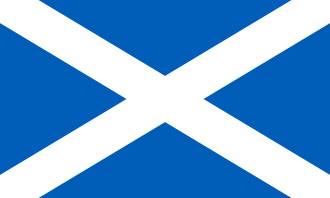
In 1603 James VI, King of Scots inherited the thrones of the Kingdom of England and the Kingdom of Ireland in the Union of the Crowns, and moved to London. This was a personal union as despite having the same monarch the kingdoms retained their separate parliaments, laws and other institutions. The first Union Jack was designed at James's behest, to be flown in addition to the St Andrew's Cross on Scots vessels at sea.
James VI and I intended to create a single kingdom of Great Britain, but was thwarted in his attempt to do so by the Parliament of England, which supported the wrecking proposal that a full legal union be sought instead, a proposal to which the Scots Parliament would not assent, causing the king to withdraw the plan.
Except for a short period under the Protectorate, Scotland remained a separate state in the 17th century, but there was considerable conflict between the crown and the Covenanters over the form of church government. The military was strengthened, allowing the imposition of royal authority on the western Highland clans.
The 1609 Statutes of Iona compelled the cultural integration of Hebridean clan leaders. In 1641 and again in 1643, the Parliament of Scotland unsuccessfully sought a union with England which was "federative" and not "incorporating", in which Scotland would retain a separate parliament. The issue of union split the parliament in 1648.