














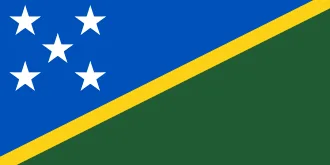
The islands have been settled since at least some time between 30,000 and 28,800 BC, with later waves of migrants, notably the Lapita people, mixing and producing the modern indigenous Solomon Islanders population. In 1568, the Spanish navigator Álvaro de Mendaña was the first European to visit them. Though not named by Mendaña, it is believed that the islands were called "the Solomons" by those who later received word of his voyage and mapped his discovery.
Mendaña returned decades later, in 1595, and another Spanish expedition, led by Portuguese navigator Pedro Fernandes de Queirós, visited the Solomons in 1606.
In June 1893, Captain Herbert Gibson of HMS Curacoa declared the southern Solomon Islands a British protectorate. During World War II, the Solomon Islands campaign (1942–1945) saw fierce fighting between the United States, British Imperial forces, and the Empire of Japan, including the Battle of Guadalcanal.
The official name of the then-British administration was changed from the "British Solomon Islands Protectorate" to "The Solomon Islands" in 1975, and self-government was achieved the following year. Independence was obtained, and the name changed to just "Solomon Islands" (without the definite article), in 1978. At independence, Solomon Islands became a constitutional monarchy.
The King of Solomon Islands is Charles III, who is represented in the country by a governor-general appointed on the advice of the prime minister.
Name
In 1568, the Spanish navigator Álvaro de Mendaña was the first European to visit the Solomon Islands archipelago but did not name the archipelago at that time, only certain individual islands. Though not named by Mendaña, the islands were subsequently referred to as Islas Salomón (Solomon Islands) by others following reports of his voyage optimistically conflated with stories of the wealthy biblical King Solomon, believing them to be the Bible-mentioned city of Ophir.
During most of the colonial period, the territory's official name was the "British Solomon Islands Protectorate" until independence in 1978, when it was changed to "Solomon Islands" as defined in the Constitution of Solomon Islands and as a Commonwealth realm under this name.
The definite article, "the", has not been part of the country's official name since independence but remains for all references to the area before independence and is sometimes used, both within and outside the country. Colloquially, the islands are referred to simply as "the Solomons".
History
Prehistory
The Solomons were first settled by people coming from the Bismarck Islands and New Guinea during the Pleistocene era c. 30,000–28,000 BC, based on archaeological evidence found at Kilu Cave on Buka Island in the Autonomous Region of Bougainville, Papua New Guinea. At this point sea levels were lower and Buka and Bougainville were physically joined to the southern Solomons in one landmass ("Greater Bougainville"), though it is unclear precisely how far south these early settlers spread as no other archaeological sites from this period have been found.
As sea levels rose as the Ice Age ended c. 4000–3500 BC, the Greater Bougainville landmass split into the numerous islands that exist today. Evidence of later human settlements dating to c. 4500–2500 BC have been found at Poha Cave and Vatuluma Posovi Cave on Guadalcanal.
The ethnic identity of these early peoples is unclear, though it is thought that the speakers of the Central Solomon languages (a self-contained language family unrelated to other languages spoken in the Solomons) likely represent the descendants of these earlier settlers.
From c. 1200–800 BC, Austronesian Lapita people began arriving from the Bismarcks with their characteristic ceramics. Evidence for their presence has been found across the Solomon archipelago, as well at the Santa Cruz Islands in the south-east, with different islands being settled at different times.
Linguistic and genetic evidence suggests that the Lapita people "leap-frogged" the already inhabited main Solomon Islands and settled first on the Santa Cruz group, with later back-migrations bringing their culture to the main group. These peoples mixed with the native Solomon Islanders and over time their languages became dominant, with most of the 60–70 languages spoken there belonging to the Oceanic branch of the Austronesian language family.
Then, as now, communities tended to exist in small villages practising subsistence agriculture, though extensive inter-island trade networks existed. Numerous ancient burial sites and other evidence of permanent settlements have been found from the period AD 1000–1500 throughout the islands, one of the most prominent examples being the Roviana cultural complex centred on the islands off the southern coast of New Georgia, where a large number of megalithic shrines and other structures were constructed in the 13th century.
The people of Solomon Islands were notorious for headhunting and cannibalism before the arrival of the Europeans.
Arrival of Europeans (1568–1886)
The first European to visit the islands was the Spanish navigator Álvaro de Mendaña de Neira, sailing from Peru in 1568. Landing on Santa Isabel on 7 February, Mendaña explored several of the other islands including Makira, Guadalcanal and Malaita. Relations with the native Solomon Islanders were initially cordial, although they often soured as time went by.
As a result, Mendaña returned to Peru in August 1568. He returned to the Solomons with a larger crew on a second voyage in 1595, aiming to colonise the islands. They landed on Nendö in the Santa Cruz Islands and established a small settlement at Gracioso Bay. However, the settlement failed due to poor relations with the native peoples and epidemics of disease amongst the Spanish which caused numerous deaths, with Mendaña himself dying in October.
The new commander Pedro Fernandes de Queirós thus decided to abandon the settlement and they sailed north to the Spanish territory of the Philippines. Queirós later returned to the area in 1606, where he sighted Tikopia and Taumako, though this voyage was primarily to Vanuatu in the search of Terra Australis.
Save for Abel Tasman's sighting of the remote Ontong Java Atoll in 1648, no European sailed to the Solomons again until 1767, when the British explorer Philip Carteret sailed by the Santa Cruz Islands, Malaita, and, continuing further north, Bougainville and the Bismarck Islands. French explorers also reached the Solomons, with Louis Antoine de Bougainville naming Choiseul in 1768 and Jean-François de Surville exploring the islands in 1769.
In 1788 John Shortland, captaining a supply ship for Britain's new Australian colony at Botany Bay, sighted the Treasury and Shortland Islands. That same year the French explorer Jean-François de La Pérouse was wrecked on Vanikoro; a rescue expedition led by Bruni d'Entrecasteaux sailed to Vanikoro but found no trace of La Pérouse.
The fate of La Pérouse was not confirmed until 1826, when the English merchant Peter Dillon visited Tikopia and discovered items belonging to La Pérouse in the possession of the local people, confirmed by the subsequent voyage of Jules Dumont d'Urville in 1828.
Some of the earliest regular foreign visitors to the islands were whaling vessels from Britain, the United States and Australia. They came for food, wood and water from late in the 18th century, establishing a trading relationship with the Solomon Islanders and later taking aboard islanders to serve as crewmen on their ships.
Relations between the islanders and visiting seamen were not always good and sometimes there was bloodshed. A knock-on effect of the greater European contact was the spread of diseases to which local peoples had no immunity, as well as a shift in the balance of power between coastal groups, who had access to European weapons and technology, and inland groups who did not.
In the second half of the 1800s more traders arrived seeking turtleshells, sea cucumbers, copra and sandalwood, occasionally establishing semi-permanent trading stations. However, initial attempts at more long-term settlement, such as Benjamin Boyd's colony on Guadalcanal in 1851, were unsuccessful.
Beginning in the 1840s, and accelerating in the 1860s, islanders began to be recruited (or often kidnapped) as labourers for the colonies in Australia, Fiji and Samoa in a process known as "blackbirding". Conditions for workers were often poor and exploitative, and local islanders often violently attacked any Europeans who appeared on their island.
The blackbird trade was chronicled by prominent Western writers, such as Joe Melvin and Jack London. Christian missionaries also began visiting the Solomons from the 1840s, beginning with an attempt by French Catholics under Jean-Baptiste Epalle to establish a mission on Santa Isabel, which was abandoned after Epalle was killed by islanders in 1845.
Anglican missionaries began arriving from the 1850s, followed by other denominations, over time gaining a large number of converts.
Colonial period (1886–1978)
Establishment of colonial rule
In 1884, Germany annexed northeast New Guinea and the Bismarck Archipelago and, in 1886, extended its rule over the North Solomon Islands, covering Bougainville, Buka, Choiseul, Santa Isabel, the Shortlands and Ontong Java atoll. In 1886 Germany and Britain confirmed this arrangement, with the British gaining a "sphere of influence" over the southern Solomons.
Germany paid little attention to the islands, with German authorities based in New Guinea not even visiting the area until 1888. The German presence, along with pressure from the missionaries to rein in the excesses of the coercive labour recruitment practices, known as blackbirding, prompted the British to declare a protectorate over the southern Solomons in March 1893, initially encompassing New Georgia, Malaita, Guadalcanal, Makira, Mono Island and the central Nggela Islands.
In April 1896, Charles Morris Woodford was appointed as the acting deputy commissioner in the protectorate, subject to the jurisdiction of the Western Pacific High Commission. The Colonial Office appointed Woodford as the resident commissioner in the Solomon Islands on 17 February 1897. He was directed to control the coercive labour recruitment practices, known as blackbirding, operating in the Solomon Island waters and to stop the illegal trade in firearms.
Woodford set up an administrative headquarters on the small island of Tulagi, having proclaimed it the protectorate capital in 1896. and in 1898 and 1899 the Rennell and Bellona Islands, Sikaiana, the Santa Cruz Islands and outlying islands such as Anuta, Fataka, Temotu and Tikopia were added to the protectorate. In 1900, under the terms of the Tripartite Convention of 1899, Germany ceded the Northern Solomon to Britain, minus Buka and Bougainville, the latter becoming part of German New Guinea despite geographically belonging to the Solomons archipelago. This was when the Shortlands, Choiseul, Santa Isabel and Ontong Java became part of the Solomons.
Woodford's underfunded administration struggled to maintain law and order on the remote colony. From the late 1890s until the early 1900s, there were numerous instances of European merchants and colonists being killed by islanders; the British response was to deploy Royal Navy warships to launch punitive expeditions against the villages which were responsible for the murders.
Arthur Mahaffy was appointed at the Deputy Commissioner in January 1898. He was based in Gizo, his duties included suppressing headhunting in New Georgia and neighbouring islands.
The British colonial government attempted to encourage the establishment of plantations by colonists; however, by 1902, there were only about 80 European colonists residing on the islands. Attempts at economic development met with mixed results, though Levers Pacific Plantations Ltd., a subsidiary of Lever Brothers, managed to establish a profitable copra plantation industry which employed many islanders.
Small scale mining and logging industries were also developed. However, the colony remained something of a backwater, with education, medical and other social services being under the administration of the missionaries. Violence also continued, most notably with the murder of colonial administrator William R. Bell by Basiana of the Kwaio people on Malaita in 1927, as Bell attempted to enforce an unpopular head tax. Several Kwaio were killed in a retaliatory raid, and Basiana and his accomplices executed.
World War II
With the outbreak of the Second World War most planters and traders were evacuated to Australia and most cultivation ceased. Some of the most intense fighting of the war occurred in the Solomons.
From 1942 until the end of 1943, the Solomon Islands were the scene of several major land, sea, and air battles between the Allies and the Empire of Japan's armed forces. Following the Japanese attack on Pearl Harbor in 1941, war was declared between Japan and the Allied Powers, and the Japanese, seeking to protect their southern flank, invaded South-East Asia and New Guinea.
In May 1942, the Japanese launched Operation Mo, occupying Tulagi and most of the western Solomon Islands, including Guadalcanal where they began work on an airstrip. The British administration had already relocated to Auki, Malaita, and most of the European population had been evacuated to Australia. The Allies counter-invaded Guadalcanal in August 1942, followed by the New Georgia campaign in 1943, both of which were turning points in the Pacific War, stopping and then countering the Japanese advance.
The conflict resulted in thousands of Allied, Japanese and civilian deaths, and extensive destruction across the islands. The Solomon Islands Campaign cost the Allies approximately 7,100 men, 29 ships, and 615 aircraft. The Japanese lost 31,000 men, 38 ships, and 683 aircraft.
Coastwatchers from the Solomon Islands played a major role in providing intelligence and rescuing other Allied servicemen. U.S. Admiral William Halsey, the commander of Allied forces during the Battle for Guadalcanal, recognised the coastwatchers' contributions by stating "The coastwatchers saved Guadalcanal and Guadalcanal saved the South Pacific." In addition, around 3,200 men served in the Solomon Islands Labour Corps and some 6,000 enlisted in the British Solomon Islands Protectorate Defence Force, with their exposure to the Americans leading to several social and political transformations.
For example, the Americans had extensively developed Honiara, with the capital shifting there from Tulagi in 1952, and the Pijin language was heavily influenced by the communication between Americans and the Islands inhabitants.
The most significant of the Allied Forces' operations against the Japanese Imperial Forces was launched on 7 August 1942, with simultaneous naval bombardments and amphibious landings on the Florida Islands at Tulagi and Red Beach on Guadalcanal.
The Battle of Guadalcanal became an important and bloody campaign fought in the Pacific War as the Allies began to repulse the Japanese expansion. Of strategic importance during the war were the coastwatchers operating in remote locations, often on Japanese held islands, providing early warning and intelligence of Japanese naval, army and aircraft movements during the campaign.
Islanders Biuku Gasa and Eroni Kumana were the first to find the shipwrecked John F. Kennedy and his crew of the PT-109. They suggested writing a rescue message on a coconut, and delivered the coconut by paddling a dugout canoe. The coconut was later kept on Kennedy's desk when he became President of the United States.
Post-war period and the lead-up to independence
In 1943–44 the Malaita-based chief Aliki Nono'ohimae had founded the Maasina Rule movement (also called the Native Council Movement, literally "Brotherhood Rule"), and was later joined by another chief, Hoasihau. Their aims were to improve the economic well-being of native Solomon Islanders, gain greater autonomy and to act as a liaison between Islanders and the colonial administration.
The movement was especially popular with ex-Labour Corp members and after the war its numbers swelled, with the movement spreading to other islands. Alarmed at the growth of the movement, the British launched "Operation De-Louse" in 1947–8 and arrested most of the Maasina leaders. Malaitans then organised a campaign of civil disobedience, prompting mass arrests.
In 1950 a new Resident Commissioner, Henry Gregory-Smith, arrived and released the leaders of the movement, though the disobedience campaign continued. In 1952 new High Commissioner (later Governor) Robert Stanley met with leaders of the movement and agreed to the creation of an island council. In late 1952 Stanley formally moved the capital of the territory to Honiara.
In the early 1950s the possibility of transferring sovereignty of the islands to Australia was discussed by the British and Australian governments; however, the Australians were reluctant to accept the financial burden of administering the territory and the idea was shelved.
With decolonisation sweeping the colonial world, and Britain no longer willing (or able) to bear the financial burdens of the Empire, the colonial authorities sought to prepare the Solomons for self-governance. Appointed Executive and Legislative Councils were established in 1960, with a degree of elected Solomon Islander representation introduced in 1964 and then extended in 1967.
A new constitution was drawn up in 1970 which merged the two Councils into one Governing Council, though the British Governor still retained extensive powers. Discontent with this prompted the creation of a new constitution in 1974 which reduced much of the Governor's remaining powers and created the post of Chief Minister, first held by Solomon Mamaloni.
Full self-government for the territory was achieved in 1976, a year after the independence of neighbouring Papua New Guinea from Australia. Meanwhile, discontent grew in the Western islands, with many fearing marginalisation in a future Honiara- or Malaita-dominated state, prompting the formation of the Western Breakaway Movement.
A conference held in London in 1977 agreed that the Solomons would gain full independence the following year. Under the terms of the Solomon Islands Act 1978 the country was annexed to Her Majesty's dominions and granted independence on 7 July 1978. The first prime minister was Sir Peter Kenilorea of the Solomon Islands United Party (SIUP), with Elizabeth II becoming Queen of Solomon Islands, represented locally by a Governor General.
Independence era (1978–present)
Early post-independence years
Peter Kenilorea went on to win the 1980 Solomon Islands general election, serving as PM until 1981, when he was replaced by Solomon Mamaloni of the People's Alliance Party (PAP) after a no confidence vote. Mamaloni created the Central Bank and national airline, and pushed for greater autonomy for individual islands of the country.
Kenilorea returned to power after winning the 1984 election, though his second term lasted only two years before he was replaced by Ezekiel Alebua following allegations of misuse of French aid money. In 1986 the Solomons helped found the Melanesian Spearhead Group, aimed at fostering cooperation and trade in the region.
After winning the 1989 election Mamaloni and the PAP returned to power, with Mamaloni dominating Solomon Islands politics from the early to mid 1990s (save for the one year Premiership of Francis Billy Hilly). Mamaloni made efforts to make the Solomons a republic; however, these were unsuccessful. He also had to deal with the effects of the conflict in neighbouring Bougainville which broke out in 1988, causing many refugees to flee to the Solomons.
Tensions arose with Papua New Guinea as PNG forces frequently entered Solomons territory in the pursuit of rebels. The situation calmed down and relations improved following the end of the conflict in 1998. Meanwhile, the country's financial situation continued to deteriorate, with much of the budget coming from the logging industry, often conducted at an unsustainable rate, not helped by Mamaloni's creation of a 'discretionary fund' for use by politicians, which fostered fraud and corruption.
Discontent with his rule led to a split in the PAP, and Mamaloni lost the 1993 election to Billy Hilly, though Hilly was later sacked by the Governor-General after a number of defections caused him to lose his majority, allowing Mamaloni to return to power in 1994, where he remained until 1997. Excessive logging, government corruption and unsustainable levels of public spending continued to grow, and public discontent caused Mamaloni to lose the 1997 election.
The new prime minister, Bartholomew Ulufa'alu of the Solomon Islands Liberal Party, attempted to enact economic reforms; however, his premiership soon became engulfed in a serious ethnic conflict known as "The Tensions".