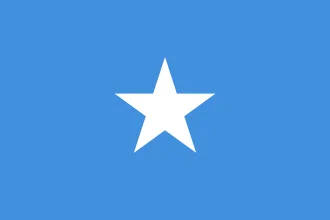
In antiquity, Somalia was an important commercial centre. During the Middle Ages, several powerful Somali empires dominated the regional trade, including the Ajuran Sultanate, Adal Sultanate, and the Sultanate of the Geledi. In the late 19th century, the Somali sultanates were colonised by the Italian and British empires, who merged these tribal territories into two colonies: Italian Somaliland and British Somaliland.
In 1960, the two territories united to form the independent Somali Republic under a civilian government. Siad Barre of the Supreme Revolutionary Council (SRC) seized power in 1969 and established the Somali Democratic Republic, launching a failed invasion of Ethiopia which triggered major instability in Somalia and brutally attempting to quash the Somaliland War of Independence in the north of the country.
The SRC collapsed in 1991 with the onset of the Somali Civil War. Instability continued through periods of reduced conflict under transitional governments in the early 2000s.At the end of 2006, a US-backed Ethiopian invasion overthrew the Islamic Courts Union (ICU), leading to the installation of the Transitional Federal Government of Somalia (TFG) in Mogadishu under an Ethiopian military occupation.
The subsequent insurgency which emerged saw the ICU fragment into various rebel factions, including the militant group al-Shabaab, which waged a protracted conflict against Ethiopian forces, the two powers exchanging control of territories through mid-2012. A new provisional constitution was passed in August 2012, reforming Somalia as a federation and began reconstruction under the Federal Government of Somalia. Insurgents still control much of central and southern Somalia and influence government-controlled areas.
Somalia is among the least developed countries in the world, because of its low GDP per capita and the Human Development Index. It has maintained an informal economy mainly based on livestock, remittances from Somalis working abroad, and telecommunications. It is a member of the United Nations, the Arab League, African Union, Non-Aligned Movement, East African Community, and the Organisation of Islamic Cooperation.
In 2026 the United Nations and the World Food Programme warned that six million people or one third of Somalia's population were facing food crises and that 1.9 million children faced acute malnutrition, primarily due to a severe drought and cut in aid expenditures.
Etymology
Samaale, the last common ancestor of several Somali clans, is generally regarded as the source of the ethnonym Somali. One other theory is that the name is derived from the words soo and maal, which together mean "go" and "milk". This interpretation varies depending on region, with northern Somalis implying it refers to the camel's milk, and southern Somalis using the transliteration "sa maal", which refers to cow's milk.
This is a reference to the ubiquitous pastoralism of the Somali people. Another proposed etymology is that the term Somali is derived from the Arabic ذوو مال, transliterated as dhawu māl and meaning "wealthy" or "those with wealth", again referring to Somali riches in livestock.
The first clear written reference of the sobriquet Somali dates back to the early 15th century AD during the reign of Ethiopian Emperor Yeshaq I, who had one of his court officials compose a hymn celebrating a military victory over the Sultanate of Ifat. Simur was also an ancient Harari alias for the Somali people.
History
Prehistory
Somalia was likely one of the first lands to be settled by early humans due to its location. Hunter-gatherers who would later migrate out of Africa likely settled here before their migrations. During the Stone Age, the Doian and Hargeisan cultures flourished here. The oldest evidence of burial customs in the Horn of Africa comes from cemeteries in Somalia dating back to the 4th millennium BC.
The stone implements from the Jalelo site in the north were also characterised in 1909 as important artefacts demonstrating the archaeological universality during the Paleolithic between the East and the West.
According to linguists, the first Afroasiatic-speaking populations arrived in the region during the ensuing Neolithic period from the family's proposed urheimat ("original homeland") in the Nile Valley, or the Near East.
The Laas Geel complex on the outskirts of Hargeisa in northwestern Somalia dates back approximately 5,000 years, and has rock art depicting both wild animals and decorated cows. Other cave paintings are found in the northern Dhambalin region, which feature one of the earliest known depictions of a hunter on horseback.
The rock art is dated to 1,000 to 3,000 BC. Additionally, between the towns of Las Khorey and El Ayo in northern Somalia lies Karinhegane, the site of numerous cave paintings, which collectively have been estimated to be around 2,500 years old.
The camel is believed to have been domesticated in the Horn region sometime between the 2nd and 3rd millennium BC. From there, it spread to Egypt and the Maghreb.
Classical era
Ancient pyramidical structures, mausoleums, ruined cities and stone walls, such as the Wargaade Wall, are evidence of an old civilisation that once thrived in the Somali peninsula. This civilisation enjoyed a trading relationship with ancient Egypt and Mycenaean Greece since the second millennium BC, supporting the hypothesis that Somalia or adjacent regions were the location of the ancient Land of Punt.
The Puntites native to the region traded myrrh, spices, gold, ebony, short-horned cattle, ivory and frankincense with the Egyptians, Phoenicians, Babylonians, Indians, Chinese and Romans through their commercial ports. An Egyptian expedition sent to Punt by the 18th dynasty Queen Hatshepsut is recorded on the temple reliefs at Deir el-Bahari, during the reign of the Puntite King Parahu and Queen Ati.
In the classical era, the Macrobians, who may have been ancestral to Somalis, established a powerful kingdom that ruled large parts of modern Somalia. They were reputed for their longevity and wealth, and were said to be the "tallest and handsomest of all men". The Macrobians were warrior herders and seafarers. According to Herodotus' account, the Persian Emperor Cambyses II, upon his conquest of Egypt in 525 BC, sent ambassadors to Macrobia, bringing luxury gifts for the Macrobian king to entice his submission.
The Macrobian ruler, who was elected based on his stature and beauty, replied instead with a challenge for his Persian counterpart in the form of an unstrung bow: if the Persians could manage to draw it, they would have the right to invade his country; but until then, they should thank the gods that the Macrobians never decided to invade their empire.
The Macrobians were a regional power reputed for their advanced architecture and gold wealth, which was so plentiful that they shackled their prisoners in golden chains.
During the classical period, the Barbara city-states of Mosylon, Opone, Mundus, Isis, Malao, Avalites, Essina, Nikon and Sarapion developed a lucrative trade network, connecting with merchants from Ptolemaic Egypt, Ancient Greece, Phoenicia, Parthian Persia, Saba, the Nabataean Kingdom, and the Roman Empire. They used the ancient Somali maritime vessel known as the beden to transport their cargo.
After the Roman conquest of the Nabataean Empire and the Roman naval presence at Aden to curb piracy, Arab and Somali merchants agreed with the Romans to bar Indian ships from trading in the free port cities of the Arabian peninsula to protect the interests of Somali and Arab merchants in the lucrative commerce between the Red and Mediterranean Seas.
However, Indian merchants continued to trade in the port cities of the Somali peninsula, which was free from Roman interference. For centuries, Indian merchants brought large quantities of cinnamon to Somalia and Arabia from Ceylon and the Spice Islands. The source of the cinnamon and other spices is said to have been the best-kept secret of Arab and Somali merchants in their trade with the Roman and Greek world; the Romans and Greeks believed the source to have been the Somali peninsula.
The collusive agreement among Somali and Arab traders inflated the price of Indian and Chinese cinnamon in North Africa, the Near East, and Europe, and made the cinnamon trade a very profitable revenue generator, especially for the Somali merchants.
Islamic era
Islam was introduced to the area early on by the first Muslims of Mecca fleeing prosecution during the first Hejira with Masjid al-Qiblatayn in Zeila being built before the Qiblah towards Mecca. It is one of the oldest mosques in Africa. In the late 9th century, Al-Yaqubi wrote that Muslims were living along the northern Somali seaboard.
He also mentioned that the Adal Kingdom had its capital in the city. According to Leo Africanus, the Adal Sultanate was governed by local Somali dynasties and its realm encompassed the geographical area between the Bab-el-Mandeb and Cape Guardafui. It was thus flanked to the south by the Ajuran Empire and to the west by the Abyssinian Empire.
Throughout the Middle Ages, Arab immigrants arrived in Somaliland, a historical experience which would later lead to the legendary stories about Muslim sheikhs such as Daarood and Ishaaq bin Ahmed (the purported ancestors of the Darod and Isaaq clans, respectively) travelling from Arabia to Somalia and marrying into the local Dir clan.
The oldest writing in Somalia dates to this time, with the funerary inscription of Ḥajj Shānid in the al-Jami mosque in Barawa dating to 1104 or 1105 CE (year 498 AH). Although these medieval inscriptions are in Arabic, they were clearly written by people who were well-integrated into Somali culture and society. For example, an inscription from 1365 CE calls this year a Saturday year, using the traditional Somali calendar where years are named after the weekday on which the year begins.
In 1332, the Zeila-based King of Adal was slain in a military campaign aimed at halting Abyssinian emperor Amda Seyon I's march toward the city. When the last Sultan of Ifat, Sa'ad ad-Din II, was also killed by Emperor Dawit I in Zeila in 1410, his children escaped to Yemen, before returning in 1415. In the early 15th century, Adal's capital was moved further inland to the town of Dakkar, where Sabr ad-Din II, the eldest son of Sa'ad ad-Din II, established a new base after his return from Yemen.
Muslim Chinese diplomat Zheng He visited Mogadishu in his voyages to the horn of Africa.
Adal's headquarters were again relocated the following century, this time southward to Harar. From this new capital, Adal organised an effective army led by Imam Ahmad ibn Ibrahim al-Ghazi, (Ahmad "Gurey" or "Gran"; both meaning "the left-handed") and his closest top general and brother in law Garad Matan. Imam Ahmed clan is documented to be from the Geri Koombe, a sub clan of Darod.
This 16th-century campaign is historically known as the Conquest of Abyssinia (Futuh al-Habash). During the war, Imam Ahmad pioneered the use of cannons supplied by the Ottoman Empire, which he imported through Zeila and deployed against Abyssinian forces and their Portuguese allies led by Cristóvão da Gama.
During the Ajuran Sultanate period, the city-states and republics of Merca, Mogadishu, Barawa, Hobyo and their respective ports flourished and had a lucrative foreign commerce with ships sailing to and from Arabia, India, Venetia, Persia, Egypt, Portugal, and as far away as China. Vasco da Gama, who passed by Mogadishu in the 15th century, noted that it was a large city with houses several storeys high and large palaces in its centre, in addition to many mosques with cylindrical minarets.
The Harla, an early Hamitic group of tall stature who inhabited parts of Somalia, Tchertcher and other areas in the Horn, also erected various tumuli. These masons are believed to have been ancestral to ethnic Somalis.
In the 16th century, Duarte Barbosa noted that many ships from the Kingdom of Cambaya in modern-day India sailed to Mogadishu with cloth and spices, for which they in return received gold, wax and ivory. Barbosa also highlighted the abundance of meat, wheat, barley, horses, and fruit on the coastal markets, which generated enormous wealth for the merchants.
Mogadishu, the centre of a thriving textile industry known as toob benadir (specialised for the markets in Egypt, among other places), together with Merca and Barawa, also served as a transit stop for Swahili merchants from Mombasa and Malindi and for the gold trade from Kilwa. Jewish merchants from the Hormuz brought their Indian textile and fruit to the Somali coast in exchange for grain and wood.
Trading relations were established with Malacca in the 15th century, with cloth, ambergris and porcelain being the main commodities of the trade. Giraffes, zebras and incense were exported to the Ming Empire of China, which established Somali merchants as leaders in the commerce between East Asia and the Horn. Hindu merchants from Surat and Southeast African merchants from Pate, seeking to bypass both the Portuguese India blockade (and later the Omani interference), used the Somali ports of Merca and Barawa (which were out of the two powers' direct jurisdiction) to conduct their trade in safety and without interference.
Modern era
In the early modern period, successor states to the Adal Sultanate and Ajuran Sultanate began to flourish in Somalia. These included the Hiraab Imamate, the Isaaq Sultanate led by the Guled dynasty, the Habr Yunis Sultanate led by the Ainanshe dynasty, the Sultanate of the Geledi (Gobroon dynasty), the Majeerteen Sultanate (Migiurtinia), and the Sultanate of Hobyo (Obbia).
They continued the tradition of castle-building and seaborne trade established by previous Somali empires.
Sultan Yusuf Mahamud Ibrahim, the third Sultan of the House of Gobroon, started the golden age of the Gobroon Dynasty. His army came out victorious during the Bardheere Jihad, which restored stability in the region and revitalised the East African ivory trade. He also had cordial relations and received gifts from the rulers of neighbouring and distant kingdoms such as the Omani, Witu and Yemeni Sultans.
Sultan Ibrahim's son Ahmed Yusuf succeeded him as one of the most important figures in 19th-century East Africa, receiving tribute from Omani governors and creating alliances with important Muslim families on the East African coast.
In Somaliland, the Isaaq Sultanate was established in 1750. The Isaaq Sultanate was a Somali kingdom that ruled parts of the Horn of Africa during the 18th and 19th centuries. It spanned the territories of the Isaaq clan, descendants of the Banu Hashim clan, in modern-day Somaliland and Ethiopia. The sultanate was governed by the Rer Guled branch established by the first sultan, Sultan Guled Abdi, of the Eidagale clan.
According to oral tradition, prior to the Guled dynasty the Isaaq clan-family were ruled by a dynasty of the Tolje'lo branch starting from, descendants of Ahmed nicknamed Tol Je'lo, the eldest son of Sheikh Ishaaq's Harari wife. There were eight Tolje'lo rulers in total, starting with Boqor Harun (Somali: Boqor Haaruun) who ruled the Isaaq Sultanate for centuries starting from the 13th century.
The last Tolje'lo ruler Garad Dhuh Barar (Somali: Dhuux Baraar) was overthrown by a coalition of Isaaq clans. The once strong Tolje'lo clan were scattered and took refuge amongst the Habr Awal with whom they still mostly live.
In the late 19th century, after the Berlin Conference of 1884, European powers began the Scramble for Africa. In that year, a British protectorate was declared over part of Somalia, on the African coast opposite South Yemen. Initially, this region was under the control of the Indian Office, and so administered as part of the Indian Empire; in 1898 it was transferred to control by London.
In 1889, the protectorate and later colony of Italian Somalia was officially established by Italy through various treaties signed with a number of chiefs and sultans; Sultan Yusuf Ali Kenadid first sent a request to Italy in late December 1888 to make his Sultanate of Hobyo an Italian protectorate before later signing a treaty in 1889.
The Dervish movement successfully repulsed the British Empire four times and forced it to retreat to the coastal region. The Darawiish defeated the Italian, British, Abyssinian colonial powers on numerous occasions, most notably, the 1903 victory at Cagaarweyne commanded by Suleiman Aden Galaydh, forcing the British Empire to retreat to the coastal region in the early 1900s. The Dervishes were finally defeated in 1920 by British airpower.
The dawn of fascism in the early 1920s heralded a change of strategy for Italy, as the north-eastern sultanates were soon to be forced within the boundaries of La Grande Somalia ("Greater Somalia") according to the plan of Fascist Italy. With the arrival of Governor Cesare Maria De Vecchi on 15 December 1923, things began to change for that part of Somaliland known as Italian Somaliland.
De Vecchi was responsible for an aggressive expansion campaign and large construction projects, including the cathedral of Mogadishu. The last piece of land acquired by Italy in Somalia was Oltre Giuba, present-day Jubaland region, in 1925.
The Italians began local infrastructure projects, including the construction of hospitals, farms and schools. Fascist Italy, under Benito Mussolini, attacked Abyssinia (Ethiopia) in 1935, with an aim to colonise it. The invasion was condemned by the League of Nations, but little was done to stop it or to liberate occupied Ethiopia.
In 1936, Italian Somalia was integrated into Italian East Africa, alongside Eritrea and Ethiopia, as the Somalia Governorate. On 3 August 1940, Italian troops, including Somali colonial units, crossed from Ethiopia to invade British Somaliland, and by 14 August, succeeded in taking Berbera from the British.[citation needed]