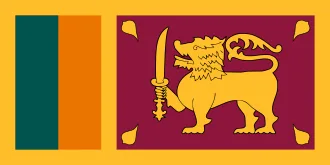
The island has a documented history of over 3,000 years, with evidence of prehistoric human settlement dating back 125,000 years. Sri Lanka has been given various names throughout its long history, with Ceylon most notably being used prior to its independence in 1948. The earliest known Buddhist writings in the island, known collectively as the Pali Canon, date back to 29 BCE.
Sri Lanka, owing to its strategic geographical location, played a role as a major trading hub, and was well known to explorers across the world as early as the Anuradhapura period. The Portuguese Empire established a colony in the sixteenth century, during a period of political upheaval in the Kingdom of Kotte where it also faced attacks from neighbouring kingdoms of Kandy and Sitawaka.
Following the Sinhalese–Portuguese War, the Dutch colonial empire controlled the coastal areas. By the early 19th century, the British Empire established a colony on the island, which lasted until 1948. The early 20th century saw the rise of nationalist movements and increasing calls for independence. In 1948, Sri Lanka gained independence as the Dominion of Ceylon, eventually becoming a republic in 1972.
Sri Lanka's recent history has been marred by a prolonged civil war between the Tamil separatist militant organisation of Liberation Tigers of Tamil Eelam and the Sri Lankan Armed Forces, which lasted from 1983 to 2009, and ended with the defeat of the separatists.
In the 21st century, Sri Lanka has emerged as a developing country, with a strategically important geographical location in the Indian Ocean, with its deep harbours giving it significant geopolitical leverage as a major trading post from the ancient Maritime Silk Road. It has the highest level of human development in South Asia and the second-highest GDP per capita in the region.
Sri Lanka has a long history of international engagement and cooperation, and is a member of several international organisations—including SAARC, the G77, the Non-Aligned Movement and the Commonwealth of Nations.
Names and toponymy
In antiquity, Sri Lanka was known to travellers by a variety of names. According to the Mahāvaṃsa, the legendary Prince Vijaya named the island Tambapaṇṇĩ ("copper-red hands" or "copper-red earth"), because his followers' hands were reddened by the red soil of the area where he landed. In Hindu mythology, the term Lankā ("Island") appears but it is unknown whether it refers to the island.
The Tamil term Eelam (Tamil: ஈழம், īḻam) was used to designate the whole island in Sangam literature. The island was known under Chola rule as Mummudi Cholamandalam ("realm of the three crowned Cholas").
Ancient Greek geographers called it Taprobanā (Ancient Greek: Ταπροβανᾶ) or Taprobanē (Ταπροβανῆ) from the word Tambapanni. The Arabs and Persians referred to it as Sarandīb (the origin of the word "serendipity") from Sanskrit Siṃhaladvīpaḥ. Ceilão, the name given to Sri Lanka by the Portuguese when they arrived in 1505, was transliterated into English as Ceylon.
As a British crown colony, the island was known as Ceylon; it achieved independence as the Dominion of Ceylon in 1948.
The country is now known in Sinhala as Śrī Laṅkā (Sinhala: ශ්රී ලංකා) and in Tamil as Ilaṅkai (Tamil: இலங்கை, IPA: [iˈlaŋɡaɪ]).
In 1972, its formal name was changed to Free, Sovereign and Independent Republic of Sri Lanka. Later, on 7 September 1978, it was changed to the Democratic Socialist Republic of Sri Lanka. As the name Ceylon still appears in the names of a number of organisations, the Sri Lankan government announced in 2011 a plan to rename all those over which it has authority.
History
Prehistory
The pre-history of Sri Lanka goes back 125,000 years and possibly even as far back as 500,000 years. The era spans the Palaeolithic, Mesolithic, and early Iron Ages. Among the Palaeolithic human settlements discovered in Sri Lanka, Pahiyangala (37,000 BP), named after the Chinese traveller monk Faxian; Batadombalena (28,500 BP); and Belilena (12,000 BP) are the most important.
In these caves, archaeologists have found the remains of anatomically modern humans which they have named Balangoda Man, and other evidence suggesting that they may have engaged in agriculture and kept domestic dogs for driving game.
The earliest inhabitants of Sri Lanka were likely ancestors of the Vedda people, an indigenous people numbering approximately 2,500 living in modern-day Sri Lanka.
During the protohistoric period (1000–500 BCE) Sri Lanka was culturally united with southern India, and shared the same megalithic burials, pottery, iron technology, farming techniques and megalithic graffiti. This cultural complex spread from southern India along with Dravidian clans such as the Velir, prior to the migration of Prakrit speakers.
One of the first written references to the island is found in the Indian epic Ramayana, which provides details of a kingdom named Lanka that was created by the divine sculptor Vishvakarma for Kubera, the God of Wealth. It is said that Kubera was overthrown by his rakshasa stepbrother, Ravana.
Ancient history
According to the Mahāvaṃsa, a Pāḷi chronicle written in the 5th century CE, the original inhabitants of Sri Lanka are said to be the Yakshas and Nagas. Sinhalese history traditionally starts in 543 BCE with the arrival of Prince Vijaya, a semi-legendary prince who sailed with 700 followers to Sri Lanka, after being expelled from Vanga kingdom (present-day Bengal).
He established the Kingdom of Tambapanni, near modern-day Mannar. Vijaya (Singha) is the first of the approximately 189 monarchs of Sri Lanka described in chronicles such as the Dīpavaṃsa, Mahāvaṃsa, Cūḷavaṃsa, and Rājāvaliya.
Once Prakrit speakers had attained dominance on the island, the Mahāvaṃsa further recounts the later migration of royal brides and service castes from the Tamil Pandya kingdom to the Anuradhapura kingdom in the early historic period.
The Anuradhapura period (377 BCE – 1017 CE) began with the establishment of the Anuradhapura kingdom in 380 BCE during the reign of Pandukabhaya. Thereafter, Anuradhapura served as the capital city of the country for nearly 1,400 years. Ancient Sri Lankans excelled at building certain types of structures such as tanks, dagobas and palaces.
Society underwent a major transformation during the reign of Devanampiya Tissa, with the arrival of Buddhism from India. In 250 BCE, Mahinda, a bhikkhu and the son of the Mauryan Emperor Ashoka arrived in Mihintale carrying the message of Buddhism. His mission won over the monarch, who embraced the faith and propagated it throughout the Sinhalese population.
Succeeding kingdoms of Sri Lanka would maintain many Buddhist schools and monasteries and support the propagation of Buddhism into other countries in Southeast Asia. Sri Lankan Bhikkhus studied in India's famous ancient Buddhist University of Nalanda, which was destroyed by Bakhtiyar Khalji. It is probable that many of the scriptures from Nalanda are preserved in Sri Lanka's many monasteries and that the written form of the Tripiṭaka, including Sinhalese Buddhist literature, were part of the University of Nalanda.
In 245 BCE, bhikkhunī Sanghamitta arrived with the Jaya Sri Maha Bodhi tree, which is considered to be a sapling from the historical Bodhi Tree under which Gautama Buddha became enlightened. It is considered the oldest human-planted tree (with a continuous historical record) in the world. (Bodhivaṃsa)
Sri Lanka experienced the first of many foreign invasions during the reign of Suratissa, who was defeated by two horse traders named Sena and Guttika from South India. The next invasion came immediately in 205 BCE by a Chola named Elara, who overthrew Asela and ruled the country for 44 years. Dutugamunu, the eldest son of the southern regional sub-king, Kavan Tissa, defeated Elara in the Battle of Vijithapura.
During its two and a half millennia of existence, the Sinhala kingdom was invaded at least eight times by neighbouring South Indian dynasties such as the Chola, Pandya, and Pallava.[citation needed] There also were incursions by the kingdoms of Kalinga (modern Odisha) and from the Malay Peninsula as well.[citation needed]
The Fourth Theravāda Council was held at the Anuradhapura Maha Viharaya in Sri Lanka under the patronage of Valagamba in 25 BCE. The council was held in response to a year in which the harvests in Sri Lanka were particularly poor and many Buddhist monks subsequently died of starvation. Because the Pali Canon was at that time oral literature maintained in several recensions by dhammabhāṇakas (dharma reciters), the surviving monks recognised the danger of not writing it down so that even if some of the monks whose duty it was to study and remember parts of the Canon for later generations died, the teachings would not be lost.
After the council, palm-leaf manuscripts containing the completed Canon were taken to other countries such as Burma, Thailand, Cambodia and Laos.
Sri Lanka was the first Asian country known to have a female ruler: Anula of Anuradhapura (r. 47–42 BCE). Sri Lankan monarchs undertook some remarkable construction projects such as Sigiriya, the so-called "Fortress in the Sky", built during the reign of Kashyapa I, who ruled between 477 and 495. The Sigiriya rock fortress is surrounded by an extensive network of ramparts and moats. Inside this protective enclosure were gardens, ponds, pavilions, palaces and other structures.
In 993 CE, the invasion of Chola emperor Rajaraja I forced the then Sinhalese ruler Mahinda V to flee to the southern part of Sri Lanka. Taking advantage of this situation, Rajendra I, son of Rajaraja I, launched a large invasion in 1017. Mahinda V was captured and taken to India, and the Cholas sacked the city of Anuradhapura causing the fall of Anuradhapura kingdom. Subsequently, they moved the capital to Polonnaruwa.
Post-classical period
Following a 17-year-long campaign, Vijayabahu I successfully drove the Chola out of Sri Lanka in 1070, reuniting the country for the first time in over a century. Upon his request, ordained monks were sent from Burma to Sri Lanka to re-establish Buddhism, which had almost disappeared from the country during the Chola reign. During the mediaeval period, Sri Lanka was divided into three sub-territories, namely, Ruhunu, Pihiti and Maya.
Sri Lanka's irrigation system was extensively expanded during the reign of Parākramabāhu the Great (1153–1186). This period is considered as a time when Sri Lanka was at the height of its power. He built 1,470 reservoirs – the highest number by any ruler in Sri Lanka's history – repaired 165 dams, 3,910 canals, 163 major reservoirs, and 2,376 mini-reservoirs.
His most famous construction is the Parakrama Samudra, the largest irrigation project of mediaeval Sri Lanka. Parākramabāhu's reign is memorable for two major campaigns – in the south of India as part of a Pandyan war of succession, and a punitive strike against the kings of Ramanna (Burma) for various perceived insults to Sri Lanka.
After his demise, Sri Lanka gradually decayed in power. In 1215, Kalinga Magha, an invader with uncertain origins, identified as the founder of the Jaffna kingdom, invaded and captured the Kingdom of Polonnaruwa. He sailed from Kalinga 690 nautical miles on 100 large ships with a 24,000 strong army. Unlike previous invaders, he looted, ransacked and destroyed everything in the ancient Anuradhapura and Polonnaruwa Kingdoms beyond recovery.
His priorities in ruling were to extract as much as possible from the land and overturn as many of the traditions of Rajarata as possible. His reign saw the massive migration of native Sinhalese people to the south and west of Sri Lanka, and into the mountainous interior, in a bid to escape his power.
Sri Lanka never really recovered from the effects of Kalinga Magha's invasion. King Vijayabâhu III, who led the resistance, brought the kingdom to Dambadeniya. The north, in the meanwhile, eventually evolved into the Jaffna kingdom. The Jaffna kingdom never came under the rule of any kingdom of the south except on one occasion; in 1450, following the conquest led by king Parâkramabâhu VI's adopted son, Prince Sapumal. He ruled the North from 1450 to 1467 CE.
The next three centuries starting from 1215 were marked by kaleidoscopically shifting collections of capitals in south and central Sri Lanka, including Dambadeniya, Yapahuwa, Gampola, Raigama, Kotte, Sitawaka, and finally, Kandy. In 1247, the Malay kingdom of Tambralinga which was a vassal of Sri Vijaya led by their king Chandrabhanu briefly invaded Sri Lanka from Insular Southeast Asia.
They were then expelled by the South Indian Pandyan dynasty. However, this temporary invasion reinforced the steady flow of the presence of various Austronesian merchant ethnic groups, from Sumatrans (Indonesia) to Lucoes (Philippines) into Sri Lanka which occurred since 200 BCE. Chinese admiral Zheng He and his naval expeditionary force landed at Galle, Sri Lanka in 1409 and got into battle with the local king Vira Alakesvara of Gampola.
Zheng He captured King Vira Alakesvara and later released him. Zheng He erected the Galle Trilingual Inscription, a stone tablet at Galle written in three languages (Chinese, Tamil, and Persian), to commemorate his visit. The stele was discovered by S. H. Thomlin at Galle in 1911 and is now preserved in the Colombo National Museum.
Early modern period
The early modern period of Sri Lanka begins with the arrival of Portuguese soldier and explorer Lourenço de Almeida, the son of Francisco de Almeida, in 1505. In 1517, the Portuguese built a fort at the port city of Colombo and gradually extended their control over the coastal areas. In 1592, after decades of intermittent warfare with the Portuguese, Vimaladharmasuriya I moved his kingdom to the inland city of Kandy, a location he thought more secure from attack.
In 1619, succumbing to attacks by the Portuguese, the independent existence of the Jaffna kingdom came to an end.
During the reign of the Rajasinha II, Dutch explorers arrived on the island. In 1638, the king signed a treaty with the Dutch East India Company to get rid of the Portuguese who ruled most of the coastal areas. The following Dutch–Portuguese War resulted in a Dutch victory, with Colombo falling into Dutch hands by 1656.
The Dutch remained in the areas they had captured, thereby violating the treaty they had signed in 1638. The Burgher people, a distinct ethnic group, emerged as a result of intermingling between the Dutch and native Sri Lankans in this period.
The Kingdom of Kandy was the last independent monarchy of Sri Lanka. In 1595, Vimaladharmasurya brought the sacred Tooth Relic—the traditional symbol of royal and religious authority amongst the Sinhalese—to Kandy and built the Temple of the Tooth. In spite of on-going intermittent warfare with Europeans, the kingdom survived.
Later, a crisis of succession emerged in Kandy upon king Vira Narendra Sinha 's death in 1739. He was married to a Telugu-speaking Nayakkar princess from South India (Madurai) and was childless by her.