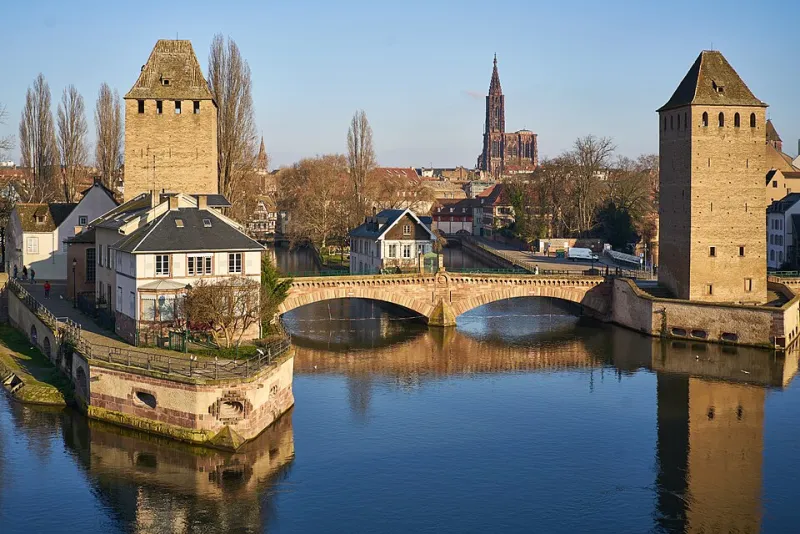
The city has approximately three hundred thousand inhabitants, and Greater Strasbourg and the Strasbourg arrondissement together have more than five hundred thousand inhabitants. The population of the Strasbourg metropolitan area was 860,744 in 2020, making it the eighth largest metropolitan area in France and home to 14% of the population of the Grand Est region.
The population of the international Eurodistrict Strasbourg-Ortenau is approximately 1,000,000 in 2022. Strasbourg is one of the de facto four main capitals of the European Union (along with Brussels, Luxembourg and Frankfurt) because it is the headquarters of various European institutions such as the European Parliament, Eurocorps and the European Union Ombudsman.
The Council of Europe, a separate organization from the European Union (along with the European Court of Human Rights, the European Directorate for the Quality of Medicines (most commonly known as "Pharmacopée Européenne" in French) and the European Audiovisual Observatory) is also based in the city.
Along with Basel (Bank for International Settlements), Geneva (United Nations), The Hague (International Court of Justice) and New York (United Nations world headquarters), Strasbourg is one of the few cities in the world that is not a national capital and hosts first-tier international organizations. The city is the headquarters of many non-European international institutions, such as the Central Commission for Rhine Navigation and the International Institute for Human Rights.
It is the second largest city in France in terms of international congresses and symposiums, after Paris. The Grande Île (Big Island), the historic city center of Strasbourg, was classified as a World Heritage Site by UNESCO in 1988, and the newer "Neustadt" was added to this area in 2017. Strasbourg is deeply rooted in Franco-German culture, and although it has been the subject of fierce debate throughout history, it has been a cultural bridge between France and Germany for centuries, especially thanks to the University of Strasbourg, France's second largest university, and the coexistence of Catholic and Protestant cultures. It is also home to the Great Mosque of Strasbourg, France's largest Islamic place of worship.
Economically, Strasbourg is an important center of manufacturing and engineering, as well as road, rail and river transport. The port of Strasbourg is the second largest river port on the Rhine after Duisburg in Germany and the second largest river port in France after Paris.
Geography
Location
Strasbourg is on France's eastern border with Germany. This border is formed by the Rhine, which is also the eastern border of the modern city, and faces the German town of Kehl across the river. However, the historical center of Strasbourg is on the Grande Île of the river Ill, which flows here parallel to Strasbourg and roughly 4 km from the Rhine.
The natural courses of the two rivers eventually meet somewhere below Strasbourg, but several artificial waterways connect them within the city.
History
Strasbourg was founded by the Roman emperor Augustus. It passed from the Germans to the French in 1681. With the French Revolution of 1789, the city came under the influence of French culture. In the second half of the 19th century, it was recaptured by Otto von Bismarck and incorporated into the German Empire and made the capital of the Alsace-Lorraine state. The city rejoined France in 1919, following World War I.
It has witnessed many important events in history. The French national anthem, La Marseillaise, was composed here in 1792 by Rouget de Lisle. Gutenberg invented the printing press here. The famous German writer Goethe also spent part of his life and studied here.
Education
The University of Strasbourg, one of the most important universities in France, is located here. The city is also home to the headquarters of EM Strasbourg Business School.
Culture and tourism
The city has been on the UNESCO World Heritage list since 1988. Strasbourg resembles an open-air museum with the influence of the Middle Ages and Renaissance architecture in both the city center and the surrounding area. The city is surrounded by vineyards. There are many parks and gardens in the city. Some of the must-see attractions and museums include:
- Notre Dame Cathedral
- La Petite France and Ponts Couverts
- Kleber Square (Place Kleber)
- Republic Square (Place de la République)
- Kammerzell House, the oldest house in the city
- Botanical Garden (Jardin Botanique)
- Gutenberg Square (La Place Gutenberg)
- Palace of Rohan (Le Palais Rohan)
- Alsace Museum (Le Musée Alsacien)
- Canal tour on the River Ill
- Orangerie Park
- Citadelle Park
- European Parliament
- Council of Europe
- European Court of Human Rights
Sport
The city's team is Strasbourg, which plays in the French 1st League.
sister cities
Strasbourg's sister cities:
 Boston, USA, (1960)
 Leicester, United Kingdom, (1960)
 Stuttgart, Germany, (1962)
- Dresden, Germany, (1990)
 Ramat Gan, Israel, (1991)
Cities that have a cooperation agreement with Strasbourg:
 Jacmel, Haiti, (1991)
 Fez, Morocco (1999)
 Douala, Cameroon, (2005)
 Vologda, Russia, (2009)
 Oran, Algeria, (2015)
 Kairouan, Tunisia, (2015)
- Moscow, Russia, (2016)
 Kampala, Uganda, (2018)
 Kagoshima (city), Japan, Japan, (2019)
See also
- List of cities with more than 20,000 inhabitants in France
- Sack of Strasbourg (451)