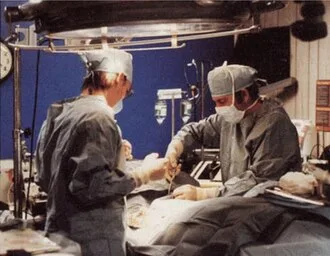
The act of performing surgery may be called a surgical procedure or surgical operation, or simply "surgery" or "operation". In this context, the verb "operate" means to perform surgery. The adjective surgical means pertaining to surgery; e.g. surgical instruments, surgical facility or surgical nurse.
Most surgical procedures are performed by a pair of operators: a surgeon who is the main operator performing the surgery, and a surgical assistant who provides in-procedure manual assistance during surgery. Modern surgical operations typically require a surgical team that typically consists of the surgeon, the surgical assistant, an anaesthetist (often also complemented by an anaesthetic nurse), a scrub nurse (who handles sterile equipment), a circulating nurse and a surgical technologist, while procedures that mandate cardiopulmonary bypass will also have a perfusionist.
All surgical procedures are considered invasive and often require a period of postoperative care (sometimes intensive care) for the patient to recover from the iatrogenic trauma inflicted by the procedure. The duration of surgery can span from several minutes to tens of hours depending on the specialty, the nature of the condition, the target body parts involved and the circumstance of each procedure, but most surgeries are designed to be one-off interventions that are typically not intended as an ongoing or repeated type of treatment.
In British colloquialism, the term "surgery" can also refer to the facility where surgery is performed, or simply the office/clinic of a physician, dentist or veterinarian.
Definitions
As a general rule, a procedure is considered surgical when it involves cutting a person's tissues to treat a disease or injury. Other procedures that do not necessarily fall under this rubric, such as angioplasty or endoscopy, may be considered surgery if they involve "common" surgical procedure or settings, such as use of antiseptic measures and sterile fields, sedation/anesthesia, proactive hemostasis, typical surgical instruments, suturing or stapling.
Minimally invasive surgeries are procedures that utilize natural orifices (e.g. most urological procedures), do not penetrate the structure being excised (e.g. endoscopic polyp excision, rubber band ligation, laser eye surgery), or are percutaneous (e.g. arthroscopy, catheter ablation, angioplasty and valvuloplasty).[citation needed]
Types of surgery
Surgical procedures are commonly categorized by urgency, type of procedure, body system involved, the degree of invasiveness, and special instrumentation.
- Based on timing:
- Elective surgery is done to correct a non-life-threatening condition, and is carried out at the person's convenience, or to the surgeon's and the surgical facility's availability.
- Emergency surgery is surgery which must be done without any delay to prevent death or serious disabilities or loss of limbs and functions.
- Urgent surgery is one that is better done early to avoid complications or potential deterioration of the patient's condition, but such risks are sufficiently low that the procedure can be postponed for a short period time.
- Based on purpose:[citation needed]
- Bariatric surgery is done to assist weight loss when dietary and pharmaceutical methods alone have failed.
- Exploratory surgery is performed to establish or aid a diagnosis.
- Non-survival surgery, or terminal surgery, is where euthanasia is performed while the subject is under anesthesia so that the subject will not regain conscious pain perception. This type of surgery is usually done in animal testing experiments.
- Plastic surgery is done to improve a body part's function or appearance.
- Cosmetic surgery is done to subjectively improve the appearance of an otherwise normal body part.
- Reconstructive surgery is done to improve the function or subjective appearance of a damaged or malformed body part.
- Therapeutic surgery is performed to treat a previously diagnosed condition.
- Curative surgery is a therapeutic procedure done to permanently remove a pathology.
- By type of procedure:
- Ablation is destruction of tissue through the use of energy-transmitting devices such as electrocautery/fulguration, laser, focused ultrasound or freezing.
- Amputation involves removing an entire body part, usually a limb or digit; castration is the amputation of testes; circumcision is the removal of prepuce from the penis or clitoral hood from the clitoris (see female circumcision). Replantation involves reattaching a severed body part.
- Bypass involves the relocation/grafting of a tubular structure onto another in order to reroute the content flow of that target structure from a specific segment directly to a more distal ("downstream") segment.
- Extirpation is the complete excision or surgical destruction of a body part.
- Grafting is the relocation and establishment of a tissue from one part of the body to another. A flap is the relocation of a tissue without complete separation of its original attachment, and a free flap is a completely detached flap that carries an intact neurovascular structure ready for grafting onto a new location.
- Implantation is insertion of artificial medical devices to replace or augment existing tissue.
- Repair involves the direct closure or restoration of an injured, mutilated or deformed organ or body part, usually by suturing or internal fixation. Reconstruction is an extensive repair of a complex body part (such as joints), often with some degrees of structural/functional replacement and commonly involves grafting and/or use of implants.
- Resection is the removal of all or part of an internal organ and/or connective tissue. A segmental resection specifically removes an independent vascular region of an organ such as a hepatic segment, a bronchopulmonary segment or a renal lobe. Excision is the resection of only part of an organ, tissue or other body part (e.g. skin) without discriminating specific vascular territories. Exenteration is the complete removal of all organs and soft tissue content (especially lymphoid tissues) within a body cavity.
- Transplantation is the replacement of an organ or body part by insertion of another from a different human (or animal) into the person undergoing surgery. Harvesting is the resection of an organ or body part from a live human or animal (known as the donor) for transplantation into another patient (known as the recipient).
- By organ system: Surgical specialties are traditionally and academically categorized by the organ, organ system or body region involved. Examples include:
- Cardiac surgery — the heart and mediastinal great vessels;
- ENT surgery — ear, nose and throat, also known as head and neck surgery when including the neck region;
- Gastrointestinal surgery — the digestive tract and its accessory organs;
- Neurosurgery — the central nervous system, and;
- Oral and maxillofacial surgery — the oral cavity, jaws, and face;
- Orthopedic surgery — the musculoskeletal system.
- Thoracic surgery — the thoracic cavity including the lungs;
- Urological surgery — the genitourinary system;
- Vascular surgery — the extra-mediastinal great vessels and peripheral circulatory system;
- By degree of invasiveness of surgical procedures:
- Conventional open surgery (such as a laparotomy) requires a large incision to access the area of interest, and directly exposes the internal body cavity to the outside.
- Hybrid surgery uses a combination of open and minimally-invasive techniques, and may include hand ports or larger incisions to assist with performance of elements of the procedure.
- Minimally-invasive surgery involves much smaller surface incisions or even natural orifices (nostril, mouth, anus or urethra) to insert miniaturized instruments within a body cavity or structure, as in laparoscopic surgery or angioplasty.
- By equipment used:
- Cryosurgery uses low-temperature cryoablation to freeze and destroy a target tissue.
- Electrosurgery involves use of electrocautery to cut and coagulate tissue.
- Endoscopic surgery uses optical instruments to relay the image from inside an enclosed body cavity to the outside, and the surgeon performs the procedure using specialized handheld instruments inserted through trocars placed through the body wall. Most modern endoscopic procedures are video-assisted, meaning the images are viewed on a display screen rather than through the eyepiece on the endoscope.
- Laser surgery involves use of laser ablation to divide tissue instead of a scalpel, scissors or similar sharp-edged instruments.
- Microsurgery involves the use of an operating microscope for the surgeon to see and manipulate small structures.
- Robotic surgery makes use of robotics such as the Da Vinci or the ZEUS robotic surgical systems, to remotely control endoscopic or minimally-invasive instruments.
- By age:
- Fetal surgery treats unborn children.
- Geriatric surgery involves surgical treatment tailored to the specific needs of older adults.
- Pediatric surgery exclusively treats infants, toddlers, children, and adolescents.
Terminology
- Resection and excisional procedures start with a prefix for the target organ to be excised (cut out) and end in the suffix -ectomy. For example, removal of part of the stomach would be called a subtotal gastrectomy.
- Procedures involving cutting into an organ or tissue end in -otomy. A surgical procedure cutting through the abdominal wall to gain access to the abdominal cavity is a laparotomy.
- Minimally invasive procedures, involving small incisions through which an endoscope is inserted, end in -oscopy. For example, such surgery in the abdominal cavity is called laparoscopy.
- Procedures for formation of a permanent or semi-permanent opening called a stoma in the body end in -ostomy, such as creation of a colostomy, a connection of colon and the abdominal wall. This prefix is also used for connection between two viscera, such as how an esophagojejunostomy refers to a connection created between the esophagus and the jejunum.
- Plastic and reconstruction procedures start with the name for the body part to be reconstructed and end in -plasty. For example, rhino- is a prefix meaning "nose", therefore a rhinoplasty is a reconstructive or cosmetic surgery for the nose. A pyloroplasty refers to a type of reconstruction of the gastric pylorus.
- Procedures that involve cutting the muscular layers of an organ end in -myotomy. A pyloromyotomy refers to cutting the muscular layers of the gastric pylorus.
- Repair of a damaged or abnormal structure ends in -orraphy. This includes herniorrhaphy, another name for a hernia repair.
- Reoperation, revision, or "redo" procedures refer to a planned or unplanned return to the operating theater after a surgery is performed to re-address an aspect of patient care. Unplanned reasons for reoperation include postoperative complications such as bleeding or hematoma formation, development of a seroma or abscess, anastomotic leak, tissue necrosis requiring debridement or excision, or in the case of malignancy, close or involved resection margins that may require re-excision to avoid local recurrence. Reoperation can be performed in the acute phase, or it can be also performed months to years later if the surgery failed to solve the indicated problem. Reoperation can also be planned as a staged operation where components of the procedure are performed or reversed under separate anesthesia.
Description of surgical procedure
Setting
Inpatient surgery is performed in a hospital, and the person undergoing surgery stays at least one night in the hospital after the surgery. Outpatient surgery occurs in a hospital outpatient department or freestanding ambulatory surgery center, and the person who had surgery is discharged the same working day. Office-based surgery occurs in a physician's office, and the person is discharged the same day.
At a hospital, modern surgery is often performed in an operating theater using surgical instruments, an operating table, and other equipment. Among United States hospitalizations for non-maternal and non-neonatal conditions in 2012, more than one-fourth of stays and half of hospital costs involved stays that included operating room (OR) procedures.
The environment and procedures used in surgery are governed by the principles of aseptic technique: the strict separation of "sterile" (free of microorganisms) things from "unsterile" or "contaminated" things. All surgical instruments must be sterilized, and an instrument must be replaced or re-sterilized if it becomes contaminated (i.e. handled in an unsterile manner, or allowed to touch an unsterile surface).
Operating room staff must wear sterile attire (scrubs, a scrub cap, a sterile surgical gown, sterile latex or non-latex polymer gloves and a surgical mask), and they must scrub hands and arms with an approved disinfectant agent before each procedure.
Preoperative care
Prior to surgery, the person is given a medical examination, receives certain pre-operative tests, and their physical status is rated according to the ASA physical status classification system. If these results are satisfactory, the person requiring surgery signs a consent form and is given a surgical clearance. If the procedure is expected to result in significant blood loss, an autologous blood donation may be made some weeks prior to surgery.
If the surgery involves the digestive system, the person requiring surgery may be instructed to perform a bowel prep by drinking a solution of polyethylene glycol the night before the procedure. People preparing for surgery are also instructed to abstain from food or drink (an NPO order after midnight on the night before the procedure), to minimize the effect of stomach contents on pre-operative medications and reduce the risk of aspiration if the person vomits during or after the procedure.
Some medical systems have a practice of routinely performing chest x-rays before surgery. The premise behind this practice is that the physician might discover some unknown medical condition which would complicate the surgery, and that upon discovering this with the chest x-ray, the physician would adapt the surgery practice accordingly.
However, medical specialty professional organizations recommend against routine pre-operative chest x-rays for people who have an unremarkable medical history and presented with a physical exam which did not indicate a chest x-ray. Routine x-ray examination is more likely to result in problems like misdiagnosis, overtreatment, or other negative outcomes than it is to result in a benefit to the person.
Likewise, other tests including complete blood count, prothrombin time, partial thromboplastin time, basic metabolic panel, and urinalysis should not be done unless the results of these tests can help evaluate surgical risk.
Preparing for surgery
A surgical team may include a surgeon, anesthetist, a circulating nurse, and a "scrub tech", or surgical technician, as well as other assistants who provide equipment and supplies as required. While informed consent discussions may be performed in a clinic or acute care setting, the pre-operative holding area is where documentation is reviewed and where family members can also meet the surgical team.
Nurses in the preoperative holding area confirm orders and answer additional questions of the family members of the patient prior to surgery. In the pre-operative holding area, the person preparing for surgery changes out of their street clothes and are asked to confirm the details of his or her surgery as previously discussed during the process of informed consent.
A set of vital signs are recorded, a peripheral IV line is placed, and pre-operative medications (antibiotics, sedatives, etc.) are given.
When the patient enters the operating room and is appropriately anesthetized, the team will then position the patient in an appropriate surgical position. If hair is present at the surgical site, it is clipped (instead of shaving). The skin surface within the operating field is cleansed and prepared by applying an antiseptic (typically chlorhexidine gluconate in alcohol, as this is twice as effective as povidone-iodine at reducing the risk of infection).
Sterile drapes are then used to cover the borders of the operating field. Depending on the type of procedure, the cephalad drapes are secured to a pair of poles near the head of the bed to form an "ether screen", which separate the anesthetist/anesthesiologist's working area (unsterile) from the surgical site (sterile).
Anesthesia is administered to prevent pain from the trauma of cutting, tissue manipulation, application of thermal energy, and suturing. Depending on the type of operation, anesthesia may be provided locally, regionally, or as general anesthesia. Spinal anesthesia may be used when the surgical site is too large or deep for a local block, but general anesthesia may not be desirable.
With local and spinal anesthesia, the surgical site is anesthetized, but the person can remain conscious or minimally sedated. In contrast, general anesthesia may render the person unconscious and paralyzed during surgery. The person is typically intubated to protect their airway and placed on a mechanical ventilator, and anesthesia is produced by a combination of injected and inhaled agents.
The choice of surgical method and anesthetic technique aims to solve the indicated problem, minimize the risk of complications, optimize the time needed for recovery, and limit the surgical stress response.