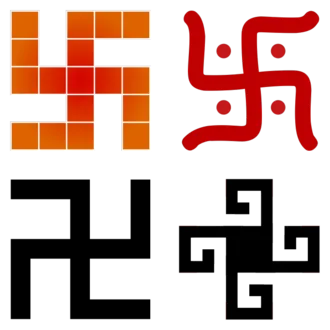
Swastika is a deep and multi-layered symbol whose origins date back to prehistoric times. This motif, often called the swastika, appears in two basic forms: right-facing (卐) and left-facing (卍). The left-facing version is also called "sauvastika". This symbol has carried holiness, good luck and spiritual meanings in different cultures of Eurasia for centuries, and has an important place in Indian religions such as Hinduism, Buddhism and Jainism.
In the Western world, the fate of the swastika changed radically when it was used as a symbol by the National Socialist German Workers' Party since the 1920s. After this period, in Western societies, the swastika began to be identified with far-right ideologies and National Socialism. However, in countries such as India, Nepal, Mongolia, China and Japan, it is still considered a symbol of luck and charity, and is even frequently used in Hindu wedding ceremonies.
The origin of the name of the Swastika is quite interesting. The Greek letter gamma (Γ) and the cross shape (✚) combined to form the name "swastika". In Sanskrit, it emerged as a term meaning "to be well, happy and healthy" by combining the words "su" (good) and "asti" (to be). The geometric structure of this symbol is quite flexible; The swastika, which fits into an imaginary square, can be transformed into a circle or other geometric shapes.
This motif, which can also be defined as an irregular twenty-sided polygon, can be enriched with different variations and new forms can be obtained.
Throughout history, the swastika appears in countless civilizations and cultures. For example, there are swastika motifs on a clay pot from the Majiyao culture dating back to 2200-2000 BC, exhibited in the Hong Kong Museum of Art. This symbol, which is widely used by different religions and cultures in India, is also seen in Central and South American civilizations, especially the Mayans and Navarros.
Swastika was used on some coins in Mesopotamia, in early Christianity, and even in the Byzantine Empire. Its four arms symbolize the four cosmic powers (fire, water, air, earth) and according to some sources, it is believed that magic was performed through this symbol in ancient times.