
















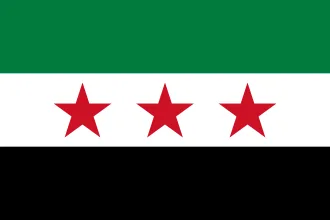
The name "Syria" historically referred to the region of Syria, or known as Greater Syria and Syria-Palestine. The modern state encompasses the sites of several ancient kingdoms and empires, including the Eblan civilization. Damascus was the capital of the Umayyad Empire and later became an important political and administrative center, alongside Aleppo, under the Ayyubid and Mamluk Sultanates and the Ottoman Empire.
The modern Syrian state was established in the mid-20th century after centuries of Ottoman rule, as a French Mandate. The state represented the largest Arab state to emerge from the formerly Ottoman-ruled Syrian provinces. It gained de jure independence as a parliamentary republic in 1945 when the First Syrian Republic became a founding member of the United Nations, an act which legally ended the French Mandate.
French troops withdrew in April 1946, granting the nation de facto independence. The post-independence period was tumultuous, with multiple coups and coup attempts between 1949 and 1971. In 1958, Syria entered a brief pan-Arab union with Egypt, which was terminated following a 1961 coup d'état. The 1963 coup d'état carried out by the military committee of the Ba'ath Party established a one-party state, which ran Syria under martial law from 1963 to 2011.
Internal power-struggles within Ba'athist factions caused further coups in 1966 and 1970, the latter of which saw Hafez al-Assad come to power. Under Assad, Syria became a hereditary dictatorship. Assad died in 2000, and he was succeeded by his son, Bashar.
During the Arab Spring in 2011, members of the Syrian opposition organized protests against the Assad regime, which became known as the Syrian Revolution. After the government responded with lethal violence, the Free Syrian Army was formed, and the revolution escalated into a multifaceted 13-year civil war, drawing in several countries and triggering a refugee crisis that displaced more than 6 million people.
Rebel advances were reversed following the emergence of the Islamic State, which occupied roughly two-thirds of Syria by May 2015. Alongside rebel and government counteroffensives, several countries led a campaign that resulted in the Islamic State's territorial defeat in 2017. Following its defeat in the four-year Battle of Aleppo, the Free Syrian Army fragmented and declined.
By 2020, the civil war had become a frozen conflict, while Hay'at Tahrir al-Sham (HTS) consolidated the remaining rebel groups in its stronghold in northwestern Syria. In late 2024, HTS and other opposition forces launched a series of offensives, culminating in the fall of Damascus and the fall of the Assad regime on 8 December 2024.
The Syrian caretaker government was established following the fall of the Assad regime and remained in place until it was replaced by the Syrian transitional government in March 2025, under Ahmed al-Sharaa, the new president of Syria. Post-war conflict continues following the fall of the Assad regime, involving clashes with Assad loyalists, Alawite and Druze insurgents, the former Syrian Democratic Forces, and Israeli forces.
Syria has been a unitary presidential republic since the fall of the Assad regime and is currently undergoing a political transition. It is governed by the Syrian transitional government under the Constitutional Declaration, with executive authority vested in the president. Syria is a developing country with a mixed economy.
Its economy was primarily based on agriculture in its early years but deteriorated following the outbreak of the Syrian civil war in 2011. A country of fertile plains, high mountains, plateaus, and deserts, Syria is home to diverse ethnic and religious groups. Levantine Arabs are the largest ethnic group, while Sunni Muslims constitute the largest religious group.
Syria is a founding member of the United Nations and the Arab League and is a member of numerous international organizations. It is also home to six UNESCO World Heritage Sites.
Etymology
Several sources indicate that the name Syria is borrowed from the Ancient Greek name Σύριοι Sýrioi, or Σύροι Sýroi, which is in turn borrowed from Luwian sura/i- (attested in the 8th century BC), and ultimately derived from Aššūr (Assyria) in northern Mesopotamia (present-day Iraq and north-eastern Syria).
However, from the Seleucid Empire (323–150 BC), this term was also applied to the Levant, and from this point the Greeks applied the term without distinction between the Assyrians of Mesopotamia and Arameans of the Levant. Mainstream modern academic opinion strongly favors the argument that the Greek word is related to Ἀσσυρία Assyria, ultimately borrowed from Akkadian Aššur.
The Greek name appears to correspond to Phoenician ʾšr 'Assur', ʾšrym 'Assyrians', recorded in the Çineköy inscription (dated to the 8th century BC), where Luwian sura/i- is also attested.
The area designated by the word has changed over time. Classically, Syria lies at the eastern end of the Mediterranean, between Arabia to the south and Asia Minor to the north, stretching inland to include parts of Iraq, and having an uncertain border to the northeast that Pliny the Elder describes as including, from west to east, Commagene, Sophene, and Adiabene.
By Pliny's time, however, this larger Syria had been divided into a number of provinces under the Roman Empire (but politically independent from each other): Judaea, later renamed Palaestina in AD 135 (the region corresponding to modern-day Israel, the Palestinian territories, and Jordan) in the extreme southwest; Phoenice (established in 194) corresponding to modern Lebanon, Damascus and Homs regions; Coele-Syria (or "Hollow Syria") and south of the Eleutheris river.
History
Ancient antiquity
The Natufian culture was the first to become sedentary around the 11th millennium BC and became one of the centers of Neolithic culture (known as Pre-Pottery Neolithic A), where agriculture and cattle breeding first began to appear. The site of Tell Qaramel has several round stone towers dated to 10650 BC, making them the oldest structures of this kind in the world.
The Neolithic period (Pre-Pottery Neolithic B) is represented by rectangular houses of Mureybet culture. At the time, people used containers made of stone, gyps, and burnt lime (Vaisselle blanche). The discovery of obsidian tools from Anatolia are evidence of early trade. The ancient cities of Hamoukar and Emar played an important role during the late Neolithic and Bronze Age.
Archaeologists have demonstrated that civilization in Syria was one of the most ancient on earth, perhaps preceded by only that of Mesopotamia.[citation needed]
The earliest recorded indigenous civilization in the region was the Kingdom of Ebla near present-day Idlib, northern Syria. Ebla appears to have been founded around 3500 BC and gradually built its fortune through trade with the Mesopotamian states of Sumer, Assyria, and Akkad, as well as with the Hurrian and Hattian peoples to the northwest, in Asia Minor.
Gifts from Pharaohs, found during excavations, confirm Ebla's contact with Egypt. One of the earliest written texts from Syria is a trading agreement between Vizier Ibrium of Ebla and an ambiguous kingdom called Abarsal c. 2300 BC. This is known as the Treaty between Ebla and Abarsal.
Scholars believe the language of Ebla to be among the oldest known written Semitic languages after Akkadian. Recent classifications of the Eblaite language have shown that it was an East Semitic language, closely related to the Akkadian language. Ebla was weakened by a long war with Mari, and the whole of Syria became part of the Mesopotamian Akkadian Empire after Sargon of Akkad and his grandson Naram-Sin's conquests ended Eblan domination over Syria in the first half of the 23rd century BC.
By the 21st century BC, Hurrians settled in the northern east parts of Syria while the rest of the region was dominated by the Amorites. Syria was called the Land of the Amurru (Amorites) by their Assyro-Babylonian neighbors. The Northwest Semitic Amorite language is the earliest attested of the Canaanite languages. Mari reemerged during this period until conquered by Hammurabi of Babylon.
Ugarit also arose during this time, circa 1800 BC, close to modern Latakia. Ugaritic was a Semitic language loosely related to the Canaanite languages and developed the Ugaritic alphabet, considered to be the world's earliest known alphabet. The Ugaritic kingdom survived until its destruction at the hands of the marauding Indo-European Sea Peoples in the 12th century BC in what was known as the Late Bronze Age collapse.[citation needed]
Aleppo and Damascus are among the oldest continuously inhabited cities in the world. Yamhad (modern Aleppo) dominated northern Syria for two centuries, although eastern Syria was occupied in the 19th and 18th centuries BC by the Old Assyrian Empire ruled by the Amorite dynasty of Shamshi-Adad I, and by the Babylonian Empire which was founded by Amorites.
Yamhad was described in the tablets of Mari as the mightiest state in the near east and as having more vassals than Hammurabi. Yamhad imposed its authority over Alalakh, Qatna, the Hurrians states, and the Euphrates valley down to the borders with Babylon. The army of Yamhad campaigned as far away as Dēr on the border of Elam (modern Iran).
Yamhad was conquered and destroyed, along with Ebla, by the Hittites from Asia Minor circa 1600 BC. From this time, Syria became a battle ground for various foreign empires, these being the Hittite Empire, Mitanni Empire, Egyptian Empire, Middle Assyrian Empire, and to a lesser degree Babylonia. The Egyptians initially occupied much of the south, while the Hittites and the Mitanni occupied much of the north.
However, Assyria eventually gained the upper hand, destroying the Mitanni Empire and annexing huge swathes of territory previously held by the Hittites and Babylon.[citation needed]
Around the 14th century BC, various Semitic people appeared in the area, such as the semi-nomadic Suteans who came into an unsuccessful conflict with Babylonia to the east, and the West Semitic speaking Arameans who subsumed the earlier Amorites. They too were subjugated by Assyria and the Hittites for centuries. The Egyptians fought the Hittites for control over western Syria; the fighting reached its zenith in 1274 BC with the Battle of Kadesh.
The west remained part of the Hittite empire until its destruction c. 1200 BC, while eastern Syria largely became part of the Middle Assyrian Empire, who also annexed much of the west during the reign of Tiglath-Pileser I 1114–1076 BC. With the destruction of the Hittites and the decline of Assyria in the late 11th century BC, the Aramean tribes gained control of much of the interior, founding states such as Bit Bahiani, Aram-Damascus, Hamath, Aram-Rehob, Aram-Naharaim, and Luhuti.
From this point, the region became known as Aramea or Aram. There was also a synthesis between the Semitic Arameans and the remnants of the Indo-European Hittites, with the founding of a number of Syro-Hittite states centered in north central Aram (Syria) and south central Asia Minor (modern Turkey), including Palistin, Carchemish and Sam'al.[citation needed]
A Canaanite group known as the Phoenicians came to dominate the coasts of Syria, (and also Lebanon and northern Palestine) from the 13th century BC, founding city states such as Amrit, Simyra, Arwad, Paltos, Ramitha, and Shuksi. From these coastal regions, they eventually spread their influence throughout the Mediterranean, including building colonies in Malta, Sicily, the Iberian peninsula, and the coasts of North Africa and most significantly, founding the major city-state of Carthage in the 9th century BC, which was much later to become the center of a major empire, rivaling the Roman Republic.[citation needed]
Syria and the western half of Near East then fell to the vast Neo Assyrian Empire (911 BC – 605 BC). The Assyrians introduced Imperial Aramaic as the lingua franca of their empire. This language was to remain dominant in Syria and the entire Near East until after the Islamic conquest in the 7th and 8th centuries AD, and was to be a vehicle for the spread of Christianity.
The Assyrians named their colonies of Syria and Lebanon Eber-Nari. Assyrian domination ended after the Assyrians greatly weakened themselves in a series of brutal internal civil wars, followed by attacks from: the Medes, Babylonians, Chaldeans, Persians, Scythians and Cimmerians. During the fall of Assyria, the Scythians ravaged and plundered much of Syria.
The last stand of the Assyrian army was at Carchemish in northern Syria in 605 BC. The Assyrian Empire was followed by the Neo-Babylonian Empire (605 BC – 539 BC). During this period, Syria became a battle ground between Babylonia and another former Assyrian colony, that of Egypt. The Babylonians, like their Assyrian relations, were victorious over Egypt.[citation needed]
Classical antiquity
Lands that constitute modern-day Syria were part of the Neo-Babylonian Empire and had been annexed by the Achaemenid Empire in 539 BC. Led by Cyrus the Great, the Achaemenid Persians retained Imperial Aramaic as one of the diplomatic languages of their empire, as well as the Assyrian name for the new satrapy of Aram/Syria Eber-Nari.
Syria was conquered by the Macedonian Empire which was ruled by Alexander the Great c. 330 BC and consequently became Coele-Syria province of the Seleucid Empire (323 BC – 64 BC), with the Seleucid kings styling themselves "King of Syria" and the city of Antioch being its capital starting from 240 BC.
Thus, it was the Greeks who introduced the name "Syria" to the region. Originally an Indo-European corruption of "Assyria" in northern Mesopotamia (Iraq), the Greeks used this term to describe not only Assyria itself but also the lands to the west which had for centuries been under Assyrian dominion. Thus in the Greco-Roman world both the Arameans of Syria and the Assyrians of Mesopotamia (modern day Iraq) to the east were referred to as "Syrians" or "Syriacs", despite these being distinct peoples in their own right, a confusion which would continue into the modern world.
Eventually parts of southern Seleucid Syria were taken by the Jewish Hasmonean dynasty upon the slow disintegration of the Hellenistic Empire.[citation needed]