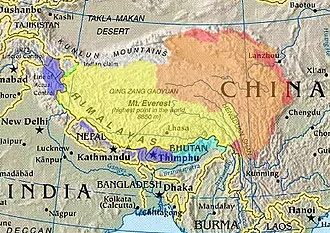
In the 7th century, the central Tibetan Yarlung dynasty expanded into surrounding areas such as Zhangzhung and Amdo, and by the 9th century the Tibetan Empire stretched from the Tarim Basin and Pamirs in the west to Yunnan and Bengal in the southeast, ruling over various non-Tibetan peoples. Following its dissolution, the region was divided among a number of principalities and tribal groups.
Central Tibet and peripheral areas often fell under Chinese or Mongol patronage between the 13th and the 18th centuries, when the Gelug school of Tibetan Buddhism rose to prominence. The Qing dynasty established its rule in Tibet after expelling Mongol forces and incorporated many areas into Sichuan and other administrative regions.
Following the Xinhai Revolution in 1912, Qing soldiers were disarmed and escorted out of Tibet, but it was constitutionally claimed by the Republic of China as the Tibet Area. The 13th Dalai Lama declared independence in 1913, although it was neither recognised by the Chinese government nor any foreign power. Central Tibet operated autonomously until 1951 when, following the Battle of Chamdo, it was annexed by the People's Republic of China after the 14th Dalai Lama ratified the Seventeen Point Agreement. His government was abolished after the failure of the 1959 Tibetan uprising.
The Tibetan independence movement is principally led by the Tibetan diaspora. Various human rights organizations have reported restrictions on civil liberties, including limitations on religious practices, freedom of expression, and assembly, with the Chinese government maintaining strict control over information. Reports on the extent of these restrictions vary, and claims of cultural suppression, including the sinicization of Tibet, are a subject of debate among scholars and international observers.
The dominant religion in Tibet is Tibetan Buddhism; other religions include Bön, an indigenous religion similar to Tibetan Buddhism; Islam; and Christianity. Tibetan Buddhism is a primary influence on the art, music, and festivals of the region. Tibetan architecture reflects Chinese and Indian influences. Staple foods in Tibet are roasted barley, yak meat, and butter tea.
With the growth of tourism in recent years, the service sector has become the largest sector in Tibet, accounting for 50.1% of the local GDP in 2020.[needs update] In 2025, around 70 million tourists visited Tibet.
Name and languages
The endonymic term for Tibet is Bod(Bö) (Tibetan: བོད, IPA: [pʰøː˩˧˨]). Some scholars believe it is derived from the Sanskrit Bhauṭṭa, IPA: [bʰɐu̯ʈːɐ] and referenced in Greek in Geography (Ptolemy) and Periplus of the Erythraean Sea. The first known English word Tibet dates back to 1827 CE and may have been derived from Arabic, Mongolic, or Turkic languages.
Linguists generally classify Tibetic languages under the Tibeto-Burman branch of the Sino-Tibetan language family. They come in numerous dialects which are generally not mutually intelligible. Tibetic languages are spoken across the Tibetan plateau, Bhutan, parts of Nepal, and northern India such as Sikkim. In general, dialects of central Tibet (including the prestige Lhasa variety), Kham, Amdo and some smaller nearby areas are considered Tibetan dialects.
Other forms, particularly Dzongkha, Sikkimese, Sherpa, and Ladakhi, are considered by their speakers to be separate languages largely for political reasons. However, if the latter group is included in the calculation, then 'greater Tibetan' is spoken by approximately 6 million people in the region and about 150,000 speakers in exile.
Although spoken Tibetan varies according to the region, the written language based on Classical Tibetan is consistent throughout. This is probably due to the long-standing influence of the Tibetan empire, whose rule encompassed and at times extended beyond the present Tibetan linguistic area, from Gilgit-Baltistan in the west to Yunnan and Sichuan in the east and from north of Qinghai Lake to as far south as Bhutan.
The Tibetan script, which is used for Ladakhi and Dzongkha as well, is derived from the ancient Indian Brahmi script.
Starting in 2001, the local deaf sign languages of Tibet were standardized, and Tibetan Sign Language is now being promoted across the country.[citation needed]
History
Early history
Humans inhabited the Tibetan Plateau at least 21,000 years ago. This population was largely replaced around 3,000 BP by Neolithic immigrants from northern China, but there is a partial genetic continuity between the Paleolithic inhabitants and contemporary Tibetan populations.
The earliest Tibetan historical texts identify the Zhang Zhung culture as a people who migrated from the Amdo region into what is now the region of Guge in western Tibet. Zhang Zhung is considered to be the original home of the Bön religion. By the 1st century BCE, a neighboring kingdom arose in the Yarlung valley, and the Yarlung king, Drigum Tsenpo, attempted to remove the influence of the Zhang Zhung by expelling the Zhang's Bön priests from Yarlung.
He was assassinated and Zhang Zhung continued its dominance of the region until it was annexed by Songtsen Gampo in the 7th century. Prior to Songtsen Gampo, the kings of Tibet were more mythological than factual, and there is insufficient evidence of their existence.
Tibetan Empire
In the 6th century, the king, Namri Songtsen, began to annex neighboring tribes by force. He was later murdered and his son Songtsen Gampo succeeded him and quelled rebellions in various regions. Songtsen Gampo inherited his father's will and successively conquered and annexed other countries such as "Songbo" in the Yushu area of Qinghai, Sumpa in the west, "Kangguo" (called "Dongnwu Kingdom" in the Old Book of Tang) in Qianduo (now Chamdo), "Fuguo (Chinese:附国)" in Ganzi, "Fanlu (Chinese:蕃绿)" in Litang, and Tuyuhun in Qinghai.
Songtsen Gampo also led a large army to attack Zhangzhung in 642. It took him three years to conquer Zhangzhung and sent Khyungpo Pungse Sutse as the governor of Zhangzhung. Zhangzhung then became a vassal state of the Tibetan Empire.
Songtsen Gampo also brought in many reforms, and Tibetan power spread rapidly, creating a large and powerful empire. It is traditionally considered that his first wife was the Princess of Nepal, Bhrikuti, and that she played a great role in the establishment of Buddhism in Tibet. In 640, he married Princess Wencheng, the niece of the Chinese emperor Taizong of Tang China.
Under the next few Tibetan kings, Buddhism became established as the state religion and Tibetan power increased even further over large areas of Central Asia, while major inroads were made into Chinese territory, even reaching the Tang's capital Chang'an (modern Xi'an) in late 763. However, the Tibetan occupation of Chang'an only lasted for fifteen days, after which they were defeated by Tang and its ally, the Turkic Uyghur Khaganate.
The Kingdom of Nanzhao (in Yunnan and neighbouring regions) remained under Tibetan control from 750 to 794, when they turned on their Tibetan overlords and helped the Chinese inflict a serious defeat on the Tibetans.
In 747, the hold of Tibet was loosened by the campaign of general Gao Xianzhi, who tried to re-open the direct communications between Central Asia and Kashmir. By 750, the Tibetans had lost almost all of their central Asian possessions to the Chinese. However, after Gao Xianzhi's defeat by the Arabs and Qarluqs at the Battle of Talas (751) and the subsequent civil war known as the An Lushan Rebellion (755), Chinese influence decreased rapidly and Tibetan influence resumed.
At its height in the 780s to 790s, the Tibetan Empire reached its highest glory when it ruled and controlled a territory stretching from modern-day Afghanistan, Bangladesh, Bhutan, Burma, China, India, Nepal, Pakistan, Kazakhstan, Kyrgyzstan, Tajikistan.
In 821/822 CE, Tibet and China signed a peace treaty. A bilingual account of this treaty, including details of the borders between the two countries, is inscribed on a stone pillar which stands outside the Jokhang temple in Lhasa. Tibet continued as a Central Asian empire until the mid-9th century, when a civil war over succession led to the collapse of imperial Tibet.
The period that followed is known traditionally as the Era of Fragmentation, when political control over Tibet became divided between regional warlords and tribes with no dominant centralized authority. An Islamic invasion from Bengal took place in 1206.
Yuan dynasty
The Mongol Yuan dynasty, through the Bureau of Buddhist and Tibetan Affairs, or Xuanzheng Yuan, ruled Tibet through a top-level administrative department. One of the department's purposes was to select a dpon-chen ("great administrator"), usually appointed by the lama and confirmed by the Mongol emperor in Beijing.
The Sakya lama retained a degree of autonomy, acting as the political authority of the region, while the dpon-chen held administrative and military power. Mongol rule of Tibet remained separate from the main provinces of China, but the region existed under the administration of the Yuan dynasty. If the Sakya lama ever came into conflict with the dpon-chen, the dpon-chen had the authority to send Chinese troops into the region.
Tibet retained nominal power over religious and regional political affairs, while the Mongols managed a structural and administrative rule over the region, reinforced by the rare military intervention. This existed as a "diarchic structure" under the Yuan emperor, with power primarily in favor of the Mongols. Mongolian prince Khuden gained temporal power in Tibet in the 1240s and sponsored Sakya Pandita, whose seat became the capital of Tibet.
Drogön Chögyal Phagpa, Sakya Pandita's nephew became Imperial Preceptor of Kublai Khan, founder of the Yuan dynasty.
Yuan control over the region ended with the Ming overthrow of the Yuan and Tai Situ Changchub Gyaltsen's revolt against the Mongols. Following the uprising, Tai Situ Changchub Gyaltsen founded the Phagmodrupa dynasty, and sought to reduce Yuan influences over Tibetan culture and politics.
Phagmodrupa, Rinpungpa and Tsangpa dynasties
Between 1346 and 1354, Tai Situ Changchub Gyaltsen toppled the Sakya and founded the Phagmodrupa dynasty. The following 80 years saw the founding of the Gelug school (also known as Yellow Hats) by the disciples of Je Tsongkhapa, and the founding of the important Ganden, Drepung and Sera monasteries near Lhasa. However, internal strife within the dynasty and the strong localism of the various fiefs and political-religious factions led to a long series of internal conflicts.
The minister family Rinpungpa, based in Tsang (West Central Tibet), dominated politics after 1435. In 1565 they were overthrown by the Tsangpa dynasty of Shigatse which expanded its power in different directions of Tibet in the following decades and favoured the Karma Kagyu sect.
Rise of Ganden Phodrang and Buddhist Gelug school
In 1578, Altan Khan of the Tümed Mongols gave Sonam Gyatso, a high lama of the Gelugpa school, the name Dalai Lama, Dalai being the Mongolian translation of the Tibetan name Gyatso "Ocean".
The 5th Dalai Lama (1617–1682) is known for unifying the Tibetan heartland under the control of the Gelug school of Tibetan Buddhism, after defeating the rival Kagyu and Jonang sects and the secular ruler, the Tsangpa prince, in a prolonged civil war. His efforts were successful in part because of aid from Güshi Khan, the Oirat leader of the Khoshut Khanate.
With Güshi Khan as a largely uninvolved overlord, the 5th Dalai Lama and his intimates established a civil administration which is referred to by historians as the Lhasa state. This Tibetan regime or government is also referred to as the Ganden Phodrang.
Qing dynasty
Qing dynasty rule in Tibet began with their 1720 expedition to the country when they expelled the invading Dzungars. Amdo came under Qing control in 1724, and eastern Kham was incorporated into neighbouring Chinese provinces in 1728. Meanwhile, the Qing government sent resident commissioners called Ambans to Lhasa.
In 1750, the Ambans and the majority of the Han Chinese and Manchus living in Lhasa were killed in a riot, and Qing troops arrived quickly and suppressed the rebels in the next year. Like the preceding Yuan dynasty, the Manchus of the Qing dynasty exerted military and administrative control of the region, while granting it a degree of political autonomy.
The Qing commander publicly executed a number of supporters of the rebels and, as in 1723 and 1728, made changes in the political structure and drew up a formal organization plan. The Qing now restored the Dalai Lama as ruler, leading the governing council called Kashag, but elevated the role of Ambans to include more direct involvement in Tibetan internal affairs.
At the same time, the Qing took steps to counterbalance the power of the aristocracy by adding officials recruited from the clergy to key posts.
For several decades, peace reigned in Tibet, but in 1792, the Qing Qianlong Emperor sent a large Chinese army into Tibet to push the invading Nepalese out. This prompted yet another Qing reorganization of the Tibetan government, this time through a written plan called the "Twenty-Nine Regulations for Better Government in Tibet".
Qing military garrisons staffed with Qing troops were now also established near the Nepalese border. Tibet was dominated by the Manchus in various stages in the 18th century, and the years immediately following the 1792 regulations were the peak of the Qing imperial commissioners' authority; but there was no attempt to make Tibet a Chinese province.
In 1834, the Sikh Empire invaded and annexed Ladakh, a culturally Tibetan region that was an independent kingdom at the time. Seven years later, a Sikh army led by General Zorawar Singh invaded western Tibet from Ladakh, starting the Sino-Sikh War. A Qing-Tibetan army repelled the invaders but was in turn defeated when it chased the Sikhs into Ladakh. The war ended with the signing of the Treaty of Chushul between the Chinese and Sikh empires.
As the Qing dynasty weakened, its authority over Tibet also gradually declined, and by the mid-19th century, its influence was minuscule. Qing authority over Tibet had become more symbolic than real by the late 19th century, although in the 1860s, the Tibetans still chose for reasons of their own to emphasize the empire's symbolic authority and make it seem substantial.
In 1774, a Scottish nobleman, George Bogle, travelled to Shigatse to investigate prospects of trade for the East India Company. His efforts, while largely unsuccessful, established permanent contact between Tibet and the Western world. However, in the 19th century, tensions between foreign powers and Tibet increased. The British Empire was expanding its territories in India into the Himalayas, while the Emirate of Afghanistan and the Russian Empire were both doing likewise in Central Asia.
In 1904, a British expedition to Tibet, spurred in part by a fear that Russia was extending its power into Tibet as part of the Great Game, was launched. Although the expedition initially set out with the stated purpose of resolving border disputes between Tibet and Sikkim, it quickly turned into a military invasion. The British expeditionary force, consisting of mostly Indian troops, quickly invaded and captured Lhasa, with the Dalai Lama fleeing to the countryside.
Afterwards, the leader of the expedition, Sir Francis Younghusband, negotiated the Convention Between Great Britain and Tibet with the Tibetans, which guaranteed the British great economic influence but ensured the region remained under Chinese control. The Qing imperial resident, known as the Amban, publicly repudiated the treaty, while the British government, eager for friendly relations with China, negotiated a new treaty two years later known as the Convention Between Great Britain and China Respecting Tibet.
The British agreed not to annex or interfere in Tibet in return for an indemnity from the Chinese government, while China agreed not to permit any other foreign state to interfere with the territory or internal administration of Tibet.