
















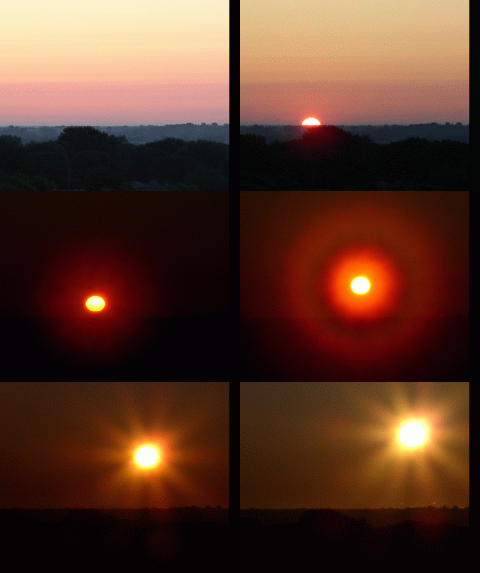
Time is primarily measured in linear spans or periods, ordered from shortest to longest. Practical, human-scale measurements of time are performed using clocks and calendars, reflecting a 24-hour day collected into a 365-day year linked to the astronomical motion of the Earth. Scientific measurements of time instead vary from Planck time at the shortest to billions of years at the longest.
Measurable time is believed to have effectively begun with the Big Bang 13.8 billion years ago, encompassed by the chronology of the universe. Modern physics understands time to be inextricable from space within the concept of spacetime described by general relativity. Time can therefore be dilated by velocity and matter to pass faster or slower for an external observer, though this is considered negligible outside of extreme conditions, namely relativistic speeds or the gravitational pulls of black holes.
Throughout history, time has been an important subject of study in religion, philosophy, and science. Temporal measurement has occupied scientists and technologists, and has been a prime motivation in navigation and astronomy. Time is also of significant social importance, having economic value ("time is money") as well as personal value, due to an awareness of the limited time in each day ("carpe diem") and in human life spans.
Definition
The concept of time can be complex. Multiple notions exist, and defining time in a manner applicable to all fields without circularity has consistently eluded scholars. Nevertheless, diverse fields such as business, industry, sports, the sciences, and the performing arts all incorporate some notion of time into their respective measuring systems.
Traditional definitions of time involved the observation of periodic motion such as the apparent motion of the sun across the sky, the phases of the moon, and the passage of a free-swinging pendulum. More modern systems include the Global Positioning System, other satellite systems, Coordinated Universal Time and mean solar time. Although these systems differ from one another, with careful measurements they can be synchronized.
In physics, time is a fundamental concept to define other quantities, such as velocity. To avoid a circular definition, time in physics is operationally defined as "what a clock reads", specifically a count of repeating events such as the SI second. Although this aids in practical measurements, it does not address the essence of time.
Physicists developed the concept of the spacetime continuum, where events are assigned four coordinates: three for space and one for time. Events like particle collisions, supernovas, or rocket launches have coordinates that may vary for different observers, making concepts like "now" and "here" relative. In general relativity, these coordinates do not directly correspond to the causal structure of events.
Instead, the spacetime interval is calculated and classified as either space-like or time-like, depending on whether an observer exists that would say the events are separated by space or by time. Since the time required for light to travel a specific distance is the same for all observers—a fact first publicly demonstrated by the Michelson–Morley experiment—all observers will consistently agree on this definition of time as a causal relation.
General relativity does not address the nature of time for extremely small intervals where quantum mechanics holds. In quantum mechanics, time is treated as a universal and absolute parameter, differing from general relativity's notion of independent clocks. The problem of time consists of reconciling these two theories. As of 2026, there is no generally accepted theory of quantum general relativity.
Measurement
Methods of temporal measurement, or chronometry, generally take two forms. The first is a calendar, a mathematical tool for organising intervals of time on Earth, consulted for periods longer than a day. The second is a clock, a physical mechanism that indicates the passage of time, consulted for periods less than a day. The combined measurement marks a specific moment in time from a reference point, or epoch.
Time is one of the seven fundamental physical quantities in both the International System of Units (SI) and International System of Quantities. The SI base unit of time is the second, which is defined by measuring the electronic transition frequency of caesium atoms.
History of the calendar
Artifacts from the Paleolithic suggest that the moon was being used to reckon time by at least 6,000 years ago.[disputed – discuss] Lunar calendars were among the first to appear, with years of either 12 or 13 lunar months (either 354 or 384 days).
Without intercalation to add days or months to some years, seasons quickly drift in a calendar based solely on twelve lunar months. Lunisolar calendars have a thirteenth month added to some years to make up for the difference between a full year (now known to be about 365.24 days) and a year of just twelve lunar months.
The numbers twelve and thirteen came to feature prominently in many cultures, at least partly due to this relationship of months to years.
Other early forms of calendars originated in Mesoamerica, particularly in ancient Mayan civilization, in which they developed the Maya calendar, consisting of multiple interrelated calendars. These calendars were religiously and astronomically based; the Haab' calendar has 18 months in a year and 20 days in a month, plus five epagomenal days at the end of the year. In conjunction, the Maya also used a 260-day sacred calendar called the Tzolk'in.
The reforms of Julius Caesar in 45 BC put the Roman world on a solar calendar. This Julian calendar was faulty in that its intercalation still allowed the astronomical solstices and equinoxes to advance against it by about 11 minutes per year. Pope Gregory XIII introduced a correction in 1582; the Gregorian calendar was only slowly adopted by different nations over a period of centuries, but it is now by far the most commonly used calendar around the world.
During the French Revolution, a new clock and calendar were invented as part of the dechristianization of France and to create a more rational system in order to replace the Gregorian calendar. The French Republican Calendar's days consisted of ten hours of a hundred minutes of a hundred seconds, which marked a deviation from the base 12 (duodecimal) system used in many other devices by many cultures. The system was abolished in 1806.
History of other devices
A large variety of devices have been invented to measure time. The study of these devices is called horology. They can be driven by a variety of means, including gravity, springs, and various forms of electrical power, and regulated by a variety of means.
A sundial is any device that uses the direction of sunlight to cast shadows from a gnomon onto a set of markings calibrated to indicate the local time, usually to the hour. The idea to separate the day into smaller parts is credited to Egyptians because of their sundials, which operated on a duodecimal system. The importance of the number 12 is due to the number of lunar cycles in a year and the number of stars used to count the passage of night.
Obelisks made as a gnomon were built as early as c. 3500 BC. An Egyptian device that dates to c. 1500 BC, similar in shape to a bent T-square, also measured the passage of time from the shadow cast by its crossbar on a nonlinear rule.
The T was oriented eastward in the mornings. At noon, the device was turned around so that it could cast its shadow in the evening direction.
Alarm clocks reportedly first appeared in ancient Greece c. 250 BC with a water clock made by Plato that would set off a whistle. The hydraulic alarm worked by gradually filling a series of vessels with water. After some time, the water emptied out of a siphon. Inventor Ctesibius revised Plato's design; the water clock uses a float as the power drive system and uses a sundial to correct the water flow rate.
In medieval philosophical writings, the atom was a unit of time referred to as the smallest possible division of time. The earliest known occurrence in English is in Byrhtferth's Enchiridion (a science text) of 1010–1012, where it was defined as 1/564 of a momentum (11⁄2 minutes), and thus equal to 15/94 of a second.
It was used in the computus, the process of calculating the date of Easter. The most precise timekeeping device of the ancient world was the water clock, or clepsydra, one of which was found in the tomb of Egyptian pharaoh Amenhotep I. They could be used to measure the hours even at night but required manual upkeep to replenish the flow of water.
The ancient Greeks and the people from Chaldea (southeastern Mesopotamia) regularly maintained timekeeping records as an essential part of their astronomical observations. Arab inventors and engineers, in particular, made improvements on the use of water clocks up to the Middle Ages. In the 11th century, Chinese inventors and engineers invented the first mechanical clocks driven by an escapement mechanism.
Incense sticks and candles were, and are, commonly used to measure time in temples and churches across the globe. Water clocks, and, later, mechanical clocks, were used to mark the events of the abbeys and monasteries of the Middle Ages. The passage of the hours at sea can also be marked by bell. The hours were marked by bells in abbeys as well as at sea.
Richard of Wallingford (1292–1336), abbot of St. Alban's abbey, famously built a mechanical clock as an astronomical orrery about 1330. The hourglass uses the flow of sand to measure the flow of time. They were also used in navigation. Ferdinand Magellan used 18 glasses on each ship for his circumnavigation of the globe (1522).
The English word clock probably comes from the Middle Dutch word klocke which, in turn, derives from the medieval Latin word clocca, which ultimately derives from Celtic and is cognate with French, Latin, and German words that mean bell.
Great advances in accurate time-keeping were made by Galileo Galilei and especially Christiaan Huygens with the invention of pendulum-driven clocks along with the invention of the minute hand by Jost Burgi. There is also a clock that was designed to keep time for 10,000 years called the Clock of the Long Now. Alarm clock devices were later mechanized.
Levi Hutchins's alarm clock has been credited as the first American alarm clock, though it can only ring at 4 a.m. Antoine Redier was also credited as the first person to patent an adjustable mechanical alarm clock in 1847. Digital forms of alarm clocks became more accessible through digitization and integration with other technologies, such as smartphones.
The most accurate timekeeping devices are atomic clocks, which are accurate to seconds in many millions of years, and are used to calibrate other clocks and timekeeping instruments. Atomic clocks use the frequency of electronic transitions in certain atoms to measure the second. One of the atoms used is caesium; most modern atomic clocks probe caesium with microwaves to determine the frequency of these electron vibrations.
Since 1967, the International System of Measurements bases its unit of time, the second, on the properties of caesium atoms. SI defines the second as 9,192,631,770 cycles of the radiation that corresponds to the transition between two electron spin energy levels of the ground state of the 133Cs atom. A portable timekeeper that meets certain precision standards is called a chronometer.
Initially, the term was used to refer to the marine chronometer, a timepiece used to determine longitude by means of celestial navigation, a precision first achieved by John Harrison. More recently, the term has also been applied to the chronometer watch, a watch that meets precision standards set by the Swiss agency COSC.
In modern times, the Global Positioning System in coordination with the Network Time Protocol can be used to synchronize timekeeping systems across the globe. As of May 2010[update], the smallest time interval uncertainty in direct measurements is on the order of 12 attoseconds (1.2 × 10⁻¹⁷ seconds), about 3.7 × 1026 Planck times. The time measured was the delay caused by out-of-sync electron waves' interference patterns.
Units
The second (s) is the SI base unit. A minute (min) is 60 seconds in length (or, rarely, 59 or 61 seconds when leap seconds are employed), and an hour is 60 minutes or 3600 seconds in length. A day is usually 24 hours or 86,400 seconds in length; however, the duration of a calendar day can vary due to daylight saving time and leap seconds.
Standards
A time standard is a specification for measuring time: assigning a number or calendar date to an instant (point in time), quantifying the duration of a time interval, and establishing a chronology (ordering of events). In modern times, several time specifications have been officially recognized as standards, where formerly they were matters of custom and practice.
The invention in 1955 of the caesium atomic clock has led to the replacement of older and purely astronomical time standards such as sidereal time and ephemeris time, for most practical purposes, by newer time standards based wholly or partly on atomic time using the SI second.
International Atomic Time (TAI) is the primary international time standard from which other time standards are calculated. Universal Time (UT1) is mean solar time at 0° longitude, computed from astronomical observations. It varies from TAI because of the irregularities in Earth's rotation. Coordinated Universal Time (UTC) is an atomic time scale designed to approximate Universal Time.
UTC differs from TAI by an integral number of seconds. UTC is kept within 0.9 second of UT1 by the introduction of one-second steps to UTC, the leap second. The Global Positioning System broadcasts a very precise time signal based on UTC time.
The surface of the Earth is split into a number of time zones. Standard time or civil time in a time zone deviates a fixed, round amount, usually a whole number of hours, from some form of Universal Time, usually UTC. Most time zones are exactly one hour apart, and by convention compute their local time as an offset from UTC.
For example, time zones at sea are based on UTC. In many locations (but not at sea) these offsets vary twice yearly due to daylight saving time transitions.
Some other time standards are used mainly for scientific work. Terrestrial Time is a theoretical ideal scale realized by TAI. Geocentric Coordinate Time and Barycentric Coordinate Time are scales defined as coordinate times in the context of the general theory of relativity, with TCG applying to Earth's center and TCB to the solar system's barycenter. Barycentric Dynamical Time is an older relativistic scale related to TCB that is still in use.
Philosophy
Religion
Cyclical views of time
Many ancient cultures, particularly in the East, had a cyclical view of time. In these traditions, time was often seen as a recurring pattern of ages or cycles, where events and phenomena repeated themselves in a predictable manner. One of the most famous examples of this concept is found in Hindu philosophy, where time is depicted as a wheel called the "Kalachakra" or "Wheel of Time." According to this belief, the universe undergoes endless cycles of creation, preservation, and destruction.
Similarly, in other ancient cultures such as those of the Mayans, Aztecs, and Chinese, there were also beliefs in cyclical time, often associated with astronomical observations and calendars. These cultures developed complex systems to track time, seasons, and celestial movements, reflecting their understanding of cyclical patterns in nature and the universe.
The cyclical view of time contrasts with the linear concept of time more common in Western thought, where time is seen as progressing in a straight line from past to future without repetition.
Time in Abrahamic religions
Jewish, Christian, and Islamic world-views generally regard time as linear and directional, beginning with the act of creation by God.
In the Hebrew Bible book, Ecclesiastes (Kohelet), traditionally attributed to King Solomon (“Shlomo Hamelech” or שְׁלֹמֹה הַמֶּלֶךְ in Hebrew) (970–928 BC), time is depicted as cyclical and beyond human control. Ecclesiastes 3:1 states, “To everything there is a season, and a time to every purpose under the heaven.”
The traditional Christian view sees time ending, teleologically, with the eschatological end of the present order of things, the "end time". However, some Christian theologians (such as Augustine of Hippo and Aquinas) believe that God is outside of time, seeing all events simultaneously, that time did not exist before God, and that God created time.
Time in Greek mythology
The Greek language denotes two distinct principles, Chronos and Kairos. The former refers to numeric, or chronological, time. The latter, literally "the right or opportune moment", relates specifically to metaphysical or Divine time. In theology, Kairos is qualitative, as opposed to quantitative.
In Greek mythology, Chronos (ancient Greek: Χρόνος) is identified as the personification of time. His name in Greek means "time" and is alternatively spelled Chronus (Latin spelling) or Khronos. Chronos is usually portrayed as an old, wise man with a long, gray beard, such as "Father Time". Some English words whose etymological root is khronos/chronos include chronology, chronometer, chronic, anachronism, synchronise, and chronicle.
Time in Kabbalah & Rabbinical thought
Rabbis sometimes saw time like "an accordion that was expanded and collapsed at will." According to Kabbalists, "time" is a paradox and an illusion.
Time in Advaita Vedanta
According to Advaita Vedanta, time is integral to the phenomenal world, which lacks independent reality. Time and the phenomenal world are products of maya, influenced by our senses, concepts, and imaginations. The phenomenal world, including time, is seen as impermanent and characterized by plurality, suffering, conflict, and division.
Since phenomenal existence is dominated by temporality (kala), everything within time is subject to change and decay. Overcoming pain and death requires knowledge that transcends temporal existence and reveals its eternal foundation.
In Western philosophy
Two contrasting viewpoints on time divide prominent philosophers. One view is that time is part of the fundamental structure of the universe—a dimension independent of events, in which events occur in sequence. Isaac Newton subscribed to this realist view, and hence it is sometimes referred to as Newtonian time.
The opposing view is that time does not refer to any kind of "container" that events and objects "move through", nor to any entity that "flows", but that it is instead part of a fundamental intellectual structure (together with space and number) within which humans sequence and compare events. This second view, in the tradition of Gottfried Leibniz and Immanuel Kant, holds that time is neither an event nor a thing, and thus is not itself measurable nor can it be travelled.
Furthermore, it may be that there is a subjective component to time, but whether or not time itself is "felt", as a sensation, or is a judgment, is a matter of debate.
In philosophy, time was questioned throughout the centuries; what time is and if it is real or not. Ancient Greek philosophers asked if time was linear or cyclical and if time was endless or finite. These philosophers had different ways of explaining time; for instance, ancient Indian philosophers had something called the Wheel of Time.
It is believed that there was repeating ages over the lifespan of the universe. This led to beliefs like cycles of rebirth and reincarnation. The Greek philosophers believe that the universe was infinite, and was an illusion to humans. Plato believed that time was made by the Creator at the same instant as the heavens.
He also says that time is a period of motion of the heavenly bodies. Aristotle believed that time correlated to movement, that time did not exist on its own but was relative to motion of objects. He also believed that time was related to the motion of celestial bodies; the reason that humans can tell time was because of orbital periods and therefore there was a duration on time.