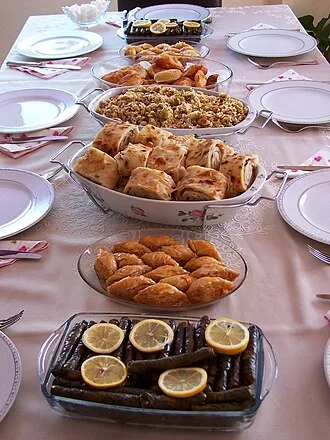
The cooking of Istanbul, Bursa, İzmir, and the rest of the Anatolia region inherits many elements of Ottoman court cuisine, including moderate use of spices, a preference for rice over bulgur, koftes, and a wider availability of vegetable stews (türlü), eggplant and stuffed dolmas. The cuisine of the Black Sea region uses fish extensively, especially the Black Sea anchovy (hamsi) and includes maize dishes.
The cuisine of the southeast (including Urfa, Gaziantep, Adıyaman and Adana) is famous for its variety of kebabs, mezes and dough-based desserts such as baklava, şöbiyet, kadayıf, katmer and künefe.
Especially in the western parts of Turkey, where olive trees grow abundantly, olive oil is the primary type of cooking oil. The cuisines of the Aegean, Marmara and Mediterranean regions are rich in vegetables, herbs, and fish. Central Anatolia has many well-known specialties, such as keşkek, mantı (especially from Kayseri) and gözleme.
Food names directly cognate with mantı are also found in Chinese (mantou or steamed bun), and it is generally considered to have originated in Mongolia during the 13th century.
Specialties are often named for places, and may refer to different styles of preparation. For example, Urfa kebap is less spicy and thicker than Adana kebap. Although meat-based foods such as kebabs are common in Turkish cuisine abroad, meals in Turkey largely center around rice, vegetables, and bread.
History
In the early years of the republic, a few studies were published about regional Anatolian dishes, but cuisine did not feature heavily in Turkish folkloric studies until the 1980s when the fledgling tourism industry encouraged the Turkish state to sponsor two food symposia. The papers submitted at the symposia presented the history of Turkish cuisine on a "historical continuum" that dated back to Turkic origins in Central Asia and continued through the Seljuk and Ottoman periods.
Prior to the symposia, the study of Turkish culinary culture was first popularized by the publication of Süheyl Ünver's Fifty Dishes in Turkish History in 1948. This book was based on recipes found in an 18th-century Ottoman manuscript. His second book was about the 15th century palace cuisine during the reign of Sultan Mehmed II.
Following the publication of Ünver's book, subsequent studies were published, including a 1978 study by historian Bahaettin Ögel about the Central Asian origins of Turkish cuisine.
Culinary customs
Breakfast
A traditional Turkish breakfast is rich in variety. A typical serving consists of cheese (such as white cheese, kashar, and others), butter, olives, eggs, muhammara, tomatoes, cucumbers, jam, honey, kaymak, sucuk (optionally spicy Turkish sausage), pastırma, börek, simit, poğaça, açma, fried dough (pişi), and various soups may be eaten as a morning meal in Turkey.
A specialty for breakfast is menemen, prepared with tomatoes, green peppers, onion, olive oil and eggs. The breakfast menu can also include kuymak (depending on the province the dish is also known as muhlama, mıhlama and yağlaş) or egg with spinach or potato. Another specialty is the Balkan Turkish dish çılbır, also known as Turkish eggs, made with poached eggs and yogurt.
Invariably, Turkish tea is served at breakfast. The Turkish word for breakfast, kahvaltı, means "before coffee".
Homemade food
Homemade food is still preferred by Turkish people. A typical meal starts with soup (especially in wintertime), followed by a dish made of vegetables (with olive oil or ground meat), boiled meat or legumes (typically cooked with meat), often with or before Turkish pilav, pasta or bulgur pilav accompanied by a salad or cacık (a diluted cold yogurt dish with garlic, salt, and cucumber slices).
In summertime many prefer a cold dish of vegetables cooked with olive oil (zeytinyağlı yemekler) instead of soup, either before or after the main course, which can also be a chicken, meat or fish plate.
Restaurants
Esnaf lokantası, a typically modest restaurant that provides home-made, traditional dishes (such as bulgur, stew, dolma, lentil soup) in variety with relatively reasonable prices is found across the provinces of Turkiye. It is specifically favoured by male workers, provided that meals are often served before sunrise that is before the shifts and is suitable for lower-wage payees to afford.
Many restaurants are specialized in certain foods; such as köfte, döner, kokoreç, kumpir, midye tava, börek and gözleme. Eating out has always been common in cities. Fast food is gaining popularity and many major foreign fast-food chains have opened all over Turkey.
Summer cuisine
In the hot Turkish summer, a meal often consists of fried vegetables such as patlıcan (eggplant/aubergine) and peppers or potatoes served with yogurt or tomato sauce. Menemen and çılbır are typical summer dishes based on eggs. Sheep cheese, cucumbers, tomatoes, watermelons and melons also make a light summer meal. Those who like helva for dessert prefer "summer helva", which is lighter and less sweet than the regular version.
Key ingredients
Frequently used ingredients in Turkish specialties include lamb, chicken, beef, fish, rice, eggplants, green peppers, onions, garlic, lentils, beans, zucchinis, chickpeas and tomatoes. The average beef consumption per person per year is 15 kilograms (33 lb). Nuts, especially pistachios, chestnuts, almonds, hazelnuts, and walnuts, together with spices, have a special place in Turkish cuisine, and are used extensively in desserts or eaten separately.
About 1.5 kg of pistachios are eaten per person per year, some packaged and some used in desserts such as baklava. Tahini is a common sauce made from sesame seeds, sold both pre-packaged or in bulk on tap. Semolina flour is used to make a cake called revani and irmik helvasi.
Olives are also common on various breakfast and meze tables. Beyaz peynir and yoğurt are part of many dishes including börek, manti, kebab and cacık.
Oils and fats
Butter, olive oil, sunflower oil, canola oil, and corn oil are widely used for cooking. Sesame, hazelnut, peanut and walnut oils are used as well. Kuyruk yağı (tail fat of sheep) is sometimes used in kebabs and meat dishes.
Fruit
The diverse flora of Turkey means that fruit is varied, abundant and cheap. In Ottoman cuisine, fruit frequently accompanied meat as a side dish. Plums, apricots, pomegranates, pears, apples, grapes, figs and quinces along with many kinds of citrus are the most frequently used fruit, either fresh or dried, in Turkish cuisine.
For example, komposto (compote) or hoşaf (from Persian khosh âb, literally meaning "nice water") are among the main side dishes to meat or pilav. Dolma and pilav usually contain currants or raisins. Etli yaprak sarma (vine leaves stuffed with meat and rice) used to be cooked with sour plums in Ottoman cuisine. Turkish desserts do not normally contain fresh fruit, but may contain dried varieties.
Meats
The main use of meat in cooking remains the combination of ground meat and vegetable, with names such as kıymalı fasulye (beans with ground meat) or kıymalı ıspanak (spinach with ground meat, which is sometimes served with yoğurt).
Alternatively, in coastal towns cheap fish such as sardalya (sardines) or hamsi (anchovies) are widely available, as well as many others with seasonal availability. Poultry consumption, almost exclusively of chicken and eggs, is common. Milk-fed lambs, once the most popular source of meat in Turkey, comprise a small part of contemporary consumption. Kuzu çevirme, cooking milk-fed lamb on a spit, once an important ceremony, is rarely seen.
Pork is available in some stores but is not commonly eaten since most Turks are Muslims.
Dishes and foods
Dairy products
Yoğurt is an important element in Turkish cuisine. In fact, the English word yogurt or yoghurt derives from the Turkish word yoğurt. Yoğurt can accompany almost all meat dishes (kebabs, köfte), vegetable dishes (especially fried eggplant, courgette, and spinach with minced meat, along with others), meze, and mantı (folded triangles of dough containing minced meat).
In villages, yoğurt is regularly eaten with pilav or bread. A thicker, higher-fat variety, süzme yoğurt or "strained yogurt", is made by straining the yoğurt curds from the whey. One of the most common Turkish drinks, ayran, is made from yoğurt. Also, yoğurt is often used in the preparation of cakes, some soups and pastries.
Keş (kashk) is a fermented and strained sour yogurt that can be consumed on its own as a cheese, or used as an ingredient in soups.
Cheeses
Turkey produces many varieties of cheese, mostly from sheep's milk. In general, these cheeses are not long-matured, with a comparatively low fat content. The production of many kinds of cheese is local to particular regions. There are 193 different cheeses in Turkey, but only 8 of these cheeses have geographical indication.
- Beyaz peynir – a salty brined cheese taking its name from its white color ("white cheese"). It is similar to feta but not as strong. This is produced in styles ranging from unmatured cheese curds to a strong mature version. It has many varieties due to different sources of milk, regions (Ezine or Thrace) and production methods (classic or cultured). It is eaten plain (for example, as part of the traditional Turkish breakfast), used in salads, and incorporated into cooked foods such as menemen, börek and pide.
- Çerkez peyniri – means "Circassian cheese". It has two variations, smoked or non-smoked.
- Çökelek – is dried cottage cheese. There are many regional varieties of çökelek. Some are eaten fresh while others are preserved, either by storage in goatskin bags or pottery jars, or by drying in the sun.
- Çömlek cheese – is a typical artisanal cheese from Central Anatolia.
- Kurut and keş – are regional names for dried bricks of yogurt made from low-fat milk or from çökelek made from buttermilk.
- Golot cheese – is one of the most important traditional cheeses produced in the region of East Black Sea.
- Gravyer – is produced in Turkey as well. Among others, Kars is famous for this type of cheese.
- Hellim – is a salty, firm-textured goat cheese, generally with some mint added, made in Cyprus. In Turkey, it is common to fry hellim in a pan in some olive oil.
- Kaşar – is Turkey's other ubiquitous cheese made from cow's milk (occasionally mixed with sheep's or goat's milk), sometimes marketed as "Turkish cheddar", being closer in consistency and taste to mild cheddar-style cheese than other Turkish cheeses. Less matured kaşar, called fresh kaşar, is widely consumed as well. Two varieties are popular Kars and Thrace.
- Kaşkaval – is a wheel-shaped yellow sheep's cheese, similar to fresh kaşar. The name comes from Romanian word cașcaval, which bears the Italian structure of caciocavallo.
- Lor – is the other type of unsalted whey cheese, similarly made from the whey left over from kaşar or strained yogurt manufacture. Lor is used in traditional foods and desserts made from unsalted cheese like ekşimik and höşmerim.
- Mihaliç peyniri or Kelle peyniri – is a hard sheep's cheese that can be grated, like Parmesan cheese. Sometimes goat or cow milk is used. It is a specialty from Karacabey, a town in Bursa province which was called Mihaliç during the Byzantine and Ottoman periods. Mostly it is produced from non-pasteurized milk and processed with salt.
- Örgü peyniri (braided cheese) – is a specialty from Diyarbakır.
- Otlu peynir, Van herbed cheese, 'herbed cheese', – is produced in many areas, chiefly in East Anatolia. Traditionally sheep's or goat's milk is used, but more recently cow's milk otlu peynir has been produced. The type of herb used varies by region: in Van wild garlic is traditional; Bitlis otlu peynir contains a damp-loving herb known as sof otu. In other areas horse mint (Mentha longifolia) and Pimpinella rhodentha are used.
- Tulum – is a mostly sheep's curd molded in an animal-skin bag called a tulum. There are regional varieties of tulum peynir in such areas as İzmir, Ödemiş, Elazig and Erzincan, and each of the tulum cheeses have very different characteristics.
Desserts
Cuisine in the late Ottoman Empire was heavily influenced by alafranga-style food, in fashion all over Europe and in Russia in the late 19th century. In the Turkish context it has been regarded as a symbol of Westernization. This influence could still be seen in the earliest cookbooks of the early Republican period like the first edition of the Türk Kadınlar Tatlı Kitabı (Turkish Women's Book of Desserts) which had recipes for Western-style sponge cake (pandispanya), mille-feuille, petit beurre and other Western desserts.
The revised edition published in 1966 devoted far more attention to traditional confectionery like şekerpare, baklava and helva.
One of the best-known desserts in Turkish cuisine is baklava. Baklava is made either with pistachios or walnuts. Turkish cuisine has a range of baklava-like desserts which include şöbiyet, bülbül yuvası, sütlü nuriye, and burma.
Kadayıf is a common Turkish dessert that employs shredded yufka. There are different types of kadayıf: tel (wire) or burma (wring) kadayıf, both of which can be prepared with either walnuts or pistachios.
Although carrying the label "kadayıf", ekmek kadayıfı is totally different from "tel kadayıf". Künefe and ekmek kadayıfı are rich in syrup and butter, and are usually served with kaymak (clotted or scrambled butter). Künefe contains wire kadayıf with a layer of melted cheese in between and it is served hot with pistachios or walnuts.
Katmer is made as a dessert with kaymak (clotted cream), and like many other sweets from Gaziantep and Kilis, is also filled and topped with pistachios.
Among milk-based desserts, the best-known are muhallebi or sütlaç (rice pudding), keşkül, kazandibi (meaning the bottom of "kazan" because of its burnt surface), and tavuk göğsü (a sweet, gelatinous milk pudding dessert similar to kazandibi, to which very thinly peeled chicken breast is added to give a chewy texture). A speciality from the Mediterranean region is haytalı, which consists of pieces of starch pudding and ice cream (or crushed ice) in rose water sweetened with syrup.
Helva (halva): un helvası (flour helva is usually cooked after someone has died), süt helvası (made from raw cow's milk, butter, flour and sugar) irmik helvası (cooked with semolina and pine nuts), hoşmerim (cheese helva), yaz helvası (made from walnut or almond), tahin helvası (crushed sesame seeds; also eaten for breakfast), kos helva, pişmaniye (floss halva).
Other common desserts include revani (with semolina and starch), şekerpare, dilber dudağı, vezir parmağı, hanım göbeği, kemalpaşa, tulumba, zerde, lokma.
Güllaç is a dessert typically served at Ramadan, consisting of very thin, large dough layers put in milk and rose water, served with pomegranate seeds and walnuts. A story is told that in the kitchens of the Palace, those extra-thin dough layers were prepared with "prayers", as it was believed that if one did not pray while opening phyllo dough, it would never be possible to obtain such thin layers.
Aşure can be described as a sweet soup containing boiled beans, wheat and dried fruits. Sometimes cinnamon and rose water is added when being served. According to legend, it was first cooked on Noah's Ark and contained seven different ingredients in one dish. Anatolian peoples continue a tradition of cooking aşure during the month of Muharrem.
Some traditional Turkish desserts are fruit-based: ayva tatlısı (quince), incir tatlısı (fig), kabak tatlısı (pumpkin), elma tatlısı (apple) and armut tatlısı (pear). Fruits are cooked in a pot or in an oven with sugar, carnations and cinnamon (without adding water). After being chilled, they are served with walnuts or pistachios and kaymak or tahini.
Homemade cookies/biscuits are commonly called "kurabiye" in Turkish. The most common types are acıbadem kurabiyesi (prepared only with eggs, sugar and almonds), un kurabiyesi (flour kurabiye) and cevizli kurabiye (kurabiye with walnuts). Another dough based dessert is ay çöreği.
Tahin-pekmez is a traditional combination especially in rural areas. Tahin is sesame paste and pekmez is grape syrup. These are sold separately and mixed before consumption.
Lokum (Turkish delight), which was eaten for digestion after meals and called "rahat hulkum" in the Ottoman era, is another well-known sweet (candy) with a range of varieties.
Cezerye, cevizli sucuk (named after its sujuk-like shape, also known as churchkhela in Georgian cuisine, or sharots in Armenian cuisine) and pestil (fruit leather) are among other common sweets.
Marzipan (badem ezmesi) is another common confection in Turkey.