















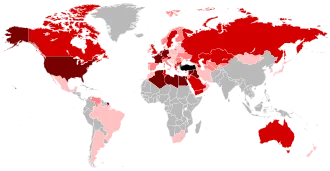
The ethnic Turks can therefore be distinguished by a number of cultural and regional variants, but do not function as separate ethnic groups. In particular, the culture of the Anatolian Turks in Asia Minor has underlain and influenced the Turkish nationalist ideology. Other Turkish groups include the Rumelian Turks (also referred to as Balkan Turks) historically located in the Balkans; Turkish Cypriots on the island of Cyprus, Meskhetian Turks originally based in Meskheti, Georgia; and ethnic Turkish people across the Middle East, where they are also called Turkmen or Turkoman in the Levant (e.g.
Iraqi Turkmen, Syrian Turkmen, Lebanese Turkmen, etc.). Consequently, the Turks form the largest minority group in Bulgaria, the second largest minority group in Iraq, Libya, North Macedonia, and Syria, and the third largest minority group in Kosovo. They also form substantial communities in the Western Thrace region of Greece, the Dobruja region of Romania, the Akkar region in Lebanon, as well as minority groups in other post-Ottoman Balkan and Middle Eastern countries.
The mass immigration of Turks also led to them forming the largest ethnic minority group in Austria, Denmark, Germany, and the Netherlands. There are also Turkish communities in other parts of Europe as well as in North America, Australia, and the post-Soviet states. Turks are the 13th largest ethnic group in the world.
Turkic peoples from Central Asia settled in Anatolia in the 11th century, through the conquests of the Seljuk Turks. This began the transformation of the region, which had been a largely Greek-speaking region after previously being Hellenized, into a Turkish and Muslim-majority one. The Ottoman Empire expanded into parts of West Asia, Southeastern Europe, and North Africa over the course of several centuries.
In the 19th and early 20th centuries, persecution of Muslims during the Ottoman contraction and in the Russian Empire resulted in large-scale loss of life and mass migration into modern-day Turkey from the Balkans, Caucasus, and Crimea; the immigrants were both Turkish and non-Turkish people, and overwhelmingly Muslim.
The empire lasted until the end of World War I, when it was defeated by the Allies and partitioned. Following the Turkish War of Independence that ended with the Turkish National Movement retaking much of the territory lost to the Allies, the Movement ended the Ottoman Empire on 1 November 1922 and proclaimed the Republic of Turkey on 29 October 1923.
Etymology and definition
Etymology
As an ethnonym, the etymology of Turk is still unknown. In Chinese sources, Turk appears as Tujue (Chinese: 突厥; Wade–Giles: T'u-chüe), which referred to the Göktürks. The earliest mention of Turk (𐱅𐰇𐰺𐰜, türü̲k̲; or 𐱅𐰇𐰼𐰚, türk/tẄrk) in Turkic languages comes from the Second Turkic Khaganate. In Orkhon inscriptions, kök türü̲k̲ (𐰚𐰇𐰚 𐱅𐰇𐰼𐰜) is also mentioned, potentially referring to "Ashina-led Turks" or "Ashinas and Turks".
There are several theories regarding the origin of the ethnonym Turk. There is a claim that it may be connected to Herodotus's (c. 484 – c. 425 BC) reference to Targitaos, (Ταργιτάος), a king of the Scythians; however, Manfred Mayrhofer (apud Lincoln) assigned Iranian etymology for Targitaos: from Old Iranian *darga-tavah, meaning "he whose strength is long-lasting".
During the first century A.D., Pomponius Mela refers to the Turcae in the forests north of the Sea of Azov, and Pliny the Elder lists the Tyrcae among the people of the same area; yet English archaeologist Ellis Minns contended that Tyrcae is "a false correction" for Iurcae/Iurkai (Ἱύρκαι), a people who dwelt beyond the Thyssagetae, according to Herodotus (Histories, IV. 22) There are references to certain groups in antiquity whose names might have been foreign transcriptions of Tür(ü)k such as Togarmah, Turukha/Turuška, Turukku and so on; but according to American historian Peter B.
Golden, while any connection of some of these ancient peoples to Turks is possible, it is rather unlikely.
As a word in Turkic languages, Türk may mean 'strong, strength, ripe' or 'flourishing, in full strength'. It may also mean ripe as for a fruit or "in the prime of life, young, and vigorous" for a person. Róna-Tas (1991) pointed to a Khotanese-Saka word, tturakä 'lid', semantically stretchable to 'helmet', as a possible source for this folk etymology, yet Golden thinks this connection requires more data.
Definition
In the 19th century Ottoman Empire, the word Türk referred to Anatolian peasants. The Ottoman ruling class identified themselves as Ottomans, not as Turks. However, they still claimed to be members of Kayi tribe of Oghuz Turks and direct descendants of Oghuz Khan. In the late 19th century, as the Ottoman upper classes adopted European ideas of nationalism, the term Türk took on a more positive connotation.
During Ottoman times, the millet system defined communities on a religious basis. In the early 20th century, the Young Turks abandoned Ottoman nationalism in favor of Turkish nationalism, while adopting the name Turks, which was finally used in the name of the new Turkish Republic.
Mustafa Kemal Atatürk defined the Turkish nation as the "people (halk) who established the Turkish republic". Further, "the natural and historical facts which effected the establishment (teessüs) of the Turkish nation" were "(a) unity in political existence, (b) unity in language, (c) unity in homeland, (d) unity in race and origin (menşe), (e) to be historically related and (f) to be morally related".
Article 66 of the Turkish Constitution defines a Turk as anyone who is "bound to the Turkish state through the bond of citizenship."
History
Prehistory, Ancient era, and Early Middle Ages
First inhabited by modern humans during the Late Paleolithic, present-day Turkey was home to various ancient peoples. The Hattians were assimilated by the Hittites and other Anatolian peoples. Classical Anatolia transitioned into cultural Hellenization after Alexander the Great's conquests, and later Romanization during the Roman and Byzantine eras.
According to historians and linguists, the Proto-Turkic language originated in Central-East Asia, potentially in Altai-Sayan region, Mongolia or Tuva. Initially, Proto-Turkic speakers were potentially both hunter-gatherers and farmers; they later became nomadic pastoralists. Early and medieval Turkic groups exhibited a wide range of both East Asian and West-Eurasian physical appearances and genetic origins, in part through long-term contact with neighboring peoples such as Iranic, Mongolic, Tocharian, Uralic and Yeniseian peoples.
In Central Asia, the earliest surviving Turkic language texts, found on the eighth-century Orkhon inscription monuments, were erected by the Göktürks in the sixth century CE, and include words not common to Turkic but found in unrelated Inner Asian languages. Although the ancient Turks were nomadic, they traded wool, leather, carpets, and horses for grain, silk, wood, and vegetables, and also had large ironworking stations in the south of the Altai Mountains during the 600s CE.
Most of the Turkic peoples were followers of Tengrism, sharing the cult of the sky god Tengri, although there were also adherents of Manichaeism, Nestorian Christianity, and Buddhism. Byzantine era Anatolia served as a center of Christianity, with the Eastern Orthodox Church being based in Constantinople. However, during the Muslim conquests, the Turks entered the Muslim world proper as slaves, the booty of Arab raids and conquests.
The Turks began converting to Islam after the Muslim conquest of Transoxiana through the efforts of missionaries, Sufis, and merchants. Although initiated by the Arabs, the conversion of the Turks to Islam was filtered through Persian and Central Asian culture. Under the Umayyads, most were domestic servants, whilst under the Abbasid Caliphate, increasing numbers were trained as soldiers.
By the ninth century, Turkic commanders were leading the caliphs' Turkic troops into battle. As the Abbasid Caliphate declined, Turkic officers assumed more military and political power by taking over or establishing provincial dynasties with their own corps of Turkic troops.
Seljuk era
During the 11th century, the Seljuk Turks, who were influenced by Persian civilization in many ways, grew in strength and succeeded in taking the eastern province of the Abbasid Empire. By 1055, the Seljuks captured Baghdad and began to make their first incursions into Anatolia. When they won the Battle of Manzikert against the Byzantine Empire in 1071, it opened the gates of Anatolia to them.
Although ethnically Turkish, the Seljuk Turks brought Turco-Persian culture to Anatolia rather than just a purely Turkish one. Nonetheless, the Turkish language and Islam were introduced and gradually spread over the region and the slow transition from a predominantly Christian and Greek-speaking Anatolia to a predominantly Muslim and Turkish-speaking one was underway.
In dire straits, the Byzantine Empire turned to the West for help, setting in motion the pleas that led to the First Crusade. The Seljuk Turks had established the Sultanate of Rum in 1077, and once the Crusaders took Iznik they ruled from their new capital, Konya, from 1097. By the 12th century, Europeans had begun to call the Anatolian region Turchia or Turkey, the land of the Turks.
The Turkish society in Anatolia was divided into urban, rural and nomadic populations; other Turkoman (Turkmen) tribes who had arrived into Anatolia at the same time as the Seljuks kept their nomadic ways. These tribes were more numerous than the Seljuks, and rejecting the sedentary lifestyle, adhered to an Islam impregnated with animism and shamanism from their Central Asian steppeland origins, which then mixed with new Christian influences.
From this popular and syncretist Islam, with its mystical and revolutionary aspects, sects such as the Alevis and Bektashis emerged. Furthermore, intermarriage between the Turks and local inhabitants, as well as the conversion of many to Islam, also increased the Turkish-speaking Muslim population in Anatolia.
By 1243, at the Battle of Köse Dağ, the Mongols defeated the Seljuk Turks and became the new rulers of Anatolia, and in 1256, the second Mongol invasion of Anatolia caused widespread destruction. Particularly after 1277, political stability within the Seljuk territories rapidly disintegrated, leading to the strengthening of Turkoman principalities in the western and southern parts of Anatolia called the "beyliks".
Beyliks era
When the Mongols defeated the Seljuk Turks and conquered Anatolia, the Turks became the vassals of the Ilkhans who established their own empire in the vast area which stretched from present-day Afghanistan to present-day Turkey. As the Mongols occupied more lands in Asia Minor, the Turks moved further into western Anatolia and settled in the Seljuk-Byzantine frontier.
By the last decades of the 13th century, the Ilkhans and their Seljuk vassals lost control over much of Anatolia to these Turkoman peoples. A number of Turkish lords managed to establish themselves as rulers of various principalities, known as "Beyliks" or emirates. Amongst these beyliks, along the Aegean coast, from north to south, stretched the beyliks of Karasi, Saruhan, Aydin, Menteşe, and Teke. Inland from Teke was Hamid and east of Karasi was the beylik of Germiyan.
To the northwest of Anatolia, around Söğüt, was the small and, at this stage, insignificant, Ottoman beylik. It was hemmed into the east by other more substantial powers like Karaman on Iconium, which ruled from the Kızılırmak River to the Mediterranean. Although the Ottomans was only a small principality among the numerous Turkish beyliks, and thus posed the smallest threat to the Byzantine authority, their location in north-western Anatolia, in the former Byzantine province of Bithynia, became a fortunate position for their future conquests.
The Latins, who had conquered the city of Constantinople in 1204 during the Fourth Crusade, established a Latin Empire (1204–1261), divided the former Byzantine territories in the Balkans and the Aegean among themselves, and forced the Byzantine Emperors into exile at Nicaea (present-day Iznik). From 1261 onwards, the Byzantines were largely preoccupied with regaining their control in the Balkans.
Toward the end of the 13th century, as Mongol power began to decline, the Turkoman chiefs assumed greater independence.
Ottoman Empire
Under its founder, Osman I, the nomadic Ottoman beylik expanded along the Sakarya River and westward towards the Sea of Marmara. Thus, the population of western Asia Minor had largely become Turkish-speaking and Muslim in religion. It was under his son, Orhan I, who had attacked and conquered the important urban center of Bursa in 1326, proclaiming it as the Ottoman capital, that the Ottoman Empire developed considerably.
In 1354, the Ottomans crossed into Europe and established a foothold on the Gallipoli Peninsula while at the same time pushing east and taking Ankara. Many Turks from Anatolia began to settle in the region which had been abandoned by the inhabitants who had fled Thrace before the Ottoman invasion. However, the Byzantines were not the only ones to suffer from the Ottoman advance for, in the mid-1330s, Orhan annexed the Turkish beylik of Karasi.
This advancement was maintained by Murad I who more than tripled the territories under his direct rule, reaching some 100,000 square miles (260,000 km2), evenly distributed in Europe and Asia Minor. Gains in Anatolia were matched by those in Europe; once the Ottoman forces took Edirne (Adrianople), which became the capital of the Ottoman Empire in 1365, they opened their way into Bulgaria and Macedonia in 1371 at the Battle of Maritsa.
With the conquests of Thrace, Macedonia, and Bulgaria, significant numbers of Turkish emigrants settled in these regions. This form of Ottoman-Turkish colonization became a very effective method to consolidate their position and power in the Balkans. The settlers consisted of soldiers, nomads, farmers, artisans and merchants, dervishes, preachers and other religious functionaries, and administrative personnel.