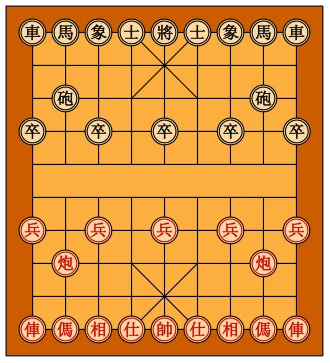
The game represents a battle between two armies, with the primary object being to checkmate the enemy's general (king). Distinctive features of xiangqi include the cannon (pao), which must jump to capture; a rule prohibiting the generals from facing each other directly; areas on the board called the river and palace, which restrict the movement of some pieces but enhance that of others; and the placement of the pieces on the intersections of the board lines, rather than within the squares.
Etymology
As 象; xiàng means "elephant"—the sense in which it is used as the name of one of the pieces in the game—and 棋; qí is a word for "chess" or "board game" which also appears in the names of games such as weiqi and fangqi, the name xiangqi is generally interpreted literally as "elephant chess."
However, the character 象; xiàng, besides "elephant," may mean "ivory," a "figure" or "representation" (such as might be carved from ivory), or a "celestial phenomenon" or "apparition." H. J. R. Murray therefore offers "the Elephant Game," "the Ivory Game," "the Astronomical Game," and "the Figure Game" as possible interpretations of the name, and holds "the Figure Game" to probably be the true meaning, arguing that although the game is now played with pieces distinguished by the inscription of their names and not with figures like Indian or Persian chess, it was played with figures at an earlier stage in its history, and this name would reflect one of the game's most distinctive features.
Board
Xiangqi is played on a board nine lines wide and ten lines long. As in the game Go (围棋; or Wéi qí 圍棋), the pieces are placed on the intersections, which are known as points.
The vertical lines are known as files (Chinese: 路; pinyin: lù; lit. 'road'), and the horizontal lines are known as ranks (Chinese: 線/綫; pinyin: xiàn; lit. 'line').
The board historically has usually consisted of a lined sheet of paper, often disposed of after being used once, but wooden or plastic boards are common as well.
Centred at the first to third and eighth to tenth ranks of the board are two zones, each three points by three points, demarcated by two diagonal lines connecting opposite corners and intersecting at the centre point. Each of these areas is known as 宮 ⓘ, a palace.
Dividing the two opposing sides, between the fifth and sixth ranks, is 河 hé, the "river". The river is usually marked with the phrases 楚河 ⓘ, meaning "River of the Chu", and 漢界 ⓘ, meaning "Border of the Han", a reference to the Chu–Han War.
Although the river (or Hanchu boundary) provides a visual division between the two sides, only two pieces are affected by its presence: soldiers have an enhanced move after crossing the river, and elephants cannot cross it. The starting points of the soldiers and cannons are usually, but not always, marked with small crosses.
Pieces
Each player controls an army of 16 pieces. Pieces are flat circular disks labelled or engraved with a Chinese character identifying the piece type. Even in mainland China, most sets still use traditional Chinese characters (as opposed to simplified Chinese characters). Modern pieces are usually plastic, but pieces may be made of wood, various sorts of horn, bone, or ivory, and more expensive sets may use jade.
The pieces of the opposing sides are distinguished by the colours of the ink in which their names are written on them, which are usually red and black, but may be any two of blue, red, green, black, or white. Some books refer to the two sides as north and south; which direction corresponds to which colour varies from source to source.
The sides may also be distinguished by the use of two different characters for each piece according to which side it belongs to; Charles F. Wilkes remarks that "it apparently doesn't matter which choice of alternative characters are used together on a side." This practice may have originated in situations where there was only one material available to make the pieces from and no colouring material available to distinguish the opposing armies; in more ancient times, many sets were simple unpainted woodcarvings. The oldest xiangqi piece found to date is a 俥 (chariot) piece. It is kept in the Three Gorges Museum.
General
Generals (or kings) are labelled 將 (trad.) / 将 (simp.) ⓘ ("general") on the black side and 帥 (trad.) / 帅 (simp.) ⓘ ("marshal") on the red side.
The general starts the game at the midpoint of the back edge, within the palace. The general may move and capture one point orthogonally and may not leave the palace, with the following exception.
If the two generals face each other along the same file with no intervening pieces, the 飛將 ("flying general") move may be executed, in which the general to move crosses the board to capture the enemy general. In practice, this rule means that creating this situation in the first place means moving into check, and is therefore not allowed.
The Indian name king for this piece was changed to general because of Chinese naming taboos; China's rulers objected to their royal titles being given to game pieces.[dubious – discuss] Despite this, the general is sometimes called the "king" by English-speaking players, due to their similar functions as royal pieces.
Advisor
Advisors (also known as guards and less commonly as assistants, mandarins, ministers or warriors) are labelled 士 ⓘ ("scholar", "gentleman", "officer", "guardian") for Black and 仕 ⓘ ("scholar", "official", "guardian") for Red. Rarely, sets use the character 士 for both colours.
The two advisors start on each side of the general. They move and capture one point diagonally and may not leave the palace, which confines them to five points on the board. The advisor is probably derived from the mantri in chaturanga, as is the queen in Western chess.
There is some controversy about whether "士" really is intended to mean "scholar", "gentleman" which would be "士人", or "guard", "guardian" which would be "衛士" (simplified Chinese: 卫士). One argument for the latter is that their functionality seems to be to guard/protect the general. The common Western translation "advisor" does not reflect this layer of meaning.
Elephant
Elephants (or bishops) are labeled 象 xiàng ("elephant") for Black and 相 xiàng ("minister") for Red. They are located next to the advisors. These pieces move and capture exactly two points diagonally and may not jump over intervening pieces; the move is described as being like the character 田 Tián ("field"), in reference to the board's squares. Blocking an elephant with a diagonally adjacent piece is known as "blocking the elephant's eye" (塞象眼).
Elephants may not cross the river to attack the enemy general, and serve as defensive pieces. Because an elephant's movement is restricted to just seven board positions, it can be easily trapped or threatened. The two elephants are often used to defend each other.
The Chinese characters for "minister" and "elephant" are homophones in Mandarin (ⓘ) and both have alternative meanings as "appearance" or "image". However, in English, both are referred to as elephants, and less commonly as "bishops", due to their similar movements.
Horse
Horses (or knights) are labelled 馬 ⓘ for Black and 傌 mǎ for Red in sets marked with Traditional Chinese characters and 马 mǎ for both Black and Red in sets marked with Simplified Chinese characters.
Some sets use 馬 for both colours. Horses begin the game next to the elephants, on their outside flanks. A horse moves and captures one point orthogonally and then one point diagonally away from its former position, a move which is traditionally described as being like the character 日 Rì. The horse does not jump as the knight does in Western chess, and can be blocked by a piece of either colour located one point horizontally or vertically adjacent to it.
Blocking a horse is called "hobbling the horse's leg" (蹩馬腿). The diagram on the right illustrates the horse's movement.
Since horses can be blocked, and the path of a horse from one point to another is not the same as the reverse move, it is possible for one player's horse to have an asymmetric attack advantage if an opponent's horse is blocked, as seen in the diagram on the right.
The horse is sometimes called the "knight" by English-speaking players, due to their similar movements.
Chariot
Chariots (or rooks or cars) are labelled 車 ⓘ for Black and 俥 ⓘ for Red in sets marked with Traditional Chinese characters and 车 for both Black and Red in sets marked with Simplified Chinese characters.
Some traditional sets use 車 for both colours. In the context of xiangqi, all of these characters are pronounced as ⓘ (instead of the common pronunciation chē).
The chariot moves and captures any distance orthogonally, but may not jump over intervening pieces. The chariots begin the game on the points at the corners of the board. The chariot is often considered to be the strongest piece in the game due to its freedom of movement and lack of restrictions.
The chariot is sometimes called the "rook" by English-speaking players, since it moves identically to the rook in Western chess. Chinese players (and others) often call this piece a car, since that is one modern meaning of the character 車.
Cannon
Cannons are labelled 砲 ⓘ ("catapult") for Black and 炮 pào ("cannon") for Red. The names are homophones, though sometimes 炮 is used for both Red and Black. The 石 shí radical of 砲 means "stone", and the 火 huǒ radical of 炮 means "fire". Both colours' pieces are normally referred to as cannons in English. The black piece is sometimes labelled 包 bāo.
Each player has two cannons, which start on the row behind the soldiers, two points in front of the horses. Cannons move like chariots, any distance orthogonally without jumping, but can only capture by jumping a single piece of either colour along the path of attack. The piece over which the cannon jumps is called the 炮臺 (trad.) / 炮台 (simp.) pào tái ("cannon platform" or "screen").
Any number of unoccupied spaces, including none, may exist between the cannon, screen, and the piece to be captured. Cannons can be exchanged for horses immediately from their starting positions.