















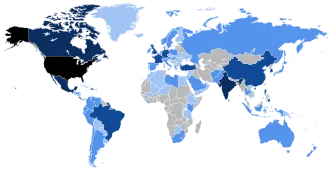
The majority of Americans trace their roots to immigrants who arrived in what is now the United States, starting with European colonization in the 16th century. This includes European American groups such as the English, Irish, Germans, Italians, and others, as well as Africans forcibly brought as slaves during the Atlantic slave trade.
However, the Native American population, whose ancestors inhabited the continent for thousands of years before European contact, are a key exception.
Despite its multi-ethnic composition, the culture of the United States held in common by most Americans can also be referred to as mainstream American culture—a Western culture largely derived from the traditions of Northern and Western European colonists, settlers, and immigrants. It also includes significant influences of African-American culture.
Westward expansion integrated the French-speaking Creoles and Cajuns of Louisiana and the Hispanos of the American Southwest, who brought close contact with the culture of Mexico. Large-scale immigration in the late 19th and early 20th centuries from Eastern and Southern Europe introduced a variety of new customs. Immigration from Africa, Asia, and Latin America has also had impact.
A cultural melting pot, or pluralistic salad bowl, describes the way in which generations of Americans have celebrated and exchanged distinctive cultural characteristics.
History
The original Indigenous population came to what is now the United States from Siberia via the Bering Strait. For thousands of years prior to European colonization, Native American tribes had been established in what is now the United States. Estimates for their pre-contact population, range from 3 million to 12 million, living in over 600 distinct societies.
Indigenous languages and cultures differed by region. European colonization of what is now the United States began in the 16th century after the Spanish conquest of Mexico, with the failed Spanish Narváez expedition in the southwestern territories in 1527. The next to arrive in North America were the French, followed by the Dutch and finally the British who each settled in different parts of North America.
Early interactions between European settlers and Indigenous peoples were often amicable; however by the 1630s, as the number of settlers grew as well as increased self-sufficiency, colonists encroached further upon Indigenous lands and imposed Christianity and their culture upon Native peoples. The impact of the European colonization was catastrophic on the Native population, as they introduced diseases, such as smallpox, syphilis, and influenza, that decimated many Native American populations.[better source needed]
Racial and ethnic groups
The United States is a diverse country, both racially and ethnically. Six races are officially recognized by the United States Census Bureau for statistical purposes: Alaska Native and American Indian, Asian, Black or African American, Native Hawaiian and Other Pacific Islander, White, and people of two or more races. "Some other race" is also an option in the census and other surveys.
The United States Census Bureau also classifies Americans as "Hispanic or Latino" and "Not Hispanic or Latino", which identifies Hispanic and Latino Americans as a racially diverse ethnicity that comprises the largest minority group in the nation.
White and European Americans
White Americans constitute the majority of the 331 million people living in the United States, with 204,277,273 people or 61.6% of the population in the 2020 United States census. The US census defines "white" as "[a] person having origins in any of the original peoples of Europe, the Middle East, or North Africa".
Non-Hispanic whites, which only account for 57.8% of the population, or 191,697,647 people, are the majority in 44 states. There are six minority-majority states: California, Texas, Maryland, New Mexico, Nevada, and Hawaii. In addition, the District of Columbia and the five inhabited U.S. territories have a non-white majority.
The state with the highest percentage of non-Hispanic white Americans is Maine, while the state with the lowest percentage is Hawaii.
Europe is the largest continent that Americans trace their ancestry to, and many claim descent from various European ethnic groups.
The Spaniards were among the first Europeans to establish a continuous presence in what is now the continental United States in 1565 in San Agustín, La Florida then a part of New Spain. Virginia Dare (b. 1587) in Roanoke Island in present-day North Carolina, was the first child born in the original Thirteen Colonies to English parents.
The Spaniards also established a continuous presence in what over three centuries later would become a possession of the United States with the founding of the city of San Juan, Puerto Rico, in 1521.
Jewish Americans trace their ancestry primarily to Central and Eastern Europe, with smaller numbers from the Middle East and North Africa. Large numbers of Jewish immigrants arrived in the United States during the late 19th and early 20th centuries, fleeing persecution in the Russian Empire and other parts of Eastern Europe. They arrived in cities such as New York City, Chicago, and Philadelphia.
In the 2020 United States census, English Americans 46.5 million (19.8%), German Americans 45m (19.1%), Irish Americans 38.6m (16.4%), and Italian Americans 16.8m (7.1%) were the four largest self-reported European ancestry groups in the United States constituting 62.4% of the white American population. However, the English Americans and British Americans demography is considered a serious under-count as they tend to self-report and identify as simply "Americans" (since the introduction of a new "American" category in the 1990 census) due to the length of time they have inhabited America.
This is highly over-represented in the Upland South, a region that was settled historically by the British.
Overall, as the largest group, European Americans have the lowest poverty rate and the second highest educational attainment levels, median household income, and median personal income of any racial demographic in the nation, second only to Asian Americans in the latter three categories.
Hispanic and Latino Americans
Hispanic and Latino Americans constitute the largest ethnic minority in the United States. They form the second-largest group in the United States, comprising 62,080,044 people or 18.7% of the population according to the 2020 United States census.
Hispanic and Latino Americans are not considered a race in the United States census, instead forming an ethnic category.
People of Spanish or Hispanic and Latino descent have lived in what is now United States territory since the founding of San Juan, Puerto Rico (the oldest continuously inhabited settlement on American soil) in 1521 by Juan Ponce de León, and the founding of St. Augustine, Florida (the oldest continuously inhabited settlement in the continental United States) in 1565 by Pedro Menéndez de Avilés.
In the State of Texas, Spaniards first settled the region in the late 1600s and formed a unique cultural group known as Tejanos.
Black and African Americans
Black and African Americans are citizens and residents of the United States with origins in sub-Saharan Africa. According to the Office of Management and Budget, the grouping includes individuals who self-identify as African American, as well as persons who emigrated from nations in the Caribbean and sub-Saharan Africa.
The grouping is thus based on geography, and may contradict or misrepresent an individual's self-identification since not all immigrants from sub-Saharan Africa are "Black". Among these racial outliers are persons from Cape Verde, Madagascar, various Arab states, and Hamito-Semitic populations in East Africa and the Sahel, and the Afrikaners of Southern Africa.
African Americans (also referred to as Black Americans or Afro-Americans, and formerly as American Negroes) are citizens or residents of the United States who have origins in any of the black populations of Africa. According to the 2020 United States census, there were 39,940,338 black and African Americans in the United States, representing 12.4% of the population.
Black and African Americans make up the third-largest group in the United States, after white and European Americans, and Hispanic and Latino Americans. The majority of the population (55%) lives in the South; compared to the 2000 United States census, there has also been a decrease of African Americans in the Northeast and Midwest.
Most African Americans are the direct descendants of captives from Central and West Africa, from ancestral populations in countries like Nigeria, Benin, Sierra Leone, Guinea-Bissau, Senegal, and Angola, who survived the slavery era within the boundaries of the present United States. As an adjective, the term is usually spelled African-American.
Montinaro et al. (2014) observed that around 50% of the overall ancestry of African Americans traces back to the Niger-Congo-speaking Yoruba of southwestern Nigeria and southern Benin (before the European colonization of Africa this people created the Oyo Empire), reflecting the centrality of this West African region in the Atlantic slave trade.
Zakharaia et al. (2009) found a similar proportion of Yoruba associated ancestry in their African American samples, with a minority also drawn from Mandinka populations (founders of the Mali Empire), and Bantu populations (who had a varying level of social organization during the colonial era, while some Bantu peoples were still tribal, other Bantu peoples had founded kingdoms such as the Kingdom of Kongo).
The first West African slaves were brought to Jamestown, Virginia in 1619. The English settlers treated these captives as indentured servants and released them after a number of years. This practice was gradually replaced by the system of race-based slavery used in the Caribbean. All the American colonies had slavery, but it was usually the form of personal servants in the North (where 2% of the people were slaves), and field hands in plantations in the South (where 25% were slaves); by the beginning of the American Revolutionary War 1/5th of the total population was enslaved.
During the revolution, some would serve in the Continental Army or Continental Navy, while others would serve the British Empire in the Ethiopian Regiment, and other units. By 1804, the northern states (north of the Mason–Dixon line) had abolished slavery. However, slavery would persist in the southern states until the end of the American Civil War and the passage of the Thirteenth Amendment.
Following the end of the Reconstruction era, which saw the first African American representation in Congress, African Americans became disenfranchised and subject to Jim Crow laws, legislation that would persist until the passage of the Civil Rights Act of 1964 and Voting Rights Act due to the civil rights movement.
According to United States Census Bureau data, very few African immigrants self-identify as African American. On average, less than 5% of African residents self-reported as "African American" or "Afro-American" on the 2000 U.S. census. The overwhelming majority of African immigrants (~95%) identified instead with their own respective ethnicities.
Self-designation as "African American" or "Afro-American" was highest among individuals from West Africa (4%–9%), and lowest among individuals from Cape Verde, East Africa and Southern Africa (0%–4%). African immigrants may also experience conflict with African Americans.
Asian Americans
Another significant population is the Asian American population, comprising 19,618,719 people in 2020, or 5.9% of the United States population. California is home to 5.6 million Asian Americans, the greatest number in any state. In Hawaii, Asian Americans make up the highest proportion of the population (57 percent). Asian Americans live across the country, yet are heavily urbanized, with significant populations in the Greater Los Angeles Area, New York metropolitan area, and the San Francisco Bay Area.
The United States census defines Asian Americans as those with origins to the countries of Central Asia, East Asia, South Asia, and Southeast Asia. Although Americans with roots in West Asia were once classified as "Asian", they are now excluded from the term in modern census classifications. The largest sub-groups are immigrants or descendants of immigrants from Cambodia, mainland China, India, Japan, Korea, Laos, Pakistan, the Philippines, Taiwan, Thailand, and Vietnam.
Asians overall have higher income levels than all other racial groups in the United States, including whites, and the trend appears to be increasing in relation to those groups. Additionally, Asians have a higher education attainment level than all other racial groups in the United States. For better or for worse, the group has been called a model minority.
While Asian Americans have been in what is now the United States since before the Revolutionary War, relatively large waves of Chinese, Filipino, and Japanese immigration did not begin until the mid-to-late 19th century. Immigration and significant population growth continue to this day. Due to a number of factors, Asian Americans have been stereotyped as "perpetual foreigners".
Middle Eastern and North African Americans
Middle Eastern Americans and North African Americans are Americans with ancestry from the Middle East and North Africa (MENA). According to the American Jewish Archives and the Arab American National Museum, the first Middle Easterners and North Africans (especially Jews) to arrive in the Americas landed in the late 15th to mid-16th centuries. Many fled ethnic or ethnoreligious persecution during the Spanish Inquisition.
In 2014, the United States Census Bureau began finalizing the ethnic classification of people of Middle Eastern and North African ("MENA") origins. According to the Arab American Institute (AAI), Arab Americans have family origins in each of the 22 Arab League member states. Following consultations with MENA organizations, the Census Bureau announced in 2014 that it would establish a new MENA ethnic category for populations from the Middle East, North Africa, and the Arab world, separate from the "white" classification that these populations had previously sought in 1909.
The groups felt that the earlier "white" designation no longer accurately represents MENA identity, so they successfully lobbied for a distinct categorization. This new category would also include Israeli Americans. The Census Bureau does not currently ask about whether one is Sikh, because it views them as followers of a religion rather than members of an ethnic group, and it does not combine questions concerning religion with race or ethnicity.
As of December 2015, the sampling strata for the new MENA category includes the Census Bureau's working classification of 19 MENA groups, as well as Iranian, Turkish, Armenian, Afghan, Azerbaijani, and Georgian groups. In January 2018, it was announced that the Census Bureau would not include the grouping in the 2020 census.
Native Americans and Alaska Natives
According to the 2020 United States census, there are 2,251,699 people who are Native Americans or Alaska Natives alone; they make up 0.7% of the total population. According to the Office of Management and Budget (OMB), an "American Indian or Alaska Native" is a person whose ancestry have origins in any of the original peoples of North, Central, or South America. 2.3 million individuals who are American Indian or Alaskan Native are multiracial; additionally the plurality of American Indians reside in the Western United States (40.7%).
Collectively and historically this race has been known by several names; as of 1995, 50% of those who fall within the OMB definition prefer the term "American Indian", 37% prefer "Native American" and the remainder have no preference or prefer a different term altogether.
Among Americans today, levels of Native American ancestry (distinct from Native American identity) differ. Based on a sample of users of the 23andMe commercial genetic test, genomes of self-reported African Americans averaged to 0.8% Native American ancestry, those of European Americans averaged to 0.18%, and those of Latinos averaged to 18.0%.
Another genetic study focusing on Native American ancestry in the general population found an average of 38% in Latinos, 1% in African Americans, and 0.1% for European American populations, respectively.