















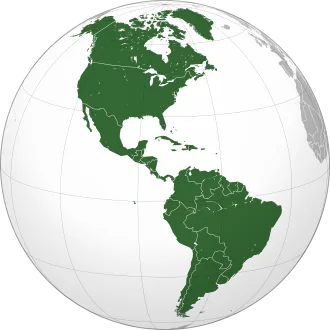
Along with their associated islands, the Americas cover 8% of Earth's total surface area and 28.4% of its land area. The topography is dominated by the American Cordillera, a long chain of mountains that runs the length of the west coast. The flatter eastern side of the Americas is dominated by large river basins, such as the Amazon, St.
Lawrence River–Great Lakes, Mississippi, and La Plata basins. Since the Americas extend 14,000 km (8,700 mi) from north to south, the climate and ecology vary widely, from the arctic tundra of Northern Canada, Greenland, and Alaska, to the tropical rainforests in Central America and South America.
Humans first settled the Americas from Asia between 20,000 and 16,000 years ago. A second migration of Na-Dene speakers followed later from Asia. The subsequent migration of the Inuit into the neoarctic c. 3500 BCE completed what is generally regarded as the settlement by the Indigenous peoples of the Americas.
The Norse colonization of North America saw several settlements established in Greenland, and perhaps on the mainland, however, these were later abandoned. The Spanish voyages of Christopher Columbus from 1492 to 1504 resulted in permanent contact with European (and subsequently, other Old World) powers, which eventually led to the Columbian exchange and inaugurated a period of exploration, conquest, and colonization whose effects and consequences persist to the present.
The Spanish presence involved the enslavement of large numbers of the indigenous population of the Americas. Diseases introduced from Europe and West Africa devastated the indigenous peoples, and the European powers colonized the Americas. Mass emigration from Europe, including large numbers of indentured servants, and importation of African slaves largely replaced the indigenous peoples in much of the Americas.
Decolonization of the Americas began with the American Revolution in the 1770s and largely ended with the Spanish–American War in the late 1890s. Currently, almost all of the population of the Americas resides in independent countries; however, the legacy of the colonization and settlement by Europeans is that the Americas share many common cultural traits, most notably Christianity and the use of West European languages: primarily Spanish, English, Portuguese, French, and, to a lesser extent, Dutch.
The Americas are home to more than a billion inhabitants, two-thirds of whom reside in the United States, Brazil, and Mexico. It is home to eight megacities (metropolitan areas with 10 million inhabitants or more): Greater Mexico City (21.2 million), São Paulo (21.2 million), New York City (19.7 million), Los Angeles (18.8 million), Buenos Aires (15.6 million), Rio de Janeiro (13.0 million), Bogotá (10.4 million), and Lima (10.1 million).
Etymology and naming
The name "America" was first recorded in 1507. A world map created by Martin Waldseemüller was the earliest recorded use of the term. The name was also used (together with the related term Amerigen) in the Cosmographiae Introductio, apparently written by Matthias Ringmann, in reference to South America. It was applied to both North and South America by Gerardus Mercator in 1538.
It is generally accepted that he derived the "America" nomenclature from the name of Amerigo Vespucci, an Italian explorer, who explored the two continents. However, Bristol antiquarian Alfred Hudd suggested in 1908 that the name was derived from the surname "Amerike" or "ap Meryk" and was used on early British maps that have since been lost.
Richard ap Meryk, anglicised to Richard Amerike, was a wealthy Anglo-Welsh merchant, royal customs officer and sheriff of Bristol. According to some writers, he was the principal owner of the Matthew, the ship sailed by John Cabot during his voyage of exploration to North America in 1497. The idea that Richard Amerike was a 'principal supporter' of Cabot has gained popular currency in the 21st century.
There is no evidence to support this. Similarly, and contrary to a recent tradition that names Amerike as principal owner and main funder of the Matthew, Cabot's ship of 1497, academic enquiry does not connect Amerike with the ship. Her ownership at that date remains uncertain. Macdonald asserts that the caravel was specifically built for the Atlantic crossing.
The feminine form America was originally used to refer to the newly discovered continent, which is why it was accorded with the feminine names of the other continents: Asia, Africa, and Europa.
Since the 1950s, however, North America and South America have generally been considered by English speakers as separate continents, and taken together are called the Americas, or more rarely America. When conceived as a unitary continent, the form is generally the continent of America in the singular. However, without a clarifying context, singular America in English commonly refers to the United States of America.
Terminology
History
The region was initially termed America or New India on the Mercator maps.
English
Speakers of English generally refer to the landmasses of North America and South America as the Americas, the Western Hemisphere, or the New World. The adjective American may be used to indicate something pertaining to the Americas, but this term is primarily used in English to indicate something pertaining to the United States.
Some non-ambiguous alternatives exist, such as the adjective Pan-American, or New Worlder as a demonym for a resident of the closely related New World. Use of America in the hemispherical sense is sometimes retained, or can occur when translated from other languages. For example, the Association of National Olympic Committees (ANOC) in Paris maintains a single continental association for "America", represented by one of the five Olympic rings.
American essayist H. L. Mencken said, "The Latin-Americans use Norteamericano in formal writing, but, save in Panama, prefer nicknames in colloquial speech." To avoid "American" one can use constructed terms in their languages derived from "United States" or even "North America". In Canada, its southern neighbor is often referred to as "the United States", "the U.S.A.", or (informally) "the States", while U.S. citizens are generally referred to as "Americans". Most Canadians resent being referred to as "Americans".
Spanish
In Spanish, América is a single continent composed of the subcontinents of América del Sur and América del Norte, the land bridge of América Central, and the islands of the Antillas. Americano or americana in Spanish refers to a person from América in a similar way that in which europeo or europea refers to a person from Europa. The terms sudamericano/a, centroamericano/a, antillano/a and norteamericano/a can be used to more specifically refer to the location where a person may live.
Citizens of the United States of America are normally referred to by the terms estadounidense and estadunidense(rough literal translation: "United Statesian") instead of americano or americana which is discouraged, and the country's name itself is officially translated as Estados Unidos de América (United States of America), commonly abbreviated as Estados Unidos (EE.
UU.). Also, the term norteamericano (North American) may refer to a citizen of the United States, though in formal writing it is less common since it is used for the inhabitants of North America.
Portuguese
In Portuguese, América is a single continent composed of América do Sul (South America), América Central (Central America) and América do Norte (North America). It can be ambiguous, as América can be used to refer to the United States of America, but is avoided in print and formal environments.
The demonym 'American' (americano) is commonly used in Portuguese to refer to people from the United States, although the terms 'norte-americano', 'estadounidense' or 'estadunidense' also formally exist and are preferred by those who wish to distinguish it from the continental demonym.
French
In French, the word américain may be used for things relating to the Americas; however, similar to English, it is most often used for things relating to the United States, with the term états-unien sometimes used for clarity. Panaméricain may be used as an adjective to refer to the Americas without ambiguity.
French speakers may use the noun Amérique to refer to the whole landmass as one continent, or two continents, Amérique du Nord and Amérique du Sud. In French, Amérique is seldom used to refer to the United States, leading to some ambiguity when it is. Similar to English usage, les Amériques or des Amériques is used to refer unambiguously to the Americas.
Dutch
In Dutch, the word Amerika mostly refers to the United States. Although the United States is equally often referred to as de Verenigde Staten ("the United States") or de VS ("the US"), Amerika relatively rarely refers to the Americas, but it is the only commonly used Dutch word for the Americas.
This often leads to ambiguity; and to stress that something concerns the Americas as a whole, Dutch uses a combination, namely Noord- en Zuid-Amerika (North and South America).
Latin America and Central America are generally referred to as Latijns Amerika and Midden-Amerika respectively.
The adjective Amerikaans is most often used for things or people relating to the United States. There are no alternative words to distinguish between things relating to the United States or to the Americas. Dutch uses the local alternative for things relating to elsewhere in the Americas, such as Argentijns for Argentine, etc.
History
Pre-Columbian era
The pre-Columbian era incorporates all period subdivisions in the history and prehistory of the Americas before the appearance of significant European influences on the American continents, spanning the time of the original settlement in the Upper Paleolithic to European colonization during the Early Modern period. The term Pre-Columbian is used especially often in the context of the great indigenous civilizations of the Americas, such as those of Mesoamerica (Olmec, Toltec, Teotihuacano, Zapotec, Mixtec, Aztec, Maya) and the Andean civilizations (Inca, Moche, Chavín, Muisca, Cañari).
Many pre-Columbian civilizations established characteristics and hallmarks which included permanent or urban settlements, agriculture, civic and monumental architecture, and complex societal hierarchies. Some of these civilizations had long faded by the time of the first permanent European arrivals (c. late 15th–early 16th centuries), and are known only through archeological investigations.
Others were contemporary with this period, and are also known from historical accounts of the time. A few, such as the Maya, had their own written records. However, most Europeans of the time viewed such texts as pagan, and much was destroyed in Christian pyres. Only a few hidden documents remain today, leaving modern historians with glimpses of ancient culture and knowledge.
Settlement
The first inhabitants migrated into the Americas from Asia. Habitation sites are known in Alaska and Yukon from at least 20,000 years ago, with suggested ages of up to 40,000 years. Beyond that, the specifics of the Paleo-Indian migration to and throughout the Americas, including the dates and routes traveled, are subject to ongoing research and discussion.
Widespread habitation of the Americas occurred after the Late Glacial Maximum, from 16,000 to 13,000 years ago.
The traditional theory has been that these early migrants moved into the Beringia land bridge between eastern Siberia and present-day Alaska about 40,000–17,000 years ago, when sea levels were significantly lowered during the Quaternary glaciation. These people are believed to have followed herds of now-extinct pleistocene megafauna along ice-free corridors that stretched between the Laurentide and Cordilleran ice sheets.
Another route proposed is that, either on foot or using primitive boats, they migrated down the Pacific coast to South America. Evidence of the latter would since have been covered by a sea level rise of hundreds of meters following the last ice age. Both routes may have been taken, although the genetic evidences suggests a single founding population.
The micro-satellite diversity and distributions specific to South American Indigenous peoples indicates that certain populations have been isolated since the initial colonization of the region.
A second migration occurred after the initial peopling of the Americas; Na Dene speakers, found predominantly in North American groups at varying genetic rates, with the highest frequency found among the Athabaskans at 42%, derive from this second wave. Linguists and biologists have reached a similar conclusion based on analysis of Amerindian language groups and ABO blood group system distributions.
Then the people of the Arctic small tool tradition, a broad cultural entity that developed along the Alaska Peninsula, around Bristol Bay, and on the eastern shores of the Bering Strait c. 2500 BCE, moved into North America. The Arctic small tool tradition, a Paleo-Eskimo culture, branched off into two cultural variants, including the Pre-Dorset and the Independence traditions of Greenland.
The descendants of the Pre-Dorset cultural group, the Dorset culture, were displaced by the final migrants from the Bering sea coast line, the Thule people (the ancestors of modern Inuit), by 1000 CE.
Norse colonization
Around the same time as the Inuit migrated into Greenland, Viking settlers began arriving in Greenland in 982 and Vinland shortly thereafter, establishing a settlement at L'Anse aux Meadows, near the northernmost tip of Newfoundland. Contact between the Norse colonies and Europe was maintained, as James Watson Curran states:
From 985 to 1410, Greenland was in touch with the world. Then silence. In 1492 the Vatican noted that no news of that country "at the end of the world" had been received for 80 years, and the bishopric of the colony was offered to a certain ecclesiastic if he would go and "restore Christianity" there. He didn't go.
Large-scale European colonization
Although there had been previous trans-oceanic contact, large-scale European colonization of the Americas began with the first voyage of Christopher Columbus in 1492. The first Spanish settlement in the Americas was La Isabela in northern Hispaniola. This town was abandoned shortly after in favor of Santo Domingo de Guzmán, founded in 1496, the oldest American city of European foundation.
This was the base from which the Spanish monarchy administered its new colonies and their expansion. Santo Domingo was subject to frequent raids by English and French pirates.
On the continent, Panama City on the Pacific coast of Central America, founded on August 15, 1519, played an important role, being the base for the Spanish conquest of South America. Conquistador Lucas Vázquez de Ayllón established San Miguel de Guadalupe, the first European settlement in what is now the United States, on the Pee Dee River in South Carolina.
During the first half of the 16th century, Spanish colonists conducted raids throughout the Caribbean Basin, bringing captives from Central America, northern South America, and Florida back to Hispaniola and other Spanish settlements.
France, led by Jacques Cartier and Giovanni da Verrazzano, focused primarily on North America. English explorations of the Americas were led by Giovanni Caboto and Sir Walter Raleigh. The Dutch in New Netherland confined their operations to Manhattan Island, Long Island, the Hudson River Valley, and what later became New Jersey.
The spread of new diseases brought by Europeans and African slaves killed many of the inhabitants of North America and South America, with a general population crash of Native Americans occurring in the mid-16th century, often well ahead of European contact. One of the most devastating diseases was smallpox.
European immigrants were often part of state-sponsored attempts to found colonies in the Americas. Migration continued as people moved to the Americas fleeing religious persecution or seeking economic opportunities. Millions of individuals were forcibly transported to the Americas as slaves, prisoners or indentured servants.
Decolonization of the Americas began with the American Revolution and the Haitian Revolution in the late 1700s. This was followed by numerous Latin American wars of independence in the early 1800s. Between 1811 and 1825, Paraguay, Argentina, Chile, Gran Colombia, the United Provinces of Central America, Mexico, Brazil, Peru, and Bolivia gained independence from Spain and Portugal in armed revolutions.
After the Dominican Republic won independence from Haiti, it was re-annexed by Spain in 1861, but reclaimed its independence in 1865 at the conclusion of the Dominican Restoration War. The last violent episode of decolonization was the Cuban War of Independence which became the Spanish–American War, which resulted in the independence of Cuba in 1898, and the transfer of sovereignty over Puerto Rico from Spain to the United States.
Peaceful decolonization began with the United States's purchase of Louisiana from France in 1803, Florida from Spain in 1819, Alaska from Russia in 1867, and the Danish West Indies from Denmark in 1916. Canada became independent of the United Kingdom, starting with the Balfour Declaration of 1926 and the Statute of Westminster 1931 and ending with the patriation of the Canadian Constitution in 1982.
The Dominion of Newfoundland similarly achieved independence under the Balfour Declaration and Statute of Westminster, but relinquished self-rule in 1934. It was subsequently confederated with Canada in 1949.
The remaining European colonies in the Caribbean began to achieve peaceful independence well after World War II. Jamaica and Trinidad and Tobago became independent in 1962, and Guyana and Barbados both achieved independence in 1966. In the 1970s, the Bahamas, Grenada, Dominica, St. Lucia, and St. Vincent and the Grenadines all became independent of the United Kingdom, and Suriname became independent of the Netherlands.
Belize, Antigua and Barbuda, and Saint Kitts and Nevis achieved independence from the United Kingdom in the 1980s.