Anthony Perkins
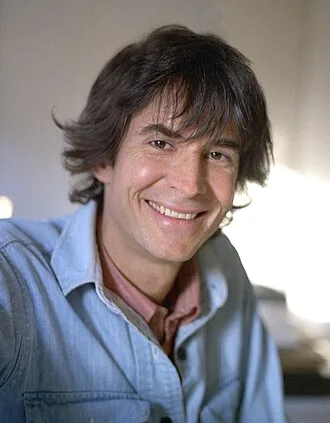
Perkins' first film role was in The Actress (1953). The next year, he debuted on Broadway in Tea and Sympathy, a performance for which he received critical acclaim. In 1956, he played his first major film role in Friendly Persuasion, which earned him a Golden Globe Award for Best New Actor of the Year and a nomination for the Academy Award for Best Supporting Actor.
Following the film's success, he signed a seven-year contract with Paramount Pictures, where he was regarded as the studio's last matinee idol. In 1957, he starred in Fear Strikes Out. During this period, Paramount promoted Perkins in romantic roles and he also embarked on a singing career. He also took on more dramatic roles, including the Broadway production of Look Homeward, Angel, for which he was nominated for a Tony Award, and the film On the Beach (1959).
Psycho, a horror thriller in which he was cast against type, then profoundly changed his image, after which Perkins moved to France and worked for several years in Europe. The first film he made there, Goodbye Again (1961), earned him a Cannes Film Festival Award for Best Actor and a David di Donatello for Best Actor.
His other European films include Orson Welles' The Trial (1962). He returned to American cinema with Pretty Poison (1968). Other films include Catch-22 (1970), for which he was nominated for a National Society of Film Critics Award for Best Supporting Actor (shared with his role in WUSA, also released in 1970), The Life and Times of Judge Roy Bean (1972), Murder on the Orient Express (1974), Mahogany (1975) and Crimes of Passion (1984).
In the later part of his career, Perkins often portrayed troubled, neurotic or mentally unstable characters. He reprised the role of Norman Bates in Psycho II (1983), Psycho III (1986), and Psycho IV: The Beginning (1990). His performance in Psycho III, which he also directed, earned him a nomination for the Saturn Award for Best Actor.
His final acting role was in the NBC television film In the Deep Woods, which aired a month after his death on September 12, 1992, from AIDS-related causes.
Early life
Early childhood: 1932–1937
Anthony Perkins was born on April 4, 1932, in Manhattan, New York City, the son of actor Osgood Perkins (1892–1937) and Janet Esselstyn (née Rane; 1894–1979). His paternal great-grandfather was the wood engraver Andrew Varick Stout Anthony. Throughout his early years, Perkins had limited contact with his father, who was occupied with acting roles.
The family employed a French nanny named Jeanne, which led to Perkins's fluency in French. In a 1983 interview with People magazine, he recalled, "I became abnormally close to my mother; whenever my father came home I was jealous. It was the Oedipal thing in a pronounced form, I loved him but I also wanted him to be dead so I could have her all to myself."
Osgood Perkins died of a heart attack on September 21, 1937. Following his father's death, Perkins experienced intense feelings of guilt. He later stated, "I was horrified. I assumed that my wanting him to be dead had actually killed him. I prayed and prayed for my father to come back. I remember long nights of crying in bed.
For years I nursed the hope that he wasn't really dead. Because I'd see him on film, it was as if he were still alive. He became a mythic being to me, to be dreaded and appeased."
After his father's death: 1937–1947
A consistent female companion in Perkins's life was aspiring playwright Michaela O'Harra, who developed a close relationship with his mother. According to accounts from those who knew the family, including childhood friend John Kerr, the bond between O'Harra and Perkins's mother was notably intimate. While the exact nature of their rapport has been subject to interpretation, it has been widely suggested they were in a lesbian relationship.
It was also during that time that Perkins's mother, according to his account, began to sexually abuse him. Perkins said, in a 1983 interview, "She was constantly touching me and caressing me. Not realising what effect she was having, she would touch me all over, even stroking the inside of my thighs right up to my crotch." The behavior continued into his adulthood.
In 1942, when Perkins was ten years old, his family moved to Boston. Through her connections in the theatre industry, his mother secured a position at the American Theatre Wing's Boston Stage Door Canteen, where she managed many of the canteen's operations. The job provided financial support for the two of them. When she was occupied with work, Perkins was often sent to stay with his grandmother.
During this period, Perkins began to struggle at the public school he attended. He was described as a "gifted drifter" and began exhibiting rebellious behaviour, which was attributed to his mother's neglect. In response, she enrolled him at Brooks School in North Andover, Massachusetts. The experience proved difficult: his childhood stutter reemerged, he avoided athletic activities, and his mother insisted he participate in baseball.
The pressure of the new environment led to extended school absences during his second year due to consecutive bouts of scarlet fever, and his academic performance declined.
Perkins eventually negotiated with his mother that if he improved his grades, he would be permitted to return to Boston for school the following year. He subsequently ranked in the top third of his class. His headmaster noted that Perkins was significantly more mature than his peers and lacked interest in many of their typical activities. Following this improvement, he was allowed to transfer back to Boston.
Summer stock: 1947–1950
As Perkins matured, the absence of his father became increasingly significant to him. According to his mother, as he observed other boys with their fathers, he began to feel the loss of his own more acutely. His connection to his late father developed through an interest in theatre. To support this interest, a family friend who operated a summer stock company agreed to allow Perkins to participate in minor roles, initiating his early involvement in summer stock theater.
Perkins's first experience was with the Brattleboro Summer Theater in Vermont, where he performed small parts in Junior Miss, Kiss and Tell, and George Washington Slept Here. In addition to acting, he worked in the box office, earning $25 per week and obtaining his Equity card. The following year, in keeping with an earlier promise, his mother enrolled him at Buckingham Browne & Nichols School, an all-boys school in Cambridge, Massachusetts.
There, he distinguished himself and gained a reputation as the class magician and pianist. He was known for his impersonations, including a popular imitation of actor Roddy McDowall, which he frequently performed between classes.
In 1948, Perkins returned to summer stock theatre, this time at the Robin Hood Theatre in Arden, Delaware, where his mother had secured a position as a manager. He again ran the box office and took on stage roles. His most notable performance that summer was in Sarah Simple. During this time he met Charles Williamson, the first boy to whom he was attracted romantically.
The following academic year, Perkins joined the varsity tennis team and the glee club at school. He also became co-literary editor of the school newspaper, The Spectator, to which he occasionally contributed articles. Around this period, Perkins began to question his sexuality.
College: 1950–1953
After Perkins graduated from high school in 1950, he enrolled at Rollins College in Winter Park, Florida, having been persuaded to attend after a college representative visited his school.
That summer, Perkins returned to the Robin Hood Theatre in Delaware, which had by then become a prominent summer stock venue. While working there, he reconnected with Charles Williamson. They spent time together during breaks, including having lunch and swimming. Perkins developed a romantic attraction to Williamson during this time, though the feelings were not expressed or acted upon.
During that summer, Perkins also played the role of Fred Whitmarsh in Years Ago, a part he would later reprise in its film adaptation.
At Rollins College that fall, Perkins struggled to find the same sense of community he had previously experienced. His arrival coincided with a period marked by heightened scrutiny and discrimination against gay individuals, later known as the Lavender Scare. There were a few supportive peers, including Fred Rogers, who would later become known as a children's television host; Rogers allowed Perkins to use his piano, which he appreciated.
Perkins participated in several stage productions and frequently changed fraternities, a pattern that frustrated his mother. During his time at Rollins, he reportedly began to explore his sexuality more openly. Not long after his arrival, a number of homosexual students—many of whom were his acquaintances—were expelled and arrested after a fellow student had beaten one of them.
According to Perkins's biographer Charles Winecoff, who interviewed former alumni, Perkins's association with a theater professor helped him avoid disciplinary action.
Despite avoiding expulsion, his association with those involved led to growing tension between him and other students, who knew of Perkins's sexuality. As a result of the increasingly hostile environment, Perkins transferred to Columbia University in New York City.
Career
1950s
Film and Broadway debut
While still a student at Rollins College, Perkins traveled to California during summer vacation in hopes of beginning a film career. Aware that Metro-Goldwyn-Mayer was producing a screen adaptation of Years Ago, he spent time around the studio lot, hoping to be noticed by a casting director and offered a screen test.
Perkins later recounted that he spent the summer running errands and delivering food for the studio guards. During a screen test for Margaret O'Brien, a director needed someone to appear in the background, and a studio worker suggested using Perkins. He was called in to stand in front of the camera, and when the director asked him to move, he responded, drawing attention to himself. This unplanned appearance led to his involvement in the screen test.
Later that summer, Perkins was cast in the role of Fred Whitmarsh in the film adaptation, retitled The Actress (1953), alongside Jean Simmons and Spencer Tracy. The film was directed by George Cukor, who had been collaborator and friend of Perkins's late father.
Perkins gained wider recognition in 1954 when he replaced John Kerr in the lead male role of Tea and Sympathy on Broadway, directed by Elia Kazan, another friend of his father. In the play, he portrayed Tom Lee, a college student perceived as homosexual who experiences personal growth through a romantic encounter with a woman.
It was one of the first major Broadway productions to depict homosexuality explicitly, and it attracted a significant gay audience. Perkins had auditioned for the play with the prospect of co-starring with Deborah Kerr, whom he idolized and who helped him relax during his reading. However, one disappointment was that shortly after he was cast, Kerr was replaced by Joan Fontaine with whom he had no chemistry.
Nevertheless, the role bore autobiographical parallels for Perkins, and he later described it as one of the most meaningful performances of his career.
Joan Fickett, who played opposite Perkins in the play, commented on his suitability for the role, noting the authenticity and emotional depth he brought to the character. The play's success and Perkins's performance drew renewed interest from Hollywood.
According to biographer Charles Winecoff, Perkins was drafted during the run of Tea and Sympathy, despite the Korean War having recently ended; he then informed the Selective Service that he was a "practicing homosexual" to be deemed unfit for military service. Having to reveal his orientation reportedly left Perkins deeply affected.
Serious roles
As Perkins's run in Tea and Sympathy concluded, director William Wyler dispatched his assistant, Stuart Millar, to scout talent on Broadway for the upcoming film Friendly Persuasion, which focused on a Quaker family during the American Civil War. Millar attended a performance of Tea and Sympathy and invited Perkins to audition for the role of Josh Birdwell, the family's eldest son.
According to Millar, Perkins was cast shortly after his audition. At the time, Perkins had been offered the lead role in Dancing in the Checkered Shade, a play by John Van Druten. In a 1956 interview, he stated, "My agents were split in their decisions. New York said I should stay and do the play. Hollywood said I should come out and do [Friendly Persuasion].
It was like flipping a coin. So I took the picture." He then traveled to Hollywood to begin filming alongside Dorothy McGuire and Gary Cooper, who played his on-screen parents. Eventually, Dancing in the Checkered Shade did not make it to Broadway, while Friendly Persuasion gave a decisive boost to Perkins's film career.
At the time, Perkins did not know how to drive and hitchhiked from his hotel, the Chateau Marmont, to the film set, a fact that was widely noted in fan magazines. His partner, Tab Hunter, later taught him how to drive. Perkins's lack of experience was noted by those on set, including actor Peter Mark Richman, who stated that Gary Cooper was supportive of both himself and Perkins.
Wyler reportedly praised Perkins's performance, and Cooper began to publicly support Perkins's acting career. The two appeared together on the July 1956 cover of Life magazine, in which Cooper spoke favorably of Perkins. Cooper's daughter, Maria Cooper Janis, later suggested that her father's support may have stemmed from both admiration for Perkins's talent and empathy for the challenges faced by closeted gay actors in Hollywood.
Friendly Persuasion was released to critical and commercial success. Perkins received the Golden Globe Award for Best New Actor and a nomination for the Academy Award for Best Supporting Actor.
Following positive feedback from early film footage, Paramount Pictures signed Perkins to a seven-year semi-exclusive contract, allowing him flexibility to continue stage work. He was their last matinee idol and was called the "fifteen million dollar gamble". His first film under the contract was the 1957 biographical drama Fear Strikes Out, about baseball player Jimmy Piersall.
The set was hostile and riddled with homophobia, which negatively affected Perkins during production. Nonetheless, his performance received critical acclaim, with The Hollywood Reporter noting: "Every recent young star has been compared to James Dean. From now on the standard is Tony Perkins."
Perkins subsequently appeared in the 1957 Western The Lonely Man, co-starring Jack Palance. Reportedly, the film set was riddled with tensions, particularly between Palance and Perkins, which was exacerbated by delays due to weather. Perkins's next Western was The Tin Star (1957), in which he starred alongside Henry Fonda.
Though producers Bill Perlberg and George Seaton reportedly expressed reluctance to cast him, Perkins auditioned and was selected. During production, Perkins and Fonda took the hours-long drive out to the set together in the same car, during which they became closely acquainted. The Tin Star grossed over $1 million and is now regarded as a classic of the genre.
Friend Gwen Davis remembered that at this point in his career, Perkins was "intellectually dazzling, physically beautiful. At twenty-four, he was already Dorian Gray." Costar Joan Fickett spoke similarly of Perkins: "Tony had a quality that was fantastic ... He was also a beautiful-looking young man." In 1958, Newsweek described Perkins as "possibly the most gifted dramatic actor in this country under 30".
Teen idol status
In 1956, while Perkins he was being groomed by Paramount as a teen idol, he demonstrated his singing ability by performing songs in the TV program Joey and in Friendly Persuasion. This led him to sign a contract with Epic Records. In 1957 and 1958, he released three pop music albums and several singles under the name Tony Perkins through Epic and RCA Victor.
His 1957 single "Moon-Light Swim" reached number 24 on the Billboard Hot 100. In 1958, "The Prettiest Girl in School" gained popularity in Australia but did not chart successfully in the United States. Perkins's musical pursuits were contemporaneous with the success of his then-partner Tab Hunter's debut single "Young Love", which topped the charts, and may have influenced Perkins's interest in music.
Perkins was insecure about his singing talent and later expressed disappointment about that aspect of his career, calling his voice "terrible" and his discography a "second rate art". He continued to record albums and EPs intermittently into the mid-1960s.
Although he was a life member of the Actors Studio, Perkins did not pursue roles in musical theatre. Instead, in 1957, he used the flexibility of his studio contract to return to Broadway in Look Homeward, Angel. Perkins played Eugene Gant, with Jo Van Fleet portraying his mother. The production ran successfully, and in 1958 Perkins was nominated for the Tony Award for Best Actor in a Play.
Reports from the production indicated tensions during rehearsals, particularly involving Van Fleet, whose behavior was described by some contemporaries as difficult. Among the audience during tryouts was Tab Hunter, who later recalled that Perkins initially gave a restrained performance, but showed significant growth later in the run.
Despite reported tensions during rehearsals for Look Homeward, Angel, the set was not without levity. Perkins's dressing room was located far from the stage, requiring him to move quickly between scenes to avoid missing cues. Cast members occasionally set up obstacles backstage as a practical joke to see if he could return in time.
According to accounts, Perkins consistently made his entrances. On the day of his final performance, the cast repeated the prank, and upon successfully navigating the obstacles, he was met with a sign reading "We love you, Tony!"
In 1958, Perkins co-starred with Silvana Mangano in This Angry Age, in which he was also reunited with Jo Van Fleet. That same year, he starred in Desire Under the Elms, alongside Sophia Loren in her first American screen kiss. In her 2014 memoir, Loren described Perkins as polite and gentle, yet visibly restless.
She recalled their on-set dynamic positively, noting mutual support during filming. However, critical reception of Perkins's performance was largely negative upon the film's release.
During this period, Perkins was offered a role in the 1959 film Some Like It Hot, which would later star Marilyn Monroe, Tony Curtis, and Jack Lemmon. Perkins was considered for the role of Shell Oil Junior. The film involved the lead characters disguising themselves in women's clothing. Paramount executives reportedly declined to allow Perkins to take the role, concerned about the implications of casting a gay actor in drag for an entire film. The role ultimately went to Curtis.
Instead, Paramount offered Perkins the lead in The Matchmaker (1958) opposite Shirley Booth, Shirley MacLaine, Paul Ford, and Robert Morse. The film included a scene in which Perkins and another male character disguise themselves as women to evade detection. To secure his participation, the studio offered Perkins a salary of $75,000 for ten weeks of work, significantly more than MacLaine's reported $25,000 for the same duration. Perkins raised concerns about the pay disparity, but no changes were made to MacLaine's compensation.
Though he defended MacLaine to studio executives, Perkins reportedly had a strained working relationship with her. MacLaine later reflected on the experience, commenting on his guarded demeanor and the difficulty in distinguishing between his public persona and authentic self.
Following the loss of the role in Some Like It Hot, Paramount cast Perkins opposite Audrey Hepburn in Green Mansions (1959), positioning the film as a means to promote his leading-man image. The studio emphasized his physicality, featuring scenes in which he appeared shirtless and engaged in physical combat.
Perkins also performed the film's title song, "Green Mansions", which briefly charted. Reflecting on the production later in life, Perkins described Hepburn as "wonderful to work with, like a real person, almost a sister".
Perkins next appeared in On the Beach (1959), which was filmed on location in Melbourne over a three-month period. This production was noted for its collaborative environment. Perkins reportedly maintained a positive working relationship with the cast, including assisting Fred Astaire, who was making his dramatic film debut.
In Tall Story (1960), Perkins played a college basketball player opposite Jane Fonda in her screen debut. To prepare for the role, he underwent basketball training. Perkins and Fonda shared a good professional rapport, aided in part by Perkins's previous work with her father Henry Fonda. According to Fonda, Perkins offered her advice on camera performance techniques, including how to position herself effectively within the frame.
She credited him with helping her understand how to act for the screen. Fonda later acknowledged both she and director Joshua Logan had developed feelings for Perkins, which led to complications during the production.
1960s
Troubles with Paramount
After signing with Paramount Pictures in 1955, Perkins was cast in a succession of leading roles intended to solidify his image as a romantic and masculine screen presence. By the time he had completed three films for the studio, Paramount had reportedly invested approximately $15 million in his career, prior to the release of any of the films. This significant investment contributed to growing tensions between Perkins and the studio.
Perkins, for his part, expressed dissatisfaction with the direction of his film career. While his contract allowed him to return to the Broadway stage, the majority of his fame stemmed from his film work, where Paramount consistently placed him in conventional leading-man roles. Perkins reportedly sought to be recognized as a serious character actor rather than a teen idol.
His resistance to being typecast, particularly in roles that emphasized traditional masculinity, resulted in the loss of certain opportunities, including the roles of Shell Oil Junior in Some Like It Hot and Tony in West Side Story.
Additional tension reportedly arose between Perkins and Paramount president Barney Balaban. According to multiple accounts, Balaban objected to Perkins's homosexuality and his relationship with actor Tab Hunter (who himself had no similar pressure from his studio, Warner Bros.). Perkins was allegedly pressured by the studio to end the relationship and was urged to undergo conversion therapy during his contract period.
One associate of Perkins recalled a conversation in which Perkins responded to the studio's demands by affirming his relationship with Hunter.
Sources suggest that Perkins resisted studio pressure until approximately 1959, during the period between filming Tall Story and Psycho. Around this time, efforts by studio executives to distance him from Hunter were reportedly successful. This separation is often cited as a contributing factor in Perkins's decision to buy out the remainder of his contract with Paramount, following a similar move previously made by Hunter at Warner Bros.
📚 Source: Wikipedia