David Attenborough
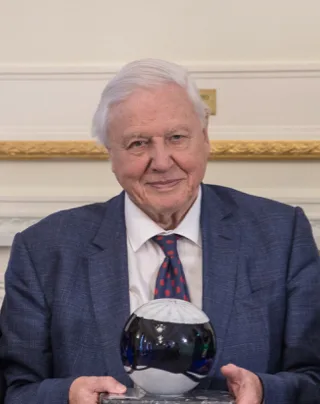
Attenborough was a senior manager at the BBC, working as controller of BBC Two and director of programming for BBC Television in the 1960s and 1970s. While his earlier work focused primarily on the natural world, his later work has been more vocal in support for environmental causes. He has advocated for restoring planetary biodiversity, limiting population growth, switching to renewable energy, mitigating climate change, reducing meat consumption and setting aside more areas for natural preservation.
On his broadcasting and passion for nature, NPR stated that Attenborough "roamed the globe and shared his discoveries and enthusiasms with his patented semi-whisper way of narrating". He is widely considered a national treasure in the UK, though he does not embrace the term.
Early life and family
David Frederick Attenborough was born on 8 May 1926 in Isleworth, Middlesex, and grew up in College House on the campus of University College, Leicester, where his father, Frederick, worked as the principal. He is the middle of three sons; his older brother, Richard, became an actor and director, and his younger brother, John, was an executive at the Italian car manufacturer Alfa Romeo.
During the Second World War, through a British volunteer network known as the Refugee Children's Movement, his parents fostered two Jewish refugee girls from Germany.
Attenborough spent his childhood collecting fossils, stones and natural specimens. He received encouragement when a young Jacquetta Hawkes admired his collection. He spent much time in the grounds of the university. Aged around 11, he heard that the zoology department needed a large supply of newts, which he offered through his father to supply for 3d each.
The source, which he did not reveal at the time, was a pond adjacent to the department. A year later, his adoptive sister Marianne gave him a piece of amber containing prehistoric creatures; some 60 years later, it would be the focus of "The Amber Time Machine", an episode of his series Natural World.
In 1936, Attenborough and his brother Richard attended a lecture by Grey Owl (Archibald Belaney) at De Montfort Hall in Leicester and were influenced by his advocacy of conservation. According to Richard, David was
bowled over by the man's determination to save the beaver, by his profound knowledge of the flora and fauna of the Canadian wilderness and by his warnings of ecological disaster should the delicate balance between them be destroyed. The idea that mankind was endangering nature by recklessly despoiling and plundering its riches was unheard of at the time, but it is one that has remained part of David's own credo to this day.
In 1999, Richard directed a biographical film of Belaney entitled Grey Owl.
Attenborough was educated at Wyggeston Grammar School for Boys in Leicester, now known as Wyggeston and Queen Elizabeth I College. In 1944 his father arranged for him to join University College Nottingham's (now the University of Nottingham) Geology Department as a part-time student on a Geology Practical course. He won a scholarship to Clare College, Cambridge, in 1945 to study geology and zoology, was a member of the undergraduate Sedgwick Club and obtained a degree in natural sciences.
In 1947, he was called up for national service in the Royal Navy and spent two years stationed in North Wales and the Firth of Forth.
Career
Early years at the BBC
After leaving the navy, Attenborough took a position editing children's science textbooks for a publishing company. He soon became disillusioned with the work and in 1950 applied for a job as a radio talk producer with the BBC. Although he was rejected for this job, his curriculum vitae later attracted the interest of Mary Adams, head of the Talks (factual broadcasting) department of the BBC's fledgling television service.
Attenborough, like most Britons at that time, did not own a television and had seen only one programme in his life.
He accepted Adams' offer of a three-month training course. In 1952, he joined the BBC full-time. Initially discouraged from appearing on camera because Adams thought his teeth were too big, he became a producer for the Talks department, which handled all non-fiction broadcasts. His early projects included the quiz show Animal, Vegetable, Mineral? and Song Hunter, a series about folk music presented by Alan Lomax.
Attenborough's association with natural history programmes began when he produced and presented the three-part series Animal Patterns. The studio-bound programme featured animals from London Zoo, with the naturalist Julian Huxley discussing their use of camouflage, aposematism and courtship displays. Through this programme, Attenborough met Jack Lester, the curator of the zoo's reptile house, and they decided to make a series about an animal-collecting expedition.
The result was Zoo Quest, first broadcast in 1954, where Attenborough became the presenter at short notice due to Lester being taken ill.
In 1957, the BBC Natural History Unit was formally established in Bristol. Attenborough was asked to join it, but declined, not wishing to move from London where he and his young family were settled. Instead, he formed his own department, the Travel and Exploration Unit, which allowed him to continue to front Zoo Quest as well as produce other documentaries, notably the Travellers' Tales and Adventure series.
In the early 1960s Attenborough resigned from the permanent staff of the BBC to study for a postgraduate degree in social anthropology at the London School of Economics, interweaving his study with further filming. However, he accepted an invitation to return to the BBC as controller of BBC Two before he could finish the degree.
BBC administration
Attenborough became Controller of BBC Two in March 1965, succeeding Michael Peacock. He had a clause inserted in his contract that would allow him to continue making programmes on an occasional basis. Later the same year he filmed elephants in Tanzania and in 1969 made a three-part series on the cultural history of the Indonesian island of Bali.
For the 1971 film A Blank on the Map, he joined the first Western expedition to a remote highland valley in New Guinea to seek out a lost tribe.
BBC Two was launched in 1964, but had struggled to capture the public's imagination. When Attenborough arrived as controller, he quickly abolished the channel's quirky kangaroo mascot and shook up the schedule. With a mission to make BBC Two's output diverse and different from that offered by other networks, he began to establish a portfolio of programmes that defined the channel's identity for decades to come.
Under his tenure, music, the arts, entertainment, archaeology, experimental comedy, travel, drama, sport, business, science and natural history all found a place in the weekly schedules. Often, an eclectic mix was offered within a single evening's viewing. Programmes he commissioned included Man Alive, Call My Bluff, Chronicle, The Old Grey Whistle Test, Monty Python's Flying Circus and The Money Programme.
With the advent of colour television, Attenborough brought snooker to the BBC to show the benefits of the format, as the sport uses coloured balls. The show – Pot Black – was later credited with the boom of the sport into the 1980s. In 1986, Attenborough influenced the creation of the yellow tennis ball by stating that the white tennis balls that were previously used could not be seen on a colour television.
One of his most significant decisions was to order a 13-part series on the history of Western art, to show off the quality of the new UHF colour television service that BBC Two offered. Broadcast to universal acclaim in 1969, Civilisation, presented by Sir Kenneth Clark, became the blueprint for landmark authored documentaries, which were informally known as "sledgehammer" projects.
Others followed, including Jacob Bronowski's The Ascent of Man (also commissioned by Attenborough) and Alistair Cooke's America: A Personal History of the United States. Attenborough thought that the story of evolution would be a natural subject for such a series. He shared his idea with Christopher Parsons, a producer at the Natural History Unit, who came up with the title Life on Earth and returned to Bristol to start planning the series.
Attenborough harboured a strong desire to present the series himself, but this would not be possible so long as he remained in a management post.
While in charge of BBC Two, Attenborough turned down Terry Wogan's job application to be a presenter on the channel, stating that there were not any suitable vacancies. The channel already had an Irish announcer, with Attenborough reflecting in 2016: "To have had two Irishmen presenting on BBC Two would have looked ridiculous.
This is no comment whatsoever on Terry Wogan's talents." Attenborough has also acknowledged that he authorised the wiping of television output during this period to cut costs, including a series by Alan Bennett, which he later regretted.
In 1969, Attenborough was promoted to director of programmes, making him responsible for the output of both BBC channels. His tasks, which included agreeing budgets, attending board meetings and firing staff, were now far removed from the business of filming programmes. When Attenborough's name was being suggested as a candidate for the position of Director-General of the BBC in 1972, he phoned his brother Richard to confess that he had no appetite for the job.
Early the following year, he left his post to return to full-time programme-making, leaving him free to write and present the planned natural history epic.
After his resignation, Attenborough became a freelance broadcaster and started work on his next project, a trip to Indonesia with a crew from the Natural History Unit. It resulted in the 1973 series Eastwards with Attenborough, which was similar in tone to the earlier Zoo Quest; the main difference was the introduction of colour.
Attenborough stated that he wanted to work in Asia, because previous nature documentaries had mostly focused on Africa. That year, Attenborough was invited to deliver the Royal Institution Christmas Lecture on The Language of Animals. After his work on Eastwards with Attenborough, he began to work on the scripts for Life on Earth.
Due to the scale of his ambition, the BBC decided to partner with an American network to secure the necessary funding. While the negotiations were proceeding, Attenborough worked on a number of other television projects. He presented a series on tribal art (The Tribal Eye, 1975) and another on the voyages of discovery (The Explorers, 1975).
He presented a BBC children's series about cryptozoology entitled Fabulous Animals (1975), which featured mythical creatures such as mermaids and unicorns. Eventually, the BBC signed a co-production deal with Turner Broadcasting and Life on Earth moved into production in 1976. In 1979, he visited the People's Republic of China and reported to the West for the first time about the Chinese one-child policy. Attenborough appeared in 14 episodes of the game show Face the Music, from 1975 to 1983.
Life series
Beginning with Life on Earth in 1979, Attenborough set about creating a body of work which became a benchmark of quality in wildlife film-making and influenced a generation of documentary film-makers. The series established many of the hallmarks of the BBC's natural history output. By treating his subject seriously and researching the latest discoveries, Attenborough and his production team gained the trust of scientists, who responded by allowing him to feature their subjects in his programmes.
Innovation was another factor in Life on Earth's success: new film-making techniques were devised to get the shots Attenborough wanted, with a focus on events and animals that were up till then unfilmed. International air travel enabled the series to be devised so that Attenborough visited several locations around the globe in each episode, sometimes even changing continents in one sequence.
Although appearing as the on-screen presenter, he restricted his time on camera to give more time to his subjects.
Five years after the success of Life on Earth, the BBC released The Living Planet. This time, Attenborough built his series around the theme of ecology, the adaptations of living things to their environment. It was another critical and commercial success, generating huge international sales for the BBC. In 1990, The Trials of Life completed the original Life trilogy, looking at animal behaviour through the different stages of life.
In the 1990s, Attenborough continued to use the "Life" title for a succession of authored documentaries. In 1993, he presented Life in the Freezer, the first television series to survey the natural history of Antarctica. Although past normal retirement age, he then embarked on a number of more specialised surveys of the natural world, beginning with plants.
They proved a difficult subject for his producers, who had to deliver hours of television featuring what are essentially immobile objects. The result was The Private Life of Plants (1995), which showed plants as dynamic organisms by using time-lapse photography to speed up their growth, and went on to earn a Peabody Award.
Prompted by an enthusiastic ornithologist at the BBC Natural History Unit, Attenborough then turned his attention to birds. As he was neither a birdwatcher nor a bird expert, he decided he was better qualified to make The Life of Birds (1998) on the theme of behaviour. The documentary series won a second Peabody Award the following year.
The order of the remaining "Life" series was dictated by developments in camera technology. For The Life of Mammals (2002), low-light and infrared cameras were deployed to reveal the behaviour of nocturnal mammals. The series contains a number of memorable two shots of Attenborough and his subjects, which included chimpanzees, a blue whale and a grizzly bear.
Advances in macro photography made it possible to capture the natural behaviour of very small creatures for the first time, and in 2005, Life in the Undergrowth introduced audiences to the world of invertebrates.
At this point, Attenborough realised that he had spent 20 years unconsciously assembling a collection of programmes on all the major groups of terrestrial animals and plants – only reptiles and amphibians were missing. When Life in Cold Blood was broadcast in 2008, he had the satisfaction of completing the set, brought together in a DVD encyclopaedia called Life on Land.
He commented: "The evolutionary history is finished. The endeavour is complete. If you'd asked me 20 years ago whether we'd be attempting such a mammoth task, I'd have said 'Don't be ridiculous!' These programmes tell a particular story and I'm sure others will come along and tell it much better than I did, but I do hope that if people watch it in 50 years' time, it will still have something to say about the world we live in."
However, in 2010 Attenborough asserted that his First Life – dealing with evolutionary history before Life on Earth – should be included within the "Life" series. In the documentary Attenborough's Journey, he stated, "This series, to a degree which I really didn't fully appreciate until I started working on it, really completes the set."
Beyond Life on Earth
Alongside the Life series, Attenborough continued to work on other television documentaries, mainly in the natural history genre. He wrote and presented a series on man's influence on the natural history of the Mediterranean basin, The First Eden, in 1987. Two years later, he demonstrated his passion for fossils in Lost Worlds, Vanished Lives.
In 1990, he worked on the BBC's Prisoners of Conscience series where he highlighted the case of the Sudanese poet Mahjoub Sharif.
Attenborough narrated every episode of Wildlife on One, a BBC One wildlife series that ran for 253 episodes between 1977 and 2005. At its peak, it drew a weekly audience of eight to ten million, while the 1987 episode "Meerkats United" was voted the best wildlife documentary of all time by BBC viewers. He has narrated over 50 episodes of Natural World, BBC Two's flagship wildlife series.
Its forerunner, The World About Us, was created by Attenborough in 1969, as a vehicle for colour television. In 1997, he narrated the BBC Wildlife Specials, each focusing on a charismatic species and screened to mark the Natural History Unit's 40th anniversary.
As a writer and narrator, Attenborough continued to collaborate with the BBC Natural History Unit in the new millennium. Alastair Fothergill, a senior producer with whom Attenborough had worked on The Trials of Life and Life in the Freezer, was making The Blue Planet (2001), the Unit's first comprehensive series on marine life.
He decided not to use an on-screen presenter due to difficulties in speaking to a camera through diving apparatus, but asked Attenborough to narrate the films. The same team reunited for Planet Earth (2006), the biggest nature documentary ever made for television and the first BBC wildlife series to be shot in high definition.
In 2009, Attenborough co-wrote and narrated Life, a ten-part series focusing on extraordinary animal behaviour, and narrated Nature's Great Events, which showed how seasonal changes trigger major natural spectacles. In January 2009 the BBC commissioned Attenborough to provide a series of 20 ten-minute monologues covering the history of nature. Entitled David Attenborough's Life Stories, they were broadcast on Radio 4 on Friday nights.
In 2011, Fothergill gave Attenborough a more prominent role in Frozen Planet, a major series on the natural history of the polar regions; Attenborough appeared on screen and authored the final episode, in addition to performing voiceover duties. Attenborough introduced and narrated the Unit's first 4K production, Life Story. For Planet Earth II (2016), Attenborough returned as narrator and presenter, with the main theme music composed by Hans Zimmer.
In October 2014, the corporation announced a trio of new one-off Attenborough documentaries as part of a raft of new natural history programmes. BBC Two aired "Attenborough's Paradise Birds" and "Attenborough's Big Birds", while BBC One broadcast "Waking Giants", which follows the discovery of giant dinosaur bones in South America, aired on BBC One.
The BBC commissioned Atlantic Productions in 2015 to develop a three-part, Attenborough-fronted series, Great Barrier Reef. This was their tenth collaboration and marked his return to a location he first filmed in 1957.
On radio, Attenborough has continued as one of the presenters of BBC Radio 4's Tweet of the Day, which began a second series in September 2014. Attenborough forged a partnership with Sky, working on documentaries for the broadcaster's new 3D network, Sky 3D. Their first collaboration was Flying Monsters 3D, a film about pterosaurs which debuted on Christmas Day in 2010.
A second film, The Penguin King 3D, followed a year later. His next 3D project, Conquest of the Skies, made by the team behind the BAFTA award-winning David Attenborough's Natural History Museum Alive, aired on Sky 3D during Christmas 2014.
📚 Source: Wikipedia