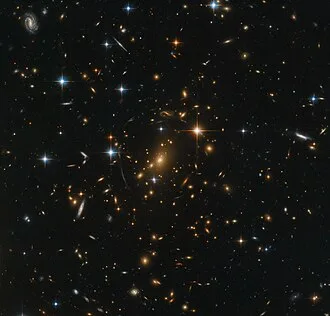
The plasma between galaxies is thought to account for about half of the baryonic (ordinary) matter in the observable universe, having a number density of less than one hydrogen atom per cubic metre and a kinetic temperature of millions of kelvins. Local concentrations of matter have condensed into stars and galaxies. Intergalactic space takes up most of the volume, but even galaxies and star systems consist almost entirely of empty space. Most of the remaining mass-energy is made up of an unknown form, dubbed dark matter and dark energy.
Outer space does not begin at a definite altitude above Earth's surface. The Kármán line, an altitude of 100 km (62 mi) above sea level, is conventionally used as the start of outer space in space treaties and for aerospace records keeping. Certain portions of the upper stratosphere and the mesosphere are sometimes referred to as "near space".
The framework for international space law was established by the Outer Space Treaty, which entered into force on 10 October 1967. This treaty precludes any claims of national sovereignty and permits all states to freely explore outer space. Despite the drafting of UN resolutions for the peaceful uses of outer space, anti-satellite weapons have been tested in Earth orbit.
The concept that the space between the Earth and the Moon must be a vacuum was first proposed in the 17th century after scientists discovered that air pressure decreased with altitude. The immense scale of outer space was grasped in the 20th century when the distance to the Andromeda Galaxy was first measured. Humans began the physical exploration of space later in the same century with the advent of high-altitude balloon flights.
This was followed by crewed rocket flights and, then, crewed Earth orbit, first achieved by Yuri Gagarin of the Soviet Union in 1961. The economic cost of putting objects, including humans, into space is very high, limiting human spaceflight to low Earth orbit and the Moon. On the other hand, uncrewed spacecraft have reached all of the known planets in the Solar System.
Outer space represents a challenging environment for human exploration because of the hazards of vacuum and radiation. Microgravity has a negative effect on human physiology that causes both muscle atrophy and bone loss.
Terminology
The use of the short version space, as meaning "the region beyond Earth's sky", predates the use of full term "outer space", with the earliest recorded use of this meaning in an epic poem by John Milton called Paradise Lost, published in 1667.
The term outward space existed in a poem from 1842 by the English poet Lady Emmeline Stuart-Wortley called "The Maiden of Moscow", but in astronomy the term outer space found its application for the first time in 1845 by Alexander von Humboldt. The term was eventually popularized through the writings of H. G. Wells after 1901.
Theodore von Kármán used the term of free space to name the space of altitudes above Earth where spacecraft reach conditions sufficiently free from atmospheric drag, differentiating it from airspace, identifying a legal space above territories free from the sovereign jurisdiction of countries. This definition of the transition to outer space became known as the Kármán line.
"Spaceborne" denotes existing in outer space, especially if carried by a spacecraft; similarly, "space-based" means based in outer space or on a planet or moon.
Formation and state
The size of the whole universe is unknown, and it might be infinite in extent. According to the Big Bang theory, the very early universe was in an extremely hot and dense state about 13.8 billion years ago and rapidly expanded. About 380,000 years later the universe had cooled sufficiently to allow protons and electrons to combine and form hydrogen—the so-called recombination epoch.
When this happened, matter and energy became decoupled, allowing photons to travel freely through the continually expanding space. Matter that remained following the initial expansion has since undergone gravitational collapse to create stars, galaxies and other astronomical objects, leaving behind a deep vacuum that forms what is now called outer space. As light has a finite velocity, this theory constrains the size of the directly observable universe.
The present day shape of the universe has been determined from measurements of the cosmic microwave background using satellites like the Wilkinson Microwave Anisotropy Probe. These observations indicate that the spatial geometry of the observable universe is "flat", meaning that photons on parallel paths at one point remain parallel as they travel through space to the limit of the observable universe, except for local gravity.
The flat universe, combined with the measured mass density of the universe and the accelerating expansion of the universe, indicates that space has a non-zero vacuum energy, which is called dark energy.
Estimates put the average energy density of the present day universe at the equivalent of 5.9 protons per cubic meter, including dark energy, dark matter, and baryonic matter (ordinary matter composed of atoms). The atoms account for only 4.6% of the total energy density, or a density of one proton per four cubic meters.
The density of the universe is clearly not uniform; it ranges from relatively high density in galaxies—including very high density in structures within galaxies, such as planets, stars, and black holes—to conditions in vast voids that have much lower density, at least in terms of visible matter. Unlike matter and dark matter, dark energy seems not to be concentrated in galaxies: although dark energy may account for a majority of the mass-energy in the universe, within the Milky Way dark energy's influence is 5 orders of magnitude smaller than the influence of gravity from matter and dark matter.
Environment
Outer space is the closest known approximation to a perfect vacuum. It has effectively no friction, allowing stars, planets, and moons to move freely along their orbits. The deep vacuum of intergalactic space is not devoid of matter, as it contains a few hydrogen atoms per cubic meter. By comparison, the air humans breathe contains about 1025 molecules per cubic meter.
The low density of matter in outer space means that electromagnetic radiation can travel great distances without being scattered: the mean free path of a photon in intergalactic space is about 1023 km, or 10 billion light years. In spite of this, extinction, which is the absorption and scattering of photons by dust and gas, is an important factor in galactic and intergalactic astronomy.
Stars, planets, and moons retain their atmospheres by gravitational attraction. Atmospheres have no clearly delineated upper boundary: the density of atmospheric gas gradually decreases with distance from the object until it becomes indistinguishable from outer space. The Earth's atmospheric pressure drops to about 0.032 Pa at 100 kilometres (62 miles) of altitude, compared to 100,000 Pa for the International Union of Pure and Applied Chemistry (IUPAC) definition of standard pressure.
Above this altitude, isotropic gas pressure rapidly becomes insignificant when compared to radiation pressure from the Sun and the dynamic pressure of the solar wind. The thermosphere in this range has large gradients of pressure, temperature and composition, and varies greatly due to space weather.
The temperature of outer space is measured in terms of the kinetic activity of the gas, as it is on Earth. The radiation of outer space has a different temperature than the kinetic temperature of the gas, meaning that the gas and radiation are not in thermodynamic equilibrium. All of the observable universe is filled with photons that were created during the Big Bang, which is known as the cosmic microwave background radiation (CMB). (There is quite likely a correspondingly large number of neutrinos called the cosmic neutrino background.) The current black body temperature of the background radiation is about 2.7 K (−270 °C; −455 °F).
The gas temperatures in outer space can vary widely. For example, the temperature in the Boomerang Nebula is 1 K (−272 °C; −458 °F), while the solar corona reaches temperatures of 1,200,000–2,600,000 K (2,200,000–4,700,000 °F).
Magnetic fields have been detected in the space around many classes of celestial objects. Star formation in spiral galaxies can generate small-scale dynamos, creating turbulent magnetic field strengths of around 5–10 μG. The Davis–Greenstein effect causes elongated dust grains to align themselves with a galaxy's magnetic field, resulting in weak optical polarization.
This has been used to show ordered magnetic fields that exist in several nearby galaxies. Magneto-hydrodynamic processes in active elliptical galaxies produce their characteristic jets and radio lobes. Non-thermal radio sources have been detected even among the most distant high-z sources, indicating the presence of magnetic fields.
Outside a protective atmosphere and magnetic field, there are few obstacles to the passage through space of energetic subatomic particles known as cosmic rays. These particles have energies ranging from about 106 eV up to an extreme 1020 eV of ultra-high-energy cosmic rays. The peak flux of cosmic rays occurs at energies of about 109 eV, with approximately 87% protons, 12% helium nuclei and 1% heavier nuclei.
In the high energy range, the flux of electrons is only about 1% of that of protons. Cosmic rays can damage electronic components and pose a health threat to space travelers.
Scents retained from low Earth orbit, when returning from extravehicular activity, have a burned, metallic odor, similar to the scent of arc welding fumes. This results from oxygen in low Earth orbit, which clings to suits and equipment. Other regions of space could have very different odors, like that of different alcohols in molecular clouds.
Human access
Humankind's burgeoning effort to explore outer space has come with certain technological, physiological, legal, societal, and ethical obstacles that need to be overcome.
Effect on biology and human bodies
Despite the harsh environment, several life forms have been found that can withstand extreme space conditions for extended periods. Species of lichen carried on the ESA BIOPAN facility survived exposure for ten days in 2007. Seeds of Arabidopsis thaliana and Nicotiana tabacum germinated after being exposed to space for 1.5 years.
A strain of Bacillus subtilis has survived 559 days when exposed to low Earth orbit or a simulated Martian environment.
The lithopanspermia hypothesis suggests that rocks ejected into outer space from life-harboring planets may successfully transport life forms to another habitable world. A conjecture is that just such a scenario occurred early in the history of the Solar System, with potentially microorganism-bearing rocks being exchanged between Venus, Earth, and Mars.
Because bacteria can survive for millions of years, it is at least theoretically possible for Galactic-scale panspermia to occur.
Vacuum
The lack of pressure in space is the most immediate dangerous characteristic of space to humans. Pressure decreases above Earth, reaching a level at an altitude of around 19.14 km (11.89 mi) that matches the vapor pressure of water at the temperature of the human body. This pressure level is called the Armstrong line, named after American physician Harry G.
Armstrong. At or above the Armstrong line, fluids in the throat and lungs boil away. More specifically, exposed bodily liquids such as saliva, tears, and liquids in the lungs boil away. Hence, at this altitude, human survival requires a pressure suit, or a pressurized capsule.
Out in space, sudden exposure of an unprotected human to very low pressure, such as during a rapid decompression, can cause pulmonary barotrauma—a rupture of the lungs, due to the large pressure differential between inside and outside the chest. Even if the subject's airway is fully open, the flow of air through the windpipe may be too slow to prevent the rupture.
Rapid decompression can rupture eardrums and sinuses, bruising and blood seep can occur in soft tissues, and shock can cause an increase in oxygen consumption that leads to hypoxia.
As a consequence of rapid decompression, oxygen dissolved in the blood empties into the lungs to try to equalize the partial pressure gradient. Once the deoxygenated blood arrives at the brain, humans lose consciousness after a few seconds and die of hypoxia within minutes. Blood and other body fluids boil when the pressure drops below 6.3 kilopascals (1 psi), and this condition is called ebullism.
The steam may bloat the body to twice its normal size and slow circulation, but tissues are elastic and porous enough to prevent rupture. Ebullism is slowed by the pressure containment of blood vessels, so some blood remains liquid.
Swelling and ebullism can be reduced by containment in a pressure suit. The Crew Altitude Protection Suit (CAPS), a fitted elastic garment designed in the 1960s for astronauts, prevents ebullism at pressures as low as 2 kilopascals (0.3 psi). Supplemental oxygen is needed at 8 km (5 mi) to provide enough oxygen for breathing and to prevent water loss, while above 20 km (12 mi) pressure suits are essential to prevent ebullism.
Most space suits use around 30–39 kilopascals (4–6 psi) of pure oxygen, about the same as the partial pressure of oxygen at the Earth's surface. This pressure is high enough to prevent ebullism, but evaporation of nitrogen dissolved in the blood could still cause decompression sickness and gas embolisms if not managed.
Weightlessness and radiation
Humans evolved for life in Earth gravity, and exposure to weightlessness has been shown to have deleterious effects on human health. Initially, more than 50% of astronauts experience space motion sickness. This can cause nausea and vomiting, vertigo, headaches, lethargy, and overall malaise. The duration of space sickness varies, but it typically lasts for 1–3 days, after which the body adjusts to the new environment.
Longer-term exposure to weightlessness results in muscle atrophy and deterioration of the skeleton, or spaceflight osteopenia. These effects can be minimized through a regimen of exercise. Other effects include fluid redistribution, slowing of the cardiovascular system, decreased production of red blood cells, balance disorders, and a weakening of the immune system.
Lesser symptoms include loss of body mass, nasal congestion, sleep disturbance, and puffiness of the face.
During long-duration space travel, radiation can pose an acute health hazard. Exposure to high-energy, ionizing cosmic rays can result in fatigue, nausea, vomiting, as well as damage to the immune system and changes to the white blood cell count. Over longer durations, symptoms include an increased risk of cancer, plus damage to the eyes, nervous system, lungs and the gastrointestinal tract.
On a round-trip Mars mission lasting three years, a large fraction of the cells in an astronaut's body would be traversed and potentially damaged by high energy nuclei. The energy of such particles is significantly diminished by the shielding provided by the walls of a spacecraft and can be further diminished by water containers and other barriers.
The impact of the cosmic rays upon the shielding produces additional radiation that can affect the crew. Further research is needed to assess the radiation hazards and determine suitable countermeasures.
Transition region
The transition between Earth's atmosphere and outer space lacks a well-defined physical boundary, with the air pressure steadily decreasing with altitude until it mixes with the solar wind. Various definitions for a practical boundary have been proposed, ranging from 30 km (19 mi) out to 1,600,000 km (990,000 mi).
In 2009, measurements of the direction and speed of ions in the atmosphere were made from a sounding rocket. The altitude of 118 km (73.3 mi) above Earth was the midpoint for charged particles transitioning from the gentle winds of the Earth's atmosphere to the more extreme flows of outer space. The latter can reach velocities well over 268 m/s (880 ft/s).
High-altitude aircraft, such as high-altitude balloons have reached altitudes above Earth of up to 50 km. Up until 2021, the United States designated people who travel above an altitude of 50 mi (80 km) as astronauts. Astronaut wings are now only awarded to spacecraft crew members that "demonstrated activities during flight that were essential to public safety, or contributed to human space flight safety".
The region between airspace and outer space is termed "near space". There is no widely accepted definition for this extent, but typically this is the altitude range from 20 to 100 km (12 to 62 mi). For safety reasons, commercial aircraft are typically limited to altitudes of 12 km (7.5 mi), and air navigation services only extend to 18 to 20 km (11 to 12 mi).
The upper limit of the range is the Kármán line, where astrodynamics must take over from aerodynamics in order to achieve flight. This range includes the stratosphere, mesosphere and lower thermosphere layers of the Earth's atmosphere.
Larger ranges for near space are used by some authors, such as 18 to 160 km (11 to 99 mi). These extend to the altitudes where orbital flight in very low Earth orbits becomes practical. Spacecraft have entered into a highly elliptical orbit with a perigee as low as 80 to 90 km (50 to 56 mi), surviving for multiple orbits.
At an altitude of 120 km (75 mi), descending spacecraft begin atmospheric entry as atmospheric drag becomes noticeable. For spaceplanes such as NASA's Space Shuttle, this begins the process of switching from steering with thrusters to maneuvering with aerodynamic control surfaces.
The Kármán line, established by the Fédération Aéronautique Internationale, and used internationally by the United Nations, is set at an altitude of 100 km (62 mi) as a working definition for the boundary between aeronautics and astronautics. This line is named after Theodore von Kármán. Around this altitude a vehicle cannot generate sufficient aerodynamic lift from the atmosphere to support itself.
Legal status
There is no internationally recognized legal altitude limit on national airspace, although the Kármán line is the most frequently used for this purpose. Objections have been made to setting this limit too high, as it could inhibit space activities due to concerns about airspace violations. It has been argued for setting no specified singular altitude in international law, instead applying different limits depending on the case, in particular based on the craft and its purpose.
Increased commercial and military sub-orbital spaceflight has raised the issue of where to apply laws of airspace and outer space. Spacecraft have flown over foreign countries as low as 30 km (19 mi), as in the example of the Space Shuttle.