Donald Sutherland
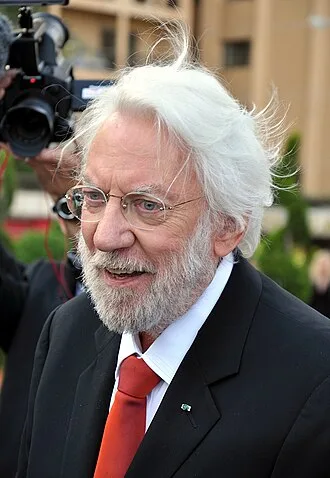
Sutherland rose to fame after roles in the war films The Dirty Dozen (1967); M*A*S*H (1970); and Kelly's Heroes (1970). He further established himself with leading roles in Klute (1971), Don't Look Now (1973), The Day of the Locust (1975), 1900 (1976), Fellini's Casanova (1976), Invasion of the Body Snatchers (1978), Ordinary People (1980), The Eye of the Needle (1981), A Dry White Season (1989), Six Degrees of Separation (1993), Without Limits (1998), Space Cowboys (2000) and supporting roles in Animal House (1978), JFK (1991), Cold Mountain (2003), The Italian Job (2003), Pride & Prejudice (2005), and Ad Astra (2019). He portrayed President Snow in The Hunger Games franchise (2012–2015).
On television, he portrayed Mikhail Fetisov in the HBO thriller Citizen X (1995), which earned him the Primetime Emmy Award for Outstanding Supporting Actor in a Limited Series or Movie. He played Clark Clifford in the HBO biographical war film Path to War (2002) for which he received the Golden Globe Award for Best Supporting Actor – Series, Miniseries or Television Film.
He also acted in the NBC war drama Uprising (2001), the miniseries Human Trafficking (2005), the FX drama series Trust (2018), and the HBO mystery limited series The Undoing (2020).
Sutherland was made an Officer of the Order of Canada (OC) in 1978, raised to Companion (CC) in 2019, inducted into the Canadian Walk of Fame in 2000 and the Hollywood Walk of Fame in 2011. He is the father of Kiefer, Rossif, and Angus Sutherland, all actors. Sutherland was a prominent voice in politics throughout his life and was particularly vocal as an anti-war activist during the Vietnam War.
Early life and education
Donald McNichol Sutherland was born on 17 July 1935 at the Saint John General Hospital in Saint John, New Brunswick, Canada, the youngest son of Dorothy Isobel (née McNichol; 1892–1956) and Frederick McLea Sutherland (1894–1983), who worked in sales and ran the local gas, electricity, and bus company.
He was of Scottish, German, and English ancestry. His grandfather was a Scots church minister. As a child, he had rheumatic fever, hepatitis, and polio. During the first six years of his life, Sutherland and his family lived on present-day Kennebecasis River Road in Hampton, a town in Kings County, having moved there from Saint John while he was an infant.
He first received education at a one-room schoolhouse in Hampton; Sutherland's family moved back to Saint John when he was six, his father having secured a position in the New Brunswick Power Company as its vice president and general manager. Sutherland attended the Victoria School in Saint John, and later played hockey for the school. During this time, Sutherland also practiced puppetry.
In a letter Sutherland sent to a Saint John Free Public Library representative in 2017, he detailed how he and his family had lived in a farmhouse in Lakeside, located in present-day Hampton, before moving to Bridgewater, Nova Scotia, at the age of 12, where he spent his teenage years. He obtained his first part-time job, at the age of 14, as a news correspondent for local radio station CKBW.
At the age of 19, Sutherland spent four months as an exchange student in Finland, where he lived near an iron mine in Otanmäki, Kainuu.
Sutherland graduated from Bridgewater High School. He then began studying at the University of Toronto, initially in engineering before switching to English at Victoria College, where he met his first wife Lois May Hardwick. He graduated in 1958, with a dual degree in engineering and drama. He had at one point been a member of the "UC Follies" comedy troupe in Toronto.
He changed his mind about becoming an engineer, and left Canada for Britain in 1957, studying at the London Academy of Music and Dramatic Art (LAMDA).
Career
1960–1968: Early work and breakthrough
While at LAMDA, Sutherland began appearing in West End productions. He dropped out his first year and moved to Scotland, where he acted at the Perth Repertory Theatre for 18 months from 1960. He appeared as Heracles in Benn Levy's The Rape of the Belt and toured throughout Scotland, including Arbroath, Dunfermline and Kirkcaldy.
His roommate was actor Michael Sheard. In the early-to-mid-1960s, Sutherland began to gain small roles in British films and TV, such as a hotel receptionist in The Sentimental Agent episode, "A Very Desirable Plot" (1963). He was featured alongside Christopher Lee in several horror films, such as Castle of the Living Dead (1964) and the anthology film Dr.
Terror's House of Horrors (1965). He also had a supporting role in the Hammer Films production of Die! Die! My Darling! (1965), with Tallulah Bankhead and Stefanie Powers. In the same year, he appeared in the Cold War classic, The Bedford Incident, and in the TV series Gideon's Way, in the 1966 episode "The Millionaire's Daughter".
In 1966, Sutherland appeared in the BBC TV play Lee Oswald – Assassin, playing a friend of Lee Harvey Oswald's named Charles Givens (even though Givens himself was an African American). He also appeared in the TV series The Saint.
In 1967, he appeared in "The Superlative Seven", an episode of The Avengers. In 1966, he also made a second, and more substantial appearance in The Saint (S5,E14). The episode, "Escape Route", which was directed by the show's star, Roger Moore, who later recalled Sutherland "asked me if he could show it to some producers as he was up for an important role... they came to view a rough cut and he got The Dirty Dozen".
The film, which starred Lee Marvin, Charles Bronson, John Cassavetes, Robert Ryan and several other popular actors, was the fifth highest-grossing film of 1967 and MGM's highest-grossing film of the year. In 1968, after the breakthrough in the UK-filmed The Dirty Dozen, Sutherland left London for Hollywood.
1970–1979: Stardom and praise
Sutherland then appeared in two war films, playing the lead role as Hawkeye Pierce in the Robert Altman–directed comedy M*A*S*H in 1970; and, again in 1970, as hippie tank commander "Oddball" in Kelly's Heroes alongside Clint Eastwood, Telly Savalas and Don Rickles. His health was threatened by spinal meningitis contracted during the filming of the latter film.
Sutherland starred with Gene Wilder in the 1970 comedy Start the Revolution Without Me. During the filming of the Academy Award-winning detective thriller Klute (1971), Sutherland had an intimate relationship with co-star Jane Fonda.Also in 1971, Sutherland starred as Christ in the independent anti-war film, Johnny Got His Gun , based on the Dalton Trumbo novel of the same name.
Sutherland and Fonda went on to co-produce and star together in the anti–Vietnam War documentary F.T.A. (1972), consisting of a series of sketches performed outside army bases in the Pacific Rim and interviews with U.S. troops who were then on active service. As a follow-up to their appearance in Klute, Sutherland and Fonda performed together in Steelyard Blues (1973), a "freewheeling, Age-of-Aquarius, romp-and-roll caper" from the writer David S. Ward.
Sutherland found himself as a leading man throughout the 1970s in films such as the Venice-based psychological horror film Don't Look Now (1973), co-starring Julie Christie, a role which saw him nominated for the BAFTA Award for Best Actor. He took a leading role in the war film The Eagle Has Landed (1976) acting opposite Michael Caine and Robert Duvall That same year he starred in Federico Fellini's film Federico Fellini's Casanova (1976) playing Giacomo Casanova.
A year later, he had parts as a clumsy waiter in the comedy The Kentucky Fried Movie and as a contract killer in the thriller The Disappearance.
Sutherland took the role of a health inspector in the science fiction/horror film Invasion of the Body Snatchers (1978) alongside Brooke Adams, Leonard Nimoy, and Jeff Goldblum. Janet Maslin of The New York Times wrote of his performance, "Mr. Sutherland is by turns personable and opaque, affecting in a way that he hasn't been since Klute".
He helped launch the internationally popular Canadian television series Witness to Yesterday, with a performance as the Montreal doctor Norman Bethune, a physician and humanitarian, largely talking of Bethune's experiences in revolutionary China. Sutherland also had a role as pot-smoking Professor Dave Jennings in National Lampoon's Animal House in 1978, making himself known to younger fans as a result of the film's popularity.
When cast, he was offered either $40,000 upfront or two per cent of the film's gross earnings. Thinking the film would certainly not be a big success, he chose the upfront payment. The film eventually grossed $141.6 million. Also, in 1978 Sutherland starred in the heist comedy film The First Great Train Robbery, alongside Sean Connery.
Sutherland's performance as Attila, an Italian fascist in Bernardo Bertolucci's 1976 epic film 1900, received praise from critics such as A. O. Scott of The New York Times for his portrayal of a sadistic, "over-the-top villainy" villain.
1980–2009: Established actor
Sutherland received praise for his role as the conflicted and grieving father in the Robert Redford-directed family drama Ordinary People (1980), alongside Mary Tyler Moore and Timothy Hutton. In September 1980, Vincent Canby of The New York Times wrote, "Mr. Sutherland realizes his best film role in years, playing a fellow who, filled with love for both his wife and his son, is angrily accused by each of fence-sitting, of being weak and indecisive when he's really the only one in the family with some idea of what is wrong." Sutherland was nominated for the Golden Globe Award for Best Actor in a Motion Picture – Drama.
In 1981, he starred in the English spy thriller Eye of the Needle and narrated Anne Wheeler's Canadian docudrama A War Story. He played the role of physician-hero Norman Bethune in Bethune (1977) and Bethune: The Making of a Hero (1990). In 1983, he co-starred with Teri Garr and Tuesday Weld in an adaptation of John Steinbeck's The Winter of Our Discontent.
Some of Sutherland's better known roles in the 1980s and 1990s were in the apartheid drama A Dry White Season (1989), alongside Marlon Brando and Susan Sarandon; as a sadistic warden in Lock Up (1989) with Sylvester Stallone; as an incarcerated pyromaniac in the firefighter thriller Backdraft (1991) alongside Kurt Russell and Robert De Niro, as the humanitarian doctor-activist Norman Bethune in 1990's Bethune: The Making of a Hero, and as a snobbish New York City art dealer in Six Degrees of Separation (1993), with Stockard Channing and Will Smith.
In the 1991 Oliver Stone film JFK, he played a mysterious Washington intelligence officer, reputed to have been L. Fletcher Prouty, who spoke of links to the military–industrial complex in the assassination of John F. Kennedy. He played psychiatrist and visionary Wilhelm Reich in the video for Kate Bush's 1985 single, "Cloudbusting".
In 1992, he played the role of Merrick in the film Buffy the Vampire Slayer, with Kristy Swanson. In 1994, he played the head of a government agency hunting for aliens who take over people's bodies (a premise similar to Invasion of the Body Snatchers) in the film of Robert A. Heinlein's 1951 book The Puppet Masters.
In 1994, Sutherland played a software company's scheming CEO in Barry Levinson's drama Disclosure opposite Michael Douglas and Demi Moore, in 1994 he played a KGB officer in the video game Conspiracy, and in 1995 was cast as Maj. Gen. Donald McClintock in Wolfgang Petersen's Outbreak. In 1995, he was also in the HBO film Citizen X, which won him the Primetime Emmy Award for Outstanding Supporting Actor in a Limited Series or Movie and the Golden Globe Award for Best Supporting Actor – Series, Miniseries or Television Film.
He was later cast in 1996 (for only the second time) with his son Kiefer in Joel Schumacher's A Time to Kill. In 1998 he took the role of Bill Bowerman in the sports drama Without Limits for which he was nominated for the Golden Globe Award for Best Supporting Actor – Motion Picture. Critic Roger Ebert wrote, "Sutherland's performance is the film's treasure... brings a deep patience to Bowerman, who understands that running is a matter of endurance and strategy, as well as heart". Sutherland played the famous American Civil War General P.G.T. Beauregard in the 1999 film The Hunley.
He played an astronaut in Space Cowboys (2000), with co-stars Clint Eastwood, Tommy Lee Jones, and James Garner. Sutherland was a model for Chris Claremont and John Byrne to create Donald Pierce, the Marvel Comics character whose last name comes from Sutherland's character in the 1970 film M*A*S*H, Hawkeye Pierce.
He starred as Adam Czerniaków in the NBC miniseries Uprising (2001). He starred as Clark Clifford in the HBO film Path to War (2002), which again earned him the Golden Globe Award for Best Supporting Actor – Series, Miniseries or Television Film. In more recent years, Sutherland was known for his role as Reverend Monroe in the Civil War drama Cold Mountain (2003), Lou Aldryn in the drama thriller Baltic Storm (2003), John Bridger in the remake of The Italian Job (2003), Nathan Templeton in the TV series Commander in Chief (2005–2006), Ogden C. Osbourne in the film Fierce People (2005) with Diane Lane and Anton Yelchin.
📚 Source: Wikipedia