French is the 22nd most natively spoken language in the world, the sixth most spoken language by total number of speakers, and is among the top five most studied languages worldwide, with about 120 million learners as of 2017[update].
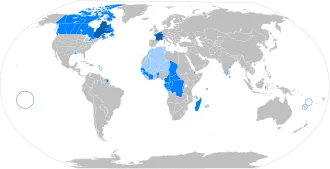
It is estimated to have about 310 million speakers, of which about 74 million are native speakers; it is spoken as a first language (in descending order of the number of speakers) in France, Canada (Quebec), Belgium (Wallonia and the Brussels-Capital Region), western Switzerland (Romandy region), Luxembourg, and Monaco.
Meanwhile, in Francophone Africa it is spoken mainly as a second language or lingua franca, though it has also become a native language in several urban areas. In some North African countries like Algeria and Morocco, it is the primary language for the elite (alongside Arabic) while being an auxiliary language for the general population.
French is an official language in 26 countries, as well as one of the most geographically widespread languages in the world, with speakers in about 50 countries. Most of these countries are members of the Organisation internationale de la Francophonie (OIF), the community of 54 member states which share the use or teaching of French.
In 2025, approximately 50% of the Francophone population lived in sub-Saharan Africa and the Indian Ocean, 30% lived in Europe, 15% in North Africa, 7% in the Americas, and a small percent in Asia and Oceania. French is the second most widely spoken mother tongue in the European Union. Of Europeans who speak other languages natively, approximately one-fifth are able to speak French as a second language.
French has a long history as an international language of literature, diplomacy and science and is a primary or second language of many international organizations including the United Nations, the European Union, the North Atlantic Treaty Organization, the World Trade Organization, the International Olympic Committee, the General Conference on Weights and Measures, and the International Committee of the Red Cross. Many institutions of the EU use French as a working language along with English, German and Italian; in some institutions, French is the sole working language (e.g. at the Court of Justice of the European Union).
History
French is a Romance language (meaning that it is descended primarily from Vulgar Latin) that evolved out of the Gallo-Romance dialects spoken in northern France. The language's early forms include Old French and Middle French.
Vulgar Latin in Gaul
Due to Roman rule, Latin was gradually adopted by the inhabitants of Gaul. As the language was learned by the common people, it developed a distinct local character, with grammatical differences from Latin as spoken elsewhere, some of which is attested in graffiti. This local variety evolved into the Gallo-Romance tongues, which include French and its closest relatives, such as Franco-Provençal.
The Gaulish language likely survived into the sixth century in France despite considerable Romanization. Coexisting with Latin, Gaulish helped shape the Vulgar Latin dialects that developed into French contributing loanwords and calques (including oui, the word for "yes"), sound changes shaped by Gaulish influence, and influences in conjugation and word order.
Recent computational studies suggest that early gender shifts may have been motivated by the gender of the corresponding word in Gaulish.
Following the Roman conquest of Gaul, 90% of the population remained indigenous in origin. Furthermore, sociological factors drove an uneven language shift. Latin spread from urban centers—such as Narbonensis—into rural hinterlands as native populations became bilingual. Although the Roman state lacked a deliberate policy of suppression, its requirement that formal administration use Latin accelerated the language's adoption in regulated zones.
During the Crisis of the Third Century, locals increasingly adopted Latin to communicate with Germanic tribes and Roman settlers. Consequently, writing in Gaulish and monolingualism all but disappeared between the 4th and 5th centuries. By the time the Romans left, the majority of the population spoke a mix of Celtic, Latin, and occasionally Greek.
Additionally, because Northern Gaul was politically cut off from the Mediterranean by the 5th century, its local Latin diverged sharply from standard grammar rules. Overall, Latin was largely adopted by the masses after the Roman departure, largely because of the increasing influence of missionaries and the Romanized elite as sources of authority, rather than the central Imperial authority.
The estimated number of French words that can be attributed to Gaulish is placed at 154 by the Petit Robert, which is often viewed as representing standardized French, while if non-standard dialects are included, the number increases to 240. Known Gaulish loans are skewed toward certain semantic fields, such as plant life (chêne, bille, etc.), animals (mouton, cheval, etc.), nature (boue, etc.), domestic activities (ex. berceau), farming and rural units of measure (arpent, lieue, borne, boisseau), weapons, and products traded regionally rather than further afield. This semantic distribution has been attributed to peasants being the last to hold onto Gaulish.
Old French
The beginning of French in Gaul was greatly influenced by Germanic invasions into the country. These invasions had the greatest impact on the northern part of the country and on the language there. A language divide began to grow across the country. The population in the north spoke langues d'oïl while the population in the south spoke langues d'oc.
One langue d'oïl became Old French. The Old French period spanned between the late 8th and mid-14th centuries. Old French shared many characteristics with Latin. For example, Old French used different word orders, just as Latin did, because it had a case system retaining the distinction between nominative subjects and oblique non-subjects.
The period is marked by a heavy superstrate influence from the Germanic Frankish language, which non-exhaustively included the use in upper-class speech and higher registers of V2 word order, a large percentage of the vocabulary (now at around 15% of modern French vocabulary) including the impersonal singular pronoun on (a calque of Germanic man), and the name of the language itself.
Up until its later stages, Old French, alongside the langue d'oc called Old Occitan, maintained a relic of the old nominal case system of Latin longer than most other Romance languages (with the notable exception of Romanian which still currently maintains a case distinction), differentiating between an oblique case and a nominative case. The phonology was characterized by heavy syllabic stress, which led to the emergence of various complicated diphthongs such as -eau, which would later be leveled as monophthongs.[citation needed]
The earliest evidence of what became Old French can be seen in the Oaths of Strasbourg and the Sequence of Saint Eulalia, while Old French literature began to be produced in the eleventh century, with major early works often focusing on the lives of saints (such as the Vie de Saint Alexis), or wars and royal courts, notably including the Chanson de Roland, the Matter of Britain, as well as a cycle focused on William of Orange.[citation needed]
During the period of the Crusades, French became so dominant in the Mediterranean Sea that it became the lingua franca (literally 'Frankish language'). Due to increased contact with Arabs (who referred to the Crusaders as Franj), numerous Arabic loanwords entered French, such as amiral (admiral), alcool (alcohol), coton (cotton) and sirop (syrup), as well as scientific terms such as algébre (algebra), alchimie (alchemy) and zéro (zero).
Middle French
Within Old French many dialects emerged but the Francien dialect is one that not only continued but also thrived during the Middle French period between the mid-14th to the early 17th centuries. Modern French grew out of this Francien dialect. The status of French as a global language of administration and diplomacy is not merely a product of modern history, but the result of a process of state-building that began in the Crusader states.
The transition towards French as a formal language began in the Kingdom of Jerusalem. Facing a crisis of authority during the War of the Lombards of the mid-13th century, the nobility replaced Latin with Outremer French—a koiné of Parisian, Norman, and Picard dialects—to codify the Assizes of Jerusalem. For the knights and jurists of Outremer, this refined vernacular became a vital tool for legal security in matters of property and inheritance, distinguishing them from Byzantines, Muslims, and newly arrived European crusaders.
The military elite, who often lacked academic training in Latin, standardized laws they could read and debate in their native tongue.
This made Jerusalem the first state to implement French for legal and administrative security, three decades before France itself. This administrative model "rebounded" to Europe through Louis IX, who, after his stay in the Levant (1250–1254), professionalized the French chancery. This trajectory reached its legal peak with the Ordinance of Villers-Cotterêts (1539), where Francis I mandated French as the exclusive language for all legal acts and official communications, effectively ending the official role of Latin and centralizing the state around the Parisian standard.
Grammatically, during the period of Middle French, noun declensions were lost and there began to be standardized rules. Robert Estienne published the first Latin-French dictionary, which included information about phonetics, etymology, and grammar. Politically, the first government authority to adopt Modern French as the official language was the Aosta Valley in 1536, three years before France itself.
Modern French
During the 17th century, French replaced Latin as the most important language of diplomacy and international relations (lingua franca). It retained this role until approximately the middle of the 20th century, when it was replaced by English as the United States became the dominant global power following the Second World War.
Stanley Meisler of the Los Angeles Times said that the fact that the Treaty of Versailles was written in English as well as French was the "first diplomatic blow" against the language.
During the Grand Siècle (17th century), France, under the rule of powerful leaders such as Cardinal Richelieu and Louis XIV, enjoyed a period of prosperity and prominence among European nations. Richelieu established the Académie française to protect the French language. By the early 1800s, Parisian French had become the primary language of the aristocracy in France.
Near the beginning of the 19th century, the French government began to pursue policies with the end goal of eradicating the many minorities and regional languages (patois) spoken in France. This began in 1794 with Henri Grégoire's "Report on the necessity and means to annihilate the patois and to universalize the use of the French language".
When public education was made compulsory, only French was taught and the use of any other (patois) language was punished. The goals of the public school system were made especially clear to the French-speaking teachers sent to teach students in regions such as Occitania and Brittany. Instructions given by a French official to teachers in the department of Finistère, in western Brittany, included the following: "And remember, Gents: you were given your position in order to kill the Breton language".
The prefect of Basses-Pyrénées in the French Basque Country wrote in 1846: "Our schools in the Basque Country are particularly meant to replace the Basque language with French..." Students were taught that their ancestral languages were inferior and they should be ashamed of them; this process was known in the Occitan-speaking region as Vergonha.
French in the 21st century
In the 21st century, the French language has undergone significant transformations in both linguistic and sociopolitical contexts. Linguistically, French is increasingly shaped by regional variations, particularly those emerging from sub-Saharan Africa. Youth sociolects and vernacular influences, such as Camfranglais in Cameroon and Nouchi in Côte d'Ivoire, have given rise to hybrid linguistic forms that not only dominate local informal communication but are also gaining traction in Francophone popular culture, music, and social media across the broader Francosphere.
While there is significant variation in spoken French, written French stays largely consistent. While French is a significant language on the internet ranking fourth, only approximately 65.5% of Francophones have access to the internet. In the 21st century, French remains a major language for business, diplomacy, and culture though its use, geography, and sociopolitical context continues to shift with declines in some areas (including academia) and growth in others.
On a global scale, the number of French speakers continues to rise, largely attributable to demographic growth in sub-Saharan Africa, where French serves as an official, educational, and administrative language in numerous states. French now serves as a language of instruction in the educational systems serving approximately 93 million pupils from 36 countries and governments worldwide, 24 of which are located in the Africa–Indian Ocean and Middle East regions, either as the sole language or in combination with others.
Notably, 80% of students attending French-language schools are in Africa, where French is commonly used both for teaching and as a shared means of communication among different communities. The majority of Francophones in the sub-Saharan region and the Maghreb are young, and are found in the 15–24 age group. This growth contrasts with the declining presence of French in parts of Asia, particularly in former French colonies such as Vietnam, Laos, and Cambodia, where it has been largely replaced by local languages and English in both public life and education, though significant immigrant populations from these regions continue in France and other francophone regions.
In sociopolitical terms, French remains deeply entangled in debates over language, identity, and historical legacy. In the Republic of the Congo, the Democratic Republic of the Congo, Côte d'Ivoire, and Cameroon, (among others) French remains the undisputed language of government, formal education, and major media. The 2022 OIF report highlights that in Kinshasa, Brazzaville, Abidjan, and Yaoundé, French serves as the dominant vehicular language, so entrenched that many urban children acquire it alongside local vernaculars as a de facto first language.
Several Sahelian states have formally curtailed French as part of postcolonial language-planning. Many governments and residents perceive it to be a remnant of colonial rule, in a complex context of cultural and political sovereignty discussions, local and Russian propaganda, political and military conflicts, and other factors.
In July 2023, Mali's constitutional referendum demoted French from "official" to merely "working" status while elevating thirteen indigenous tongues to constitutional parity. Burkina Faso's transitional authorities have announced similar plans to strip French of its official role, framing these moves as assertions of cultural sovereignty as well as a closer relationship to Russian than France.
Yet in both Bamako and Ouagadougou, French endures as the lingua franca of higher education, national media, and interethnic commerce. The language being primarily spoken by secondary-language speakers who have mixed use of the language but reflecting the complicated role of the language in these contexts amidst French military withdrawal in Africa, rising nationalism, shifting alliances, and other factors.
In longstanding Francophone strongholds, policymakers now seek a more balanced multilingual landscape. Senegal's government has expanded Wolof-language programming on public television and begun renaming colonial-era names in Dakar, even though French remains the sole constitutional language and continues to dominate academia.
This reflects a real commitment seen in Senegal and elsewhere to shift from French to local languages or English. Algeria has mandated Arabic-medium instruction in formerly Francophone private schools and introduced English tracks at its universities, framed as part of a broader multilingual strategy but in the context of diplomatic issues with France, yet French persists in judicial proceedings, international business, and everyday urban speech in Algiers and Oran and debate continues internally on language in the country.
Meanwhile, in Morocco and Tunisia, French continues to enjoy high prestige, both governments maintain bilingual curricula in secondary and tertiary education, and French remains the lingua franca of tourism, scientific research, and many private-sector enterprises. Québec has doubled down on French through Bill 96 (An Act respecting French, the official and common language of Québec), assented on 1 June 2022.
Bill 96 reaffirms French as the province's sole official language, tightens requirements for French language services and commercial signage, and expands the Charter of the French Language's scope which are measures designed to counter anglophone pressures and reinforce cultural identity. Similarly, countries such as Madagascar, Central African Republic, Chad, and Haiti, have legally committed to French alongside local languages.