Grace Kelly
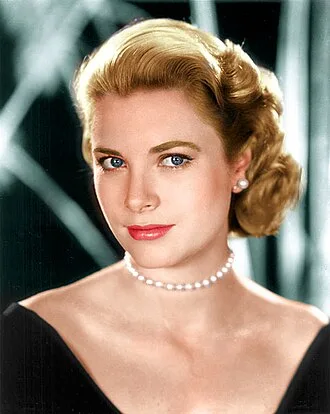
Kelly was born into a prominent Catholic family in Philadelphia. After graduating from the American Academy of Dramatic Arts in 1949, she began appearing in New York City theatrical productions and television broadcasts. Kelly made her film debut in Fourteen Hours (1951) and gained stardom from her roles in Fred Zinnemann's western film High Noon (1952), and John Ford's adventure-romance Mogambo (1953), the latter of which earned her the Academy Award for Best Supporting Actress nomination.
She won the Academy Award for Best Actress for her performance in the drama The Country Girl (1954). Other notable works include the war film The Bridges at Toko-Ri (1954), the romantic comedy High Society (1956), and three Alfred Hitchcock suspense thrillers: Dial M for Murder (1954), Rear Window (1954), and To Catch a Thief (1955).
Kelly retired from acting at age 26 to marry Rainier and began her duties as Princess of Monaco. Grace and Rainier had three children: Princess Caroline, Prince Albert, and Princess Stéphanie. Princess Grace's charity work focused on children and the arts. In 1964, she established the Princess Grace Foundation to support local artisans.
Her organization for children's rights, AMADE Mondiale, gained consultive status within UNICEF and UNESCO. Her final film role was narrating The Children of Theatre Street (1977), which was nominated for an Academy Award for Best Documentary Feature.
She died at the age of 52 at Monaco Hospital, from injuries sustained in a car crash. Her son, Prince Albert, helped establish the Princess Grace Awards in 1984 to recognize emerging performers in film, theatre, and dance.
Early life and family
Grace Patricia Kelly was born on November 12, 1929, at Hahnemann University Hospital in Philadelphia, Pennsylvania, to an affluent and influential family. Her father, John B. Kelly Sr., was born to Irish immigrants; he won three Olympic gold medals for sculling. He owned a successful brickwork contracting company that was well known on the East Coast.
As the Democratic Party nominee in the 1935 election for mayor of Philadelphia, he lost by the closest margin in the city's history. In later years, he served on the Fairmount Park Commission and, during World War II, was appointed by President Franklin D. Roosevelt as National Director of Physical Fitness. His brother Walter C.
Kelly was a vaudeville star, who also made films for Metro-Goldwyn-Mayer and Paramount Pictures, and another brother named George was a Pulitzer Prize-winning dramatist, screenwriter, and director. John Kelly Sr. built the family home at 3901 Henry Avenue in the East Falls, Philadelphia, neighborhood.
Kelly's mother, Margaret Majer, was of German ancestry. Margaret had taught physical education at the University of Pennsylvania and had been the first woman to coach women's athletics at Penn. She also modeled for a time in her youth. After marrying John Kelly in 1924, Margaret focused on being a homemaker until all her children were of school age, following which she began actively participating in various civic organizations.
While living in Germany, Margaret's father, Karl Majer, owned Schloss Helmsdorf (Castle Helmsdorf) in Immenstaad am Bodensee and lived on the estate. He managed the property as a German landowner, established himself as a local wine merchant, and constructed a large wine cellar on-site. In 1872, he sold the castle and its estate to Hermann Winter, a businessman from Backnang, for 54,000 guilders before relocating to the United States.
Patrilineally, Grace's mother descended from Prof. Johann Christian von Majer (1741–1821) from Ludwigsburg, who worked as a political scientist, jurist and theologian, and was elected five times Rector of the University of Tübingen.
In recognition of his distinguished service as a jurist and his contributions to legal scholarship and state administration Johann Christian was raised in 1808 to the personal nobility (Personaladel) by Frederick I of Württemberg in the Kingdom of Württemberg. Through him, Grace was descended from the Schenk von Stauffenberg family — best known for Claus Schenk Graf von Stauffenberg, who attempted to assassinate Adolf Hitler — as well as from several other German noble families, including the von Zedlitz, von Plieningen, von Münchingen, von Ow, von Bettendorf, von Nippenburg, von Roth and Megenzer von Velldorf families.
Kelly had two older siblings, Margaret and John Jr., and a younger sister, Elizabeth. The children were raised in the Catholic faith, and Grace continued to practice the faith until her death, with Rita Gam describing her as a "deeply religious person". Kelly grew up in a small, close-knit Catholic community. She was baptized and received her elementary education in the parish of Saint Bridget's in East Falls.
Founded in 1853 by Saint John Neumann, the fourth Bishop of Philadelphia, Saint Bridget's was a relatively young parish, with families very familiar with one another. While attending Ravenhill Academy, a Catholic girls' school, Kelly modeled fashions at local charity events with her mother and sisters. In 1942, at the age of 12, she played the lead in Don't Feed the Animals, a play produced in East Falls by the Old Academy Players.
In May 1947, Kelly graduated from Stevens School, a private institution in nearby Chestnut Hill, where she participated in drama and dance programs. Her graduation yearbook listed her favorite actress as Ingrid Bergman and her favorite actor as Joseph Cotten. Written in the "Stevens' Prophecy" section was "Miss Grace P.
Kelly – a famous star of stage and screen". Owing to her low mathematics scores, Kelly was rejected by Bennington College in July 1947. Despite her parents' initial disapproval, Kelly decided to pursue her dreams of becoming an actress. Her father was particularly displeased with her decision, as he viewed acting as "a slim cut above streetwalker" at the time. In 1947, Kelly signed with the Walter Thornton Model Agency gracing the covers of magazines.
In 1954, Kelly dated and was engaged to Oleg Cassini after his divorce from Gene Tierney.
Career
1949–1950: Beginnings
To start her career, she auditioned for the American Academy of Dramatic Arts in New York, using a scene from her uncle George Kelly's The Torch-Bearers (1923). Although the school had already met its semester quota, she obtained an interview with the admissions department, and was admitted through George's influence.
Kelly worked diligently, and practiced her speech by using a tape recorder. Her early acting pursuits led her to the stage, and she made her Broadway debut in Strindberg's The Father, alongside Raymond Massey. At 19, her graduation performance was as Tracy Lord in The Philadelphia Story. Her uncle continued to advise and mentor Kelly throughout her acting career.
At her father's insistence, she lived at the Barbizon Hotel for Women in Manhattan. She was hired as a model by the John Robert Powers agency, where some of her first modeling jobs were doing commercials for bug spray and cigarettes. Kelly was reportedly "fond of dancing to Hawaiian music down the hallways of the Barbizon, and given to shocking her fellow residents by performing topless". She later wrote that she had "wonderful memories of the three years I spent at the Barbizon".
Television producer Delbert Mann cast Kelly as the lead in an adaptation of the Sinclair Lewis novel Bethel Merriday; this was her first of nearly sixty live television programs. She was mentioned in Theatre World magazine as "[a] most promising personality of the Broadway stage of 1950". Some of her well-known works as a theater actress were: The Father, The Rockingham Tea Set, The Apple Tree, The Mirror of Delusion, Episode (for Somerset Maugham's tele-serial), among others.
Impressed by her work in The Father, Henry Hathaway, director of the Twentieth Century-Fox film Fourteen Hours (1951), offered her a small role in the film. Kelly had a minor role opposite Paul Douglas, Richard Basehart, and Barbara Bel Geddes, as a young woman contemplating divorce. Douglas commented: "In two senses, she did not have a bad side – you could film her from any angle, and she was one of the most un-temperamental, cooperative people in the business." Following the release of the film, the "Grace Kelly Fan Club" was established, gaining popularity across the country with local chapters springing up and attracting many members. Kelly referred to her fan club as "terrifically amusing".
Kelly was noticed during a visit to the set of Fourteen Hours by Gary Cooper. However, Kelly's performance in Fourteen Hours went largely unnoticed by critics and did not contribute to her film career's momentum. She continued her work in the theater and on television, although she lacked "vocal horsepower" and it was thought she would likely not have had a lengthy stage career.
1951–1953: Early films and breakthrough
Kelly was performing at Colorado's Elitch Theatre when producer Stanley Kramer offered her a role co-starring opposite Cooper in Fred Zinnemann's High Noon (1952), a Western filmed in Columbia, California. She accepted the role, and the film was shot in the late summer and early fall of 1951 over a 28-day shooting schedule in hot weather conditions.
She was cast as a "young Quaker bride to Gary Cooper's stoic marshal", and wore a "suitably demure vaguely Victorian dress". High Noon garnered four Academy Awards, and has since been ranked by some reviewers among the best films of all time.
Biographer H. Haughland stated: "Miss Kelly's acting did not excite the critics, or live up to her own expectations." Some critics scoffed at the conclusion of the film in which Cooper's character has to be saved by Kelly's. One critic argued that her pacifist character, killing a man who is about to shoot her husband, was cold and abstract.
Alfred Hitchcock described her performance as "rather mousey", and stated that it lacked animation. He said that it was only in her later films that she "really blossomed" and showed her quality.
After filming High Noon, Kelly returned to New York City and took private acting lessons, wanting to be taken seriously as an actress. She performed in a few dramas in the theater, and in TV serials. She appeared in several television plays, and screen-tested for the film Taxi in the spring of 1952. Director John Ford noticed Kelly in the screen test, and his studio (MGM) flew her out to Los Angeles to audition in September 1952.
Ford said that Kelly showed "breeding, quality, and class". She was given the role, along with a seven-year contract with MGM at the relatively low salary of $850 a week (equivalent to $10,305 in 2025). Kelly signed the deal under two conditions: first, that one out of every two years, she had time off to work in the theatre; and second, that she be able to live in New York City at her residence in Manhattan House, at 200 E. 66th Street, now a landmark.
In November 1952, Kelly and the cast arrived in Nairobi to begin the production of the film Mogambo, replacing Gene Tierney, who dropped out at the last minute due to personal issues. Kelly later told Hollywood columnist Hedda Hopper, "Mogambo had three things that interested me: John Ford, Clark Gable, and a trip to Africa, with expenses paid.
If Mogambo had been made in Arizona, I wouldn't have done it." Kelly played Linda Nordley, a contemplative English wife with a romantic interest in Clark Gable's character. Filming took place over the course of three months. The costumes were designed by Helen Rose. A break in the filming schedule afforded her and Mogambo co-star Ava Gardner a visit to Rome.
The film was released in 1953, and had a successful run at the box office. Kelly won a Golden Globe Award for Best Supporting Actress, and received her first Academy Award nomination for Best Supporting Actress for her performance.
1954–1956: Critical acclaim and final films
After the success of Mogambo, Kelly starred in the television play The Way of an Eagle with Jean-Pierre Aumont, before being cast in the film adaptation of Frederick Knott's Broadway play Dial M for Murder, opposite Ray Milland and Robert Cummings. Kelly played the role of the wealthy wife of a retired professional tennis player.
Alfred Hitchcock became one of Kelly's mentors during the last years of her career. She was subsequently lent by MGM to work in several Hitchcock films, which would become some of her most critically acclaimed and recognized work. Kelly began filming scenes for her next film, The Bridges at Toko-Ri, in early 1954, with William Holden, for Paramount Pictures.
The story, based on the novel by James Michener, is about American Navy jet fighters stationed to fight in Asia. Kelly played the role of Holden's wife. Edith Head, with whom she had established a friendly relationship, did her costumes.
Kelly unhesitatingly turned down the opportunity to star alongside Marlon Brando in On the Waterfront (1954). Eva Marie Saint, who replaced her, went on to win an Academy Award for the role. Instead, Kelly played the role of Lisa Fremont in Rear Window. Kelly stated, "All through the making of Dial M for Murder, he (Hitchcock) sat and talked to me about Rear Window all the time, even before we had discussed my being in it." Kelly's co-star, James Stewart, was highly enthusiastic about working with her.[page needed] The role of Lisa Fremont, a wealthy Manhattan socialite and fashion model who "never wore the same dress twice," was unlike any of the previous women she had played.
This marked her first performance as an independent career woman. In line with their previous collaborations, Hitchcock provided the camera with a slow-sequenced silhouette of Kelly, along with close-ups of the two stars kissing, finally lingering closely on her profile. Hitchcock brought her elegance to the foreground by changing her dresses many times, including: "glamorous evening short dresses, a sheer negligee over a sleek nightgown, a full-skirted floral dress, and a casual pair of jeans".
Upon the film's opening in October 1954, Kelly was again praised. Variety's film critic remarked on the casting, commenting on the "earthy quality to the relationship between Stewart and Miss Kelly", as "both do a fine job of the picture's acting demands".
Kelly played the role of Bing Crosby's long-suffering wife, Georgie Elgin, in The Country Girl (1954), after a pregnant Jennifer Jones bowed out. Already familiar with the play, Kelly was highly interested in the part. To do it, MGM once again would have to lend Kelly to Paramount Pictures. Kelly was adamant, and threatened the studio, saying that if they did not allow her to do the film she would pack her bags and leave for New York for good.
MGM eventually relented. Kelly also negotiated a more lucrative contract in light of her recent success. In the film, Kelly played the wife of a washed-up, alcoholic singer, played by Crosby. Her character becomes torn emotionally between her two lovers, played by Crosby and William Holden. She was again dressed by Edith Head to suit her role in the film, initially appearing in fashionable dresses, shifting to ordinary-looking cardigans toward the end of the film.
As a result of her performance in The Country Girl, Kelly won the Academy Award for Best Actress. Her acceptance speech was brief: "The thrill of this moment keeps me from saying what I really feel. I can only say thank you with all my heart to all who made this possible for me. Thank you." Her main competitor was Judy Garland for her performance in A Star Is Born.
After receiving the Oscar nomination, Kelly won the New York Film Critics Circle Award for Best Actress for her performances in her three big movie roles of 1954: Rear Window, Dial M for Murder, and The Country Girl. At the Golden Globes in 1955, Kelly won the award Best Actress in a Motion Picture – Drama. The New York Times praised her performance in The Country Girl as "excellent", and Rear Window got her marquee credits on par with, and beyond, those of Stewart and Hitchcock.
In April 1954, Kelly flew to Colombia for a 10-day shoot on her next project, Green Fire, with Stewart Granger. She played Catherine Knowland, a coffee plantation owner. Kelly told Hedda Hopper, "It wasn't pleasant. We worked at a pathetic village – miserable huts and dirty. Part of the crew got shipwrecked ...
It was awful." After the consecutive filming of Rear Window, Toko-Ri, Country Girl, and Green Fire, Kelly flew to the French Riviera to work on her third, and last, film for Hitchcock, To Catch a Thief. Loaned to Paramount for the fifth time, Kelly played the role of a temptress who wears "luxurious and alluring clothes", while Cary Grant played the role of a former cat burglar, then looking to catch a thief who is imitating him.
Kelly and Grant developed a mutual bond and admiration for each other. Years later, when asked to name his all-time favorite actress, Grant replied: "Well, with all due respect to dear Ingrid Bergman, I much preferred Grace. She had serenity."
In 1956, Kelly resided in a home rented from Bill Lear in Pacific Palisades, California for the duration of her filming. She portrayed Princess Alexandra in the film The Swan, directed by Charles Vidor, opposite Alec Guinness and Louis Jourdan. Her final role was in Charles Walters's musical film High Society, a re-make of MGM's The Philadelphia Story (1940).
She portrayed Tracy Lord, opposite Bing Crosby, Frank Sinatra, and Celeste Holm in the other leads. When it was released in July 1956, Variety stated, "Miss Kelly impresses as the femme lead with pleasantly comedienne overtones," and that it was "possibly her most relaxed performance."
Marriage
Kelly headed the U.S. delegation at the Cannes Film Festival in April 1955. While there, she was invited to participate in a photo session with Prince Rainier III, the sovereign of the Principality of Monaco, at the Prince's Palace of Monaco. After a series of delays and complications, she met him at the palace on May 6, 1955.
After a year-long courtship described as containing "a good deal of rational appraisal on both sides," they married on April 19, 1956.
The Napoleonic Code of Monaco and the laws of the Catholic Church necessitated two ceremonies, civil and religious. The 16-minute civil ceremony took place in the Palace Throne Room of Monaco on April 18, 1956, and a reception later in the day was attended by 3,000 Monégasque citizens. The 142 official titles that she acquired in the union (counterparts of her husband's) were formally recited.
The church ceremony took place the following day at Monaco's Saint Nicholas Cathedral, presided over by Bishop Gilles Barthe. The wedding was estimated to have been watched by over 30 million viewers on television, and was described by biographer Robert Lacey in 2010 as "the first modern event to generate media overkill".
Her wedding dress, designed by MGM's Helen Rose, was worked on for 6 weeks by three dozen dress makers. The couple left that night for their seven-week Mediterranean honeymoon cruise on the prince's yacht.
Princess of Monaco
Princess Grace gave birth to the couple's first child, Princess Caroline, on January 23, 1957. Their next child and the heir to the throne, Prince Albert, was born on March 14, 1958. Their youngest, Princess Stéphanie, was born on February 1, 1965.
📚 Source: Wikipedia