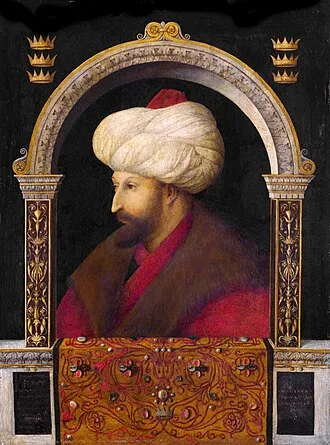
During his first reign, he defeated the crusade led by John Hunyadi after Hungarian incursions into his lands violated the Treaties of Edirne and Szeged. Upon his restoration to the throne in 1451, he strengthened the Ottoman Navy and made preparations to attack Constantinople. In 1453, at the age of 21, he conquered Constantinople and effectively brought an end to the Byzantine Empire.
After the conquest, Mehmed claimed the title caesar of Rome (Ottoman Turkish: قیصر روم, qayṣar-i rūm), on the grounds that Constantinople had been the seat and capital of the surviving Eastern Roman Empire since its consecration in 330 AD by Emperor Constantine I.
The claim was soon recognized by the Patriarchate of Constantinople, but rejected by most European monarchs.
Mehmed continued his conquests and reunified Anatolia, and campaigned as far west as Bosnia in Southeast Europe. At home, he implemented many political and social reforms. He was a patron of the arts and sciences, and by the end of his reign, Constantinople had been transformed into a thriving imperial capital. He is considered a hero in modern-day Turkey and parts of the wider Muslim world, with Istanbul's Fatih district, Fatih Sultan Mehmet Bridge and Fatih Mosque being named after him.
Early life and first reign
Mehmed II was born on 30 March 1432, in Edirne, then the capital city of the Ottoman Empire. His father was Sultan Murad II (1404–1451) and his mother Hüma Hatun, a slave of uncertain origin.
When Mehmed II was eleven years old, he was sent to Amasya with his two lalas (advisors) to govern and thus gain experience, per the custom of Ottoman rulers before his time. Sultan Murad II also sent a number of teachers for him to study under. This Islamic education had a great impact in molding Mehmed's mindset and reinforcing his Muslim beliefs.
He was influenced in his practice of Islamic epistemology by practitioners of science, particularly by his mentor, Molla Gürâni, and he followed their approach. The influence of Akshamsaddin in Mehmed's life became predominant from a young age, especially in the imperative of fulfilling his Islamic duty to overthrow the Byzantine Empire by conquering Constantinople.
After Murad II made peace with Hungary on 12 June 1444, he abdicated the throne in favour of his 12-year-old son Mehmed II in July/August 1444.
During Mehmed II's first reign, he defeated the crusade led by John Hunyadi after the Hungarian incursions into his country broke the conditions of the truce per the Treaties of Edirne and Szeged in September 1444. Cardinal Julian Cesarini, the representative of the Pope, had convinced the king of Hungary that breaking the truce with Muslims was not a betrayal.[citation needed] At this time, Mehmed II asked his father Murad II to reclaim the throne, but Murad II refused.
According to the 17th-century chronicles, Mehmed II wrote, "If you are the sultan, come and lead your armies. If I am the sultan, I hereby order you to come and lead my armies." Then, Murad II led the Ottoman army and won the Battle of Varna on 10 November 1444. Halil Inalcik states that Mehmed II did not ask for his father. Instead, it was Çandarlı Halil Pasha's effort to bring Murad II back to the throne.
In 1446, while Murad II returned to the throne, Mehmed retained the title of sultan but only acted as a governor of Manisa. Following the death of Murad II in 1451, Mehmed II became sultan for the second time. Ibrahim II of Karaman invaded the disputed area and instigated various revolts against Ottoman rule. Mehmed II conducted his first campaign against İbrahim of Karaman; the Byzantines threatened to release Ottoman claimant Orhan.
Conquests
Conquest of Constantinople
When Mehmed II ascended the throne again in 1451, he devoted himself to strengthening the Ottoman navy and made preparations for an attack on Constantinople. In the narrow Bosphorus Straits, the fortress Anadoluhisarı had been built by his great-grandfather Bayezid I on the Asian side; Mehmed erected an even stronger fortress called Rumelihisarı on the European side, and thus gained complete control of the strait.
Having completed his fortresses, Mehmed proceeded to levy a toll on ships passing within reach of their cannon. A Venetian vessel ignoring signals to stop was sunk with a single shot and all the surviving sailors beheaded, except for the captain, who was impaled and mounted like a human scarecrow as a warning to other sailors on the strait.
Abu Ayyub al-Ansari, the companion and standard bearer of the Islamic prophet Muhammad, had died during the first Siege of Constantinople (674–678). As Mehmed II's army approached Constantinople, Mehmed's sheikh Akshamsaddin discovered the tomb of Abu Ayyub al-Ansari. After the conquest, Mehmed built Eyüp Sultan Mosque at the site to emphasize the importance of the conquest to the Islamic world and highlight his role as ghazi.
In 1453, Mehmed commenced the siege of Constantinople with an army between 80,000 and 200,000 troops, an artillery train of over seventy large field pieces, and a navy of 320 vessels, the bulk of them transports and storeships. The city was surrounded by sea and land; the fleet at the entrance of the Bosphorus stretched from shore to shore in the form of a crescent, to intercept or repel any assistance for Constantinople from the sea.
In early April, the Siege of Constantinople began. At first, the city's walls held off the Turks, even though Mehmed's army used the new bombard designed by Orban, a giant cannon similar to the Dardanelles Gun. The harbor of the Golden Horn was blocked by a boom chain and defended by twenty-eight warships.
On 22 April, Mehmed transported his lighter warships overland, around the Genoese colony of Galata, and into the Golden Horn's northern shore; eighty galleys were transported from the Bosphorus after paving a route, little over one mile, with wood. Thus, the Byzantines stretched their troops over a longer portion of the walls.
About a month later, Constantinople fell, on 29 May, following a fifty-seven-day siege. After this conquest, Mehmed moved the Ottoman capital from Adrianople to Constantinople.
When Sultan Mehmed II stepped into the ruins of the Boukoleon, known to the Ottomans and Persians as the Palace of the Caesars, probably built over a thousand years before by Theodosius II, he uttered the famous lines of Saadi:
The spider is curtain-bearer in the palace of Chosroes,
The owl sounds the relief in the castle of Afrasiyab.
Some Muslim scholars claimed that a hadith in Musnad Ahmad referred specifically to Mehmed's conquest of Constantinople, seeing it as the fulfillment of a prophecy and a sign of the approaching apocalypse.
After the conquest of Constantinople, Mehmed claimed the title of caesar of the Roman Empire (Qayser-i Rûm), based on the assertion that Constantinople had been the seat and capital of the Roman Empire since 330 AD and whoever possessed the Imperial capital was the ruler of the empire. The contemporary scholar George of Trebizond supported his claim.
The claim was not recognized by the Catholic Church and most of, if not all, Western Europe, but was recognized by the Eastern Orthodox Church. Mehmed had installed Gennadius Scholarius, a staunch antagonist of the West, as the ecumenical patriarch of Constantinople with all the ceremonial elements, ethnarch (or milletbashi) status, and rights of property that made him the second largest landlord in the empire after the sultan himself in 1454, and in turn, Gennadius II recognized Mehmed the Conqueror as the successor to the throne.
Emperor Constantine XI Palaiologos died without producing an heir, and had Constantinople not fallen to the Ottomans, he likely would have been succeeded by the sons of his deceased elder brother. Those children were taken into the palace service of Mehmed after the fall of Constantinople. The oldest boy, renamed Hass Murad, became a personal favorite of Mehmed and served as beylerbey of the Balkans.
The younger son, renamed Mesih Pasha, became admiral of the Ottoman fleet and sanjak-bey of the Gallipoli. He eventually served twice as Grand Vizier under Mehmed's son, Bayezid II.
After the fall of Constantinople, Mehmed would also go on to conquer the Despotate of Morea in the Peloponnese in two campaigns in 1458 and 1460 and the Empire of Trebizond in northeastern Anatolia in 1461. The last two vestiges of Byzantine rule were thus absorbed by the Ottoman Empire. The conquest of Constantinople bestowed immense glory and prestige on the country.
Kritovoulos reports that 10 years after the conquest of Constantinople, Mehmed II allegedly visited the site of Troy and boasted that he had avenged the Trojans by conquering the Greeks (Byzantines). This story is considered to be fictitious, as there are no Ottoman sources which mention it and there is no further evidence of any Turkish claiming of Troy.
Mehmed also allegedly visited the Acropolis, but this, too, is considered apocryphal. These myths were customary in propaganda writing and encomia; Kritovoulos, in particular, used those two stories because he sought to "Hellenize" Mehmed.
Conquest of Serbia (1454–1459)
Mehmed II's first campaigns after Constantinople were in the direction of Serbia, which had been an Ottoman vassal state intermittently since the Battle of Kosovo in 1389. The Ottoman ruler had a connection with the Serbian Despotate – one of Murad II's wives was Mara Branković – and he used that fact to claim Serbian lands. Đurađ Branković's recently made alliance with the Hungarians, and his irregular payments of tribute, further served as justifications for the invasion.
The Ottomans sent an ultimatum demanding the keys to some Serbian castles which formerly belonged to the Ottomans. When Serbia refused these demands, the Ottoman army led by Mehmed set out from Edirne towards Serbia in 1454, sometime after the 18th of April. Mehmed's forces quickly succeeded in capturing Sivricehisar (sometimes identified with the Ostrvica Fortress) and Omolhisar, and repulsed a Serbian cavalry force of 9,000 cavalry sent against them by the despot.
Following these actions, the Serbian capital of Smederevo was put under siege by the Ottoman forces. Before the city could be taken, intelligence was received about an approaching Hungarian relief force led by Hunyadi, which caused Mehmed to lift the siege and start marching back to his domains. By August the campaign was effectively over, Mehmed left a part of his force under the command of Firuz Bey in Serbia in anticipation of a possible offensive on Ottoman territories by Hunyadi.
This force was defeated by a combined Hungarian-Serbian army led by Hunyadi and Nikola Skobaljić on the 2nd of October near Kruševac, after which Hunyadi went on to raid Ottoman controlled Nish and Pirot before returning back to Belgrade. Roughly a month later, on the 16th of November, the Ottomans avenged their earlier defeat at Kruševac by defeating Skobaljić's army near Tripolje, where the Serbian voivode was captured and executed via impalement.
Following this a temporary treaty was signed with the Serbian despot, where Đurađ would formally recognize the recently captured Serbian forts as Ottoman land, send thirty thousand florins to the Porte as yearly tribute and provide troops for Ottoman campaigns. The 1454 campaign had resulted in the capture of fifty thousand prisoners from Serbia, four thousand of whom were settled in various villages near Constantinople.
The following year, Mehmed received reports from one of his frontier commanders about Serbian weakness against a possible invasion, the reports in combination with the dissatisfactory results of the 1454 campaign convinced Mehmed to initiate another campaign against Serbia. The Ottoman army marched on the important mining town of Novo Brdo, which Mehmed put under siege.
The Serbians couldn't resist the Ottoman army out in the open, thus resorted to fortifying their various settlements and having their peasants flee to either various fortresses or forests. After forty days of siege and intense cannon fire, Novo Brdo surrendered. Following the conquest of the city, Mehmed captured various other Serbian settlements in the surrounding area, after which he started his march back towards Edirne, visiting his ancestor Murad I's grave in Kosovo on the way.
In 1456, Mehmed decided to continue his momentum towards the northwest and capture the city of Belgrade, which had been ceded to the Kingdom of Hungary by the Serbian despot Đurađ Branković in 1427. Significant preparations were made by the Sultan for the conquest of the city, including the casting of 22 large cannons alongside many smaller ones and the establishment of a navy which would sail up the Danube to aid the army during the siege.
The exact number of troops Mehmed commanded varies between sources, but the rumours of its size were significant enough to cause panic in Italy. Ottoman troops began arriving at Belgrade on the 13th of June. After the necessary preparations were finished, Ottoman cannons started bombarding the city walls and Ottoman troops started filling the ditches in front of the walls with earth to advance forward.
As despair started to set in amongst the defenders, news started arriving of a relief force assembling across the Danube under the command of John Hunyadi. Upon learning of this development, Mehmed held a war council with his commanders to determine the army's next actions. Karaca Pasha recommended that a part of the army should cross the Danube to counter the approaching relief army.
This plan was rejected by the council, particularly due to the opposition by the Rumelian Begs. Instead, the decision was made to prioritize capturing the fortress, a move seen as a tactical blunder by modern historians. This allowed Hunyadi to set up camp with his army across the Danube uncontested. Shortly after, the Ottoman navy was defeated in a five hour long battle by the newly arrived Christian Danubian navy.
Following this, Hunyadi's troops started entering the city to reinforce the besieged, which increased the morale of the defending forces. Infuriated by the unfolding events, Mehmed ordered a final attack to capture the city on the 21st of July, after continuous cannon fire building up to the day of the attack. Ottoman troops were initially successful in breaching the defences and entering the city, however were eventually repulsed by the defenders.
The Christians pressed their advantage by launching a counter attack, which started pushing back the Ottoman forces, managing to advance as far as the Ottoman camp. At this crucial point of the battle, one of the viziers advised Mehmed to abandon the camp for his safety, which he refused to do so on the grounds that it would be a "sign of cowardice".
After this, Mehmed personally joined the fighting, accompanied by two of his begs. The Sultan managed to personally kill three enemy soldiers before being injured, forcing him to abandon the battlefield. The news of their Sultan fighting alongside them and the arrival of reinforcements caused a morale boost amongst the Ottoman troops, which allowed them to go on the offensive again and push the Christian forces out of the Ottoman camp.
The actions of the Sultan had prevented a complete rout of the Ottoman army, however, the army had been far too weakened to attempt to take the city again, causing the Ottoman war council to decide on ending the siege. The Sultan and his army began a retreat to Edirne during the night, without the Christian forces being able to pursue them.
Hunyadi died shortly after the siege, meanwhile Đurađ Branković regained possession of some parts of Serbia.
Shortly before the end of the year 1456, roughly 5 months after the Siege of Belgrade, the 79-year-old Branković died. Serbian independence survived after him for only around three years, when the Ottoman Empire formally annexed Serbian lands following dissension among his widow and three remaining sons. Lazar, the youngest, poisoned his mother and exiled his brothers, but he died soon afterwards.
In the continuing turmoil the oldest brother Stefan Branković gained the throne. Observing the chaotic situation in Serbia, the Ottoman government decided to definitively conclude the Serbian issue. The Grand Vizier Mahmud Pasha was dispatched with an army to the region in 1458, where he initially conquered Resava and a number of other settlements before moving towards Smederevo.
After a battle outside the city walls, the defenders were forced to retreat inside the fortress. In the ensuing siege, the outer walls were breached by Ottoman forces, however the Serbians continued to resist inside the inner walls of the fortress. Not wanting to waste time capturing the inner citadel, Mahmud lifted the siege and diverted his army elsewhere, conquering Rudnik and its environs before attacking and capturing the fortress of Golubac.
Subsequently, Mehmed who had returned from his campaign in Morea met up with Mahmud Pasha in Skopje. During this meeting, reports were received that a Hungarian army was assembling near the Danube to launch an offensive against the Ottoman positions in the region. The Hungarians crossed the Danube near Belgrade, after which they marched south towards Užice.
While the Hungarian troops were engaged in plunder near Užice, they got ambushed by the Ottoman forces in the region, forcing them to retreat. Despite this victory, for Serbia to be fully annexed into the empire, Smederevo still had to be taken. The opportunity for its capture presented itself the following year. Stefan Branković was ousted from power in March 1459.
After that the Serbian throne was offered to Stephen Tomašević, the future king of Bosnia, which infuriated Sultan Mehmed. After Mahmud Pasha suppressed an uprising near Pizren, Mehmed personally led an army against the Serbian capital, capturing Smederevo on the 20th of June 1459. After the surrender of the capital, other Serbian castles which continued to resist were captured in the following months, ending the existence of the Serbian Despotate.
Conquest of the Morea (1458–1460)
The Despotate of the Morea bordered the southern Ottoman Balkans. The Ottomans had already invaded the region under Murad II, destroying the Byzantine defenses – the Hexamilion wall – at the Isthmus of Corinth in 1446. Before the final siege of Constantinople, Mehmed ordered Ottoman troops to attack the Morea.
The despots, Demetrios Palaiologos and Thomas Palaiologos, brothers of the last emperor, failed to send any aid. The chronic instability and the tribute payment to the Turks, after the peace treaty of 1446 with Mehmed II, resulted in an Albanian-Greek revolt against them, during which the brothers invited Ottoman troops to help put down the revolt.
At this time, a number of influential Moreote Greeks and Albanians made private peace with Mehmed. After more years of incompetent rule by the despots, their failure to pay their annual tribute to the Sultan, and finally their own revolt against Ottoman rule, Mehmed entered the Morea in May 1460. The capital Mistra fell exactly seven years after Constantinople, on 29 May 1460.
Demetrios ended up a prisoner of the Ottomans and his younger brother Thomas fled. By the end of the summer, the Ottomans had achieved the submission of virtually all cities possessed by the Greeks.
A few holdouts remained for a time. The island of Monemvasia refused to surrender, and it was ruled for a brief time by a Catalan corsair. When the population drove him out they obtained the consent of Thomas to submit to the Pope's protection before the end of 1460. The Mani Peninsula, on the Morea's south end, resisted under a loose coalition of local clans, and the area then came under the rule of Venice.
The last holdout was Salmeniko, in the Morea's northwest. Graitzas Palaiologos was the military commander there, stationed at Salmeniko Castle (also known as Castle Orgia). While the town eventually surrendered, Graitzas and his garrison and some town residents held out in the castle until July 1461, when they escaped and reached Venetian territory.
Conquest of Trebizond (1460–1461)
Emperors of Trebizond formed alliances through royal marriages with various Muslim rulers. Emperor John IV of Trebizond married his daughter to the son of his brother-in-law, Uzun Hasan, sultan of the Aq Qoyunlu (also known as White Sheep Turkomans), in return for his promise to defend Trebizond. He also secured promises of support from the Turkish beys of Sinope and Karamania, and from the king and princes of Georgia.
The Ottomans were motivated to capture Trebizond or to get an annual tribute. In the time of Murad II, they first attempted to take the capital by sea in 1442, but bad weather made the landings difficult and the attempt was repulsed. While Mehmed II was away laying siege to Belgrade in 1456, the Ottoman governor of Amasya attacked Trebizond, and although he was defeated, he took many prisoners and extracted a heavy tribute.
After John's death in 1459, his brother David came to power and intrigued with various European powers for help against the Ottomans, speaking of wild schemes that included the conquest of Jerusalem. Mehmed II eventually heard of these intrigues and was further provoked to action by David's demand that Mehmed remit the tribute imposed on his brother.
Mehmed the Conqueror's response came in the summer of 1461. He led a sizable army from Bursa by land and the Ottoman navy by sea, first to Sinope, joining forces with Ismail's brother Ahmed (the Red). He captured Sinope and ended the official reign of the Jandarid dynasty, although he appointed Ahmed as the governor of Kastamonu and Sinope, only to revoke the appointment the same year.
Various other members of the Jandarid dynasty were offered important functions throughout the history of the Ottoman Empire. During the march to Trebizond, Uzun Hasan sent his mother Sara Khatun as an ambassador; while they were climbing the steep heights of Zigana on foot, she asked Sultan Mehmed why he was undergoing such hardship for the sake of Trebizond. Mehmed replied:
Mother, in my hand is the sword of Islam, without this hardship I should not deserve the name of ghazi, and today and tomorrow I should have to cover my face in shame before Allah.
Having isolated Trebizond, Mehmed quickly swept down upon it before the inhabitants knew he was coming, and he placed it under siege. The city held out for a month before the emperor David surrendered on 15 August 1461.