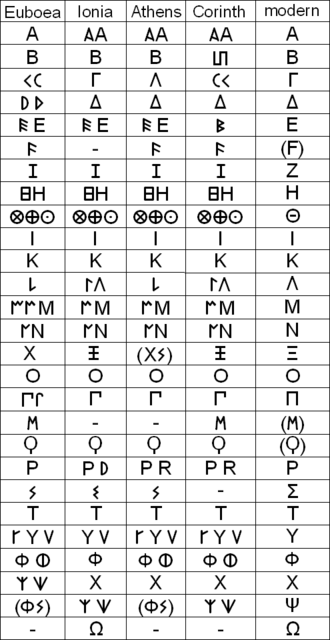
The Greek language holds a very important place in the history of the Western world. Beginning with the epic poetry of Homer, ancient Greek literature includes many works of lasting importance in the European canon. Greek is also the language in which many of the foundational texts in science and philosophy were originally composed.
The New Testament of the Christian Bible was also originally written in Greek. Together with the Latin texts and traditions of the Roman world, the Greek texts and Greek societies of antiquity constitute the objects of study of the discipline of Classics.
During antiquity, Greek was by far the most widely spoken lingua franca in the Mediterranean world. It eventually became the official language of the Byzantine Empire and developed into Medieval Greek. In its modern form, Greek is the official language of Greece and Cyprus and one of the 24 official languages of the European Union.
It is spoken by at least 13.5 million people today in Greece, Cyprus, Italy, Albania, Turkey, and the many other countries of the Greek diaspora.
Greek roots have been widely used for centuries and continue to be widely used to coin new words in other languages; Greek and Latin are highly-influential on the English language and remain the predominant sources of international scientific vocabulary.
History
Greek has been spoken in the Balkan peninsula since around the 3rd millennium BC, or possibly earlier. The earliest written evidence is a Linear B clay tablet found in Messenia that dates to between 1450 and 1350 BC, making Greek the world's oldest recorded living language. Among the Indo-European languages, its date of earliest written attestation is matched only by the now-extinct Anatolian languages.
Periods
The Greek language is conventionally divided into the following periods:
- Proto-Greek
- The unrecorded but assumed last ancestor of all known varieties of Greek. The unity of Proto-Greek would have ended as Hellenic migrants entered the Greek peninsula sometime in the Neolithic era or the Bronze Age.
- Mycenaean Greek
- The language of the Mycenaean civilisation. It is recorded in the Linear B script on tablets dating from the 15th century BC onwards.
- Ancient Greek
- In its various dialects, the language of the Archaic and Classical periods of the ancient Greek civilisation. It was widely known throughout the Roman Empire. Ancient Greek fell into disuse in Western Europe in the Middle Ages but remained officially in use in the Byzantine world and was reintroduced to the rest of Europe with the Fall of Constantinople and Greek migration to western Europe.
- Koine Greek (also known as Hellenistic Greek)
- The fusion of Ionian with Attic, the dialect of Athens, began the process that resulted in the creation of the first common Greek dialect, which became a lingua franca across the Eastern Mediterranean and Near East. Koine Greek can be initially traced within the armies and conquered territories of Alexander the Great; after the Hellenistic colonisation of the known world, it was spoken from Egypt to the fringes of India. Due to the widespread use of the Greek language during this period, a set of rules had to be established for the proper dissemination of the language. It is at this point that the term Hellenism (Ἑλληνισμός) first appears. Hellenism was used by the grammarians and Strabo to denote "correct Greek". After the Roman conquest of Greece, an unofficial bilingualism of Greek and Latin was established in the city of Rome and Koine Greek became the first or second language in the Roman Empire. In the eastern parts of the Roman Empire, Rome refrained from imposing the use of Latin and instead communicated with its subjects in Greek, even in regions where Greek was not the predominant spoken language. The origin of Christianity can also be traced through Koine Greek because the Apostles used this form of the language to spread Christianity. Because Koine was the original language of Christianity's New Testament, and the Hebrew Bible was translated into Koine as the Septuagint, that variety of Koine Greek may be referred to as New Testament Greek or sometimes Biblical Greek.
- Medieval Greek (also known as Byzantine Greek)
- The continuation of Koine Greek up to the demise of the Byzantine Empire in the 15th century. Medieval Greek is a cover phrase for a whole continuum of different speech and writing styles, ranging from vernacular continuations of spoken Koine that were already approaching Modern Greek in many respects, to highly learned forms imitating classical Attic. Much of the written Greek that was used as the official language of the Byzantine Empire was an eclectic middle-ground variety based on the tradition of written Koine.
- Modern Greek (also known as Neo-Hellenic)
- Stemming from Medieval Greek, Modern Greek usages can be traced in the Byzantine period, as early as the 11th century. It is the language used by the modern Greeks, and, apart from Standard Modern Greek, there are several dialects of it.
Diglossia
In the modern era, the Greek language entered a state of diglossia: the coexistence of vernacular and archaising written forms of the language. What came to be known as the Greek language question was a polarisation between two competing varieties of Modern Greek: Dimotiki, the vernacular form of Modern Greek proper, and Katharevousa, meaning 'purified', a compromise between Dimotiki and Ancient Greek developed in the early 19th century that was used for literary and official purposes in the newly formed Greek state.
In 1976, Dimotiki was declared the official language of Greece, after having incorporated features of Katharevousa and thus giving birth to Standard Modern Greek, used today for all official purposes and in education. The clash between Dimotiki and Katharevousa has sometimes been violent; renderings of ancient Greek or biblical works into vernacular Greek have come as far as to lead to the outbreak of riots – such as the Evangelika (Gospel riots) and the Orestiaka (Oresteia riots) – and even deaths.
Historical unity
The historical unity and continuing identity between the various stages of the Greek language are often emphasised. Although Greek has undergone morphological and phonological changes comparable to those seen in other languages, never since classical antiquity has its cultural, literary, and orthographic tradition been interrupted to the extent that one can speak of a new language emerging.
Greek speakers today still tend to regard literary works of ancient Greek as part of their own rather than a foreign language. It is also often stated that the historical changes have been relatively slight compared with some other languages. According to one estimation, "Homeric Greek is probably closer to Demotic than 12-century Middle English is to modern spoken English".
Geographic distribution
Greek is spoken today by at least 13 million people, principally in Greece and Cyprus along with a sizable Greek-speaking minority in Albania near the Greek-Albanian border. A significant percentage of Albania's population has knowledge of the Greek language due in part to the Albanian wave of immigration to Greece in the 1980s and '90s and the Greek community in the country.
Prior to the Greco-Turkish War and the resulting population exchange in 1923 a very large population of Greek-speakers also existed in Turkey, though very few remain today. A small Greek-speaking community is also found in Bulgaria near the Greek-Bulgarian border. Greek is also spoken worldwide by the sizeable Greek diaspora which has notable communities in the United States, Australia, Canada, South Africa, Chile, Brazil, Argentina, Russia, Ukraine, the United Kingdom, and throughout the European Union, especially in Germany.
Historically, significant Greek-speaking communities and regions were found throughout the Eastern Mediterranean, in what are today Southern Italy, Turkey, Cyprus, Syria, Lebanon, Israel, Palestine, Egypt, and Libya; in the area of the Black Sea, in what are today Turkey, Bulgaria, Romania, Ukraine, Russia, Georgia, Armenia, and Azerbaijan; and, to a lesser extent, in the Western Mediterranean in and around colonies such as Massalia, Monoikos, and Mainake. It was also used as the official language of government and religion in the Christian Nubian kingdoms, for most of their history.
Official status
Greek, in its modern form, is the official language of Greece, where it is spoken by almost the entire population. It is also the official language of Cyprus (alongside Turkish) and the British Overseas Territory of Akrotiri and Dhekelia (alongside English). Because of the membership of Greece and Cyprus in the European Union, Greek is one of the organization's 24 official languages.
Greek is recognized as a minority language in Albania, and used co-officially in some of its municipalities, in the districts of Gjirokastër and Sarandë. It is also an official minority language in the regions of Apulia and Calabria in Italy. In the framework of the European Charter for Regional or Minority Languages, Greek is protected and promoted officially as a regional and minority language in Armenia, Hungary, Romania, and Ukraine. It is recognized as a minority language and protected in Turkey by the 1923 Treaty of Lausanne.
Characteristics
The phonology, morphology, syntax, and vocabulary of the language show both conservative and innovative tendencies across the entire attestation of the language from the ancient to the modern period. The division into conventional periods is, as with all such periodizations, relatively arbitrary, especially because, in all periods, Ancient Greek has enjoyed high prestige, and the literate borrowed heavily from it.
Phonology
Across its history, the syllabic structure of Greek has varied little: Greek shows a mixed syllable structure, permitting complex syllabic onsets but very restricted codas. It has only oral vowels and a fairly stable set of consonantal contrasts. The main phonological changes occurred during the Hellenistic and Roman period (see Koine Greek phonology for details):
- replacement of the pitch accent with a stress accent.
- simplification of the system of vowels and diphthongs: loss of vowel length distinction, monophthongisation of most diphthongs and several steps in a chain shift of vowels towards /i/ (iotacism).
- development of the voiceless aspirated plosives /pʰ/ and /tʰ/ to the voiceless fricatives /f/ and /θ/, respectively; the similar development of /kʰ/ to /x/ may have taken place later (the phonological changes are not reflected in the orthography, and both earlier and later phonemes are written with φ, θ, and χ).
- development of the voiced plosives /b/, /d/, and /ɡ/ to their voiced fricative counterparts /β/ (later /v/), /ð/, and /ɣ/.
Morphology
In all its stages, the morphology of Greek shows an extensive set of productive derivational affixes, a limited but productive system of compounding and a rich inflectional system. Although its morphological categories have been fairly stable over time, morphological changes are present throughout, particularly in the nominal and verbal systems.
The major change in the nominal morphology since the classical stage was the disuse of the dative case (its functions being largely taken over by the genitive). The verbal system has lost the infinitive, the synthetically-formed future, and perfect tenses and the optative mood. Many have been replaced by periphrastic (analytical) forms.
Nouns and adjectives
Pronouns show distinctions in person (1st, 2nd, and 3rd), number (singular, dual, and plural in the ancient language; singular and plural alone in later stages), and gender (masculine, feminine, and neuter), and decline for case (from six cases in the earliest forms attested to four in the modern language). Nouns, articles, and adjectives show all the distinctions except for a person. Both attributive and predicative adjectives agree with the noun.
Verbs
The inflectional categories of the Greek verb have likewise remained largely the same over the course of the language's history but with significant changes in the number of distinctions within each category and their morphological expression. Greek verbs have synthetic inflectional forms for:
Syntax
Many aspects of the syntax of Greek have remained constant: verbs agree with their subject only, the use of the surviving cases is largely intact (nominative for subjects and predicates, accusative for objects of most verbs and many prepositions, genitive for possessors), articles precede nouns, adpositions are largely prepositional, relative clauses follow the noun they modify and relative pronouns are clause-initial.
However, the morphological changes also have their counterparts in the syntax, and there are also significant differences between the syntax of the ancient and that of the modern form of the language. Ancient Greek made great use of participial constructions and of constructions involving the infinitive, and the modern variety lacks the infinitive entirely (employing a raft of new periphrastic constructions instead) and uses participles more restrictively.
The loss of the dative led to a rise of prepositional indirect objects (and the use of the genitive to directly mark these as well). Ancient Greek tended to be verb-final, but neutral word order in the modern language is verb–subject–object or subject–verb–object.
Vocabulary
Modern Greek inherits most of its vocabulary from Ancient Greek, which in turn is an Indo-European language, but also includes a number of borrowings from the languages of the populations that inhabited Greece before the arrival of Proto-Greeks, some documented in Mycenaean texts; they include a large number of Greek toponyms.
The form and meaning of many words have changed. Loanwords (words of foreign origin) have entered the language, mainly from Latin, Venetian, Ottoman Turkish and Semitic languages. During the older periods of Greek, loanwords into Greek acquired Greek inflections, thus leaving only a foreign root word. Modern borrowings (from the 20th century on), especially from French and English, are typically not inflected; other modern borrowings are derived from Slavic languages, Albanian and Eastern Romance languages (Romanian and Aromanian).