Harrison Ford
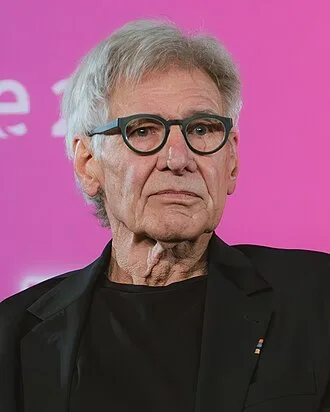
After making his screen debut in 1966 and early supporting roles in the films American Graffiti (1973) and The Conversation (1974), Ford achieved global stardom for portraying Han Solo in the space opera film Star Wars (1977), a role he reprised in four subsequent films for the eponymous franchise spanning the next four decades.
He also received recognition for his portrayal of the titular character in the Indiana Jones franchise (1981–2023); Rick Deckard in the Blade Runner franchise (1982–2017); and Jack Ryan in the action thriller films Patriot Games (1992) and Clear and Present Danger (1994). These roles established him as an action hero and one of Hollywood's most bankable stars from the late 1970s into the early 2000s.
Ford's performance in the thriller film Witness (1985) earned him his sole Oscar nomination for Best Actor. His other films include The Mosquito Coast (1986); Working Girl (1988); Presumed Innocent (1990); The Fugitive (1993); Sabrina (1995); The Devil's Own (1997); Air Force One (1997); Six Days, Seven Nights (1998); What Lies Beneath (2000); K-19: The Widowmaker (2002); Cowboys & Aliens (2011); 42 (2013); The Age of Adaline (2015); The Call of the Wild (2020); and Captain America: Brave New World (2025).
Ford has also starred in the Paramount+ western series 1923 (2022–2025) and the Apple TV+ comedy series Shrinking (since 2023), earning two nominations at the Primetime Emmy Awards for the latter.
Outside acting, Ford is a licensed pilot. He has often assisted the emergency services in rescue missions near his home in Wyoming and he chaired an aviation education program for youth from 2004 to 2009. Ford is also an environmental activist, having served as the inaugural vice chair of Conservation International since 1991. He is married to actress Calista Flockhart.
Early life and education
Harrison Ford was born on July 13, 1942, at the Swedish Covenant Hospital in the Lincoln Square community area of Chicago, Illinois, to Dorothy (née Nidelman) and advertising executive and former vaudeville and radio actor John William "Christopher" Ford. His mother has been described as a radio actress, but Harrison Ford denies this, and the attribution may be due to confusion with the unrelated actress and model Dorothy Ford.
Ford's younger brother, Terence, was born in 1945. Their father was an Irish Catholic, while their mother was an Ashkenazi Jew whose parents were emigrants from Minsk, Belarus, then in the Russian Empire. When asked in which religion he and his brother were raised, Ford jokingly responded "Democrat" and more seriously stated that they were raised to be "liberals of every stripe".
When asked about what influence his Jewish and Irish Catholic ancestry may have had on him, he quipped, "As a man I've always felt Irish, as an actor I've always felt Jewish."
Ford was a Boy Scout, achieving the second-highest rank of Life Scout. He worked at Napowan Adventure Base Scout Camp as a counselor for the Reptile Study merit badge. Because of this, he and director Steven Spielberg later decided to depict the young Indiana Jones as a Life Scout in Indiana Jones and the Last Crusade (1989).
Ford graduated in 1960 from Maine East High School in Park Ridge, Illinois. His voice was the first student voice broadcast on his high school's new radio station, WMTH, and he was its first sportscaster during his senior year. He attended Ripon College in Ripon, Wisconsin, where he was a philosophy major and a member of the Sigma Nu fraternity.
A self-described "late bloomer", Ford took a drama class in the final quarter of his senior year to get over his shyness and became fascinated with acting. Ford was expelled from college for plagiarism four days before graduation.
Career
1964–1976: Early work
In 1964, after a season of summer stock with the Belfry Players in Wisconsin, Ford traveled to Los Angeles and eventually signed a contract with Columbia Pictures' new talent program. His first known role was an uncredited one as a bellhop in Dead Heat on a Merry-Go-Round (1966). There is little record of his non-speaking (or "extra") roles in film.
Ford was at the bottom of the hiring list, having offended producer Jerry Tokofsky. According to one anecdote, Tokofsky told Ford that when actor Tony Curtis delivered a bag of groceries, he could tell that Curtis was a movie star whereas Ford was not; Ford immediately retorted that if Curtis was truly a talented actor, he would have delivered them like a bellhop.
Ford was apparently fired soon after. In 1970 Ford met Patricia McQueeney, who would go on to work as his agent and manager.
His speaking roles continued next with Luv (1967), though he was still uncredited. He was finally credited as "Harrison J. Ford" in the 1967 Western film A Time for Killing, starring Glenn Ford, George Hamilton and Inger Stevens, but the "J" did not stand for anything since he has no middle name. It was added to avoid confusion with a silent film actor named Harrison Ford, who appeared in more than 80 films between 1915 and 1932 and died in 1957.
Ford later said that he was unaware of the existence of the earlier actor until he came upon a star with his own name on the Hollywood Walk of Fame. Ford soon dropped the "J" and worked for Universal Studios, playing minor roles in many television series throughout the late 1960s and early 1970s, including Gunsmoke, Ironside, The Virginian, The F.B.I., Love, American Style and Kung Fu.
He appeared in the western Journey to Shiloh (1968) and had an uncredited, non-speaking role in Michelangelo Antonioni's 1970 film Zabriskie Point as an arrested student protester. In 1968, he also worked as a camera operator for one of the Doors' tours.[better source needed] French filmmaker Jacques Demy chose Ford for the lead role of his first American film, Model Shop (1969), but the head of Columbia Pictures thought Ford had "no future" in the film business and told Demy to hire a more experienced actor.
The part eventually went to Gary Lockwood. Ford later commented that the experience had been nevertheless a positive one because Demy was the first to show such faith in him.
Not happy with the roles offered to him, Ford became a self-taught professional carpenter to support his then-wife and two young sons. Clients at this time included the writers Joan Didion and John Gregory Dunne, who lived on the beach at Malibu. Ford appears in the documentary Joan Didion: The Center Will Not Hold.
He and his wife became friends of the writers. Casting director and fledgling producer Fred Roos championed the young Ford and secured him an audition with George Lucas for the role of Bob Falfa, which Ford went on to play in American Graffiti (1973). Ford's relationship with Lucas profoundly affected his career later.
After director Francis Ford Coppola's film The Godfather (1972) was a success, he hired Ford to expand his office and gave him small roles in his next two films, The Conversation (1974) and Apocalypse Now (1979); in the latter film, Ford played an army colonel named "G. Lucas".
1977–1997: Worldwide stardom and acclaim
Ford's work in American Graffiti eventually landed him his first starring film role, when Lucas hired him to read lines for actors auditioning for roles in Lucas's upcoming epic space-opera film Star Wars (1977). Lucas was eventually won over by Ford's performance during these line reads and cast him as Han Solo. Star Wars became one of the most successful and groundbreaking films of all time and brought Ford and his co-stars Mark Hamill and Carrie Fisher widespread recognition.
Ford began to be cast in bigger roles in films throughout the late 1970s, including Heroes (1977), Force 10 from Navarone (1978) and Hanover Street (1979). He also co-starred alongside Gene Wilder in the buddy-comedy western The Frisco Kid (1979), playing a bank robber with a heart of gold.
Ford returned to star in the successful Star Wars sequels The Empire Strikes Back (1980) and Return of the Jedi (1983), as well as the Star Wars Holiday Special (1978). Ford wanted Lucas to kill off Han Solo at the end of Return of the Jedi, saying, "That would have given the whole film a bottom," but Lucas refused.
Ford's status as a leading actor was solidified with Raiders of the Lost Ark (1981), an action-adventure collaboration between Lucas and Steven Spielberg that gave Ford his second franchise role as the heroic, globe-trotting archaeologist Indiana Jones. Like Star Wars, the film was massively successful; it became the highest-grossing film of the year.
Both Spielberg and Lucas were hesitant in casting Ford in the beginning according to Howard Kazanjian in his book A Producer's Life. Lucas's reasons were due to having already worked with him on both American Graffiti and Star Wars. Lucas relented after Tom Selleck was unable to accept, and Spielberg relented for that reason and after considering his performance in The Empire Strikes Back.
Ford went on to reprise the role throughout the rest of the decade in the prequel Indiana Jones and the Temple of Doom (1984) and the sequel Indiana Jones and the Last Crusade (1989). During the June 1983 filming of Temple of Doom in London, Ford herniated a disc in his back. The 40-year-old actor was forced to fly back to Los Angeles for surgery and returned six weeks later.
Following his leading-man success as Indiana Jones, Ford played Rick Deckard in Ridley Scott's dystopian science-fiction film Blade Runner (1982). Compared to his experiences on the Star Wars and Indiana Jones films, Ford had a difficult time with the production. He recalled to Vanity Fair, "It was a long slog.
I didn't really find it that physically difficult—I thought it was mentally difficult." Ford and Scott also had differing views on the nature of his character, Deckard, that persist decades later. While not initially a success, Blade Runner became a cult classic and one of Ford's most highly regarded films. Ford proved his versatility throughout the 1980s with dramatic parts in films such as Witness (1985), The Mosquito Coast (1986) and Frantic (1988), as well as the romantic male lead opposite Melanie Griffith and Sigourney Weaver in the comedy-drama Working Girl (1988). Witness and The Mosquito Coast allowed Ford to explore his potential as a dramatic actor and both performances were widely acclaimed.
Ford later recalled that working with director Peter Weir on Witness and The Mosquito Coast were two of the best experiences of his career.
In late 1991, Ford was scheduled to star in an action-historical film titled Night Ride Down, where he would have portrayed a Pullman Company executive whose daughter was kidnapped during a labor strike of the 1930s. Paramount Pictures shelved the project, after Ford quit the film over script changes he disagreed with.
In the next few years, Ford became the second actor to portray Jack Ryan in two films of the film series based on the literary character created by Tom Clancy: Patriot Games (1992) and Clear and Present Danger (1994), both co-starring Anne Archer and James Earl Jones. Ford took over the role from Alec Baldwin, who had played Ryan in The Hunt for Red October (1990).
This led to long-lasting resentment from Baldwin, who said that he had wanted to reprise the role but Ford had negotiated with Paramount behind his back. Ford played leading roles in other action-based thrillers throughout the decade, such as The Fugitive (1993), The Devil's Own (1997) and Air Force One (1997).
For his performance in The Fugitive, which co-starred Tommy Lee Jones, Ford received some of the best reviews of his career, including from Roger Ebert, who concluded that, "Ford is once again the great modern movie everyman. As an actor, nothing he does seems merely for show and in the face of this melodramatic material he deliberately plays down, lays low, gets on with business instead of trying to exploit the drama in meaningless acting flourishes."
Ford played more straight dramatic roles in Presumed Innocent (1990) and Regarding Henry (1991) and another romantic lead role in Sabrina (1995), a remake of the classic 1954 film of the same name. Ford established working relationships with many well-regarded directors during this time, including Weir, Alan J.
Pakula, Mike Nichols, Phillip Noyce and Sydney Pollack, collaborating twice with each of them. This was the most lucrative period of Ford's career. From 1977 to 1997, he appeared in 14 films that reached the top 15 in the yearly domestic box-office rankings, 12 of which reached the top ten. Six of the films he appeared in during this time were nominated for the Academy Award for Best Picture, among other awards: Star Wars, Apocalypse Now, Raiders of the Lost Ark, Witness, Working Girl and The Fugitive.
1998–2014: Established career
In the late 1990s, Ford started appearing in several critically derided and commercially disappointing films that failed to match his earlier successes, including Six Days, Seven Nights (1998), Random Hearts (1999), K-19: The Widowmaker (2002), Hollywood Homicide (2003), Firewall (2006) and Extraordinary Measures (2010).
One exception was What Lies Beneath (2000), which grossed over $155 million in the United States and $291 million worldwide. Ford served as an executive producer on K-19: The Widowmaker and Extraordinary Measures, both of which were based on true events.
In 2004, Ford declined a chance to star in the thriller Syriana, later commenting that "I didn't feel strongly enough about the truth of the material and I think I made a mistake." The role went to George Clooney, who won an Oscar and a Golden Globe for his work. Before that, Ford had passed on a role in another Stephen Gaghan-written film, that of Robert Wakefield in Traffic, which went to Michael Douglas.
In 2008, Ford enjoyed success with the release of Indiana Jones and the Kingdom of the Crystal Skull, the first Indiana Jones film in 19 years and another collaboration with Lucas and Spielberg. The film received generally positive reviews and was the second-highest-grossing film worldwide in 2008. Ford later said he would like to star in another sequel "if it didn't take another 20 years to digest." Other 2008 work included Crossing Over, directed by Wayne Kramer.
In the film, Ford plays an ICE/Homeland Security Investigations Special Agent, working alongside Ashley Judd and Ray Liotta. He also narrated a feature documentary film about the Dalai Lama, Dalai Lama Renaissance.
Ford filmed the medical drama Extraordinary Measures in 2009 in Portland, Oregon. Released on January 22, 2010, the film also starred Brendan Fraser and Alan Ruck. Also in 2010, he co-starred in the film Morning Glory, along with Rachel McAdams, Diane Keaton and Patrick Wilson. Although the film was a disappointment at the box office, Ford's performance was well received by critics, some of whom thought it was his best role in years.
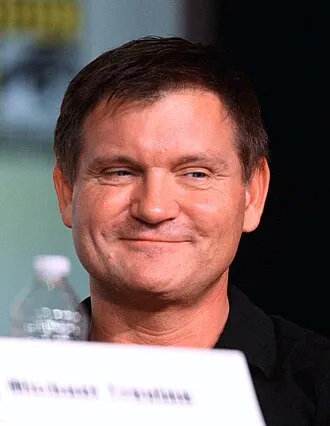
In July 2011, Ford starred alongside Daniel Craig and Olivia Wilde in the science-fiction/western hybrid film Cowboys & Aliens. To promote the film, he appeared at San Diego Comic-Con and, apparently surprised by the warm welcome, told the audience, "I just wanted to make a living as an actor. I didn't know about this." Also in 2011, Ford starred in Japanese commercials advertising the video game Uncharted 3: Drake's Deception for the PlayStation 3.
2013 began a trend that saw Ford accepting more diverse supporting roles. That year, he co-starred in the corporate espionage thriller Paranoia with Liam Hemsworth and Gary Oldman, whom he had previously worked with in Air Force One, and also appeared in Ender's Game, 42 and Anchorman 2: The Legend Continues.
Ford's performance as Branch Rickey in the film 42 was praised by many critics and garnered Ford a nomination as best supporting actor for the Satellite Awards. Initially, Brian Helgeland was hesitant to cast Ford, seeking a character actor for the role of Rickey. However, Ford's persistence and dedication to the role, including studying Rickey's life and adopting significant physical transformations, won Helgeland over.
Ford's commitment to embodying Rickey involved wearing a fat suit, prosthetics and mastering Rickey's distinctive voice and mannerisms. He researched Rickey's life, listened to recordings from the Baseball Hall of Fame and worked with a voice coach to capture Rickey's distinct speech. "I loved the language of the guy, I loved his style," Ford noted.
In a 2023 interview with James Hibberd of The Hollywood Reporter, Ford said Branch Rickey is one of his roles he is most proud of.
In 2014, he appeared in The Expendables 3 and the following year, co-starred with Blake Lively in the romantic drama The Age of Adaline to positive reviews.
📚 Source: Wikipedia