The majority of Italian nationals are native speakers of the country's official language, Standard Italian, a Romance language of the Indo-European language family that evolved from the Vulgar Latin. However, many of them also speak a regional or minority language native to Italy, the existence of which predates the national language of Standard Italian. (According to UNESCO, there are approximately 30 languages native to Italy, although many are often incorrectly referred to as "Italian dialects".)
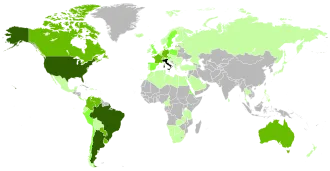
In addition to the approximately 55 million Italians living in Italy (91% of the Italian national population), Italian-speaking groups are found in neighboring nations, including Switzerland, France, the regions of Istria and Dalmatia, and the entire population of San Marino. Due to the wide-ranging diaspora of Italians following Italian unification, World War I, and World War II, over 5 million Italian citizens live outside of Italy and over 80 million people around the world claim full or partial Italian ancestry.
The largest Italian diaspora communities are found in Brazil (15% of Brazilians), Argentina (60% of Argentinians), the United States, and Canada.
Italians have influenced and contributed to fields like arts and music, science, technology, fashion, cinema, cuisine, restaurants, sports, jurisprudence, banking and business. Furthermore, Italian people are generally known for their attachment to their locale, expressed in the form of either regionalism or municipalism.
Name

The Latin name "Italia" may have been borrowed via Greek from the Oscan Víteliú ("land of calves"). Accounts by Dionysius of Halicarnassus, Aristotle, and Thucydides reference this etymology, together with the legend that Italy was named after legendary King Italus. According to Antiochus of Syracuse, the Greeks initially used the term Italy to refer only to the southern portion of the Bruttium peninsula (corresponding to parts of the modern provinces of Reggio, Catanzaro, and Vibo Valentia); however, over time, the Greeks gradually came to apply the name "Italia" to a larger region including Lucania and Calabria.
Roman historian Cato the Elder described Italy as the entire peninsula south of the Alps, which he said formed the "walls of Italy". In the 260s BCE, Roman Italy extended from the Arno and Rubicon rivers to the entire south. The northern area of Cisalpine Gaul was occupied by Rome in the 220s BC and became considered geographically and de facto part of Italy, but remained politically and de jure separated until Octavian legally merged it into the administrative unit of Italy in 42 BCE.
Under Emperor Diocletian, Italy was further enlarged to include the three big islands of the western Mediterranean Sea: Sicily (with the Maltese archipelago), Sardinia, and Corsica. All its inhabitants were considered Italic and Roman.
The Latin term Italicus was used to describe "a man of Italy" as opposed to a provincial from the greater Roman provinces. The Greeks likewise used terms such as Ἰταλικοί (Italikoi) and Ἰταλιώτης (Italiotes) to refer to the peoples and inhabitants of Italy. The adjective Italianus emerged in the medieval period and was used as an alternative alongside Italicus into the early modern period.
The Kingdom of Italy was created after the fall of the Western Roman Empire. The name "Italia" was retained for the kingdom under the Lombards and later their successor kingdom within the Holy Roman Empire.
History
Roman era
The Italian peninsula was divided into multiple tribal or ethnic territories prior to the Roman conquest of Italy in the 3rd century BCE. The Latins, with Rome as their capital, came to dominate the Italian peninsula by 218 BCE.[citation needed] They continued to expand beyond Italy, and after a century-long struggle against Carthage, Rome conquered Sicily, Sardinia, and Corsica.
By the end of the Third Punic War in 146 BCE, Rome had completely destroyed Carthage and become the dominant power in the Mediterranean.[citation needed] Unification and Romanization of Italy culminated in 88 BC, when, in the aftermath of the Social War, Rome granted Roman citizenship to all fellow Italic peoples.
Rome was originally a republican city-state, but four famous civil conflicts destroyed the Roman Republic: Sulla against Marius (88–82 BCE), Julius Caesar against Pompey (49–45 BC), Brutus and Cassius against Mark Antony and Octavian (43 BC), and Mark Antony against Octavian. Octavian, the final victor (31 BC), became the first Roman Emperor.[citation needed]
During the Crisis of the Third Century, the Roman Empire nearly collapsed under the combined pressures of invasions, civil wars, and hyperinflation.[citation needed] In 284 CE, Emperor Diocletian restored political stability. He divided the Roman Empire's territory and administration into the Western and Eastern Empires.[citation needed] Christianity became the Roman state religion in AD 380, under Emperor Theodosius I.[citation needed] The defeat of the last Western Roman emperor, Romulus Augustulus, by Germanic general Odoacer marked the end of the Western Roman Empire (and political unification of Italy until the establishment of the modern Kingdom of Italy in 1861).[citation needed]
The Middle Ages
Odoacer ruled as the first king of Italy. After the death of his successor Theodoric in 526 CE, the kingdom began to grow weak. By 553 CE, Byzantine Emperor Justinian I expelled the Ostrogoths from Italy and brought it back under Roman control.[citation needed] However, within twenty years, the Lombards invaded Italy and conquered most of the peninsula.[citation needed] (Remnants of Byzantine control remained in Southern Italy until the Arab conquest of Sicily in the 9th century and the Norman conquest of Southern Italy in the 11th; the interaction among Latin, Byzantine, Arab, and Norman cultures resulted in the formation of a unique Norman-Arab-Byzantine culture in Southern Italy.)[citation needed]
For two centuries following the Lombard invasion, the popes opposed foreign rule in Italy. They ultimately defeated the Lombards, with the aid of two Frankish kings, Pepin and Charlemagne, and established the Papal States in central Italy in 756.[citation needed] To cement the Church's alliance with Charlemagne, Pope Leo III crowned him the Roman Emperor in 800.
Members of the Carolingian dynasty continued to rule Italy, and this Kingdom of Italy became part of the Holy Roman Empire in the 10th century.[citation needed]
The Renaissance and the Age of Discovery
From the 11th century on, Italian cities rapidly grew in independence and importance, becoming centers of political life, banking, and foreign trade. Many, including Florence, Rome, Genoa, Milan, Pisa, Siena and Venice, grew into nearly independent city-states and maritime republics, each with its own foreign policy and trade.
By the 14th and 15th centuries, some Italian city-states, such as Venice and Florence, ranked among the most influential powers in Europe.[citation needed] The Italian merchant cities acted as a gateway for goods and ideas from the Byzantine and Islamic world into Europe; the Renaissance began in Florence in the 14th century and led to an unparalleled flourishing of the arts, literature, music, and science.
Italian explorers and navigators, eager to find alternative trade routes to the Indies, ushered in the Age of Discovery and the European colonization of the Americas. Notable among them were: Christopher Columbus (Cristoforo Colombo), who discovered the New World and opened the Americas for European conquest; John Cabot (Giovanni Caboto), the first European to arrive in Newfoundland; Amerigo Vespucci (for whom the Americas were named), who demonstrated circa 1501 that the New World was not Asia but a previously unknown continent; and Giovanni da Verrazzano, the first European to explore the Atlantic coast of North America.
The French Revolution and Napoleon
The French Revolution began in 1789 and immediately found supporters among the Italian people. After the French king was overthrown and France became a republic, secret clubs favouring an Italian republic were formed throughout Italy.[citation needed] In 1796, Napoleon Bonaparte led a French army into northern Italy and drove out its Austrian rulers.
Napoleon made himself emperor in 1804; parts of northern and central Italy were unified under the name of the Kingdom of Italy, with Napoleon as king, the rest was annexed by France.[citation needed] French domination, which lasted less than 20 years, brought representative assemblies and new laws that were uniform across the country; for the first time since ancient Rome, Italians from different regions were using the same money and served in the same army.
Many Italians began to see the possibility of a united Italy free of foreign control.[citation needed]
Italian unification and the Kingdom of Italy
In the aftermath of Napoleon's defeat and the Congress of Vienna, Italy came under control of the Austrian Empire and the Habsburg dynasty. Italian nationalist movements, led by reformers such as Giuseppe Mazzini, occurred in several parts of the peninsula from the 1830s to 1849.[citation needed] The Risorgimento revolution of the 1850s was ultimately successful, and on 17 March 1861, Victor Emmanuel II was proclaimed king of the Kingdom of Italy.[citation needed]
Italian troops occupied Rome in 1870, and in July 1871, it formally became the capital of the kingdom.[citation needed] Pope Pius IX, a longtime rival of Italian kings, stated he had been made a "prisoner" inside the Vatican walls and refused to cooperate with the royal administration. Only in 1929 did the pope accept the unified Italy with Rome as its capital.
The process of Italian unification was completed in World War I, with the annexation of Trieste, Istria, Trentino-Alto Adige, and Zara.[citation needed] After World War I, Italy emerged as one of the world's four great powers. In the decades following unification, Italy began creating colonies in Africa, and under Benito Mussolini's Fascist regime conquered Ethiopia, founding the Italian Empire in 1936.[citation needed] The population of Italy grew to 45 million in 1940 and the economy, which had been based upon agriculture until that time, started its industrial development, mainly in northern Italy.[citation needed]
The Italian Republic
On 2 June 1946, Italy held its first free election after more than 20 years of Fascist rule. Italians chose to replace the monarchy, which had been closely associated with Fascism, with a republic.[citation needed] They elected a Constituent Assembly of anti-fascist representatives, which created a new democratic Italian constitution in 1947.
Under the Treaty of Peace with Italy, Yugoslavia annexed Istria, Kvarner, most of the Julian March, and Zara, which led to the emigration of between 230,000 and 350,000 ethnic Italians, Slovenians, Croatians, and Istro-Romanians, who chose to maintain Italian citizenship.
In 1949 Italy became a member of NATO. The Marshall Plan helped to revive the Italian economy which, until the late 1960s, enjoyed a period of sustained economic growth commonly called the "Economic Miracle".[citation needed] In 1957, Italy was a founding member of the European Economic Community (EEC), which became the European Union (EU) in 1993.[citation needed]
Ethnogenesis
Due to historic demographic shifts in the Italian peninsula throughout history, its geographical position in the center of the Mediterranean Sea, and Italy's regional ethnic diversity since ancient times, modern Italians are genetically diverse.