James Earl Jones
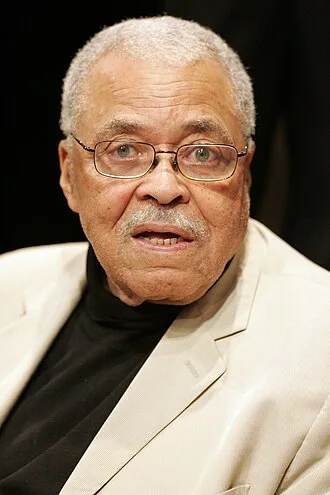
Born in Arkabutla, Mississippi, Jones overcame a childhood stutter. A pre-med major in college, he served as an officer in the U.S. Army during the Korean War before pursuing a career in acting. His deep voice was praised as a "stirring basso profondo that has lent gravel and gravitas" to his projects. Jones made his Broadway debut in the play Sunrise at Campobello (1957) and gained fame starring in several productions with Shakespeare in the Park including Othello (1964), Coriolanus (1965), Hamlet (1972), and King Lear (1973).
For his roles on Broadway, Jones won two Tony Awards for Best Actor in a Play for playing a boxer in the Howard Sackler play The Great White Hope (1968) and a working class father in August Wilson's Fences (1987). He was nominated for other Tonys for his roles as part of an elderly couple in On Golden Pond (2005) and as a former president in The Best Man (2012).
Jones acted in Cat on a Hot Tin Roof (2008), Driving Miss Daisy (2010–2011), You Can't Take It with You (2014), and The Gin Game (2015). He received a Special Tony Award for Lifetime Achievement in 2017.
On film, Jones made his acting debut in Stanley Kubrick's Dr. Strangelove (1964). He reprised his Broadway role in the film adaptation of The Great White Hope (1970), earning a nomination for the Academy Award for Best Actor. He gained international fame for his voice roles such as Darth Vader in the Star Wars franchise and Mufasa in The Lion King (1994).
He acted in The Man (1972), Claudine (1974), Conan the Barbarian (1982), Matewan (1987), Coming to America (1988), Field of Dreams (1989), The Hunt for Red October (1990), Sneakers (1992), The Sandlot (1993), and Cry, the Beloved Country (1995).
Early life and education
James Earl Jones was born in Arkabutla, Mississippi, on January 17, 1931, to Ruth (née Connolly; 1911–1986), a teacher and maid, and Robert Earl Jones (1910–2006), a boxer, butler, and chauffeur. His father left the family shortly after James Earl's birth and later became a stage and screen actor in New York and Hollywood.
Jones and his father did not get to know each other until the 1950s, when they reconciled. He said in interviews that his parents were of mixed African-American, Irish, and Native American ancestry.
From the age of five, Jones was raised by his maternal grandparents, John Henry and Maggie Connolly, on their farm in Dublin, Michigan; they had moved from Mississippi in the Great Migration. Jones found the transition to living with his grandparents in Michigan traumatic and developed a stutter so severe that he refused to speak.
He said, "I was a stutterer. I couldn't talk. So my first year of school was my first mute year, and then those mute years continued until I got to high school." He credited his English teacher, Donald Crouch, who discovered he had a gift for writing poetry, with helping him end his silence. Crouch urged him to challenge his reluctance to speak through reading poetry aloud to the class.
In 1949, Jones graduated from Dickson Rural Agricultural School (now Brethren High School) in Brethren, Michigan, where he served as vice president of his class.
He attended the University of Michigan where he was initially a pre-med major. He joined the Reserve Officers' Training Corps and excelled. He felt comfortable within the structure of the military environment and enjoyed the camaraderie of his fellow cadets in the Pershing Rifles Drill Team and Scabbard and Blade Honor Society.
After his junior year, he focused on drama with the thought of doing something he enjoyed, before (he assumed) he would have to go off to fight in the Korean War. Jones graduated from the university in 1955 with a Bachelor of Arts, majoring in drama.
Military service
With the Korean War intensifying, Jones expected to receive orders to active duty and be deployed as soon as he received his commission as a second lieutenant. While he waited for his orders, he worked on the stage crew and acted at the Ramsdell Theatre in Manistee, Michigan. Jones was commissioned in mid-1953, after the Korean War's end, and reported to Fort Benning to attend the Infantry Officers Basic Course.
He attended Ranger School and received his Ranger Tab. Jones was assigned to Headquarters and Headquarters Company, 38th Regimental Combat Team. He was initially to report to Fort Leonard Wood, but his unit was instead sent to establish a cold-weather training command at the former Camp Hale near Leadville, Colorado. His battalion became a training unit in the rugged terrain of the Rocky Mountains. Jones was promoted to first lieutenant prior to his discharge.
Jones moved to New York City, where he studied at the American Theatre Wing and worked as a janitor to support himself.
Career
1953–1972: Early roles and Shakespeare in the Park
Jones began his acting career at the Ramsdell Theatre in Manistee, Michigan. In 1953, he was a stage carpenter, and between 1955 and 1957, he acted and was a stage manager. In his first acting season at the Ramsdell, he portrayed Othello. His early career included an appearance in the ABC radio anthology series Theatre-Five.
In 1957, he made his Broadway debut as understudy to Lloyd Richards in the short-lived play, The Egghead, by Molly Kazan. The play ran only 21 performances, but three months later, in January 1958, Jones created the featured role of Edward the butler in Dore Schary's Sunrise at Campobello at the Cort Theatre.[better source needed]
During the early to mid 1960s, Jones acted in various works of William Shakespeare, becoming one of the best known Shakespearean actors of the time. He tackled roles such as Othello and King Lear, Oberon in A Midsummer Night's Dream, Abhorson in Measure for Measure, and Claudius in Hamlet all at Shakespeare in the Park.
In 1961, Jones appeared in an Off-Broadway production of The Blacks by Jean Genet, alongside eight subsequently prominent Black actors, including Roscoe Lee Browne, Cicely Tyson, Lou Gossett and others. The New York Public Library has a collection of photographs of this production, including one of Tyson and Jones.
During a production of The Merchant of Venice at Shakespeare in the Park, Stanley Kubrick saw George C. Scott play Shylock and Jones portray the Prince of Morocco. Kubrick was there initially to cast Scott in Dr. Strangelove or: How I Learned to Stop Worrying and Love the Bomb (1964), but then considered Jones saying "I'll take the black one too." Jones portrayed young Lt. Lothar Zogg, the B-52 bombardier in the film — this role marked his feature film debut.
Jones played a surgeon and Haitian rebel leader in The Comedians, with Richard Burton, Elizabeth Taylor, and Alec Guinness. In December 1967, Jones starred with Jane Alexander in Howard Sackler's play, The Great White Hope, at the Arena Stage in Washington, D.C. Jones took the role of the talented but troubled boxer "Jack Jefferson", who is based on the real champion Jack Johnson.
The play was a major success when it moved to Broadway on October 3, 1968 and was well received, winning the Pulitzer Prize for Drama. Jones won the 1969 Tony Award for Best Actor in a Play and the Drama Desk Award for his performance.
In 1969, Jones participated in making test films for the children's education series Sesame Street; these shorts, combined with animated segments, were shown to groups of children to gauge the effectiveness of the then-groundbreaking Sesame Street format. As cited by production notes included in the DVD release Sesame Street: Old School 1969–1974, the short that had the greatest impact with test audiences was one showing bald-headed Jones counting slowly to ten.
This and other segments featuring Jones were eventually aired as part of the Sesame Street series when it debuted in 1969 and Jones is often cited as the first celebrity guest on that series, although a segment with Carol Burnett was the first actually to be broadcast. He appeared on the soap opera Guiding Light.
In 1970, Jones reunited with Jane Alexander in the film adaptation of The Great White Hope. This was Jones's first leading film role. Jones portrayed boxer Jack Johnson, a role he had previously originated on stage. His performance was acclaimed by critics and earned him an Academy Award nomination for Best Actor.
He was the second African-American male performer after Sidney Poitier to be nominated for this award. Variety described his performance declaring, "Jones' recreation of his stage role is an eye-riveting experience. The towering rages and unrestrained joys of which his character was capable are portrayed larger than life." In The Man (1972), Jones starred as a senator who unexpectedly becomes the first African-American president of the United States.
1973–1983: Star Wars and rise to prominence
In 1973, Jones played Hickey on Broadway at the Circle in the Square Theatre in a revival of Eugene O'Neill's The Iceman Cometh and starred in the title role of William Shakespeare's King Lear opposite Paul Sorvino, René Auberjonois, and Raul Julia at the New York City Shakespeare Festival in Central Park, which was recorded and broadcast in the PBS Great Performances series the following year. In 1974, Jones played Lennie on Broadway in the 1974 Brooks Atkinson Theatre production of the adaptation of John Steinbeck's novella, Of Mice and Men, with Kevin Conway as George and Pamela Blair as Curley's wife.
In 1974, Jones co-starred with Diahann Carroll in the film Claudine, the story of a woman who raises her six children alone after two failed and two "almost" marriages. The film is a romantic comedy and drama, focusing on systemic racial disparities black families face. It was one of the first major films to tackle themes such as welfare, economic inequality, and the typical marriage of men and women in the African American community during the 1970s.
Jones and Carroll received critical acclaim and Golden Globe nominations for their performances. Carroll was nominated for an Academy Award for Best Actress.
In 1977, Jones played Balthazar in the television series Jesus of Nazareth. That same year, he made his debut in his iconic voiceover role as Darth Vader in George Lucas's space opera blockbuster film Star Wars: A New Hope, which he reprised for the sequels The Empire Strikes Back (1980) and Return of the Jedi (1983).
Darth Vader was portrayed in costume by David Prowse in the film trilogy, with Jones dubbing Vader's dialogue in post-production because Prowse's strong West Country accent was deemed unsuitable for the role by director George Lucas. At his own request, Jones was uncredited for the release of the first two Star Wars films, though he was credited for the third film and eventually for the first film's 1997 "Special Edition" re-release. As he explained in a 2008 interview:
When Linda Blair did the girl in The Exorcist, they hired Mercedes McCambridge to do the voice of the devil coming out of her. And there was controversy as to whether Mercedes should get credit. I was one who thought no, she was just special effects. So when it came to Darth Vader, I said, no, I'm just special effects. But it became so identified that by the third one, I thought, OK I'll let them put my name on it.
In 1977, Jones also received a Grammy Award for Best Spoken Word Album for Great American Documents. In late 1979, Jones appeared on the short-lived CBS police drama Paris. Jones starred that year in the critically acclaimed TV mini-series sequel Roots: The Next Generations as the older version of author Alex Haley.
1985–1999: Broadway and film roles
In 1987, Jones starred in August Wilson's play Fences as Troy Maxson, a middle aged working class father who struggles to provide for his family. The play, set in the 1950s, is part of Wilson's ten-part "Pittsburgh Cycle". The play explores the evolving African-American experience and examines race relations, among other themes.
Jones won critical acclaim, earning himself his second Tony Award for Best Actor in a Play. Beside the Star Wars sequels, Jones was featured in several other box office hits of the 1980s: the action-fantasy film Conan the Barbarian (1982), the Eddie Murphy comedy Coming to America (1988), and the sports drama-fantasy Field of Dreams (1989) which earned an Academy Award for Best Picture nomination.
He also starred in the independent film Matewan (1987), which dramatized the events of the Battle of Matewan, a coal miners' strike in 1920 in Matewan, a small town in the hills of West Virginia. He received an Independent Spirit Award nomination for his performance.
In 1985, Jones lent his bass voice as Pharaoh in the first episode of Hanna-Barbera's The Greatest Adventure: Stories from the Bible. From 1989 to 1992, Jones served as the host of the children's TV series Long Ago and Far Away. Jones appeared in several more successful films during the early-to-mid-1990s, including The Hunt for Red October (1990), Patriot Games (1992), Sneakers (1992), Sommersby (1993), The Sandlot (1993), Clear and Present Danger (1994), and Cry, the Beloved Country (1995).
He lent his voice to the role of Mufasa in the 1994 Disney animated film The Lion King. In 1992, Jones was presented with the National Medal of the Arts by President George H. W. Bush. Jones had the distinction of winning two Primetime Emmys in the same year, in 1991 as Best Actor for his role in Gabriel's Fire and as Best Supporting Actor for his work in Heat Wave.
Jones performed voice work for The Simpsons: in the 1990 "Treehouse of Horror" Halloween special and in two other episodes.
Jones played lead characters on television in three series. Gabriel's Fire and a revamped version called Pros and Cons aired on ABC between 1990 and 1992. In both formats of that show, Jones played a former policeman wrongly convicted of murder who, upon his release from prison, becomes a private eye. In 1995, Jones starred in Under One Roof as Neb Langston, a widowed African-American police officer sharing his home with his daughter, his married son and children, and Neb's newly adopted son.
The show was a mid-season replacement and lasted six weeks, and earned him another Emmy nomination. He portrayed Thad Green on "Mathnet", a parody of Dragnet that appeared in the PBS program Square One Television. In 1998, Jones starred in the acclaimed syndicated program An American Moment (created by James R. Kirk and Ninth Wave Productions). Jones took over the role filled by Charles Kuralt, upon Kuralt's death.
On July 13, 1993, accompanied by the Morgan State University choir, Jones spoke the U.S. national anthem before the 1993 Major League Baseball All-Star Game in Baltimore. In 1996, he recited the classic baseball poem "Casey at the Bat" with the Cincinnati Pops Orchestra, and on June 1, 2007, he did the same before a Philadelphia Phillies home game.
In 1994, he performed the role of "Ebenezer Scrooge" alongside Martin Sheen and Robert MacNeil in a public reading of A Christmas Carol at the Pierpont Morgan Library in New York City, which was broadcast on PBS. Jones appeared in the 1999 Disney animated film Fantasia 2000, introducing the segment The Carnival of the Animals.
📚 Source: Wikipedia