Jeremy Irons
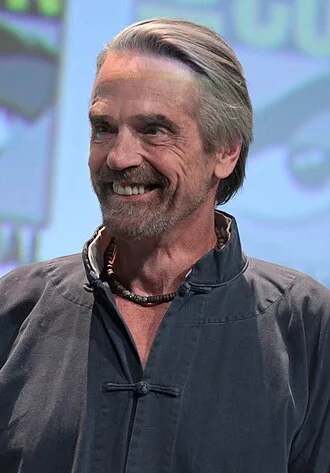
Irons received classical training at the Bristol Old Vic Theatre School and started his acting career on stage in 1969. He appeared in many West End theatre productions, including the Shakespeare plays The Winter's Tale, Macbeth, Much Ado About Nothing, The Taming of the Shrew, and Richard II. In 1984, he made his Broadway debut in Tom Stoppard's The Real Thing, receiving the Tony Award for Best Actor in a Play.
His first major film role came in The French Lieutenant's Woman (1981), for which he received a BAFTA Award for Best Actor nomination. After starring in dramas such as Moonlighting (1982), Betrayal (1983), The Mission (1986), and Dead Ringers (1988), he received the Academy Award for Best Actor for his portrayal of Claus von Bülow in Reversal of Fortune (1990).
Other notable films include Kafka (1991), Damage (1992), M. Butterfly (1993), Die Hard with a Vengeance (1995), Lolita (1997), The Man in the Iron Mask (1998), Dungeons & Dragons (2000), The Merchant of Venice (2004), Kingdom of Heaven (2005), Eragon (2006), Appaloosa (2008), The Pink Panther 2 (2009), Margin Call (2011), The Words (2012) and The Man Who Knew Infinity (2015).
He voiced Scar in Disney's The Lion King (1994) and played Alfred Pennyworth in the DC Extended Universe (2016–2023) franchise.
On television, Irons's breakthrough role came playing Charles Ryder in the ITV series Brideshead Revisited (1981), receiving nominations for the BAFTA TV Award, Primetime Emmy Award, Golden Globe Award for Best Actor. He received the Primetime Emmy Award for his portrayal of Robert Dudley, 1st Earl of Leicester in the HBO miniseries Elizabeth I (2005) and was Emmy-nominated for playing Adrian Veidt in HBO's Watchmen (2019).
He starred as Pope Alexander VI in the Showtime historical series The Borgias (2011–2013). In October 2011, he was named the Goodwill Ambassador for the UN's Food and Agriculture Organization.
Early life and education
Jeremy John Irons was born on 19 September 1948 in Cowes on the Isle of Wight, to Paul Dugan Irons, an accountant, and Barbara Anne Brereton Brymer (née Sharpe).[citation needed] Irons has a brother and a sister. He was educated at the independent Sherborne School in Dorset from 1962 to 1966. He was the drummer and harmonica player in a four-man school band called the Four Pillars of Wisdom.
Career
1969–1979: Early work and theatre roles
Irons trained as an actor at the Bristol Old Vic Theatre School and later became president of its fundraising appeal. He performed many plays, and busked on the streets of Bristol, before appearing on the London stage as John the Baptist and Judas opposite David Essex in Godspell, which opened at the Roundhouse on 17 November 1971 before transferring to Wyndham's Theatre playing a total of 1,128 performances.
Irons's television career began on British television in the early 1970s, including appearances on the children's series Play Away and as Franz Liszt in the BBC series Notorious Woman (1974). More significantly, he starred in the 13-part adaptation of H. E. Bates's novel Love for Lydia (1977) for London Weekend Television, and attracted attention for his key role as the pipe-smoking German student, a romantic pairing with Judi Dench, in Harold Pinter's screenplay adaptation of Aidan Higgins's novel Langrishe, Go Down (1978) for BBC Television. Irons has worked with the Royal Shakespeare Company three times in 1976, 1986–1987 and 2010.
After years of success in the West End in London, Irons made his New York debut as Henry, a man engaging in an affair in the Tom Stoppard play The Real Thing at the Plymouth Theatre on Broadway acting opposite Glenn Close. Irons won the Tony Award for Best Actor in a Play. Frank Rich of The New York Times wrote, "Given the sublime cast led by Mr.
Irons and Glenn Close - and the bravura force of Mike Nichols's direction - any repeat viewings are likely to be as dazzling as the first". He added "Mr. Irons...has never been better: he captures Henry's magnetic public charm, then goes on to reveal the suffering and longing within."
1980–1999: Breakthrough and film stardom
The role which significantly raised his profile was Charles Ryder in the television adaptation of Evelyn Waugh's Brideshead Revisited (1981). First broadcast on ITV, the show ranks among the most successful British television dramas, with Irons receiving nominations for the British Academy Television Award, the Primetime Emmy Award, and the Golden Globe Award for Best Actor. Brideshead reunited him with Anthony Andrews, with whom he had appeared in The Pallisers seven years earlier.
Around the same time, he starred in the film The French Lieutenant's Woman (also 1981) opposite Meryl Streep. Vincent Canby of The New York Times compared him to a young Laurence Olivier writing, "Mr. Irons seems to be one of the few actors today who could be so completely convincing as the Victorian lover who thinks he's ahead of his time, being a follower of Darwin and a socially enlightened member of his privileged class, but who finds, ultimately, that he still has a long way to go."
After these major successes, he played the leading role of an exiled Polish building contractor, working in the Twickenham area of southwest London, in Jerzy Skolimowski's independent film Moonlighting (1982). Irons made his film debut in Nijinsky in 1980. In addition, he appeared in the Cannes Palme d'Or winner The Mission in 1986 and in the dual role of twin gynecologists in David Cronenberg's Dead Ringers alongside Geneviève Bujold in 1988.
Irons would later win Best Actor for Dead Ringers from the New York Film Critics Circle that year. On 23 March 1991, he hosted Saturday Night Live on NBC in the US, and appeared as Sherlock Holmes in the Sherlock Holmes' Surprise Party sketch. In 1985, Irons directed a music video for Carly Simon and her heavily promoted single, "Tired of Being Blonde", and in 1994, he had a cameo role in the video for Elastica's hit single "Connection".
Irons has contributed to other musical performances, recording William Walton's Façade with Dame Peggy Ashcroft, Stravinsky's L'Histoire du Soldat conducted by the composer, and in 1987 the songs from Lerner and Loewe's My Fair Lady with Dame Kiri Te Kanawa, released on the Decca label. In 1994, Irons lent his distinctive voice to the antagonist Scar in the Walt Disney Animated film The Lion King (1994), where it became one of his best-known film roles.
In the film Irons sang segments of "Be Prepared". He acted alongside Matthew Broderick, Nathan Lane, James Earl Jones, Rowan Atkinson and Whoopi Goldberg. Irons has since provided voiceovers for three Disney World attractions. He narrated the Spaceship Earth ride, housed in the large geodesic globe at Epcot in Florida from October 1994 to July 2007.
He was also the English narrator for the Studio Tram Tour: Behind the Magic at the Walt Disney Studios Park at Disneyland Paris. He voiced H. G. Wells in the English-language version of the former Disney attraction The Timekeeper. He also reprised his role as Scar in Fantasmic. He is also one of the readers in the 4x CD boxed set of The Fairy Tales of Oscar Wilde, produced by Marc Sinden and sold in aid of the Royal Theatrical Fund.
He serves as the English-language version of the audio guide for Westminster Abbey in London. He voiced English soldier and WWI poet Siegfried Sassoon in The Great War and the Shaping of the 20th Century (1997), receiving the Primetime Emmy Award for Outstanding Voice-Over Performance. Other films include Danny the Champion of the World (1989), Reversal of Fortune (1990), for which he won the Academy Award for Best Actor, Kafka (1991), Damage (1993), M.
Butterfly (1993) working again with David Cronenberg, The House of the Spirits (1993) appearing again with Glenn Close, Meryl Streep, Winona Ryder and Antonio Banderas. Afterwards, he portrayed Simon Gruber in Die Hard with a Vengeance (1995), co-starring Bruce Willis and Samuel L. Jackson. He also featured in Bernardo Bertolucci's Stealing Beauty (1996), Chinese Box (1997), the 1997 remake of Lolita, and the 1998 film version of The Man in the Iron Mask, playing the musketeer Aramis share credit with Leonardo DiCaprio, John Malkovich, Gérard Depardieu and Gabriel Byrne.
2000–2010: Being Julia, Elizabeth I and roles in blockbusters
To mark the 100th anniversary of Noël Coward's birth, Irons sang a selection of his songs at the 1999 Last Night of the Proms held at the Royal Albert Hall in London, ending with "London Pride", a patriotic song written in the spring of 1941 during the Blitz. In 2003, Irons played Fredrik Egerman in a New York revival of Stephen Sondheim's A Little Night Music, and two years later appeared as King Arthur in Lerner and Loewe's Camelot at the Hollywood Bowl.
He performed the Bob Dylan song "Make You Feel My Love" on the 2006 charity album Unexpected Dreams – Songs From the Stars. Other roles include the wicked wizard Profion in the film Dungeons and Dragons (2000) and Rupert Gould in Longitude (2000). He played the Über-Morlock in the film The Time Machine (2002).
In 2004, Irons played the title character in The Merchant of Venice. In 2005, he appeared in the films Casanova opposite Heath Ledger, and Ridley Scott's Kingdom of Heaven. He reunited with his The Man in the Iron Mask co-star John Malkovich in Eragon (2006), though they didn't have any scenes together this time.
In 2004 Irons played Severus Snape in the BBC's Comic Relief's Harry Potter parody, "Harry Potter and the Secret Chamberpot of Azerbaijan".
In 2004, he starred in István Szabó's Being Julia opposite Annette Bening, receiving a Satellite Award nomination for his performance. In 2005, Irons portrayed Robert Dudley, 1st Earl of Leicester in the Channel 4-HBO mini-series, Elizabeth I, in which he starred opposite Helen Mirren (Queen Elizabeth I).
Rupert Smith of The Guardian praised their on-screen chemistry, writing, "Mirren and Irons are a screen marriage made in heaven, and when they let rip with the thwarted passion all might have been well." Irons won both a Primetime Emmy Award for Outstanding Supporting Actor in a Limited Series or Movie and a Golden Globe Award for Best Supporting Actor – Series, Miniseries or Television Film for his performance.
A year later, he participated in the third series of the BBC documentary series Who Do You Think You Are? In 2008, he played Lord Havelock Vetinari in Terry Pratchett's The Colour of Magic, an adaptation for Sky One. In 2006, Irons appeared with Laura Dern in David Lynch's Inland Empire. After an absence from the London stage for 18 years, in 2006 he co-starred with Patrick Malahide in Christopher Hampton's stage adaptation of Sándor Márai's novel Embers at the Duke of York's Theatre.
He made his National Theatre debut playing former British Prime Minister Harold Macmillan (1957–1963) in Never So Good, a new play by Howard Brenton which opened at the Lyttelton on 19 March 2008. In 2009, Irons appeared on Broadway opposite Joan Allen in the play Impressionism. The play ran through 10 May 2009 at the Gerald Schoenfeld Theater.
In 2008, Irons co-starred with Ed Harris and Viggo Mortensen in the western drama Appaloosa, directed by Harris. On 6 November 2008, TV Guide reported Irons would star as photographer Alfred Stieglitz with Joan Allen as painter Georgia O'Keeffe, in a Lifetime Television biopic, Georgia O'Keeffe (2009).
For his performance, he was nominated for the Golden Globe Award for Best Actor – Miniseries or Television Film and the Screen Actors Guild Award for Outstanding Actor in a Miniseries or Television Movie. In 2008, two researchers, a linguist and a sound engineer, found "the perfect [male] voice" to be a combination of Irons's and Alan Rickman's voices based on a sample of 50 voices.
Coincidentally, the two actors played brothers in the Die Hard series of films. Speaking at 200 words per minute and pausing for 1.2 seconds between sentences, Irons came very close to the ideal voice model, with the linguist Andrew Linn explaining why his "deep gravelly tones" inspired trust in listeners.
📚 Source: Wikipedia