Juliette Binoche
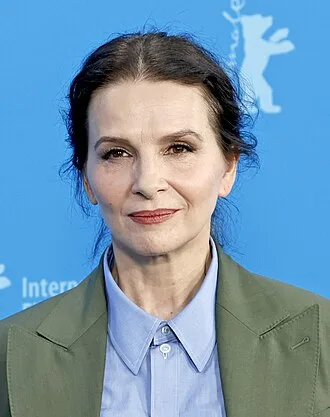
Binoche first gained recognition for working with such auteur directors as Jean-Luc Godard (Hail Mary, 1985), Jacques Doillon (Family Life, 1985), and André Téchiné; the latter made her a star in France with a leading role in his drama Rendez-vous (1985). She won the Volpi Cup and César Award for Best Actress for her performance as a grieving music composer in Krzysztof Kieślowski's Three Colours: Blue (1993), and the Academy Award for Best Supporting Actress for playing a nurse in The English Patient (1996).
For starring in the romantic film Chocolat (2000), Binoche received a nomination for the Academy Award for Best Actress. In 2010, she won the Cannes Film Festival Award for Best Actress for her role as an antiques dealer in Abbas Kiarostami's Certified Copy. Binoche has since starred in such films as Clouds of Sils Maria (2014), Happy End (2017), High Life (2018), The Taste of Things (2023), and The Return (2024).
Binoche has appeared on stage intermittently, most notably in a 1998 West End theatre production of Luigi Pirandello's Naked and in a 2000 production of Harold Pinter's Betrayal on Broadway for which she was nominated for the Tony Award for Best Actress in a Play. In 2008, she began a world tour with a modern dance production, in-i, devised in collaboration with Akram Khan.
Early life
Binoche was born in Paris, the daughter of Jean-Marie Binoche, a director, actor, and sculptor, and Monique Yvette Stalens (born 1939), a teacher, director, and actress. Her father, who is French, also has one eighth Portuguese-Brazilian ancestry; he was raised partly in Morocco by his French-born parents. Her mother was born in Częstochowa, Poland.
Binoche's maternal grandfather, Andre Stalens, was born in Poland, of Belgian (Walloon) and French descent, and Binoche's maternal grandmother, Julia Helena Młynarczyk, was of Polish origin. Both of them were actors who were born in Częstochowa; the German Nazi occupiers imprisoned them at Auschwitz as intellectuals.
Her great-uncle was Léon Binoche, who won a gold medal in rugby at the 1900 Paris Olympics.
When Binoche's parents divorced in 1968, four-year-old Juliette and her sister Marion were sent to a provincial boarding school. During their teens, the Binoche sisters spent their school holidays with their maternal grandmother, not seeing their parents for months at a time. Binoche has stated that this perceived parental abandonment had a profound effect on her.
She was not particularly academic and in her teenage years began acting at school in amateur stage productions. At seventeen, she directed and starred in a student production of the Eugène Ionesco play, Exit the King. She studied acting at the Conservatoire National Supérieur d'Art Dramatique (CNSAD), but quit after a short time as she disliked the curriculum.
In the early 1980s, she found an agent through a friend and joined a theater troupe, touring France, Belgium and Switzerland under the pseudonym "Juliette Adrienne". Around this time, she began lessons with acting coach Vera Gregh.
Her first professional screen experience came as an extra in the three-part TF1 television series Dorothée, danseuse de corde (1983) directed by Jacques Fansten, followed by a similarly small role in the provincial television film Fort bloque directed by Pierrick Guinnard. After this, Binoche secured her first feature-film appearance with a minor role in Pascal Kané's Liberty Belle (1983). Her role required just two days on-set, but was enough to inspire Binoche to pursue a career in film.
Career
1984–1991
Binoche's early films established her as a French star of some renown. In 1983, she auditioned for the female lead in Jean-Luc Godard's controversial Hail Mary, a modern retelling of the Virgin birth. Godard requested a meeting with Binoche having seen a photo of her taken by her boyfriend at the time. Although she said she spent six months on the film's set in Geneva, her presence in the final cut is confined to just a few scenes.
Further supporting roles followed in a variety of French films. Annick Lanoë's Les Nanas gave Binoche her most noteworthy role to date, playing opposite established stars Marie-France Pisier and Macha Méril in a mainstream comedy, though she has stated the experience was not particularly memorable or influential.
She gained more significant exposure in Jacques Doillon's critically acclaimed Family Life cast as the volatile teenage step-daughter of Sami Frey's central character. This film was to set the tone of her early career. Doillon has commented that in the original screenplay her character was written to be 14 years old, but he was so impressed with Binoche's audition he changed the character's age to 17 to allow her take the role.
In April 1985, Binoche followed this with another supporting role in Bob Decout's Adieu Blaireau, a policier thriller starring Philippe Léotard and Annie Girardot. Adieu Blaireau failed to have much impact with critics or audiences.
It was to be later in 1985 that Binoche would fully emerge as a leading actress with her role in André Téchiné's Rendez-vous. She was cast at short notice when Sandrine Bonnaire had to abandon the film due to a scheduling conflict. Rendez-vous premiered at the 1985 Cannes Film Festival, winning Best Director.
The film was a sensation and Binoche became the darling of the festival. Rendez-Vous is the story of a provincial actress, Nina (Binoche), who arrives in Paris and embarks on a series of dysfunctional liaisons with several men, including the moody, suicidal Quentin (Lambert Wilson). However it is her collaboration with theater director Scrutzler, played by Jean-Louis Trintignant, which comes to define Nina.
In a review of Rendez-Vous in Film Comment, Armond White described it as "Juliette Binoche's career-defining performance".
In 1986, Binoche was nominated for her first César for Best Actress in a Leading Role for her performance in the film. Following Rendez-Vous, she was unsure of what role to take next. She auditioned unsuccessfully for Yves Boisset's Bleu comme l'enfer and Robin Davis's Hors la loi, but was eventually cast in My Brother-in-Law Killed My Sister (1986) by Jacques Rouffio opposite the popular French stars Michel Serrault and Michel Piccoli.
This film was a critical and commercial failure. Binoche has commented that Rouffio's film is very significant to her career as it taught her to judge roles based on the quality of the screenplay and her connection with a director, not on the reputation of other cast members. Later in 1986, she again starred opposite Michel Piccoli in Leos Carax's Mauvais Sang.
This film was a critical and commercial success, leading to Binoche's second César nomination. Mauvais Sang is an avant-garde thriller in which she plays Anna the vastly younger lover of Marc (Piccoli) who falls in love with Alex (Denis Lavant), a young thief. Binoche has stated that she "discovered the camera" while shooting this film.
In August 1986, Binoche began filming Philip Kaufman's adaptation of Milan Kundera's novel The Unbearable Lightness of Being, portraying the young and innocent Tereza. Released in 1988, this was Binoche's first English language role and was a worldwide success with critics and audiences alike. Set against the USSR's invasion of Prague in 1968, the film tells the story of the relationships a Czech surgeon, Tomas (Daniel Day-Lewis), has with his wife Tereza and his lover Sabina (Lena Olin).
Binoche has stated that at the time her English was very limited and that she relied on a French translation to fully grasp her role. After this success, Binoche decided to return to France rather than pursue an international career. In 1988, she filmed the lead in Pierre Pradinas's Un tour de manège, a little-seen French film opposite François Cluzet.
She has stated that her attraction to this film was that it gave her the opportunity to work with close friends and family. Pradinas is the husband of her sister Marion Stalens who was set photographer on the film and appeared in a cameo role. In the summer of 1988, Binoche returned to the stage in an acclaimed production of Anton Chekhov's The Seagull directed by Russian director Andrei Konchalovsky at Théâtre de l'Odéon in Paris.
Later that year, she began work on Leos Carax's Les Amants du Pont-Neuf. The film was beset by problems and took three years to complete, requiring investment from three producers and funds from the French government. When finally released in 1991, Les Amants du Pont-Neuf was a critical success. Binoche won a European Film Award as well as securing her third César nomination for her performance.
In the film Binoche portrays an artist who lives rough on the famous Parisian bridge where she meets another young vagrant (Denis Lavant). This iconic part of the city becomes the backdrop for a wildly passionate love story and some of the most visually arresting images of the city ever created. The paintings featured in the film were Binoche's own work.
She also designed the French poster for the film which features an ink drawing of the eponymous lovers locked in embrace. During a break in filming in 1990, Binoche spent five days shooting Mara for Mike Figgis, based on Henry Miller's Quiet Days in Clichy. This 30-minute film was part of HBO's anthology series Women & Men 2.
The film became somewhat contentious when, according to Mike Figgis, HBO altered it once he had completed it. The film premiered on HBO in the U.S. on 18 August 1991.
At this point, Binoche seemed to be at a crossroads in her career. She was recognized as one of the most significant French actresses of her generation. However, the long production of Les Amants du Pont-Neuf had forced her to turn down several significant roles in international productions including The Double Life of Véronique by Krzysztof Kieślowski, Cyrano de Bergerac by Jean-Paul Rappeneau, Night and Day by Chantal Akerman, and Beyond the Aegean, an aborted project with Elia Kazan. Binoche then chose to pursue an international career outside France.
1992–2000
In the 1990s, Binoche was cast in a series of critically and commercially successful international films, winning her praise and awards. In this period, her persona developed from that of a young gamine to a more melancholic, tragic presence. Critics suggested that many of her roles were notable for her almost passive intensity in the face of tragedy and despair.
In fact, Binoche has nicknamed her characters from this period as her "sorrowful sisters". Following the long shoot of Les Amants du Pont-Neuf, Binoche relocated to London for the 1992 productions of Emily Brontë's Wuthering Heights and Damage, both of which considerably enhanced her international reputation.
Yet, from a professional and personal point of view, both films were significant challenges for Binoche; her casting opposite Ralph Fiennes's Heathcliff in Wuthering Heights, instead of English actresses Helena Bonham Carter and Kate Beckinsale, was immediately contentious and drew derision from the British press, unimpressed that a uniquely English role had gone to a French actress.
The film had its world premiere at the 1992 Edinburgh International Film Festival. Reviews were poor, with Binoche being cynically dubbed "Cathy Clouseau" and derided for her "franglais" accent. Both Binoche and director Peter Kosminsky distanced themselves from the film, with Binoche refusing to do any promotion for the film or to redub it into French.
Damage, a UK and French co-production, is the story of a British Conservative minister played by Jeremy Irons who embarks on a torrid affair with his son's fiancée (Binoche). Based on the novel by Josephine Hart and directed by veteran French director Louis Malle, Damage seemed to be the ideal international vehicle for Binoche; however the production was fraught with difficulties and dogged by rumours of serious conflict.
In an on-set interview, Malle stated that it was the "most difficult" film he had ever made, while Binoche commented that "the first day was one big argument". Damage opened in the UK late in 1992 and debuted early in 1993 on US screens. Reviews were somewhat mixed. For her performance, Binoche received her fourth César nomination.
In 1993, she appeared in Krzysztof Kieślowski's Three Colours: Blue to much critical acclaim. The first film in a trilogy inspired by the ideals of the French republic and the colors of its flag, Three Colors: Blue is the story of a young woman who loses her composer husband and daughter in a car accident.
Though devastated she learns to cope by rejecting her previous life in favor of conscious "nothing"; rejecting all people, belongings and emotions. Three Colours: Blue premiered at the 1993 Venice Film Festival, landing Binoche the Best Actress Prize. She also won a César, and a nomination for the Golden Globe.
Binoche has said her inspirations for the role were her friend and coach Vernice Klier who suffered a similar tragedy, and the book The Black Veil by Anny Duperey which deals with the author's grief at losing her parents at a young age. Binoche made cameo appearances in the other two films in Kieślowski's trilogy, Three Colours: White and Three Colours: Red.
Around this time, Steven Spielberg offered her roles in Jurassic Park and Schindler's List. She turned down both parts. After the success of Three Colors: Blue, Binoche took a short sabbatical during which she gave birth to her son Raphaël in September 1993.
In 1995, Binoche returned to the screen in a big-budget adaptation of Jean Giono's The Horseman on the Roof directed by Jean-Paul Rappeneau. The film was particularly significant in France as it was at the time the most expensive film in the history of French cinema. The film was a box office success around the world and Binoche was again nominated for a César for Best Actress.
This role, as a romantic heroine, was to influence the direction of many of her subsequent roles in the late 1990s. In 1996, Binoche appeared in her first comedic role since My Brother-in-Law Killed My Sister a decade before; A Couch in New York was directed by Chantal Akerman and co-starred William Hurt.
This screw-ball comedy tells the story of a New York psychiatrist who swaps homes with a Parisian dancer. The film was a critical and commercial failure. Three Colors: Blue, The Horseman on the Roof and A Couch in New York all gave Binoche the opportunity to work with prestigious directors she had turned down during the prolonged shoot of Les Amants du Pont-Neuf.
Her next role in The English Patient reinforced her position as an international movie star. The film, based on the novel by Michael Ondaatje and directed by Anthony Minghella, was a worldwide hit. Produced by Saul Zaentz, producer of The Unbearable Lightness of Being, the film reunited Juliette Binoche with Ralph Fiennes, Heathcliff to her Cathy four years previously.
Binoche has said that the shoot on location in Tuscany and at the famed Cinecittà in Rome was among the happiest professional experiences of her career. The film, which tells the story of a badly burned, mysterious man found in the wreckage of a plane during World War II, won nine Academy Awards, including Best Supporting Actress for Juliette Binoche.
With this film, she became the second French actress to win an Oscar, following Simone Signoret's win for Room at the Top in 1960. After this international hit, Binoche returned to France and began work opposite Daniel Auteuil on Claude Berri's Lucie Aubrac, the true story of a French Resistance heroine.
Binoche was released from the film six weeks into the shoot due to differences with Berri regarding the authenticity of his script. Binoche has described this event as being like "an earthquake" to her.
In 2025, during an interview with the Independent she refers to this period as dreamlike, saying: "I definitely enjoyed the attention [The English Patient] was getting, and myself as well," she says. "And I felt like I needed to give something back to Anthony [Minghella]." Going on to add that: "I was trembling all the time.
I was so insecure. I was aware of the chance I'd received by getting to play that part, and I would find myself just crumbling. But he helped me become more comfortable, more creative. He [Minghella] took such care of me, so when the Oscars happened, I played the game for him."
Next, Binoche was reunited with director André Téchiné for Alice et Martin (1998), the story of a relationship between an emotionally damaged Parisian musician and her younger lover who hides a dark family secret. The film failed to find an audience in France, although it was critically acclaimed in the UK. In February 1998, Binoche made her London stage debut in a new version of Luigi Pirandello's Clothe the Naked re-titled Naked and adapted by Nicolas Wright.
The production, directed by Jonathan Kent, was very favorably received. Following this acclaimed performance, she returned to French screens with Children of the Century (1999), a big budget romantic epic, in which she played 19th-century French proto-feminist author George Sand. The film depicted Sand's affair with the poet and dandy Alfred de Musset played by Benoît Magimel.
The following year saw Binoche in four contrasting roles, each of which enhanced her reputation. La Veuve de Saint-Pierre (2000) by Patrice Leconte, for which she was nominated for a César for Best Actress, was a period drama which saw Binoche appear opposite Daniel Auteuil in the role of a woman who attempts to save a condemned man from the guillotine.
The film won favorable reviews, particularly in the U.S. where it was nominated for a Golden Globe for Best Foreign Language Film.
Next, she appeared in Michael Haneke's Code Unknown, a film which was made following Binoche's approach to the Austrian director. The film premiered in competition at the 2000 Cannes Film Festival. This critically acclaimed role was a welcome change from playing the romantic heroine in a series of costume dramas.
Later that year, Binoche made her Broadway debut in an adaptation of Harold Pinter's Betrayal for which she was nominated for a Tony Award. Staged by the Roundabout Theatre Company and directed by David Leveaux, the production also featured Liev Schreiber and John Slattery. Back on screen, Binoche was the heroine of the Lasse Hallström film Chocolat from the best selling novel by Joanne Harris.
For her role Binoche won a European Film Audience Award for Best Actress and was nominated for an Academy Award and a BAFTA. Chocolat is the story of a mysterious stranger who opens a chocolaterie in a conservative French village in 1959. The film was a worldwide hit.
Between 1995 and 2000, Binoche was the advertising face of the Lancôme perfume Poème, her image adorning print campaigns photographed by Richard Avedon and a television advertising campaign, including an advert directed by Anthony Minghella and scored by Gabriel Yared. By the end of this period and following roles in a number of prestige productions, critics were wondering if Binoche was typecast as the tragic, despairing muse.
In a feature article titled "The Erotic Face" in the June 2000 edition of British film criticism magazine Sight and Sound, Ginette Vincendeau pondered Binoche's persona; Vincendeau suggested that the fixation of numerous directors upon her face had led to an erasure of her body, and to her being perceived only as a romantic icon rather than a versatile actress.
2001–2006
After the success of Chocolat, Binoche was internationally recognized as an A-list movie star in the early 2000s, but as an actor her persona became somewhat fixed following a series of period roles portraying a stoic heroine facing tragedy and desolation. Keen to try something new, Binoche returned to French cinema in 2002 in an unlikely role: she played a ditsy beautician in Jet Lag opposite Jean Reno.
The film, directed by Daniele Thompson, was a box office hit in France and Binoche was once again nominated for a César for Best Actress. The film tells the story of a couple who meet at an airport during a strike. Initially the pair despises each other, but, over the course of one night, they find common ground and maybe even love.
This playful spirit continued when Binoche featured in a 2003 Italian television commercial for the chocolates Ferrero Rocher. The advertisement played upon her Chocolat persona featuring Binoche handing out the chocolates to people on the streets of Paris.
📚 Source: Wikipedia