
















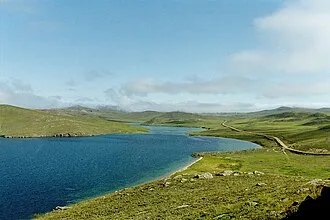
At 31,722 km2 (12,248 sq mi)—slightly larger than Belgium—Lake Baikal is the world's seventh-largest lake by surface area, as well as the second-largest lake in Eurasia after the Caspian Sea. However, because it is also the deepest lake, with a maximum depth of 1,642 metres (5,387 feet), Lake Baikal is the world's largest freshwater lake by volume, containing 23,615.39 km3 (5,670 cu mi) of water or 22–23% of the world's fresh surface water, more than all of the North American Great Lakes combined.
It is also the world's oldest lake at 25–30 million years, and among the clearest. It is estimated that the lake contains around 19% of the unfrozen fresh water on the planet.
Lake Baikal is home to thousands of species of plants and animals, many of them endemic to the region. It is also home to Buryat tribes, who raise goats, camels, cattle, sheep, and horses, on the eastern side of the lake within Buryatia, where the mean temperature varies from a winter minimum of −19 °C (−2 °F) to a summer maximum of 14 °C (57 °F).
The region to the east of Lake Baikal is referred to as Transbaikalia or as the Transbaikal, and the loosely defined region around the lake itself is sometimes known as Baikalia. UNESCO declared Baikal a World Heritage Site in 1996.
Geography and hydrography
Lake Baikal is in a rift valley, created by the Baikal Rift Zone, where the Earth's crust is slowly pulling apart. At 636 km (395 mi) long and 79 km (49 mi) wide, Lake Baikal has the largest surface area of any freshwater lake in Asia, at 31,722 km2 (12,248 sq mi), and is the deepest lake in the world at 1,642 metres (5,387 feet; 898 fathoms).
The surface of the lake is 455.5 m (1,494 ft) above sea level, while the bottom of the lake is 1,186.5 m (3,893 ft; 648.8 fathoms) below sea level, and below this lies some 7 km (4.3 mi) of sediment, placing the rift floor some 8–11 km (5.0–6.8 mi) below the surface, the deepest continental rift on Earth.
In geological terms, the rift is young and active—it widens about 4 mm (0.16 in) per year. The fault zone is also seismically active; hot springs occur in the area and notable earthquakes happen every few years. The lake is divided into three basins: North, Central, and South, with depths about 900 m (3,000 ft), 1,600 m (5,200 ft), and 1,400 m (4,600 ft), respectively.
Fault-controlled accommodation zones rising to depths of 300 m (980 ft) separate the basins. The North and Central basins are separated by Academician Ridge, while the area around the Selenga Delta and the Buguldeika Saddle separates the Central and South basins. The lake drains into the Angara, a tributary of the Yenisey. Landforms include Cape Ryty on Baikal's northwest coast.
Baikal's age is estimated at 25–30 million years, making it the most ancient lake in geological history. It is unique among large, high-latitude lakes, as its sediments not been scoured by overriding continental ice sheets. Russian, U.S., and Japanese cooperative studies of deep-drilling core sediments in the 1990s provide a detailed record of climatic variation over the past 6.7 million years.
Longer and deeper sediment cores are expected in the near future.[needs update] Lake Baikal is the only confined freshwater lake in which direct and indirect evidence of gas hydrates exists.
The lake is surrounded by mountains; the Baikal Mountains on the north shore, the Barguzin Range on the northeastern shore and the Primorsky Range stretching along the western shore. The mountains and the taiga are protected as a national park. It contains 27 islands; the largest, Olkhon, is 72 km (45 mi) long and is the third-largest lake-bound island in the world.
The lake is fed by as many as 330 inflowing rivers. The main rivers draining directly into Baikal are the Selenga, the Barguzin, the Upper Angara, the Turka, the Sarma, and the Snezhnaya. It is drained through a single outlet, the Angara.
Regular winds exist in Baikal's rift valley.
Water characteristics
Baikal is one of the clearest lakes in the world. During the winter, the water transparency in open sections can be as much as 30–40 m (100–130 ft), but during the summer it is typically 5–8 m (15–25 ft). Baikal is rich in oxygen, even in deep sections, which separates it from distinctly stratified bodies of water such as Lake Tanganyika and the Black Sea.
In Lake Baikal, the water temperature varies significantly depending on location, depth, and time of the year. During the winter and spring, the surface freezes for about 4–5 months; from early January to early May–June (latest in the north), the lake surface is covered in ice. On average, the ice reaches a thickness of 0.5 to 1.4 m (1.6–4.6 ft), but in some places with hummocks, it can be more than 2 m (6.6 ft).
During this period, the temperature slowly increases with depth in the lake, being coldest near the ice-covered surface at around freezing, and reaching about 3.5–3.8 °C (38.3–38.8 °F) at a depth of 200–250 m (660–820 ft).
After the surface ice breaks up, the surface water is slowly warmed by the sun, and in May–June, the upper 300 m (980 ft) becomes homothermic (same temperature throughout) at around 4 °C (39 °F) because of water mixing. The sun continues to heat up the surface layer, and at the peak in August can reach up to about 16 °C (61 °F) in the main sections and 20–24 °C (68–75 °F) in shallow bays in the southern half of the lake.
During this time, the pattern is inverted compared to the winter and spring, as the water temperature falls with increasing depth. As the autumn begins, the surface temperature falls again and a second homothermic period at around 4 °C (39 °F) of the upper circa 300 m (980 ft) occurs in October–November.
In the deepest parts of the lake, from about 300 m (980 ft), the temperature is stable at 3.1–3.4 °C (37.6–38.1 °F) with only minor annual variations.
The average surface temperature has risen by almost 1.5 °C (2.7 °F) in the last 50 years, resulting in a shorter period when the lake is covered by ice. At some locations, hydrothermal vents with water that is about 50 °C (122 °F) have been found. These are mostly in deep water but locally have also been found in relatively shallow water. They have little effect on the lake's temperature because of its huge volume.
Stormy weather on the lake is common, especially during the summer and autumn, and can result in waves as high as 4.5 m (15 ft).
Ecology
Lake Baikal is rich in biodiversity. It hosts more than 1,000 species of plants and 2,500 species of animals based on current knowledge, but the actual figures for both groups are believed to be significantly higher.
Flora
The watershed of Lake Baikal has numerous floral species represented. The marsh thistle (Cirsium palustre) is found here at the eastern limit of its geographic range.
Submerged macrophytic vascular plants are mostly absent, except in some shallow bays along the shores of Lake Baikal. More than 85 species of submerged macrophytes have been recorded, including genera such as Ceratophyllum, Myriophyllum, Potamogeton, and Sparganium. The invasive species Elodea canadensis was introduced to the lake in the 1950s.
Instead of vascular plants, aquatic flora is often dominated by several green algae species, notably Draparnaldioides, Tetraspora, and Ulothrix in water shallower than 20 m (65 ft); although Aegagrophila, Cladophora, and Draparnaldioides may occur deeper than 30 m (100 ft).
Except for Ulothrix, these green algae genera contain species endemic to Baikal. More than 400 diatom species, both benthic and planktonic, are found in the lake, and about half of these are endemic to Baikal; however, significant taxonomic uncertainties remain for this group.
Mammals
The Baikal seal or nerpa (Pusa sibirica) is endemic to Lake Baikal.
A wide range of land mammals can be found in the habitats around the lake, such as the brown bear (Ursus arctos), Eurasian wolf (Canis lupus lupus), red fox (Vulpes vulpes), sable (Martes zibellina), stoat (Mustela erminea), least weasel (Mustela nivalis), Eurasian otter (Lutra lutra), snow leopard (Panthera uncia), Siberian tiger (Panthera tigris tigris), Amur leopard (Panthera pardus orientalis), moose (Alces alces), elk (Cervus canadensis), reindeer (Rangifer tarandus), Siberian roe deer (Capreolus pygargus), Siberian musk deer (Moschus moschiferus), wild boar (Sus scrofa), red squirrel (Sciurus vulgaris), Siberian chipmunk (Eutamias sibiricus), marmots (Marmota sp.), lemmings (Lemmus sp.), and mountain hare (Lepus timidus). Until the Early Middle Ages, populations of the European bison (Bison bonasus) were found near the lake; this represented the easternmost range of the species.
Birds
There are 236 species of birds that inhabit Lake Baikal, 29 of which are waterfowl. Although named after the lake, both the Baikal teal and Baikal bush warbler are widespread in eastern Asia.
Fish
Fewer than 65 native fish species occur in the lake basin, but more than half of these are endemic. The families Abyssocottidae (deep-water sculpins), Comephoridae (golomyankas or Baikal oilfish), and Cottocomephoridae (Baikal sculpins) are entirely restricted to the lake basin. All these are part of the Cottoidea and are typically less than 20 cm (8 in) long.
Of particular note are the two species of golomyanka (Comephorus baicalensis and C. dybowskii). These long-finned, translucent fish typically live in open water at depths of 100–500 m (330–1,640 ft), but occur both shallower and much deeper. Together with certain abyssocottid sculpins, they are the deepest living freshwater fish in the world, occurring near the bottom of Lake Baikal.
The golomyankas are the primary prey of the Baikal seal and represent the largest fish biomass in the lake. Beyond members of Cottoidea, there are few endemic fish species in the lake basin.
The most important local species for fisheries is the omul (Coregonus migratorius), an endemic whitefish. It is caught, smoked, and then sold widely in markets around the lake. Also, a second endemic whitefish inhabits the lake, C. baicalensis. The Baikal black grayling (Thymallus baicalensis), Baikal white grayling (T. brevipinnis), and Baikal sturgeon (Acipenser baerii baicalensis) are other important species with commercial value. They are also endemic to the Lake Baikal basin.
Invertebrates
The lake hosts a rich endemic fauna of invertebrates. Among the most diverse invertebrate groups are the amphipod and ostracod crustaceans, freshwater snails, annelid worms and turbellarian worms.
Crustaceans
More than 350 species and subspecies of amphipods are endemic to the lake. They are exceptionally diverse in ecology and appearance, ranging from the pelagic Macrohectopus to the relatively large deep-water Abyssogammarus and Garjajewia, the tiny herbivorous Micruropus, and the parasitic Pachyschesis (parasitizing other amphipods).
The "gigantism" of some Baikal amphipods, which has been compared to that seen in Antarctic amphipods, has been linked to the high level of dissolved oxygen in the lake. Among the "giants" are several species of spiny Acanthogammarus and Brachyuropus (Acanthogammaridae) found at both shallow and deep depths.
These conspicuous and common amphipods are essentially carnivores (will also take detritus), and can reach a body length up to 7 cm (2.8 in). Another common species is another unique inhabitant of the lake: the pelagic amphipod Macrohectopus branickii lives its entire life in the water column, which is unique among freshwater amphipods and has been compared to krill.
The number of isopods is low; all belonging to the family Asellidae. There are four species of the genus Baicalasellus, and the two species Mesoasellus dybowskii and Limnoasellus poberezhnii. These six endemic species are found on rocky substrata in depths varying from 3–10 meters (Baicalasellus angarensis) to more than hundred meters (Mesoasellus dybowskii).
Epischurella baikalensis is a copepod endemic to the lake, being a very abundant species there; it was estimated that they make up 80 to 90% of the total biomass. It is estimated that as a species, they filter as much as a thousand cubic kilometers of water a year, or the lake's entire volume every twenty-three years.
There are about 60 known species of native cladocerans (water fleas), several of them endemic.
Similar to another ancient lake, Tanganyika, Baikal is a center for ostracod diversity. About 90% of the Lake Baikal ostracods are endemic, meaning that there are around 200 endemic species. This makes it the second-most diverse group of crustacean in the lake, after the amphipods. The vast majority of the Baikal ostracods belong to the families Candonidae (more than 100 described species) and Cytherideidae (about 50 described species), but genetic studies indicate that the true diversity in at least the latter family has been heavily underestimated. The morphology of the Baikal ostracods is highly diverse.
Snails and bivalves
As of 2006[update], almost 150 freshwater snails are known from Lake Baikal, including 117 endemic species from the subfamilies Baicaliinae (part of the Amnicolidae) and Benedictiinae (part of the Lithoglyphidae), and the families Planorbidae and Valvatidae.
All endemics have been recorded between 20 and 30 metres (66 and 98 ft), but the majority mainly live at shallower depths. About 30 freshwater snail species can be seen deeper than 100 m (330 ft), which represents the approximate limit of the sunlight zone, but only ten are truly deepwater species. In general, Baikal snails are thin-shelled and small.
Two of the most common species are Benedictia baicalensis and Megalovalvata baicalensis. Bivalve diversity is lower with more than 30 species; about half of these, all in the families Euglesidae, Pisidiidae, and Sphaeriidae, are endemic (the only other family in the lake is the Unionidae with a single nonendemic species). The endemic bivalves are mainly found in shallows, with few species from deep water.
Aquatic worms
With almost 200 described species, including more than 160 endemics, the center of diversity for aquatic freshwater oligochaetes is Lake Baikal. A smaller number of other freshwater annelids is known: 30 species of leeches (Hirudinea), and 4 polychaetes. Several hundred species of nematodes are known from the lake, but a large percentage of these are undescribed.
More than 140 endemic flatworm (Plathelminthes) species are in Lake Baikal, where they occur on a wide range of bottom types. Most of the flatworms are predatory, and some are relatively brightly marked. They are often abundant in shallow waters, where they are typically less than 2 cm (1 in) long, but in deeper parts of the lake, the largest, Baikaloplana valida, can reach up to 30 cm (1 ft) when outstretched.
Sponges
At least 18 species of sponges occur in the lake, including about 15 species from the endemic family Lubomirskiidae (the remaining are from the nonendemic family Spongillidae), which colonized the lake about 3.4 million years ago. The lake's sponges makes up around 44% of the benthic animal biomass. Lubomirskia baicalensis, Baikalospongia bacillifera, and B. intermedia are unusually large for freshwater sponges and can reach 1 m (3.3 ft) or more.
These three are also the most common sponges in the lake. While the Baikalospongia species typically have encrusting or carpet-like structures, L. baikalensis often has branching structures and in areas where common may form underwater "forests". Most sponges in the lake are typically green when alive because of symbiotic chlorophytes (zoochlorella), but can also be brownish or yellowish.
Relation to humans
History
The Baikal area, sometimes known as Baikalia, has a long history of human habitation. Near the village of Mal'ta, some 160 km northwest of the lake, remains of a young human male known as "MA-1" or "Mal'ta Boy" are indications of local habitation by the Mal'ta–Buret' culture ca. 24,000 BP. An early known tribe in the area was the Kurykans.
Located in the former northern territory of the Xiongnu confederation, Lake Baikal is one site of the Han–Xiongnu War, where the armies of the Han dynasty pursued and defeated the Xiongnu forces from the second century BC to the first century AD. They recorded that the lake was a "huge sea" (hanhai) and designated it the North Sea (Běihǎi) of the semimythical Four Seas.
The Kurykans, a Siberian tribe who inhabited the area in the sixth century, gave it a name that translates to "much water". Later on, it was called "natural lake" (Baygal nuur) by the Buryats and "rich lake" (Bay göl) by the Yakuts. Lake Baikal was under the Anbei Protectorate of the Tang dynasty from 647 CE to 682 CE.
Little was known to Europeans about the lake until Russia expanded into the area in the 1600s.
As part of Russia
Russian expansion into the Buryat area around Lake Baikal in 1628–1658 was part of the Russian conquest of Siberia. It was done first by following the Angara River upstream from Yeniseysk (founded 1619) and later by moving south from the Lena River. Russians first heard of the Buryats in 1609 at Tomsk. According to folktales related a century after the fact, in 1623, Demid Pyanda, who may have been the first Russian to reach the Lena, crossed from the upper Lena to the Angara and arrived at Yeniseysk.
The Russian explorers Vikhor Savin (1624) and Maksim Perfilyev (1626 and 1627–28) explored Tungus country on the lower Angara. To the west, Krasnoyarsk on the upper Yenisei was founded in 1627. A number of ill-documented (poorly recorded) expeditions explored eastward from Krasnoyarsk. In 1628, Pyotr Beketov first encountered a group of Buryats and collected yasak (tribute) from them at the future site of Bratsk.
In 1629, Yakov Khripunov set off from Tomsk to find a rumored silver mine. His men soon began plundering both Russians and natives. They were joined by another band of rioters from Krasnoyarsk, but left the Buryat country when they ran short of food. This made it difficult for other Russians to enter the area. In 1631, Maksim Perfilyev built an ostrog at Bratsk.
The pacification was moderately successful, but in 1634, Bratsk was destroyed and its garrison killed. In 1635, Bratsk was restored by a punitive expedition under Radukovskii. In 1638, it was besieged unsuccessfully. In 1638, Perfilyev crossed from the Angara over the Ilim portage to the Lena River and went downstream as far as Olyokminsk.
Returning, he sailed up the Vitim River into the area east of Lake Baikal (1640) where he heard reports of the Amur country. In 1641, Verkholensk was founded on the upper Lena.[citation needed]