The Maya civilization developed in the Maya Region, an area that today comprises southeastern Mexico, all of Guatemala and Belize, and the western portions of Honduras and El Salvador. Today, their descendants, known collectively as the Maya, number well over 6 million individuals, speak more than twenty-eight surviving Mayan languages, and reside in nearly the same area.
The Archaic period, before 2000 BC, saw the first developments in agriculture and the earliest villages. The Preclassic period (c. 2000 BC to 250 AD) saw the establishment of the first complex societies in the Maya region, and the cultivation of the staple crops of the Maya diet, including maize, beans, squashes, and chili peppers.
The first Maya cities developed around 750 BC. Hieroglyphic writing was being used in the Maya region by the 3rd century BC. In the Late Preclassic, a number of large cities developed in the Petén Basin, and the city of Kaminaljuyu rose to prominence in the Guatemalan Highlands. Beginning around 250 AD, the Classic period is largely defined as when the Maya were raising sculpted monuments with Long Count dates.
This period saw the Maya civilization develop many city-states linked by a complex trade network. In the Maya Lowlands two great rivals, the cities of Tikal and Calakmul, became powerful. The Classic period also saw the intrusive intervention of the central Mexican city of Teotihuacan in Maya dynastic politics. In the 9th century, there was a widespread political collapse in the central Maya region, resulting in civil wars, the abandonment of cities, and a northward shift of population.
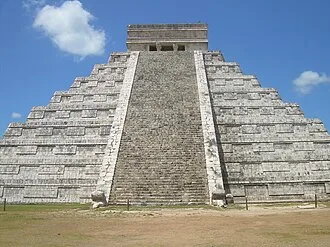
The Postclassic period saw the rise of Chichen Itza in the north, and the expansion of the aggressive Kʼicheʼ kingdom in the Guatemalan Highlands. In the 16th century, the Spanish Empire colonized the Mesoamerican region, and a lengthy series of campaigns saw the fall of Nojpetén, the last Maya city, in 1697. Rule during the Classic period centred on the concept of the "divine king", who was thought to act as a mediator between mortals and the supernatural realm.
Kingship was usually (but not exclusively) patrilineal, and power normally passed to the eldest son. A prospective king was expected to be a successful war leader as well as a ruler. Closed patronage systems were the dominant force in Maya politics, although how patronage affected the political makeup of a kingdom varied from city-state to city-state.
By the Late Classic period, the aristocracy had grown in size, reducing the previously exclusive power of the king. The Maya developed sophisticated art forms using both perishable and non-perishable materials, including wood, jade, obsidian, ceramics, sculpted stone monuments, stucco, and finely painted murals. The Maya elite were literate, and developed a complex system of hieroglyphic writing.
The Maya recorded their history and ritual knowledge in screenfold books, of which only three uncontested examples remain. In addition, a great many examples of Maya texts can be found on stelae and ceramics. The Maya developed a highly complex series of interlocking ritual calendars, and employed mathematics that included one of the earliest known instances of the explicit zero in human history. As a part of their religion, the Maya practised human sacrifice.
Etymology
"Maya" is a modern term used to refer collectively to the various peoples that inhabited this area, as Maya peoples have not had a sense of a common ethnic identity or political unity for the vast majority of their history. Early Spanish and Mayan-language colonial sources in the Yucatán Peninsula used the term "Maya" to denote both the language spoken by the Yucatec Maya and the area surrounding the then-abandoned city of Mayapán.
The term "Maya" was derived from the city of Mayapán. Some colonial Mayan-language sources also used "Maya" to refer to other Maya groups, sometimes pejoratively in reference to Maya groups more resistant to Spanish rule.
Geography
The Maya civilization occupied a wide territory that included southeastern Mexico and northern Central America. This area included the entire Yucatán Peninsula and all of the territory now in the modern countries of Guatemala and Belize, as well as the western portions of Honduras and El Salvador. Most of the peninsula is formed by a vast plain with few hills or mountains and a generally low coastline.
The territory of the Maya covered a third of Mesoamerica, and the Maya were engaged in a dynamic relationship with neighbouring cultures that included the Olmecs, Mixtecs, Teotihuacan, and Aztecs. During the Early Classic period, the Maya cities of Tikal and Kaminaljuyu were key Maya foci in a network that extended into the highlands of central Mexico; there was a strong Maya presence at the Tetitla compound of Teotihuacan.
The Maya city of Chichen Itza and the distant Toltec capital of Tula had an especially close relationship.
The Petén region consists of densely forested low-lying limestone plain; a chain of fourteen lakes runs across the central drainage basin of Petén. To the south the plain gradually rises towards the Guatemalan Highlands. The dense Maya forest covers northern Petén and Belize, most of Quintana Roo, southern Campeche, and a portion of the south of Yucatán state. Farther north, the vegetation turns to lower forest consisting of dense scrub.
The littoral zone of Soconusco lies to the south of the Sierra Madre de Chiapas, and consists of a narrow coastal plain and the foothills of the Sierra Madre. The Maya highlands extend eastwards from Chiapas into Guatemala, reaching their highest in the Sierra de los Cuchumatanes. Their major pre-Columbian population centres were in the largest highland valleys, such as the Valley of Guatemala and the Quetzaltenango Valley.
In the southern highlands, a belt of volcanic cones runs parallel to the Pacific coast. The highlands extend northwards into Verapaz, and gradually descend to the east.
History
The history of Maya civilization is divided into three principal periods: the Preclassic, Classic, and Postclassic. These were preceded by the Archaic Period, during which the first settled villages and early developments in agriculture emerged. Modern scholars regard these periods as arbitrary divisions of Maya chronology, rather than indicative of cultural evolution or decline.
Definitions of the start and end dates of period spans can vary by as much as a century, depending on the author.
- Archaic — 8000–2000 BC
- Preclassic — Early Preclassic — 2000–1000 BC
- Preclassic — Middle Preclassic — Early Middle Preclassic — 1000–600 BC
- Preclassic — Middle Preclassic — Late Middle Preclassic — 600–350 BC
- Preclassic — Late Preclassic — Early Late Preclassic — 350–1 BC
- Preclassic — Late Preclassic — Late Late Preclassic — 1 BC – AD 159
- Preclassic — Late Preclassic — Terminal Preclassic — AD 159–250
- Classic — Early Classic — AD 250–550
- Classic — Late Classic — AD 550–830
- Classic — Terminal Classic — AD 830–950
- Postclassic — Early Postclassic — AD 950–1200
- Postclassic — Late Postclassic — AD 1200–1539
- Contact period — AD 1511–1697
Preclassic period (c. 2000 BC – 250 AD)
The Maya developed their first civilization in the Preclassic period. Scholars continue to discuss when this era of Maya civilization began. Maya occupation at Cuello (modern Belize) has been carbon dated to around 2600 BC. Settlements were established around 1800 BC in the Soconusco region of the Pacific coast, and the Maya were already cultivating the staple crops of maize, beans, squash, and chili pepper.
This period was characterized by sedentary communities and the introduction of pottery and fired clay figurines.
During the Middle Preclassic Period, small villages began to grow to form cities. Nakbe in the Petén department of Guatemala is the earliest well-documented city in the Maya lowlands, where large structures have been dated to around 750 BC. The northern lowlands of Yucatán were widely settled by the Middle Preclassic.
By approximately 400 BC, early Maya rulers were raising stelae. A developed script was already being used in Petén by the 3rd century BC. In the Late Preclassic Period, the enormous city of El Mirador grew to cover approximately 16 square kilometres (6.2 sq mi). Although not as large, Tikal was already a significant city by around 350 BC.
In the highlands, Kaminaljuyu emerged as a principal centre in the Late Preclassic. Takalik Abaj and Chocolá were two of the most important cities on the Pacific coastal plain, and Komchen grew to become an important site in northern Yucatán. The Late Preclassic cultural florescence collapsed in the 1st century AD and many of the great Maya cities of the epoch were abandoned; the cause of this collapse is unknown.
Classic period (c. 250–900 AD)
The Classic period is largely defined as the period during which the lowland Maya raised dated monuments using the Long Count calendar. This period marked the peak of large-scale construction and urbanism, the recording of monumental inscriptions, and demonstrated significant intellectual and artistic development, particularly in the southern lowland regions.
The Classic period Maya political landscape has been likened to that of Renaissance Italy or Classical Greece, with multiple city-states engaged in a complex network of alliances and enmities. The largest cities had 50,000 to 120,000 people and were linked to networks of subsidiary sites.
During the Early Classic, cities throughout the Maya region were influenced by the great metropolis of Teotihuacan in the distant Valley of Mexico. In AD 378, Teotihuacan decisively intervened at Tikal and other nearby cities, deposed their rulers, and installed a new Teotihuacan-backed dynasty. This intervention was led by Siyaj Kʼakʼ ("Born of Fire"), who arrived at Tikal in early 378.
The king of Tikal, Chak Tok Ichʼaak I, died on the same day, suggesting a violent takeover. A year later, Siyaj Kʼakʼ oversaw the installation of a new king, Yax Nuun Ahiin I. This led to a period of political dominance when Tikal became the most powerful city in the central lowlands.
Tikal's great rival was Calakmul, another powerful city in the Petén Basin. Tikal and Calakmul both developed extensive systems of allies and vassals; lesser cities that entered one of these networks gained prestige from their association with the top-tier city, and maintained peaceful relations with members of the network.
Tikal and Calakmul engaged in the manoeuvering of their alliance networks against each other. At various points during the Classic period, one or other of these powers would gain a strategic victory over its great rival, resulting in respective periods of florescence and decline.
In 629, Bʼalaj Chan Kʼawiil, a son of the Tikal king Kʼinich Muwaan Jol II, was sent to found a new city at Dos Pilas, in the Petexbatún region, apparently as an outpost to extend Tikal's power beyond the reach of Calakmul. For the next two decades he fought loyally for his brother and overlord at Tikal. In 648, king Yuknoom Chʼeen II of Calakmul captured Balaj Chan Kʼawiil.
Yuknoom Chʼeen II then reinstated Balaj Chan Kʼawiil upon the throne of Dos Pilas as his vassal. He thereafter served as a loyal ally of Calakmul.
In the southeast, Copán was the most important city. Its Classic-period dynasty was founded in 426 by Kʼinich Yax Kʼukʼ Moʼ. The new king had strong ties with central Petén and Teotihuacan. Copán reached the height of its cultural and artistic development during the rule of Uaxaclajuun Ubʼaah Kʼawiil, who ruled from 695 to 738.
His reign ended catastrophically when he was captured by his vassal, king Kʼakʼ Tiliw Chan Yopaat of Quiriguá. The captured lord of Copán was taken back to Quiriguá and was decapitated in a public ritual. It is likely that this coup was backed by Calakmul, in order to weaken a powerful ally of Tikal. Palenque and Yaxchilan were the most powerful cities in the Usumacinta region.
In the highlands, Kaminaljuyu in the Valley of Guatemala was already a sprawling city by 300. In the north of the Maya area, Coba was the most important capital.
Classic Maya collapse
During the 9th century AD, the central Maya region suffered major political collapse, marked by the abandonment of cities, the ending of dynasties, and a northward shift in activity. No universally accepted theory explains this collapse, but it likely had a combination of causes, including endemic internecine warfare, overpopulation resulting in severe environmental degradation, and drought.
During this period, known as the Terminal Classic, the northern cities of Chichen Itza and Uxmal showed increased activity. Major cities in the northern Yucatán Peninsula were inhabited long after the cities of the southern lowlands ceased to raise monuments.
Classic Maya social organization was based on the ritual authority of the ruler, rather than central control of trade and food distribution. This model was poorly structured to respond to changes, because the ruler's actions were limited by tradition to such activities as construction, ritual, and warfare. This only served to exacerbate systemic problems.
By the 9th and 10th centuries, this resulted in collapse of this system of rulership. In the northern Yucatán, individual rule was replaced by a ruling council formed from elite lineages. In the southern Yucatán and central Petén, kingdoms declined; in western Petén and some other areas, the changes were catastrophic and resulted in the rapid depopulation of cities.
Within a couple of generations, large swathes of the central Maya area were all but abandoned. Both the capitals and their secondary centres were generally abandoned within a period of 50 to 100 years. One by one, cities stopped sculpting dated monuments; the last Long Count date was inscribed at Toniná in 909. Stelae were no longer raised, and squatters moved into abandoned royal palaces. Mesoamerican trade routes shifted and bypassed Petén.
Postclassic period (c. 950–1539 AD)
Although much reduced, a significant Maya presence remained into the Postclassic period after the abandonment of the major Classic period cities; the population was particularly concentrated near permanent water sources. Unlike during previous cycles of contraction, abandoned lands were not quickly resettled in the Postclassic.
Activity shifted to the northern lowlands and the Maya Highlands; this may have involved migration from the southern lowlands, because many Postclassic Maya groups had migration myths. Chichen Itza and its Puuc neighbours declined dramatically in the 11th century, and this may represent the final episode of Classic Period collapse.
After the decline of Chichen Itza, the Maya region lacked a dominant power until the rise of the city of Mayapan in the 12th century. New cities arose near the Caribbean and Gulf coasts, and new trade networks were formed.
The Postclassic Period was marked by changes from the preceding Classic Period. The once-great city of Kaminaljuyu in the Valley of Guatemala was abandoned after continuous occupation of almost 2,000 years. Across the highlands and neighbouring Pacific coast, cities came to occupy more-easily defended hilltop locations surrounded by deep ravines, with ditch-and-wall defences sometimes supplementing the natural terrain.
One of the most important cities in the Guatemalan Highlands at this time was Qʼumarkaj, the capital of the aggressive Kʼicheʼ kingdom. The government of Maya states, from the Yucatán to the Guatemalan highlands, was often organized as joint rule by a council. However, in practice one member of the council could act as a supreme ruler, while the other members served him as advisors.
Mayapan was abandoned around 1448, after a period of political, social and environmental turbulence that in many ways echoed the Classic period collapse in the southern Maya region. The city's abandonment initiated a protracted era of endemic warfare, disease, and severe climatic disruptions across the Yucatán Peninsula, which ultimately subsided shortly before Spanish contact in 1511.
Even without a dominant regional capital, the early Spanish explorers reported wealthy coastal cities and thriving marketplaces. During the Late Postclassic, the Yucatán Peninsula was divided into a number of independent provinces that shared a common culture but varied in internal sociopolitical organization. On the eve of the Spanish conquest, the highlands of Guatemala were dominated by several powerful Maya states.
The Kʼicheʼ had carved out a small empire covering a large part of the western Guatemalan Highlands and the neighbouring Pacific coastal plain. However, in the decades before the Spanish conquest the Kaqchikel kingdom had been steadily eroding the kingdom of the Kʼicheʼ.
Contact period and Spanish conquest (1511–1697 AD)
In 1511, a Spanish caravel was wrecked in the Caribbean, and about a dozen survivors made landfall on the coast of Yucatán. They were seized by a Maya lord, and most were sacrificed, although two escaped. From 1517 to 1519, three separate Spanish expeditions explored the Yucatán coast, and engaged in a number of battles with the Maya inhabitants.
After the Aztec capital Tenochtitlan fell to the Spanish in 1521, Hernán Cortés despatched Pedro de Alvarado to Guatemala with 180 cavalry, 300 infantry, 4 cannons, and thousands of allied warriors from central Mexico; they arrived in Soconusco in 1523. The Kʼicheʼ capital, Qʼumarkaj, fell to Alvarado in 1524. Shortly afterwards, the Spanish were invited as allies into Iximche, the capital city of the Kaqchikel Maya.
Good relations did not last, due to excessive Spanish demands for gold as tribute, and the city was abandoned a few months later. This was followed by the fall of Zaculeu, the Mam Maya capital, in 1525. Francisco de Montejo and his son, Francisco de Montejo the Younger, launched a long series of campaigns against the polities of the Yucatán Peninsula in 1527, and finally completed the conquest of the northern portion of the peninsula in 1546.
This left only the Maya kingdoms of the Petén Basin independent. In 1697, Martín de Ursúa launched an assault on the Itza capital Nojpetén and the last independent Maya city fell to the Spanish.
Persistence of Maya culture
The Spanish conquest stripped away most of the defining features of Maya civilization. However, many Maya villages remained remote from Spanish colonial authority, and for the most part continued to manage their own affairs. Maya communities and the nuclear family maintained their traditional day-to-day life. The basic Mesoamerican diet of maize and beans continued, although agricultural output was improved by the introduction of steel tools.
Traditional crafts such as weaving, ceramics, and basketry continued to be practised. Community markets and trade in local products continued long after the conquest. At times, the colonial administration encouraged the traditional economy in order to extract tribute in the form of ceramics or cotton textiles, although these were usually made to European specifications.
Maya beliefs and language proved resistant to change, despite vigorous efforts by Catholic missionaries. The 260-day tzolkʼin ritual calendar continues in use in modern Maya communities in the highlands of Guatemala and Chiapas, and millions of Mayan-language speakers inhabit the territory in which their ancestors developed their civilization.
Investigation of Maya civilization
The agents of the Catholic Church wrote detailed accounts of the Maya, in support of their efforts at Christianization, and absorption of the Maya into the Spanish Empire. This was followed by various Spanish priests and colonial officials who left descriptions of ruins they visited in Yucatán and Central America. In 1839, American traveller and writer John Lloyd Stephens set out to visit a number of Maya sites with English architect and draftsman Frederick Catherwood.
Their illustrated accounts of the ruins sparked strong popular interest, and brought the Maya to world attention. The later 19th century saw the recording and recovery of ethnohistoric accounts of the Maya, and the first steps in deciphering Maya hieroglyphs.
The final two decades of the 19th century saw the birth of modern scientific archaeology in the Maya region, with the meticulous work of Alfred Maudslay and Teoberto Maler. By the early 20th century, the Peabody Museum was sponsoring excavations at Copán and in the Yucatán Peninsula. In the first two decades of the 20th century, advances were made in deciphering the Maya calendar, and identifying deities, dates, and religious concepts.
Since the 1930s, archaeological exploration increased dramatically, with large-scale excavations across the Maya region.
In the 1960s, Mayanist J. Eric S. Thompson promoted the ideas that Maya cities were essentially vacant ceremonial centres serving a dispersed population in the forest, and that the Maya civilization was governed by peaceful astronomer-priests. These ideas began to collapse with major advances in the decipherment of the script in the late 20th century, pioneered by Heinrich Berlin, Tatiana Proskouriakoff, and Yuri Knorozov.
With breakthroughs in understanding of Maya script since the 1950s, the texts revealed the warlike activities of the Classic Maya kings, undermining the view of the Maya as peaceful.
Politics
Unlike the Aztecs and the Inca, the Maya political system never integrated the entire Maya cultural area into a single state or empire. Rather, throughout its history, the Maya area contained a varying mix of political complexity that included both states and chiefdoms. These polities fluctuated greatly in their relationships with each other and were engaged in a complex web of rivalries, periods of dominance or submission, vassalage, and alliances.
At times, different polities achieved regional dominance, such as Calakmul, Caracol, Mayapan, and Tikal. The first reliably evidenced polities formed in the Maya lowlands in the 9th century BC.
During the Late Preclassic, the Maya political system coalesced into a theopolitical form, where elite ideology justified the ruler's authority, and was reinforced by public display, ritual, and religion. The divine king was the centre of political power, exercising ultimate control over administrative, economic, judicial, and military functions.
The divine authority invested within the ruler was such that the king was able to mobilize both the aristocracy and commoners in executing huge infrastructure projects, apparently with no police force or standing army. Some polities engaged in a strategy of increasing administration, and filling administrative posts with loyal supporters rather than blood relatives.
Within a polity, mid-ranking population centres would have played a key role in managing resources and internal conflict.
The Maya political landscape was highly complex and Maya elites engaged in political intrigue to gain economic and social advantage over neighbours. In the Late Classic, some cities established a long period of dominance over other large cities, such as the dominance of Caracol over Naranjo for half a century. In other cases, loose alliance networks were formed around a dominant city.
Border settlements, usually located about halfway between neighbouring capitals, often switched allegiance over the course of their history, and at times acted independently. Dominant capitals exacted tribute in the form of luxury items from subjugated population centres. Political power was reinforced by military power, and the capture and humiliation of enemy warriors played an important part in elite culture.
An overriding sense of pride and honour among the warrior aristocracy could lead to extended feuds and vendettas, which caused political instability and the fragmentation of polities.
Society
From the Early Preclassic, Maya society was sharply divided between the elite and commoners. As population increased over time, various sectors of society became increasingly specialized, and political organization increasingly complex. By the Late Classic, when populations had grown enormously and hundreds of cities were connected in a complex web of political hierarchies, the wealthy segment of society multiplied.
A middle class may have developed that included artisans, low ranking priests and officials, merchants, and soldiers. Commoners included farmers, servants, labourers, and slaves. According to indigenous histories, land was held communally by noble houses or clans. Such clans held that the land was the property of the ancestors, and ties between the land and the ancestors were reinforced by the burial of the dead within residential compounds.