
















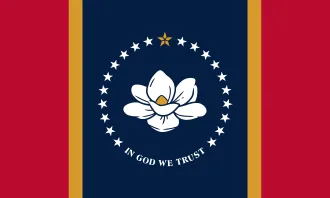
On December 10, 1817, Mississippi became the 20th state admitted to the Union. By 1860, Mississippi was the nation's top cotton-producing state and slaves accounted for 55% of the state population. Mississippi declared its secession from the Union on January 9, 1861, and was one of the seven original Confederate States, which constituted the largest slaveholding states in the nation.
Following the Civil War, it was restored to the Union on February 23, 1870. From the Reconstruction era to the 1960s, Mississippi was dominated by socially conservative and segregationist Southern Democrats dedicated to upholding white supremacy.[clarification needed]
Mississippi ranks among the highest of U.S. states in religiosity and among the lowest in measures of health, education, development, and income. Mississippi's major industries include agriculture and forestry. The state produces more than half of the country's farm-raised catfish, and is a top producer of sweet potatoes, cotton and pulpwood.
Others include advanced manufacturing, utilities, transportation, and health services. Mississippi is almost entirely within the east Gulf Coastal Plain, and generally consists of lowland plains and low hills. The northwest remainder of the state consists of the Mississippi Delta. Mississippi's highest point is Woodall Mountain at 807 feet (246 m) above sea level adjacent to the Cumberland Plateau; the lowest is the Gulf of Mexico. Mississippi has a humid subtropical climate classification.
Etymology
The state's name is derived from the Mississippi River, which flows along and defines its western boundary. European-American settlers named it after the Ojibwe word ᒥᓯ-ᓰᐱ misi-ziibi (English: great river).
History
Near 9500 BC, Native Americans or Paleo-Indians arrived in what today is referred to as the American South. Paleo-Indians in the South were hunter-gatherers who pursued the megafauna that became extinct following the end of the Pleistocene age. In the Mississippi Delta, Native American settlements and agricultural fields were developed on the natural levees, higher ground in the proximity of rivers.
The Native Americans developed extensive fields near their permanent villages. Together with other practices, they created some localized deforestation but did not alter the ecology of the Mississippi Delta as a whole.
After thousands of years, succeeding cultures of the Woodland and Mississippian culture eras developed rich and complex agricultural societies, in which surplus supported the development of specialized trades. Both were mound builder cultures. Those of the Mississippian culture were the largest and most complex, constructed beginning about 950 AD.
The peoples had a trading network spanning the continent from the Great Lakes to the Gulf Coast. Their large earthworks, which expressed their cosmology of political and religious concepts, still stand throughout the Mississippi and Ohio River valleys.
Descendant Native American tribes of the Mississippian culture in the Southeast include the Chickasaw and Choctaw. Other tribes who inhabited the territory of Mississippi (and whose names were honored by colonists in local towns) include the Natchez, the Yazoo, and the Biloxi.
The first major European expedition into the territory that became Mississippi was that of the Spanish explorer, Hernando de Soto, who passed through the northeast part of the state in 1540, in his second expedition to the New World.
Colonial era
In April 1699, French colonists established the first European settlement at Fort Maurepas (also known as Old Biloxi), built in the vicinity of present-day Ocean Springs on the Gulf Coast. It was settled by Pierre Le Moyne d'Iberville. In 1716, the French founded Natchez on the Mississippi River (as Fort Rosalie); it became the dominant town and trading post of the area.
The French called the greater territory "New France"; the Spanish continued to claim part of the Gulf coast area (east of Mobile Bay) of present-day southern Alabama, in addition to the entire area of present-day Florida. The British assumed control of the French territory after the French and Indian War.
During the colonial era, European (chiefly French and Spanish) settlers imported enslaved Africans to work on cash crop plantations. Under French and Spanish rule, there developed a class of free people of color (gens de couleur libres), mostly multiracial descendants of European men and enslaved or free black women, and their mixed-race children.
In the early days the French and Spanish colonists were chiefly men. Even as more European women joined the settlements, the men had interracial unions among women of African descent (and increasingly, multiracial descent), both before and after marriages to European women. Often the European men would help their multiracial children get educated or gain apprenticeships for trades, and sometimes they settled property on them; they often freed the mothers and their children if enslaved, as part of contracts of plaçage.
With this social capital, the free people of color became artisans, and sometimes educated merchants and property owners, forming a third class between the Europeans and most enslaved Africans in the French and Spanish settlements, although not so large a free community as in the city of New Orleans, Louisiana.
After Great Britain's victory in the French and Indian War (Seven Years' War), the French surrendered the Mississippi area to them under the terms of the Treaty of Paris (1763). They also ceded their areas to the north that were east of the Mississippi River, including the Illinois Country and Quebec. After the Peace of Paris (1783), the lower third of Mississippi came under Spanish rule as part of West Florida.
In 1819 the United States completed the purchase of West Florida and all of East Florida in the Adams–Onís Treaty, and in 1822 both were merged into the Florida Territory.
United States territory
After the American Revolution (1775–83), Britain ceded this area to the new United States of America. The Mississippi Territory was organized on April 7, 1798, from territory ceded by Georgia and South Carolina to the United States. Their original colonial charters theoretically extended west to the Pacific Ocean. The Mississippi Territory was later twice expanded to include disputed territory claimed by both the United States and Spain.
From 1800 to about 1830, the United States purchased some lands (Treaty of Doak's Stand) from Native American tribes for new settlements of European Americans. The latter were mostly migrants from other Southern states, particularly Virginia and North Carolina, where soils were exhausted. New settlers kept encroaching on Choctaw land, and they pressed the federal government to expel the Native Americans.
On September 27, 1830, the Treaty of Dancing Rabbit Creek was signed between the U.S. Government and the Choctaw. The Choctaw agreed to sell their traditional homelands in Mississippi and Alabama, for compensation and removal to reservations in Indian Territory (now Oklahoma). This opened up land for sale to European-American migrant settlement.
Article 14 of the Treaty of Dancing Rabbit Creek allowed Choctaws remaining in Mississippi to claim U.S. citizenship, requiring the forfeiture of tribal rights, the second major group to do so (following the Cherokee). Today their descendants include approximately 9,500 persons identifying as Choctaw, who live in Neshoba, Newton, Leake, and Jones counties.
The Mississippi Band of Choctaw Indians reorganized in the 20th century and is a Federally recognized tribe.
Many slaveholders brought enslaved African Americans with them or purchased them through the domestic slave trade, especially in New Orleans. Through the trade, an estimated nearly one million slaves were forcibly transported to the Deep South, including Mississippi, in an internal migration that broke up many slave families of the Upper South, where planters were selling excess slaves. The Southerners imposed slave laws in the Deep South and restricted the rights of free blacks.
Beginning in 1822, slaves in Mississippi were protected by law from cruel and unusual punishment by their owners. The Southern slave codes made the willful killing of a slave illegal in most cases. For example, the 1860 Mississippi case of Oliver v. State charged the defendant with murdering his own slave.
Statehood to Civil War
Mississippi became the 20th state on December 10, 1817. David Holmes was the first governor. The state was still occupied as ancestral land by several Native American tribes, including Choctaw, Natchez, Houma, Creek, and Chickasaw.
Plantations were developed primarily along the major rivers, where the waterfront provided access to the major transportation routes. This is also where early towns developed, linked by the steamboats that carried commercial products and crops to markets. The remainder of Native American ancestral land remained largely undeveloped but was sold through treaties until 1826, when the Choctaws and Chickasaws refused to sell more land.
The combination of the Mississippi state legislature's abolition of Choctaw Tribal Government in 1829, President Andrew Jackson's Indian Removal Act and the Treaty of Dancing Rabbit Creek of 1830, the Choctaw were effectively forced to sell their land and were transported to Oklahoma Territory. The forced migration of the Choctaw, together with other southeastern tribes removed as a result of the Act, became known as the Trail of Tears.
When cotton was king during the 1850s, Mississippi plantation owners—especially those of the Delta and Black Belt central regions—became wealthy due to the high fertility of the soil, the high price of cotton on the international market, and free labor gained through their holding enslaved African Americans. They used some of their profits to buy more cotton land and more slaves.
The planters' dependence on hundreds of thousands of slaves for labor and the severe wealth imbalances among whites, played strong roles both in state politics and in planters' support for secession. Mississippi was a slave society, with the economy dependent on slavery. The state was thinly settled, with population concentrated in the riverfront areas and towns.
By 1860, the enslaved African-American population numbered 436,631 or 55% of the state's total of 791,305 persons. Fewer than 1000 were free people of color. The relatively low population of the state before the American Civil War reflected the fact that land and villages were developed only along the riverfronts, which formed the main transportation corridors.
Ninety percent of the Delta bottomlands were still frontier and undeveloped. The state needed many more settlers for development. The land further away from the rivers was cleared by freedmen and white migrants during Reconstruction and later.
Civil War through late 19th century
On January 9, 1861, Mississippi became the second state to declare its secession from the Union, and it was one of the founding members of the Confederate States. The first six states to secede were those with the highest number of slaves. During the war, Union and Confederate forces struggled for dominance on the Mississippi River, critical to supply routes and commerce.
More than 80,000 Mississippians fought in the Civil War for the Confederate Army. Around 17,000 black and 545 white Mississippians would serve in the Union Army. Pockets of Unionism in Mississippi were in places such as the northeastern corner of the state and Jones County, where Newton Knight formed a revolt with Unionist leanings, known as the "Free State of Jones".
Union General Ulysses S. Grant's long siege of Vicksburg finally gained the Union control of the river in 1863.
In the postwar period, freedmen withdrew from white-run churches to set up independent congregations. The majority of blacks left the Southern Baptist Convention, sharply reducing its membership. They created independent black Baptist congregations. By 1895 they had established numerous black Baptist state associations and the National Baptist Convention of black churches.
In addition, independent black denominations, such as the African Methodist Episcopal Church (established in Philadelphia, Pennsylvania in the early 19th century) and the African Methodist Episcopal Zion Church (established in New York City), sent missionaries to the South in the postwar years. They quickly attracted hundreds of thousands of converts and founded new churches across the South. Southern congregations brought their own influences to those denominations as well.
During Reconstruction, the first Mississippi constitutional convention in 1868, with delegates both black and white, framed a constitution whose major elements would be maintained for 22 years. The convention was the first political organization in the state to include African-American representatives, 17 among the 100 members (32 counties had black majorities at the time).
Some among the black delegates were freedmen, but others were educated free blacks who had migrated from the North. The convention adopted universal suffrage; did away with property qualifications for suffrage or for office, a change that also benefited both blacks and poor whites; provided for the state's first public school system; forbade race distinctions in the possession and inheritance of property; and prohibited limiting civil rights in travel. Under the terms of Reconstruction, Mississippi was restored to the Union on February 23, 1870.
Because the Mississippi Delta contained so much fertile bottomland that had not been developed before the American Civil War, 90 percent of the land was still frontier. After the Civil War, tens of thousands of migrants were attracted to the area by higher wages offered by planters trying to develop land. In addition, black and white workers could earn money by clearing the land and selling timber, and eventually advance to ownership.
The new farmers included many freedmen, who by the late 19th century achieved unusually high rates of land ownership in the Mississippi bottomlands. In the 1870s and 1880s, many black farmers succeeded in gaining land ownership.
In the early 20th century, two-thirds of the Mississippi farmers who owned land in the Delta were African American. But many had become overextended with debt during the falling cotton prices of the difficult years of the late 19th century. Cotton prices fell throughout the decades following the Civil War. As another agricultural depression lowered cotton prices into the 1890s, numerous African-American farmers finally had to sell their land to pay off debts, thus losing the land which they had developed by hard, personal labor.
Democrats had regained control of the state legislature in 1875, after a year of expanded violence against blacks and intimidation of whites in what was called the "white line" campaign, based on asserting white supremacy. Democratic whites were well armed and formed paramilitary organizations such as the Red Shirts to suppress black voting.
From 1874 to the elections of 1875, they pressured whites to join the Democrats, and conducted violence against blacks in at least 15 known "riots" in cities around the state to intimidate blacks. They killed a total of 150 blacks, although other estimates place the death toll at twice as many. A total of three white Republicans and five white Democrats were reported killed.
In rural areas, deaths of blacks could be covered up. Riots (better described as massacres of blacks) took place in Vicksburg, Clinton, Macon, and in their counties, as well-armed whites broke up black meetings and lynched known black leaders, destroying local political organizations. Seeing the success of this deliberate "Mississippi Plan", South Carolina and other states followed it and also achieved white Democratic dominance. In 1877 by a national compromise, the last of federal troops were withdrawn from the region.
Even in this environment, black Mississippians continued to be elected to local office. However, black residents were deprived of all political power after white legislators passed a new state constitution in 1890 specifically to "eliminate the nigger from politics", according to the state's Democratic governor, James K.
Vardaman. It erected barriers to voter registration and instituted electoral provisions that effectively disenfranchised most black Mississippians and many poor whites. Estimates are that 100,000 black and 50,000 white men were removed from voter registration rolls in the state over the next few years.
The loss of political influence contributed to the difficulties of African Americans in their attempts to obtain extended credit in the late 19th century. Together with imposition of Jim Crow and racial segregation laws, whites increased violence against blacks, with lynchings occurring through the period of the 1890s and extending to 1930.
20th century to present
In 1900, blacks made up more than half of the state's population. By 1910, a majority of black farmers in the Delta had lost their land and became sharecroppers. By 1920, the third generation after freedom, most African Americans in Mississippi were landless laborers again facing poverty. Starting about 1913, tens of thousands of black Americans left Mississippi for the North in the Great Migration to industrial cities such as St.
Louis, Chicago, Detroit, Cleveland, Philadelphia and New York. They sought jobs, better education for their children, the right to vote, relative freedom from discrimination, and better living. In the migration of 1910–1940, they left a society that had been steadily closing off opportunity. Most migrants from Mississippi took trains directly north to Chicago and often settled near former neighbors.
Cotton crops failed due to boll weevil infestation and successive severe flooding in 1912 and 1913, creating crisis conditions for many African Americans. With control of the ballot box and more access to credit, white planters bought out such farmers, expanding their ownership of Delta bottomlands. They also took advantage of new railroads sponsored by the state.
Blacks also faced violence in the form of lynching, shooting, and the burning of churches. In 1923, the National Association for the Advancement of Colored People stated "the Negro feels that life is not safe in Mississippi and his life may be taken with impunity at any time upon the slightest pretext or provocation by a white man".
In the early 20th century, some industries were established in Mississippi, but jobs were generally restricted to whites, including child workers. The lack of jobs also drove some southern whites north to cities such as Chicago and Detroit, seeking employment, where they also competed with European immigrants. The state depended on agriculture, but mechanization put many farm laborers out of work.