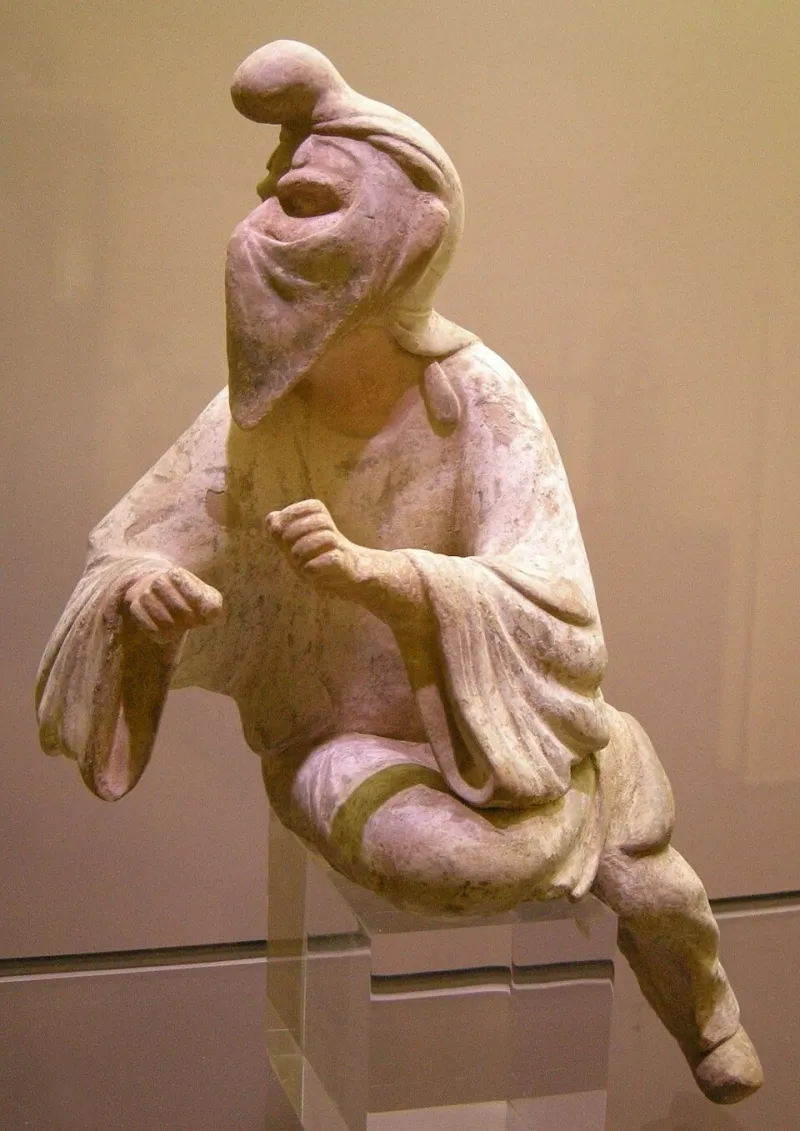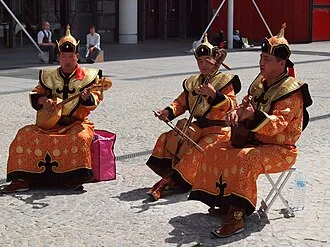
The Mongols are bound together by a common heritage and ethnic identity, descending from the Proto-Mongols. Their indigenous dialects are collectively known as the Mongolian language. The contiguous geographical area in which the Mongols primarily live is referred to as the Mongol heartland, especially in discussions of the Mongols' history under the Mongol Empire and Northern Yuan.
Etymology
There are several proposals for the etymology of the ethnonym "Mongol":
- A change from Mongkhe-tengri-gal ("Eternal Sky Fire");
- A derivation from the personal name, transcribed in Chinese-language sources as 木骨閭 Mùgǔlǘ (from Middle Chinese *muwk-kwot-ljo), of the progenitor of the Rouran Khaganate.
The designation "Mongol" first appeared in the mid-10th century Chinese Old Book of Tang to describe a tribe of the Shiwei who resided in the Argun River basin in the 9th century. In the 13th century, the word Mongol grew into an umbrella term for a large group of Mongolic-speaking tribes united under the rule of Genghis Khan.
The Mongols of the Mongol Empire were known in Central Asia, Western Asia and Europe as "Tatars", after a tribal confederation that was active on the Mongolian Steppes in the 12th century.
History
Prehistoric background
The ethnogenesis of Mongolic peoples is largely linked with the expansion of Ancient Northeast Asians. The Mongolian pastoralist lifestyle may in part be derived from the Western Steppe Herders, but without much geneflow between these two groups, suggesting cultural transmission.
Early historical background
In various times Mongolic peoples have been equated with the Scythians, the Magog, and the Tungusic peoples. Based on Chinese historical texts the ancestry of the Mongolic peoples can be traced back to the Donghu, a nomadic confederation occupying eastern Mongolia and Manchuria. The Donghu neighboured the Xiongnu, whose identity is still debated today.
Although some scholars maintain that they were proto-Mongols, they were more likely a multi-ethnic group of Mongolic and Turkic tribes.[full citation needed] It has been suggested that the language of the Huns was related to the Xiongnu.
The Donghu, however, can be much more easily labeled proto-Mongol since the Chinese histories trace only Mongolic tribes and kingdoms (Xianbei and Wuhuan peoples) from them, although some historical texts claim a mixed Xiongnu-Donghu ancestry for some tribes (e.g. the Khitan).
In the Chinese classics
The Donghu are mentioned by Sima Qian as already existing in Inner Mongolia north of Yan in 699–632 BCE along with the Shanrong. Unofficial Chinese sources such as Yi Zhou Shu ("Lost Book of Zhou") and the Classic of Mountains and Seas project the Donghu's activities back to the Shang dynasty (1600–1046 BCE).
However, the Hu (胡) were not mentioned among the non-Shang fang (方 "border-region"; modern term fāngguó 方國 "fang-countries") in the extant oracle bones from the Shang period.
The Xianbei formed part of the Donghu confederation, and possibly had in earlier times some independence within the Donghu confederation as well as from the Zhou dynasty. During the Warring States the poem "The Great Summons" (Chinese: 大招; pinyin: Dà zhāo) in the anthology Verses of Chu mentions small-waisted and long-necked Xianbei women, and possibly also the book Discourses of the States, which states that during the reign of King Cheng of Zhou (reigned 1042–1021 BCE) the Xianbei came to participate at a meeting of Zhou subject-lords at Qiyang (岐阳) (now Qishan County) but were only allowed to perform the fire ceremony under the supervision of Chu since they were not vassals (诸侯) by enfeoffment and establishment. The Xianbei chieftain was appointed joint guardian of the ritual torch along with Chu viscount Xiong Yi.
These early Xianbei came from the nearby Zhukaigou culture (2200–1500 BCE) in the Ordos Desert, where maternal DNA corresponds to the Mongol Daur people and the Tungusic Evenks. The Zhukaigou Xianbei (part of the Ordos culture of Inner Mongolia and northern Shaanxi) had trade relations with the Shang. Liu Song dynasty commentator Pei Yin (裴駰), in his Jixie (集解), quoted Eastern Han dynasty scholar Fu Qian (服虔)'s assertion that Shanrong (山戎) and Beidi (北狄) are ancestors of the present-day Xianbei (鮮卑).
Again in Inner Mongolia another closely connected core Mongolic Xianbei region was the Upper Xiajiadian culture (1000–600 BCE) where the Donghu confederation was centered.
After the Donghu were defeated by Xiongnu king Modu Chanyu, the Xianbei and Wuhuan survived as the main remnants of the confederation. Tadun Khan of the Wuhuan (died 207 AD) was the ancestor of the proto-Mongolic Kumo Xi. The Wuhuan are of the direct Donghu royal line and the New Book of Tang says that in 209 BCE, Modu Chanyu defeated the Wuhuan instead of using the word Donghu.
The Xianbei, however, were of the lateral Donghu line and had a somewhat separate identity, although they shared the same language with the Wuhuan. In 49 CE the Xianbei ruler Bianhe (Bayan Khan?) raided and defeated the Xiongnu, killing 2000, after having received generous gifts from Emperor Guangwu of Han. The Xianbei reached their peak under Tanshihuai (reigned 156–181) who expanded their vast but short lived confederation.
Three prominent groups split from the Xianbei state as recorded by the Chinese histories: the Rouran (claimed by some to be the Pannonian Avars), the Khitan people and the Shiwei (a subtribe called the "Shiwei Menggu" is held to be the origin of the Genghisid Mongols). Besides these three Xianbei groups, there were others such as the Murong, Duan and Tuoba.
Their culture was nomadic, their religion shamanism or Buddhism and their military strength formidable. There is still no direct evidence that the Rouran spoke Mongolic languages, although most scholars agree that they were Proto-Mongolic. The Khitan, however, had two scripts of their own and many Mongolic words are found in their half-deciphered writings.
Geographically, the Tuoba Xianbei ruled the southern part of Inner Mongolia and northern China, the Rouran (Yujiulü Shelun was the first to use the title khagan in 402) ruled eastern Mongolia, western Mongolia, the northern part of Inner Mongolia and northern Mongolia, the Khitan were concentrated in eastern part of Inner Mongolia north of Korea and the Shiwei were located to the north of the Khitan.
These tribes and kingdoms were soon overshadowed by the rise of the First Turkic Khaganate in 555, the Uyghur Khaganate in 745 and the Yenisei Kirghiz states in 840. The Tuoba were eventually absorbed into China. The Rouran fled west from the Göktürks and either disappeared into obscurity or, as some say, invaded Europe as the Avars under their Khan, Bayan I.
Some Rouran under Tatar Khan migrated east, founding the Tatar confederation, who became part of the Shiwei. The Khitans, who were independent after their separation from the Kumo Xi (of Wuhuan origin) in 388, continued as a minor power in Manchuria until one of them, Abaoji (872–926), established the Liao dynasty (916–1125).
Mongol Empire
The destruction of the Uyghur Khaganate by the Kirghiz resulted in the end of Turkic dominance in Mongolia. According to historians, Kirghiz were not interested in assimilating newly acquired lands. The Khitans occupied the areas vacated by the Turkic Uyghurs bringing them under their control. The Yenisei Kirghiz state was centered on Khakassia and they were expelled from Mongolia by the Khitans in 924.
Beginning in the 10th century, the Khitans, under the leadership of Abaoji, prevailed in several military campaigns against the Tang dynasty's border guards, and the Xi, Shiwei and Jurchen nomadic groups.
Remnants of the Liao dynasty led by Yelü Dashi fled west through Mongolia after being defeated by the Jurchen-led Jin dynasty and founded the Qara Khitai (Western Liao dynasty) in 1124 while still maintaining control over western Mongolia. In 1218, Genghis Khan incorporated the Qara Khitai after which the Khitan passed into obscurity.
Some remnants surfaced as the Qutlugh-Khanid dynasty (1222–1306) in Iran and the Dai Khitai in Afghanistan. With the expansion of the Mongol Empire, the Mongolic people settled over almost all Eurasia and carried on military campaigns from the Adriatic Sea to Indonesian Java and from Japan to Palestine. They simultaneously became Padishahs of Persia, Emperors of China, and Great Khans of the Mongols, and one (Al-Adil Kitbugha) became Sultan of Egypt.
The Mongolic peoples of the Golden Horde established themselves to govern Russia by 1240. By 1279, they conquered the Song dynasty and brought all of China proper under the control of the Yuan dynasty.
... from Chinggis up high down to the common people, all are shaven in the style pojiao. As with small boys in China, they leave three locks, one hanging from the crown of their heads. When it has grown some, they clip it; the strands lower on both sides they plait to hang down on the shoulders.
— Zhao Gong
With the breakup of the empire, the dispersed Mongolic peoples quickly adopted the mostly Turkic cultures surrounding them and were assimilated, forming parts of Afghanistan's Hazaras, Azerbaijanis, Uzbeks, Karakalpaks, Tatars, Bashkirs, Turkmens, Uyghurs, Nogais, Kyrgyzs, Kazakhs, Caucasus peoples, Iranian peoples, and Moghuls; linguistic and cultural Persianization also began to be prominent in these territories.[citation needed]
The Oirats, a Mongolic-speaking people who at the time inhabited the forests of northwestern Mongolia, were not yet considered as a Mongol group in contemporary sources such as the Secret History of the Mongols or the Jami' al-tawarikh. According to Joo-Yup Lee, the Oirats had a non-Mongol origin and had maintained a separate identity until the time of the Dzungar Khanate.
After the collapse of the Mongol Empire, political and ethno-political groups emerged in the Golden Horde and the Chagatai Khanate as successors to the Mongols of the 13th century. These included the Chaghatays (Moghuls and Timurids), Uzbeks, Qazaqs, Manghits, and Tatars, among others, collectively known as "Turkified Mongols".
These Turkic-speaking nomads generally referred to the Northern Yuan Mongols as Qalmaqs. The term could denote both Turkic- and Mongolic-speaking groups, including the Oirats and the Northern Yuan Mongols. In the Zafarnama Yazdi, a historical work on Turko-Mongol conqueror Timur, the Mongols who lived in the territory of modern-day Mongolia at the turn of the 15th century are referred to as "Qalmaqs". Court chroniclers described the Qalmaqs as Uzbeks or Tatars who had not converted to Islam.
Northern Yuan
After the fall of the Yuan dynasty in 1368, the Mongols continued to rule the Northern Yuan in northern China and the Mongolian steppe. However, the Oirats began to challenge the Eastern Mongols under the Borjigin monarchs in the late 14th century and Mongolia was divided into two parts: Western Mongolia (Oirats) and Eastern Mongolia (Khalkha, Inner Mongols, Barga, Buryats).
The earliest written references to the plough in Middle Mongol language sources appear towards the end of the 14th c.
In 1434, Eastern Mongol Taisun Khan's (1433–1452) Oirat prime minister Togoon Taish reunited the Mongols after killing Adai Khan in Ejin. Togoon died in 1439 and his son Esen Taish became ruler of Northern Yuan dynasty. Esen later unified the Mongol tribes. The Ming dynasty attempted to invade the Northern Yuan in the 14th to 16th centuries.
However, the Ming dynasty was defeated by the Oirat, Southern Mongol, Eastern Mongol, and united Mongol armies. Esen's 30,000 cavalries defeated 500,000 Chinese soldiers in the 1449 Tumu Crisis. Within eighteen months of his defeat of the titular Khan Taisun, in 1453, Esen himself took the title of Great Khan (1454–1455) of the Great Yuan.
The Khalkha emerged during the reign of Dayan Khan (1479–1543) as one of the six tumens of the Eastern Mongolic peoples. They quickly became the dominant Mongolic clan in Mongolia proper. He reunited the Mongols again. In 1550, Altan Khan led a Tumed Mongol raid on Beijing. The Mongols voluntarily reunified during Eastern Mongolian Tümen Zasagt Khan rule (1558–1592) for the last time (the Mongol Empire united all Mongols before this).
Eastern Mongolia was divided into three parts in the 17th century: Outer Mongolia (Khalkha), Inner Mongolia (Inner Mongols), and the Buryat region in southern Siberia.
The last Mongol khagan was Ligdan in the early 17th century. He got into conflicts with the Manchus over the looting of Chinese cities, and managed to alienate most Mongol tribes. In 1618, Ligdan signed a treaty with the Ming dynasty to protect their northern border from the Manchus attack in exchange for thousands of taels of silver. By the 1620s, only the Chahars remained under his rule.
It is noteworthy that during this period the Mongols perceived the Oirats, who are commonly referred to in modern scholarship as the "Western Mongols," as a distinct community. The Northern Yuan Mongols appear to have regarded their Turkicized Chinggisid neighbors as kindred peoples. Thus, according to the Erdeni-yin tobči, a Chinggisid prince and his Naiman retainer, fleeing from the Oirat ruler Esen Taishi, sought refuge in the Ulus of Jochi, which the Mongols at the time called Toγmaγ, saying: "The khans of Toγmaγ, the descendants of Jochi, are our kindred (töröl)." Furthermore, as noted above, the Erdeni tunumal neretü sudur relates that Altan Khan's envoys, seeking to appease the Moghuls, reminded them of their descent from Chinggis Khan.
This suggests that Altan Khan likewise regarded the rulers of Moghulistan as his kin. Oirat authors, in turn, generally portrayed both the Northern Yuan Mongols and the Oirats as distinct communities. The Northern Yuan Mongols viewed the Oirats as foreign enemies (qari daisun).
In 1688, the Oirats invaded Khalkha, looting and burning monasteries. Under the leadership of Galdan Boshugtu Khan, the Dzungar Khanate had by this time emerged as a major political power in Inner Asia. The invasion ultimately had catastrophic consequences for the Khalkha, as it compelled the Mongols of the Northern Yuan to seek protection and support from the Qing dynasty. On 30 May 1691, the Mongol princes formally submitted to the Qing emperor at the Dolon Nor assembly.
Qing era
The Chahar army was defeated in 1625 and 1628 by the Inner Mongol and Manchu armies due to Ligdan's faulty tactics. The Qing forces secured their control over Inner Mongolia by 1635, and the army of the last khan Ligdan moved to battle against Tibetan Gelugpa sect (Yellow Hat sect) forces. The Gelugpa forces supported the Manchus, while Ligdan supported Kagyu sect (Red Hat sect) of Tibetan Buddhism.
Ligden died in 1634 on his way to Tibet. By 1636, most Inner Mongolian nobles had submitted to the Qing dynasty founded by the Manchus. Inner Mongolian Tengis noyan revolted against the Qing in the 1640s and the Khalkha battled to protect Sunud.
Western Mongol Oirats and Eastern Mongolian Khalkhas vied for domination in Mongolia since the 15th century and this conflict weakened Mongol strength. In 1688, the Western Mongol Dzungar Khanate's king Galdan Boshugtu attacked Khalkha after murder of his younger brother by Tusheet Khan Chakhundorj (main or Central Khalkha leader) and the Khalkha-Oirat War began.
Galdan threatened to kill Chakhundorj and Zanabazar (Javzandamba Khutagt I, spiritual head of Khalkha) but they escaped to Sunud (Inner Mongolia). Many Khalkha nobles and commoners fled to Inner Mongolia because of the war. Some Khalkhas fled to the Buryat region and Russia threatened to exterminate them if they did not submit, but many of them instead submitted to Galdan Boshugtu.
In 1683, Galdan's armies reached Tashkent and the Syr Darya and crushed two armies of the Kazakhs. After that Galdan subjugated the Black Khirgizs and ravaged the Fergana Valley. From 1685 Galdan's forces aggressively pushed the Kazakhs. While his general Rabtan took Taraz, and his main force forced the Kazakhs to migrate westwards.
In 1687, he besieged the City of Turkistan. Under the leadership of Abul Khair Khan, the Kazakhs won major victories over the Dzungars at the Bulanty River in 1726, and at the Battle of Anrakay in 1729.
The Khalkha eventually submitted to Qing rule in 1691 by Zanabazar's decision, thus bringing all of today's Mongolia under the rule of the Qing dynasty, although Khalkha de facto remained under the rule of Galdan Boshugtu Khaan until 1696. The Mongol-Oirat's Code (a treaty of alliance) against foreign invasion between the Oirats and Khalkhas was signed in 1640.
However, the Mongols could not unite against foreign invasions. Chakhundorj fought against Russian invasion of Outer Mongolia until 1688 and stopped Russian invasion of Khövsgöl. Zanabazar struggled to bring together the Oirats and Khalkhas before the war.
Galdan Boshugtu sent his army to "liberate" Inner Mongolia after defeating the Khalkha's army and called Inner Mongolian nobles to fight for Mongolian independence. Some Inner Mongolian nobles, Tibetans, the Kumul Khanate, and some Moghulistan nobles supported his war against the Manchus, however, most Inner Mongolian nobles did not battle against the Qing.
There were three khans in Khalkha and Zasagt Khan (Western Khalkha leader) was Galdan's ally. Setsen Khan (Eastern Khalkha leader) did not engage in this conflict. While Galdan was fighting in Eastern Mongolia, his nephew Tsewang Rabtan seized the Dzungarian throne in 1689 and this event made it impossible for Galdan to fight against the Qing Empire.
The Russian and Qing Empires supported his action because this coup weakened Western Mongolian strength. Galdan Boshugtu's army was defeated by the outnumbering Qing army in 1696 and he died in 1697. The Mongols who fled to the Buryat region and Inner Mongolia returned after the war. Some Khalkhas mixed with the Buryats.