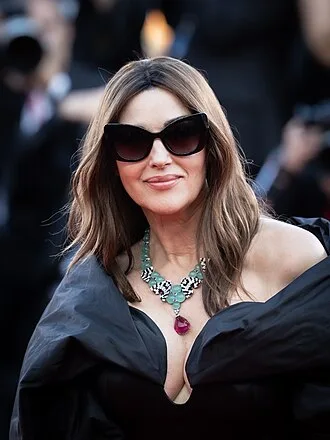
Bellucci was represented by Elite Model Management and modelled for Dolce & Gabbana campaigns. She made her acting debut in the Italian television miniseries Vita coi figli (1991); she went on to play one of Dracula's brides in the horror film Bram Stoker's Dracula (1992) and then enrolled in acting classes.
After appearing in Italian productions, she had her breakthrough role in The Apartment (1996), for which she received a César Award nomination for Most Promising Actress. Bellucci came to the attention of American audiences in Under Suspicion (2000) and gained greater international recognition as Malèna Scordia in Malèna (2000).
Bellucci starred in the period horror Brotherhood of the Wolf (2001) and the comedy Asterix & Obelix: Mission Cleopatra (2002). She portrayed a rape victim in the controversial thriller Irréversible (2002), and Persephone in the 2003 science-fiction films The Matrix Reloaded and The Matrix Revolutions.
Bellucci was praised for her portrayal of Mary Magdalene in the drama The Passion of the Christ (2004). She played a prostitute in How Much Do You Love Me? (2005) and Shoot 'Em Up (2007), and acted in diverse roles in other films, including The Whistleblower (2010), The Ages of Love (2011), and The Wonders (2014).
Her role in Ville-Marie (2015) earned her the Dublin Film Critics' Circle Award for Best Actress. At the age of 50, Bellucci appeared in the James Bond film Spectre (2015), becoming the oldest Bond girl in the history of the franchise. She later appeared in films such as On the Milky Road (2016), The Man Who Sold His Skin (2020), and Beetlejuice Beetlejuice (2024).
On television, she has acted in Mozart in the Jungle (2016) and Call My Agent! (2018). She made her stage debut in 2019 as Maria Callas in Letters and Memoirs.
Bellucci starred alongside her second husband Vincent Cassel in on-screen partnerships that spanned ten years. She has remained involved in modelling, and worked as a brand ambassador for luxury brands such as Cartier and Dior. Some media outlets have labelled Bellucci a sex symbol. Bellucci received the knight insignias of the French Order of Arts and Letters in 2006 and of the French Legion of Honour in 2016. She represents Italy as a permanent member of the Academy of Motion Picture Arts and Sciences.
Early life
Monica Anna Maria Bellucci was born in Città di Castello, Umbria, Italy, on 30 September 1964.[excessive citations] Her father, Pasquale Bellucci, owned a trucking company, and her mother, Brunella Briganti, was a housewife and amateur painter. Bellucci was the only child in her family since her parents did not want another one. Bellucci grew up in Selci-Lama, in the comune (municipality) of San Giustino on the banks of the Tiber River.
Bellucci received a Catholic education. She was an "intelligent child". According to her father, she was discreet and increasingly interested in fashion, and grew up "surrounded by love". Bellucci was introduced to modelling at age 13 when she posed for a photographer friend-of-the-family in Città di Castello.
She was distant from other children her age, regularly made detours to get home after school, and did not spend time with them in the comune's public space. Bellucci's father said she complained that everyone stared at her. Her father helped her gain self-confidence.
Bellucci developed a taste for cinema, watching films by Vittorio De Sica, Federico Fellini, Roberto Rossellini, Luchino Visconti, Marcel Carné, and Jean-Luc Godard. Bellucci has said her personality largely reflects her upbringing: "Certainly a lot of positivity also depends on the climate in which my parents raised me".
Modeling career
1980s and 1990s
At age 16, Bellucci was asked to pose for photography sessions by her father's friend, the director of a fashion agency. Having begun her modelling career, Bellucci periodically travelled to Milan and Paris while continuing her studies at Città di Castello.
According to Bellucci: "I approached the adult universe very early" because she worked with models ten years older than herself. Bellucci said: "Modelling came to me naturally, and I loved pictures. I loved the world of image".
While hitchhiking, Bellucci met Piero Montanucci, a hairdresser from Città di Castello, who persuaded her to become his model. Bellucci, a student at the liceo classico, attracted attention wherever she went due to her striking appearance.
She was considered a local model. Bellucci studied philosophy, literature, Latin and Greek. In 1983, Bellucci was dressed by Città di Castello-based fashion entrepreneur Pina Alberti and modelled at a fashion show at the Teatro degli Illuminati, the city's municipal theatre, as part of an event called Momento Donna, which Maria Giovanna Elmi hosted.
Montanucci, her mentor at the time, accompanied Bellucci to the event. While in high school, Bellucci's father's friend allowed her to debut on the catwalk during a fashion show in Florence and at another in Milan.
Bellucci studied law at the University of Perugia, aiming to become a lawyer. She financed her studies by working as a model through her father's friend. After a friend of Bellucci encouraged her to apply to modelling agencies during her studies, she moved to Milan, one of Europe's fashion centres. Modelling agent Piero Piazzi saw Bellucci's arrival at the Elite Model Management agency and thought she could have been an actress.
Piazzi had been critical in his assessment when he first saw Bellucci in 1987, telling her she was "not ready". Between 1988 and 1989, Elite signed Bellucci to a contract. In 1988, she featured on the cover of Elle France, photographed by Oliviero Toscani, and Vogue Spain.
Bellucci's work as a model for Elite required her to travel, so she decided to leave university; she later said being a lawyer would not have suited her. She appeared in numerous international advertising campaigns, and Dolce & Gabbana recruited her as their muse. Bellucci's physical attributes aligned with the image the founders of Dolce & Gabbana wanted to portray.
In 1989, Bellucci lived in New York and was already a millionaire. As a model, Bellucci was represented by Elite, and she worked in Milan, Paris, and New York.
In 1990, the French luxury house Dior used Bellucci's image and name for its Haute Couture line. She was photographed by Richard Avedon, and became the "protagonist" of Dolce & Gabbana's campaigns, "which elevated her to an icon of Mediterranean beauty". She also appeared in fashion parades for the luxury fashion house Fendi.
In 1991, Bellucci was the brand ambassador for the cosmetics company L'Oréal. The same year, Bellucci appeared in the Sports Illustrated Swimsuit Issue, which featured photographs of her in the Caribbean. Bellucci also appeared in advertisements for Givenchy, Nina Ricci, Yves Saint Laurent, Versace and other luxury brands.
In 1992, Bellucci combined her work as a model with her acting debut. In 1993, she first met Giuseppe Tornatore when he directed her in a television advertisement for Dolce & Gabbana perfume.
Bellucci opted to follow her passion for cinema, turned to acting and stopped modelling full-time, although she remained active in the industry. The Italian luxury company Breil appointed Bellucci its brand ambassador and she starred in advertising campaigns. In the 1990s, Bellucci regularly modelled for calendars, beginning in 1997 at the age of 33 when Avedon photographed her for the Pirelli Calendar.
In 1997, Bellucci became the brand ambassador and muse of Cartier jewellery. Nina Hald of the Danish newspaper Berlingske said: "Cartier chose for the first time to associate an actress closely with the house". Cartier accompanied Bellucci throughout her acting career, notably on red carpets, where she wore haute joaillerie (high jewellery) collections, and she worked as a model for opulent creations. Italian fashion photographer Fabrizio Ferri photographed Bellucci for the magazine Max's calendar.
2000s
Bellucci posed for the GQ calendar in 2000 and was photographed by Gian Paolo Barbieri. In 2004, while pregnant with her first child, Bellucci posed nude for the Italian cover of Vanity Fair in a protest against Italian laws that restricted access to in vitro fertilisation. That same year, Bellucci's status as the only actress who was contractually bound to Cartier was made public.
In 2006, she was named brand ambassador for Dior and the face of a range of products until 2010. Cartier designed a collection of luxury diamond jewellery that was inspired by Bellucci and bore her name. It was first presented at a Cartier event in Dubai in 2007.
2010s and 2020s
Bellucci's appearances in television advertisements include Martini Gold, a collaboration between Martini and Dolce & Gabbana, in 2010. She again posed semi-nude whilst pregnant for the cover of the April 2010 issue of Vanity Fair Italy. Cashmere goods manufacturer Éric Bompard appointed Bellucci as its brand ambassador for its winter 2011/2012 advertising campaign.
In 2012, Bellucci was the face of an eponymous range of Dolce & Gabbana lipstick. She appeared in other seasonal fashion campaigns for Dolce & Gabbana. She was signed to Storm Management in London and D'Management Group in Milan.
Bellucci was chosen as the face of German cosmetics manufacturer Nivea for its 2018 and 2019 campaigns. In June 2018, Bellucci appeared in a fashion parade for Dolce & Gabbana when she opened the second day of Milan Fashion Week. According to Stefano Gabbana, Bellucci returned to the catwalk for the house for the first time since 1992.
She also appeared on the catwalk for Dolce & Gabbana at the early 2019 Milan fashion week, along with Helena Christensen, Eva Herzigová, and Isabella Rossellini, who joined the influx of 1990s supermodels returning to the fashion spotlight.
Bellucci remained the "muse" and ambassador of the Cartier brand in the 2020s. Since 2000, Bellucci has appeared on national and international covers of Elle, GQ, Harper's Bazaar, Marie Claire, Maxim, Paris Match, Schön!, The Sunday Times Style, Vanity Fair, and Vogue, among others.
Acting career
1990–1999: Early roles and breakthrough
In 1990, Italian director Carlo Vanzina noticed a photo of Monica Bellucci in a magazine and recommended her to Dino Risi, who was looking for a "new face" for his television miniseries Vita coi figli. Bellucci had never thought of becoming an actress and was surprised to be chosen for a role.
Bellucci made her acting debut in Vita coi figli, a two-part television film that was broadcast in Italy in May 1991, in which she played Elda. The same year, Bellucci made her film debut in La Riffa, which Francesco Laudadio directed.
In 1992, Bellucci played one of the three brides of Dracula in the horror film Bram Stoker's Dracula. Roman Coppola saw a photograph of Bellucci in the Italian magazine Zoom and implored his father Francis Ford to offer her a film role. Coppola arranged a meeting with Bellucci in Los Angeles while she was in New York for a photography session.
After talking with Coppola, Bellucci realised she would embark on an acting career. At Coppola's request, Bellucci stayed in Los Angeles during filming; she was apprehensive about the city and believed her English needed improvement. She decided her next acting work would be in Italy. Bellucci's role as a "sensual vampire" was her international film debut.
Following her minor role in Bram Stoker's Dracula, Bellucci returned to Italy and enrolled in acting classes. According to Bellucci: "I craved it ... I needed to act". Bellucci said that a time when all of her friends were leaving the faculty was a challenging time. Bellucci had difficulty overcoming the prejudices related to her modelling and her physical appearance, and had to work to establish her credibility.
For the next four years, Bellucci starred in Italian films but was ultimately dissatisfied due to the lack of opportunities, and she aspired to an international acting career. Bellucci appeared in the Emmy-winning biblical television miniseries Joseph (1995). In her view, the Italian film industry needed to invest more money to promote films internationally. Bellucci moved to France to improve her career prospects, and settled in Paris in 1995.
Bellucci's portrayal of Lisa in The Apartment (1996), a "moody" French film noir, earned her a César Award nomination for Most Promising Actress. This launched her career in France and strengthened her position as an actress. It was her first French-language film. Gavanndra Hodge of The Sunday Times stated that her "break-out role" was in the European arthouse film The Apartment.
The BBC's Almar Haflidason described the film as "seductive" and "startling", giving it a rating of five stars. Bellucci's second French film was Jan Kounen's Dobermann (1997), in which she portrayed a mute Romani woman and had to learn sign language beforehand to embody her character. Recalling the filming process, she expressed an inclination for mise-en-scènes (stage settings) "that pass more through bodies than through words".
At this point in her career, Bellucci made a significant impact on European audiences. Pierce Brosnan performed a screen test with Bellucci for the James Bond film Tomorrow Never Dies (1997) then requested she be given the role of Paris Carver but the studio stated only an American actress could be cast in the role.
For her leading role as Giulia Giovannini in the Italian comedy-drama L'ultimo capodanno (1998), Bellucci received a Globo d'oro Award for Best Actress. The Apartment later won a British Academy Film Award (BAFTA) for Best Film not in the English language, prompting film director Stephen Hopkins to take a close interest in Bellucci.
2000–2003: American films, Malèna, and Irréversible
In 2000, Bellucci caught the attention of American audiences with her first English-language lead role in Hopkins' Under Suspicion, in which she starred opposite Morgan Freeman and Gene Hackman. Hopkins cast Bellucci after watching her performance in The Apartment and retained her ideas to create the character Chantal Hearst.
Garth Pearce, writing in The Times, noted her improved spoken English. Under Suspicion was selected as one of the 2000 Cannes Film Festival's closing films, marking her red-carpet debut at the annual event. After the film's release, Freeman said: "It's all there in her eyes. She has this quality that reminds me of Jeanne Moreau.
There is a sense of having been there, that she's had a life." Variety listed Bellucci among "the ten young actresses to keep an eye on".
Bellucci returned to Italian cinema, portraying Malèna Scordia, an enigmatic, envied and coveted World War II widow whose life unfolds before a 13-year-old boy in the Tornatore-directed film Malèna (2000), which is set in Sicily. Los Angeles Times film critic Kevin Thomas said the film emphasises the seductive appeal of the film's protagonist Scordia, to whom Bellucci gave an "heroic" portrayal that was delivered with a few lines of dialogue.
Writing for The Guardian, Mark Salisbury considered Bellucci's portrayal in the Oscar-nominated film her "breakout performance". Malèna brought Bellucci worldwide attention; it was her first international success and caused her to be "besieged by offers" from Hollywood when Miramax secured the film for US distribution. For the US release, ten minutes of explicit, erotic scenes from the film were censored.
Bellucci starred with Samuel Le Bihan and Vincent Cassel in Christophe Gans' Brotherhood of the Wolf, a 2001 French period drama film that is based on historical events involving the beast of Gévaudan that decimated the population of Lozère in 18th-century France. The Washington Post film critic Stephen Hunter found the film's stylistic approach too dense, obscuring Bellucci's "fabulous natural asset"; she played an "underused" role as a courtesan–papist spy.
The film received positive responses from other critics. Brotherhood of the Wolf was a box-office success in France, where it attracted five million viewers and grossed US$70 million worldwide, including $11 million in the US, against a budget of about €32 million.
The film earned Bellucci a Best Supporting Actress nomination at the 2002 Saturn Awards. The filming of Asterix & Obelix: Mission Cleopatra (2002), in which Bellucci starred with Jamel Debbouze, which, with its light-hearted, comic atmosphere, was one of Bellucci's favourite cinematographic experiences. She portrayed the "prickly" Cleopatra, the queen of Ancient Egypt, in the comedy film, which was directed by Alain Chabat. The Guardian film critic Peter Bradshaw wrote Bellucci was "certainly talented enough ... to merit getting the role of Cleopatra in some serious treatment", but before then, she had to perform in a "funny mainstream commercial" French production.
The film was a success, selling 14 million tickets in France at the time of its release and grossing more than $128 million worldwide.
In 2002, Bellucci co-starred with Cassel in Gaspar Noé's "violent" arthouse thriller Irréversible. The revenge film, which was filmed on Super 16 film using hand-held cameras, depicts Bellucci playing Alex, who is graphically raped for nine uninterrupted minutes in an underpass, a scene Bellucci had to film four times.
Bellucci's "indelible scene" was filmed on the outskirts of Paris, in an area frequented by prostitutes. Bellucci and Cassel, who at the time were in a relationship, were some of "the country's biggest talents". Audiences at the 2002 Cannes Film Festival were outraged during the midnight premiere of Irréversible, with some calling it "unsustainable".
Lisa Nesselson of Variety said Bellucci showed "responses to peril and joy [that are] particularly memorable". The film has been studied in film schools. Noé said he "has never seen an actress so charismatic ... with that much guts ... her performance is incredibly audacious". K. Austin Collins of Rolling Stone called Irréversible "one of the most controversial movies ever".