















New Mexico is the fifth-largest of the fifty states by area, but with just over 2.1 million residents, ranks 36th in population and 45th in population density. Its climate and geography are highly varied, ranging from forested mountains to sparse deserts; the northern and eastern regions exhibit a colder alpine climate, while the west and south are warmer and more arid.
The Rio Grande and its fertile valley runs north-to-south, creating a riparian biome through the center of the state that supports a bosque habitat and distinct Albuquerque Basin climate. One-third of New Mexico's land is federally owned, including many protected wilderness areas, 15 national parks and monuments, and three UNESCO World Heritage Sites wholly contained within the state—the most of any U.S. state.
Since time immemorial, New Mexico was home to Pueblo peoples, the Mogollon culture, and Ute. The Pueblo peoples occupied several dozen villages, mostly in northern New Mexico's Rio Grande valley. The Navajo and Apache arrived in the late 1400s, the Spanish in 1598, and the Comanche in the early 1700s. The Spanish colony of Nuevo México became a peripheral part of the viceroyalty of New Spain.
The 1680 Pueblo Revolt was the first successful revolution against colonial rule in the Americas. In 1692 Spanish colonial rule returned, but the colony fell under the influence of Comancheria with the Comanche-Spanish peace treaties of 1785 and 1786, isolated by its rugged terrain and distance from Mexico City. Upon Mexican independence in 1821, New Mexico became an autonomous territory that saw an 1837 Rebellion against the central government, with increasing economic ties to the United States.
After the Mexican–American War in 1848, the U.S. annexed New Mexico as part of the larger New Mexico Territory, which was central to U.S. westward expansion. New Mexico was a territory for 64 years before it was admitted to the Union as the 47th state on January 6, 1912. During World War II, New Mexico hosted several key facilities of the Manhattan Project, which developed the world's first atomic bomb, and was the site of the first nuclear test, Trinity in 1945.
The convergence of Pueblo, Apache, Navajo, Comanche, Ute, Spanish, Mexican, and American influences throughout history led to a culture with unique cuisine, Spanish dialect, music, and the Pueblo Revival and Territorial styles of architecture. As one of nine majority-minority states, it has the nation's highest proportion of Hispanic and Latino Americans and the second-highest proportion of Native Americans, after Alaska.
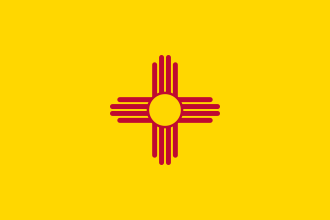
It is home to one-third of the Navajo Nation, 19 federally recognized Pueblo communities, and three federally recognized Apache tribes. The large Latino population includes Hispanos descended from families in the colonies period alongside more recent Mexican Americans. The New Mexican flag, which is among the most recognizable in the U.S., reflects indigenous and Spanish inspiration.
New Mexico's economy is highly diversified; major sectors include mining, oil and gas, aerospace, media, and film. Its total real gross domestic product (GDP) was $152.778 billion in 2025, with a GDP per capita of $61,645. New Mexico often ranks low in wealth, healthcare, and education, but has some of the highest concentrations of scientists, engineers, along with other highly skilled workers, and one of the most educated (albeit very small) counties in the U.S.: Los Alamos County.
The federal government has a significant presence in New Mexico, including U.S. military installations such as White Sands Missile Range and Kirtland Air Force Base, and Department of Energy research centers such as the Sandia and Los Alamos National Laboratories.
Etymology
New Mexico received its name long before the present-day country of Mexico won independence from Spain and adopted that name in 1821. The name "Mexico" derives from Nahuatl and originally referred to the heartland of the Mexica, the rulers of the Aztec Empire, in the Valley of Mexico. After conquering the Aztecs in the early 16th century, the Spanish began exploring what is now the Southwestern United States, calling it Nuevo México after the region known as the Kingdom of Mexico.
In 1581, the Chamuscado and Rodríguez Expedition named the region north of the Rio Grande San Felipe del Nuevo México. The Spaniards had hoped to find wealthy indigenous cultures similar to the Mexica; the indigenous cultures of New Mexico proved to be unrelated to the Mexica and lacking in riches, but the name persisted.
Before statehood in 1912, the name "New Mexico" loosely applied to various configurations of territories in the same general area, which evolved throughout the Spanish, Mexican, and U.S. periods, but typically encompassed most of present-day New Mexico along with sections of neighboring states.
History
Prehistory
The first known inhabitants of New Mexico were members of the Clovis culture of Paleo-Indians. Footprints discovered in 2017 suggest that humans may have been present in the region as long ago as 21,000–23,000 BC. Later inhabitants include the Mogollon, Ancestral Pueblo cultures, which are characterized by sophisticated pottery work and urban development; pueblos or their remnants, like those at Acoma, Taos, and Chaco Culture National Historical Park, indicate the scale of Ancestral Puebloan dwellings within the area. These cultures and the Ute form part of the broader Oasisamerica region of pre-Contact North America.
Navajos may be descendants of the lost Naha tribe, a Slavey tribe from the Nahanni region west of Great Slave Lake.
The vast trade networks of the Ancestral Puebloans led to legends throughout Mesoamerica and the Aztec Empire (Mexico) of an unseen northern empire that rivaled their own, which they called Yancuic Mexico, literally translated as "a new Mexico".[citation needed]
First Spanish colonial period
Aztec legends of a prosperous empire to their north became the primary basis for the mythical Seven Cities of Gold, which spurred exploration by Spanish conquistadors following their conquest of the Aztecs in the early 16th century; prominent explorers included Álvar Núñez Cabeza de Vaca, Andrés Dorantes de Carranza, Alonso del Castillo Maldonado, Estevanico, and Marcos de Niza.
In 1539, Esteban de Dorantes became the first person from the Old World to reach New Mexico, where he was killed by Pueblo peoples. Francisco Vázquez de Coronado arrived in 1540. In 1598 conquistador Juan de Oñate y Salazar began the Spanish colonization of New Mexico. The campaign included Oñate's 1599 Ácoma Massacre.
Oñate arrived at Acoma Pueblo on January 21 with an army including cannons and muskets. The Spanish set fire to the Pueblo. Approximately 800–1000 Ácoma were murdered. After this initial attack, on February 12, Oñate ordered that the right foot be cut off every man over 25.
The settlement of La Villa Real de la Santa Fe de San Francisco de Asís—modern day Santa Fe – was established by Pedro de Peralta as a more permanent capital at the foot of the Sangre de Cristo Mountains in 1610.
Pueblo Revolt
The first successful revolution against European rule in the Americas occurred with the 1680 Pueblo Revolt. From Taos Pueblo, the Pueblo leader Po'pay rallied the Pueblo peoples into expelling the Spanish from New Mexico. He would rule the Pueblo confederation until his death.
Return of the Spanish
After the death of Pueblo leader Po'pay, some Pueblo leaders invited the Spanish to return to New Mexico. Diego de Vargas led the return of the Spanish in 1692. with Puebloans offered greater cultural and religious liberties. Compared to the previous colonial regime, the Spanish sought relative compromise with the Pueblos on religious matters, seeking to avoid another revolt.
Beyond forging better relations with the Pueblos, governors were forbearing in their approach to the indigenous peoples, such as was with governor Tomás Vélez Cachupín; the comparatively large reservations in New Mexico and Arizona are partly a legacy of Spanish treaties recognizing indigenous land claims in Nuevo México.
Returning settlers founded La Villa de Alburquerque in 1706 at Old Town Albuquerque as a trading center for existing surrounding communities such as Barelas, Isleta, Los Ranchos, and Sandia; it was named for the viceroy of New Spain, Francisco Fernández de la Cueva, 10th Duke of Alburquerque. Governor Francisco Cuervo y Valdés established the villa in Tiguex to provide free trade access and facilitate cultural exchange in the region.
Increased Comanche influence
To encourage settlement in its vulnerable periphery amidst the increased power and reach of Comanche raids, Spain awarded land grants to European settlers in Nuevo México; due to the scarcity of water throughout the region, the vast majority of colonists resided in the central valley of the Rio Grande and its tributaries.
Most communities were walled enclaves consisting of adobe houses that opened onto a plaza, from which four streets ran outward to small, private agricultural plots and orchards; these were watered by acequias, community owned and operated irrigation canals. Just beyond the wall was the ejido, communal land for grazing, firewood, or recreation.
While New Mexico was legally part of New Spain, it fell under the influence of Comancheria in with the 1785 and 1786 Comanche-Spanish peace treaties and became a de facto protectorate, with New Mexico refusing multiple orders from Madrid and Mexico City to go to war with the Comanche. Nevertheless, relations between the various indigenous groups and Spanish settlers remained nebulous and complex, varying from trade and commerce to cultural assimilation and intermarriage to total warfare.
During most of the 18th century, raids by Navajo, Apache, and especially Comanche inhibited the growth and prosperity of the New Mexico. The region's harsh environment and remoteness, surrounded by hostile Native Americans, fostered a greater degree of self-reliance, as well as pragmatic cooperation, between the Pueblo peoples and colonists.
Many indigenous communities enjoyed a large measure of autonomy well into the late 19th century due to the improved governance.
By 1800, the population of New Mexico had reached 25,000 (not including indigenous inhabitants), far exceeding the territories of California and Texas.
Mexican territorial period
As part of New Spain, the province of New Mexico became part of the First Mexican Empire in 1821 following the Mexican War of Independence. Upon its secession from Mexico in 1836, the Republic of Texas claimed the portion east of the Rio Grande, based on the erroneous assumption that the older Hispanic settlements of the upper Rio Grande were the same as the newly established Mexican settlements of Texas.
The Texan Santa Fe Expedition was launched to seize the contested territory but failed with the capture and imprisonment of the entire army by the Hispanic New Mexico militia.
At the turn of the 19th century, France still claimed northeastern New Mexico—the area north of the Canadian River and east of the Sangre de Cristos—before selling it in the 1803 Louisiana Purchase. In 1812, the U.S. reclassified the land as part of the Missouri Territory. This region of New Mexico (along with territory comprising present-day southeastern Colorado, the Texas and Oklahoma Panhandles, and southwestern Kansas) was ceded to Spain under the Adams-Onis Treaty in 1819.
When the First Mexican Republic began to transition into the Centralist Republic of Mexico, they began to centralize power ignoring the sovereignty of Santa Fe and disregarding Pueblo land rights. The end of Spanish protectionism led to New Mexico becoming financially and politically tied to the U.S., and preferring trade along the Santa Fe Trail.
This led to the Río Arriba Rebellion in 1837, which established the Cantón de Nuevo México led by Taos Pueblo members José María González and Pablo Montoya. The rebellion began with the assassination of Centralist governor Albino Pérez and ended with the execution of González was executed by governor Manuel Armijo. Subsequent governor Juan Bautista Vigil y Alarid agreed with some of the underlying sentiment.
Initial American territorial period
Following the victory of the United States in the Mexican–American War (1846–48), Mexico ceded its northern territories to the U.S., including California, Texas, and New Mexico. The Americans were initially heavy-handed in their treatment of former Mexican citizens, triggering the Taos Revolt in 1847 by Hispanos and their Pueblo allies; the insurrection led to the death of territorial governor Charles Bent and the collapse of the civilian government established by Stephen W.
Kearny. In response, the U.S. government appointed local Donaciano Vigil as governor to better represent New Mexico, and also vowed to accept the land rights of Hispanos and grant them citizenship. In 1864, President Abraham Lincoln symbolized the recognition of Native land rights with the Lincoln Canes, sceptres of office gifted to each of the Pueblos, a tradition dating back to Spanish and Mexican eras.
After the Republic of Texas was admitted as a state in 1846, it attempted to claim the eastern portion of New Mexico east of the Rio Grande, while the California Republic and State of Deseret each claimed parts of western New Mexico. Under the Compromise of 1850, these regions were forced by the U.S. government to drop their claims, Texas received $10 million in federal funds, California was granted statehood, and officially establishing the Utah Territory; therein recognizing most of New Mexico's historically established land claims.
Pursuant to the compromise, Congress established the New Mexico Territory in September of that year; it included most of present-day Arizona and New Mexico, along with the Las Vegas Valley and what would later become Clark County in Nevada.
In 1853 the U.S. acquired the mostly desert southwestern bootheel of the state, along with Arizona's land south of the Gila River, in the Gadsden Purchase, which was needed for the right-of-way to encourage construction of a transcontinental railroad.Cite error: Unknown parameter "map" in <ref> tag; supported parameters are dir, follow, group, name (see the help page).
Postwar American territorial period
The end of the Civil War saw rapid economic development and settlement in New Mexico, which attracted homesteaders, ranchers, cowboys, businessmen, and outlaws; many of the folklore characters of the Western genre had their origins in New Mexico, most notably businesswoman Maria Gertrudis Barceló, outlaw Billy the Kid, and lawmen Pat Garrett and Elfego Baca.
The influx of "Anglo Americans" from the eastern U.S. (which include African Americans and recent European immigrants) reshaped the state's economy, culture, and politics. Into the late 19th century, the majority of New Mexicans remained ethnic mestizos of mixed Spanish and Native American ancestry (primarily Pueblo, Navajo, Apache, Genízaro, and Comanche), many of whom had roots going back to Spanish settlement in the 16th century; this distinctly New Mexican ethnic group became known as Hispanos and developed a more pronounced identity vis-a-vis the newer Anglo arrivals.
Politically, they still controlled most town and county offices through local elections, and wealthy ranching families commanded considerable influence, preferring business, legislative, and judicial relations with fellow indigenous New Mexican groups. By contrast, Anglo Americans, who were "outnumbered, but well-organized and growing" tended to have more ties to the territorial government, whose officials were appointed by the U.S. federal government; subsequently, newer residents of New Mexico generally favored maintaining territorial status, which they saw as a check on Native and Hispano influence.
A consequence of the civil war was intensifying conflict with indigenous peoples, which was part of the broader American Indian Wars along the frontier. The withdrawal of troops and material for the war effort had prompted raids by hostile tribes, and the federal government moved to subdue the many native communities that had been effectively autonomous throughout the colonial period.
Following the elimination of the Confederate threat, Brigadier General James Carleton, who had assumed command of the Military Department of New Mexico in 1862, led what he described as a "merciless war against all hostile tribes" that aimed to "force them to their knees, and then confine them to reservations where they could be Christianized and instructed in agriculture." With famed frontiersman Kit Carson placed in charge of troops in the field, powerful indigenous groups such as the Navajo, Mescalero Apache, Kiowa, and Comanche were brutally pacified through a scorched earth policy, and thereafter forced into barren and remote reservations.
Sporadic conflicts continued into the late 1880s, most notably the guerilla campaigns led by Apache chiefs Victorio and his son-in-law Nana.