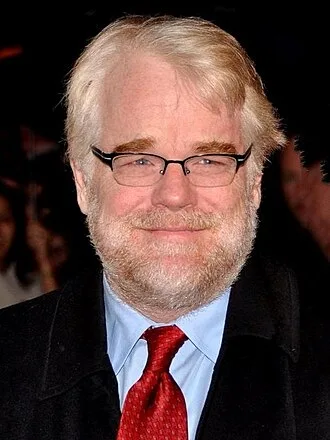
Hoffman studied acting at New York University Tisch School of the Arts. He gained recognition for his supporting work, notably in Scent of a Woman (1992), Boogie Nights (1997), Happiness (1998), The Big Lebowski (1998), Magnolia (1999), and The Talented Mr. Ripley (1999). Hoffman began to occasionally play leading roles, and he won the Academy Award for Best Actor for his portrayal of Truman Capote in Capote (2005).
He was also nominated for Academy Award for Best Supporting Actor for his performances in Charlie Wilson's War (2007), Doubt (2008), and The Master (2012). While he mainly worked in independent films, Hoffman also appeared in Hollywood blockbusters such as Twister (1996) and Mission: Impossible III (2006).
In one of his final roles before his death, he played Plutarch Heavensbee in the Hunger Games series (2013–2015). The feature film Jack Goes Boating (2010) marked Hoffman's debut as a filmmaker.
Hoffman was also an accomplished theater actor and director. He joined the off-Broadway LAByrinth Theater Company in 1995; while there, he directed, produced, and appeared in numerous stage productions. Hoffman received Tony Award nominations for his performances in the Broadway revivals of Sam Shepard's True West (2000), Eugene O'Neill's Long Day's Journey into Night (2003), and Arthur Miller's Death of a Salesman (2012).
Hoffman was known to have struggled with substance abuse. On February 2, 2014, Hoffman died from "acute mixed drug intoxication, including heroin, cocaine, benzodiazepines and amphetamine". Remembered for the nuance, depth, and humanity he brought to his diverse roles, Hoffman was described in his obituary in The New York Times as "perhaps the most ambitious and widely admired American actor of his generation".
Early life and education
Hoffman was born on July 23, 1967, in the Rochester suburb of Fairport, New York. His mother, Marilyn O'Connor (née Loucks), came from nearby Waterloo and worked as an elementary school teacher before becoming a lawyer and eventually a family court judge. His father, Gordon Stowell Hoffman, was a native of Geneva, New York, and worked for the Xerox Corporation. Hoffman had one brother, Gordy, and two sisters, Jill and Emily. He had Irish and German ancestry.
Hoffman was baptized a Catholic and attended Mass as a child, but did not have a heavily religious upbringing. His parents divorced when he was nine, and the children were raised primarily by their mother. Hoffman's childhood passion was sports, particularly wrestling and baseball, but at age 12, he attended a stage production of Arthur Miller's All My Sons and was transfixed.
He recalled in 2008, "I was changed—permanently changed—by that experience. It was like a miracle to me." Hoffman developed a love for the theater, and proceeded to attend regularly with his mother, who was a lifelong enthusiast. He remembered that productions of Quilters and Alms for the Middle Class, the latter starring a teenaged Robert Downey Jr., were also particularly inspirational.
At age 14, Hoffman suffered a neck injury that ended his sporting activity, and he began to consider acting. Encouraged by his mother, he joined a drama club, and initially committed to it because he was attracted to a female member.
Acting gradually became a passion for Hoffman: "I loved the camaraderie of it, the people, and that's when I decided it was what I wanted to do." At age 17, he was selected to attend the 1984 New York State Summer School of the Arts in Saratoga Springs, where he met his future collaborators Bennett Miller and Dan Futterman.
Miller later commented on Hoffman's popularity at the time: "We were attracted to the fact that he was genuinely serious about what he was doing. Even then, he was passionate." Hoffman applied for several drama degree programs and was accepted to New York University's (NYU) Tisch School of the Arts. Between graduating from Fairport High School and beginning the program, he continued his training at the Circle in the Square Theatre's summer program.
Hoffman had positive memories of his time at NYU, where he supported himself by working as an usher. With friends, he co-founded the Bullstoi Ensemble acting troupe. He earned a drama degree in 1989.
Career
1991–1995: Early career
After graduating, Hoffman worked in off-Broadway theater and made additional money with customer service jobs. He made his screen debut in 1991, in a Law & Order episode called "The Violence of Summer", playing a man accused of rape. He made his film debut the following year, when he was credited as "Phil Hoffman" in the independent film Triple Bogey on a Par Five Hole. After this, he adopted his grandfather's name, Seymour, to avoid confusion with another actor.
More film roles promptly followed, with appearances in the studio production My New Gun, and a small role in the comedy Leap of Faith, starring Steve Martin. Following these roles, he gained attention playing a spoiled private school student in the Oscar-winning Al Pacino film Scent of a Woman (1992).
Hoffman auditioned five times for his role, which The Guardian journalist Ryan Gilbey says gave him an early opportunity "to indulge his skill for making unctuousness compelling". The film earned US$134 million worldwide and was the first to get Hoffman noticed. Reflecting on Scent of a Woman, Hoffman later said, "If I hadn't gotten into that film, I wouldn't be where I am today." At this time, he quit his job in a delicatessen to become a professional actor.
Hoffman continued playing small roles throughout the early 1990s. After appearing in Joey Breaker and the critically panned teen zombie picture My Boyfriend's Back, he had a more notable role playing John Cusack's wealthy friend in the crime comedy Money for Nothing. In 1994, he portrayed an inexperienced mobster in the crime thriller The Getaway, starring Alec Baldwin and Kim Basinger, and he subsequently appeared with Andy García and Meg Ryan in the romantic drama When a Man Loves a Woman.
He then played an uptight police deputy who gets punched by Paul Newman—one of Hoffman's acting idols—in the drama Nobody's Fool.
Still considering stage work to be fundamental to his career, Hoffman joined the LAByrinth Theater Company of New York City in 1995. This association lasted the remainder of his life; along with appearing in multiple productions, he later became co-artistic director of the theater company with John Ortiz, and directed various plays over the years.
Hoffman's only film appearance of 1995 was in the 22-minute short comedy The Fifteen Minute Hamlet, which satirized the film industry in an Elizabethan setting. He played the characters of Bernardo, Horatio, and Laertes alongside Austin Pendleton's Hamlet.
1996–1999: Rising star
Between April and May 1996, Hoffman appeared at the Joseph Papp Public Theater in a Mark Wing-Davey production of Caryl Churchill's The Skriker. Afterwards, based on his work in Scent of a Woman, he was cast by writer–director Paul Thomas Anderson to appear in Anderson's debut feature Hard Eight (1996).
Hoffman had only a brief role in the crime thriller, playing a cocksure young craps player, but it began the most important collaboration of his career. Before cementing a creative partnership with Anderson, Hoffman appeared in one of the year's biggest blockbusters, Twister, playing a grubby, hyperactive storm chaser alongside Helen Hunt and Bill Paxton.
According to a People survey of Twitter and Facebook users, Twister is the film with which Hoffman is most popularly associated. He then reunited with Anderson for the director's second feature, Boogie Nights, about the Golden Age of Pornography. The ensemble piece starred Mark Wahlberg, Julianne Moore, and Burt Reynolds; Hoffman played a boom operator, described by David Fear of Rolling Stone as a "complete, unabashed loser", who attempts to seduce Wahlberg's character.
Warmly received by critics, the film grew into a cult classic, and has been cited as the role in which Hoffman first showed his full ability. Fear commended the "naked emotional neediness" of the performance, adding that it made for compulsive viewing. Hoffman later expressed his appreciation for Anderson when he called the director "incomparable".
That wasn't easy. It's hard to sit in your boxers and jerk off in front of people for three hours. I was pretty heavy, and I was afraid that people would laugh at me. Todd said they might laugh, but they won't laugh at you. He saw what we were working for, which was the pathos of the moment. Sometimes, acting is a really private thing that you do for the world.
Continuing with this momentum, Hoffman appeared in five films in 1998. He had supporting roles in the crime thriller Montana and the romantic comedy Next Stop Wonderland, both of which were commercial failures, before working with the Coen brothers in their dark comedy The Big Lebowski. Hoffman had long been a fan of the directors, and relished the experience of working with them.
Appearing alongside Jeff Bridges and John Goodman, Hoffman played Brandt, the smug personal assistant of the titular character. Although it was only a small role, he said it was one for which he was most recognized, in a film that has achieved cult status and a large fan base. Between March and April 1998, Hoffman made 30 appearances on stage at the New York Theatre Workshop in a production of Mark Ravenhill's Shopping and Fucking, portraying an ex-heroin addict.
Hoffman took an unflattering role in Todd Solondz's Happiness (1998), a misanthropic black comedy about the lives of three sisters and those around them. He played Allen, a sexually frustrated loner who makes obscene phone calls to women; the character furiously masturbates during one conversation, producing what film scholar Jerry Mosher calls an "embarrassingly raw performance".
Jake Coyle of the Associated Press rated Allen as "one of the creepiest characters in American movies", but critic Xan Brooks highlighted the pathos that Hoffman brought to the role. Happiness was controversial but widely praised, and Hoffman's role has been cited by critics as one of his best. His final 1998 release was more mainstream, appeared as a medical student in the Robin Williams comedy Patch Adams. The film was critically panned, but one of the highest-grossing of Hoffman's career.
In 1999, Hoffman starred opposite Robert De Niro as drag queen Rusty Zimmerman in Joel Schumacher's drama Flawless. Hoffman considered De Niro the most imposing actor with whom he had appeared, and he felt that working with the veteran performer profoundly improved his own acting. Hoffman's ability to avoid clichés in playing such a delicate role was noted by critics, and Roger Ebert said it confirmed him as "one of the best new character actors".
He was rewarded with his first Screen Actors Guild Award nomination. Hoffman then reunited with Paul Thomas Anderson, where he was given an atypically virtuous role in the ensemble drama Magnolia. The film, set over one day in Los Angeles, features Hoffman as a nurse who cares for Jason Robards' character, who is dying of cancer.
The performance was approved of by the medical industry, and Jessica Winter of the Village Voice considered it Hoffman's most indelible work, likening him to a guardian angel. Magnolia has been included in lists of the greatest films of all time, and it was a personal favorite of Hoffman's.
One of the most critically and commercially successful films of Hoffman's career was The Talented Mr. Ripley (1999), which he considered "as edgy as you can get for a Hollywood movie". He played a "preppy bully" who taunts Matt Damon's Tom Ripley in the thriller, a character which Jeff Simon of The Buffalo News called "the truest upper class twit in all of American movies".
Hoffman's performance won praise from Meryl Streep, another of his cinematic idols: "I sat up straight in my seat and said, 'Who is that?' I thought to myself: My God, this actor is fearless", she said. "He's done what we all strive for — he's given this awful character the respect he deserves, and he's made him fascinating." In recognition of his work in Magnolia and The Talented Mr. Ripley, Hoffman was named the year's Best Supporting Actor by the National Board of Review.
2000–2004: Established star
Following a string of roles in successful films in the late 1990s, Hoffman had established a reputation as a top supporting player who could be relied on to make an impression with each performance. His film appearances were likened by David Kamp of GQ to "discovering a prize in a box of cereal, receiving a bonus, or bumping unexpectedly into an old friend".
According to Jerry Mosher, as the year 2000 began, "it seemed Hoffman was everywhere, poised on the cusp of stardom".
Hoffman had begun to be recognized as a theater actor in 1999, when he received a Drama Desk Award nomination for Outstanding Featured Actor for the off-Broadway play The Author's Voice. This success continued with the 2000 Broadway revival of Sam Shepard's True West, where Hoffman alternated roles nightly with co-star John C.
Reilly, making 154 appearances between March and July 2000. Ben Brantley of The New York Times felt that it was the best stage performance of Hoffman's career, calling him "brilliant", and the actor earned a Tony Award nomination for Best Actor in a Play. The following year, Hoffman appeared with Meryl Streep, Natalie Portman, and John Goodman in a Delacorte Theater production of Chekhov's The Seagull—although Brantley felt that this performance was less fully realized.
As a stage director, Hoffman received two Drama Desk Award nominations for Outstanding Director of a Play: one for Jesus Hopped the 'A' Train in 2001, and another for Our Lady of 121st Street in 2003. In a 2008 interview, Hoffman opined that "switching hats" between acting and directing helped him improve in both roles.
David Mamet's comedy State and Main, about the difficulties of shooting a film in rural New England, was Hoffman's first film role of 2000 and had a limited release. He had a more prominent supporting role that year in Almost Famous, Cameron Crowe's popular coming-of-age film set in the 1970s music industry.
Hoffman portrayed the enthusiastic rock critic Lester Bangs, a task by which he felt burdened, but he managed to convey the real figure's mannerisms and sharp wit after watching him in a BBC interview. The following year, Hoffman featured as the narrator and interviewer in The Party's Over, a documentary about the 2000 U.S. elections.
He assumed the position of a "politically informed and alienated Generation-Xer" who seeks to be educated in U.S. politics, but ultimately reveals the extent of public dissatisfaction in this area.
In 2002, Hoffman was given his first leading role (despite joking at the time "Even if I was hired into a leading-man part, I'd probably turn it into the non-leading-man part") in Todd Louiso's tragicomedy Love Liza (2002). His brother Gordy wrote the script, which Hoffman had seen at their mother's house five years earlier, about a widower who starts sniffing gasoline to cope with his wife's suicide.
He considered it the finest piece of writing he had ever read, "incredibly humble in its exploration of grief", but critics were less enthusiastic about the production. A review for the BBC wrote that Hoffman had finally been given a part that showed "what he's truly capable of", but few witnessed this as the film had a limited release and earned only US$210,000.
Later in 2002, Hoffman starred opposite Adam Sandler and Emily Watson in Anderson's critically acclaimed fourth picture, the surrealist romantic comedy-drama Punch-Drunk Love (2002), where he played an illegal phone-sex "supervisor". Drew Hunt of the Chicago Reader saw the performance as a fine example of Hoffman's "knack for turning small roles into seminal performances" and praised the actor's comedic ability.
In a very different film, Hoffman was next seen with Anthony Hopkins in the high-budget thriller Red Dragon, a prequel to The Silence of the Lambs, portraying the meddlesome tabloid journalist Freddy Lounds. His fourth appearance of 2002 came in Spike Lee's drama 25th Hour, playing an English teacher who makes a devastating drunken mistake.
Both Lee and the film's lead Edward Norton were thrilled to work with Hoffman, and Lee confessed that he had long wanted to do a picture with the actor, but had waited until he found the right role. Hoffman considered his character, Jakob, to be one of the most reticent characters he had ever played, a straight-laced "corduroy-pants-wearing kind of guy".
Roger Ebert promoted 25th Hour to one of his "Great Movies" in 2009, and along with A. O. Scott, considered it to be one of the best films of the 2000s.
The drama Owning Mahowny (2003) gave Hoffman his second lead role, starring opposite Minnie Driver as a bank employee who embezzles money to feed his gambling addiction. It was based on the true story of Toronto banker Brian Molony, who committed the largest fraud in Canadian history. Hoffman met with Molony to prepare for the role and help him play the character as accurately as possible.
He was determined not to conform to "movie character" stereotypes, and his portrayal of addiction won approval from the Royal College of Psychiatrists. Roger Ebert assessed Hoffman's performance as "a masterpiece of discipline and precision," but the film earned little at the box office.
Hoffman's second 2003 appearance was a small role in Anthony Minghella's successful Civil War epic Cold Mountain. He played an immoral preacher, a complex character that Hoffman described as a "mass of contradictions". The same year, from April to August, he appeared with Vanessa Redgrave, Brian Dennehy, and Robert Sean Leonard in a Broadway revival of Eugene O'Neill's Long Day's Journey into Night.
Director Robert Falls later commented on the dedication and experience that Hoffman brought to his role of alcoholic Jamie Tyrone: "Every night he ripped it up to an extent that he couldn't leave [the role]. Phil carried it with him." Hoffman received his second Tony Award nomination, this time for Best Featured Actor in a Play.
In 2004, he appeared as the crude, has-been actor friend of Ben Stiller's character in the box-office hit Along Came Polly. Reflecting on the role, People said it proved that "Hoffman could deliver comedic performances with the best of them".