Woody Allen
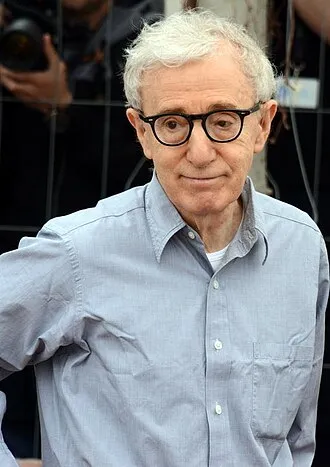
Allen began his career as part of a team of comedy writers for several Sid Caesar specials, and later wrote numerous humor pieces for The New Yorker as well as several Broadway plays, such as Don't Drink the Water (1966) and Play It Again, Sam (1969). He transitioned to working as a stand-up comedian in Greenwich Village, where he developed a monologue style and the persona of an insecure, intellectual, fretful nebbish.
He released three comedy albums, earning a Grammy Award for Best Comedy Album nomination for Woody Allen (1964). Allen also published several books of short stories, such as Getting Even (1971), Without Feathers (1975) and Side Effects (1980).
Allen then established himself as prominent director of the New Hollywood era of auteur filmmakers. After writing, directing, and starring in the slapstick comedies Take the Money and Run (1969), Bananas (1971), Sleeper (1973), and Love and Death (1975), he directed his seminal work, Annie Hall (1977), a romantic comedy-drama featuring Allen and his frequent collaborator Diane Keaton.
The film received widespread acclaim and won four Academy Awards: Best Picture, Best Director and Best Original Screenplay for Allen, and Best Actress for Keaton. Allen has since directed many films set in New York City, including Manhattan (1979), Hannah and Her Sisters (1986), and Crimes and Misdemeanors (1989).
Since the 1970s, Allen has made a film almost every year. They include Interiors (1978), Stardust Memories (1980), Zelig (1983), Broadway Danny Rose (1984), The Purple Rose of Cairo (1985), Radio Days (1987), Husbands and Wives (1992), Bullets Over Broadway (1994), Deconstructing Harry (1997), Match Point (2005), Vicky Cristina Barcelona (2008), Midnight in Paris (2011), and Blue Jasmine (2013).
In 2014, he returned to Broadway, adapting his 1994 film into the musical Bullets Over Broadway. He created and wrote the Amazon Prime Video series Crisis in Six Scenes (2016), and released a memoir, Apropos of Nothing (2020), and a novel, What's With Baum? (2025).
From 1980 to 1992, Allen had a professional and personal relationship with actress Mia Farrow. They collaborated on 13 films. The couple separated after Allen began a relationship in 1991 with Farrow's and Andre Previn's 21-year-old adopted daughter Soon-Yi Previn. In 1992, Farrow publicly accused Allen of sexually abusing their adopted daughter, Dylan.
Allen denied the allegation and was never charged with a crime, but the accusation received substantial media attention. Allen married Previn in 1997 and they have adopted two children.
Early life and education
Allen was born Allan Stewart Konigsberg at Mount Eden Hospital in the Bronx, New York City, on November 30, 1935, to Nettie (née Cherry; 1906–2002), a bookkeeper at her family's delicatessen, and Martin Konigsberg (1900–2001), who held a variety of jobs, including work as a jewelry engraver, waiter, driver, and egg candler.
His grandparents were Jewish immigrants to the U.S. from Austria and Russia. They spoke German, Hebrew, and Yiddish. He and his younger sister, film producer Letty Aronson, were raised in Brooklyn's Midwood neighborhood. Their parents were both born and raised on the Lower East Side of Manhattan.
Allen's parents did not get along, and he had an estranged relationship with his mother. He spoke German in his early years. While attending Hebrew school for eight years, he also attended Public School 99, now the Isaac Asimov School for Science and Literature, and then Midwood High School, from which he graduated in 1953.
Unlike his comic persona, he was more interested in baseball than school and was picked first for teams. He impressed students with his talent for cards and magic tricks.
Allen began to call himself Woody in high school. According to Allen, his first published joke read: "Woody Allen says he ate at a restaurant that had O.P.S. prices—over people's salaries." He was soon earning more than both of his parents combined. After high school, he attended New York University, studying communication and film in 1953, before dropping out after failing the course "Motion Picture Production".
He briefly attended City College of New York in 1954, dropping out during his first semester. He taught himself rather than studying in the classroom. He later taught at The New School and studied with writing teacher Lajos Egri.
Career
1950–1959: Comedy writing and television work
Allen began writing short jokes when he was 15, and the next year began offering them to various Broadway writers for sale. One of them, Abe Burrows, co-author of Guys and Dolls, wrote, "Wow! His stuff was dazzling." Burrows wrote Allen letters of introduction to Sid Caesar, Phil Silvers, and Peter Lind Hayes, who immediately sent Allen a check for just the jokes Burrows included as samples.
As a result of the jokes Allen mailed to various writers, he was invited, then age 19, to join the NBC Writer's Development Program in 1955, followed by a job on The NBC Comedy Hour in Los Angeles, then a job as a full-time writer for humorist Herb Shriner, initially earning $25 a week. He began writing scripts for The Ed Sullivan Show, The Tonight Show, specials for Sid Caesar post-Caesar's Hour, and other television shows.
By the time he was working for Caesar, he was earning $1,500 a week. He worked alongside Mel Brooks, Carl Reiner, Larry Gelbart, Neil Simon, and Danny Simon, whom Allen credits for helping form his writing style. In 2021, Brooks said of working with Allen, "Woody was so young then. I was about 24 when I started, but Woody must have been 19, but so wise, so smart.
He had this tricky little mind and he'd surprise you, which is the trick of being a good comedy writer." In 1962 alone, he estimated that he wrote 20,000 jokes for various comics. Allen also wrote for Candid Camera and appeared in several episodes.
Allen wrote jokes for the Buddy Hackett sitcom Stanley and The Pat Boone Chevy Showroom, and in 1958 he co-wrote a few Sid Caesar specials with Larry Gelbart. Composer Mary Rodgers said he was gaining a reputation. When given an assignment for a show, he would leave and come back the next day with "reams of paper", according to producer Max Liebman.
Similarly, after he wrote for Bob Hope, Hope called him "half a genius". Dick Cavett said: "He can go to a typewriter after breakfast and sit there until the sun sets and his head is pounding, interrupting work only for coffee and a brief walk, and then spend the whole evening working." Allen once estimated that to prepare for a 30-minute show, he spent six months of intensive writing.
He enjoyed writing, despite the work: "Nothing makes me happier than to tear open a ream of paper. And I can't wait to fill it!"
Allen wrote short stories and cartoon captions in the tradition of New Yorker humorists S. J. Perelman, George S. Kaufman, Robert Benchley, and Max Shulman, whose material he modernized. His collections of short pieces include Getting Even, Without Feathers, Side Effects, and Mere Anarchy.
In 2010, Allen released an audiobook, The Woody Allen Collection, in which he read 73 selections. He was nominated for a Grammy Award for Best Spoken Word Album.
1960–1971: Stand-up comedy
From 1960 to 1969, Allen performed as a comedian in Greenwich Village, including The Bitter End and Cafe Au Go Go, alongside Lenny Bruce, the team of Mike Nichols and Elaine May, Joan Rivers, George Carlin, Richard Pryor, Dick Cavett, Bill Cosby and Mort Sahl (his personal favorite), as well as Bob Dylan and Barbra Streisand.
Comedian Milton Berle claims to have suggested to Allen to go into standup comedy and even introduced him at the Village Vanguard. Comedy historian Gerald Nachman writes, "He helped turn it into biting, brutally honest satirical commentary on the cultural and psychological tenor of the times."
Allen's new manager, Jack Rollins, suggested he perform his written jokes as a stand-up. "I'd never had the nerve to talk about it before. Then Mort Sahl came along with a whole new style of humor, opening up vistas for people like me." Allen made his professional stage debut at the Blue Angel nightclub in Manhattan in October 1960, where comedian Shelley Berman introduced him as a young television writer who would perform his own material.
In his early stand-up shows, Allen did not improvise: "I put very little premium on improvisation", he told Studs Terkel. His jokes were created from life experiences, and his deadpan delivery made them funnier: "I don't think my family liked me. They put a live teddy bear in my crib." Although he was called a "classic nebbish", he did not tell the standard Jewish jokes of the period.
Comedy screenwriter Larry Gelbart compared Allen's style to Elaine May's: "He just styled himself completely after her".
Cavett recalled seeing the Blue Angel audience mostly ignore Allen's monologue: "I resented the fact that the audience was too dumb to realize what they were getting." But his subdued stage presence eventually became one of Allen's strongest traits, Nachman argues: "The utter absence of showbiz veneer and shtick was the best shtick any comedian had ever devised. This uneasy onstage naturalness became a trademark." Allen brought innovation to the comedy monologue genre.
Allen first appeared on The Tonight Show Starring Johnny Carson on November 1, 1963, and over nine years his guest appearances included 17 in the host's chair. He released three LP albums of live nightclub recordings: the self-titled Woody Allen (1964), Volume 2 (1965), and The Third Woody Allen Album (1968), recorded at a fund-raiser for Senator Eugene McCarthy's presidential run.
In 1965, Allen filmed a half-hour standup special in England for Granada Television, titled The Woody Allen Show in the UK and Woody Allen: Standup Comic in the U.S. It is the only complete standup show of Allen's on film. The same year, Allen, along with Nichols and May, Barbra Streisand, Carol Channing, Harry Belafonte, Julie Andrews, Carol Burnett, and Alfred Hitchcock, took part in Lyndon B.
Johnson's inaugural gala in Washington, D.C., on January 18, 1965. In A White House Diary, First Lady Lady Bird Johnson wrote, "Woody Allen, that forlorn, undernourished little comedian, stopped shooting a movie in Paris and flew across the Atlantic for about five minutes of jokes".
In 1966, Allen wrote an hour-long musical comedy television special for CBS, Gene Kelly in New York, New York. It featured Gene Kelly in a musical tour of Manhattan, dancing by such landmarks as Rockefeller Center, the Plaza Hotel, and the Museum of Modern Art. Guest stars included choreographer Gower Champion, British musical comedy star Tommy Steele, and singer Damita Jo DeBlanc.
In 1967, Allen hosted the NBC TV special Woody Allen Looks at 1967. It featured Liza Minnelli, who acted alongside Allen in some skits, Aretha Franklin as musical guest, and conservative writer William F. Buckley as featured guest. In 1969, Allen hosted his first American special for CBS television, The Woody Allen Special, which included skits with Candice Bergen, a musical performance by the 5th Dimension, and an interview between Allen and Billy Graham.
Allen also appeared as a guest on television variety shows, including The Andy Williams Show, The Perry Como Show, and The Steve Allen Show, where he performed stand-up comedy. In May 1971, Allen guest-hosted "The Tonight Show Starring Johnny Carson", with guests Bob Hope and James Coco. During the broadcast, Hope called Allen "one of the finest young talents in show business and a great delight". Life magazine put Allen on the cover of its March 21, 1969, issue.
1965–1976: Broadway debut and early films
Allen's first produced screenplay was What's New Pussycat? (1965) His directorial debut (co-written with Mickey Rose) was What's Up, Tiger Lily? (1966). That year, Allen wrote the play Don't Drink the Water, starring Lou Jacobi, Kay Medford, Anita Gillette and Tony Roberts. In 1994 Allen directed and starred in a second version for television, with Michael J. Fox and Mayim Bialik.
Allen's next Broadway play was Play It Again, Sam, which opened on February 12, 1969, starring Allen, Roberts, and Diane Keaton. Clive Barnes wrote, "Not only are Mr. Allen's jokes—with their follow-ups, asides, and twists—audaciously brilliant (only Neil Simon and Elaine May can equal him in this season's theater) but he has a great sense of character".
The play was significant to Keaton's budding career, and she has said she was in "awe" of Allen even before auditioning for her role, which was the first time she met him. In 2013, Keaton said she "fell in love with him right away", adding, "I wanted to be his girlfriend so I did something about it." For her performance she was nominated for a Tony Award for Best Featured Actress in a Play.
After co-starring with Allen in the film version of Play It Again, Sam, she acted in seven more of his films. Keaton said of their collaboration: "He showed me the ropes and I followed his lead. He is the most disciplined person I know. He works very hard".
Allen co-wrote (with Mickey Rose), directed, and starred in the crime comedy Take the Money and Run (1969) as the low-level thief Virgil Starkwell. Vincent Canby of The New York Times wrote, "Allen has made a movie that is, in effect, a feature-length, two-reel comedy—something very special and eccentric and funny." Allen wrote, directed, and starred in Bananas (1971) as Fielding Mellish, a bumbling New Yorker who becomes involved in a revolution in Latin America.
It costarred Louise Lasser as his romantic interest. In an interview with Roger Ebert, Allen said, "The big, broad laugh comedy is a form that's rarely made these days and sometimes I think it's the hardest kind of movie to make ... with a comedy like Bananas, if they're not laughing, you're dead, because laughs are all you have."
Allen reunited with Keaton for the science fiction spoof Sleeper (1973), the first of four screenplays co-written by Allen and Marshall Brickman. Allen and Keaton starred in Love and Death (1975), a Russian literature spoof set during the Napoleonic era. Canby called the film Allen's "grandest work". In 1976, Allen starred as cashier Howard Prince in the Hollywood blacklist comedy-drama The Front, directed by Martin Ritt and co-starring Zero Mostel.
1977–1989: Established career
I don't like meeting heroes. There's nobody I want to meet and nobody I want to work with—I'd rather work with Diane Keaton than anyone—she's absolutely great, a natural.
In 1977 Allen wrote, directed, and starred in the romantic comedy Annie Hall. He played Alvy Singer, a comic evaluating his past relationship with Annie Hall (Keaton). Roger Ebert wrote that Allen had "developed ... into a much more thoughtful and ... more mature director".
Vincent Canby praised Allen's direction, specifically his casting Shelley Duvall, Paul Simon, Carol Kane, Colleen Dewhurst, and Christopher Walken. In an interview with journalist Katie Couric, Keaton did not deny that Allen wrote the part for and about her. It won four Academy Awards: Best Actress in a Leading Role for Keaton, Best Original Screenplay and Best Director for Allen and Best Picture.
In 1979, at the Film Society at Lincoln Center, Allen paid tribute to one of his comedy idols, Bob Hope, who said of the honor: "It's great to have your past spring up in front of your eyes, especially when it's done by Woody Allen, because he's a near genius. Not a whole genius, but a near genius". In 1979, Allen directed Manhattan, a comic homage to New York City focused on the relationship between middle-aged Isaac Davis (Allen) and 17-year-old Tracy (Mariel Hemingway) and co-starring Keaton and Meryl Streep. Filmed in black and white by Gordon Willis, it makes heavy use of the music of George Gershwin.