















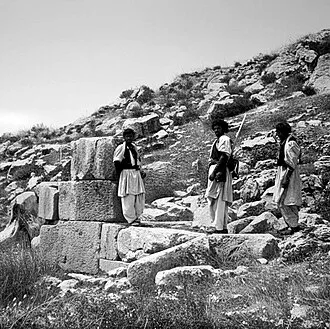
Zazas are predominantly adherent to Islam, divided internally between the Sunni school and Alevism. This sectarian division is manifested in the dialectal variations of the Zaza language; the northern dialect of the language is spoken by Alevi Zazas, the southern dialect by Hanafi Zazas, and the central dialect by Shafi Zazas.
The Zaza population is estimated to be approximately 2 to 3 million. The language of the Zazas, the Zaza language belongs to the Northwestern Iranian branch of the Iranian languages and is closely related to Tati, Talysh, Sangsari, Semnani, Mazandarani and Gilaki.
Etymology and naming
The terms Dımli or Dımıli are often used for the Zaza people and their language. According to the long-proposed theory these terms evolved from the term Dailam or Daila. Alternatively this region is termed as Dailäm, Daylâm or Dailâm. Thus it is proposed that the origin of the Zaza people lies in the province of Dailam or Daylam in ancient Persia and modern northern Iran, close to the southern Caspian Sea.
According to Encyclopædia Iranica, the endonym Dimlī or Dīmla was derived from Daylam region in Northern Iran and appears in Armenian historical records as delmik, dlmik, which was proposed to be derived from Middle Iranian *dēlmīk meaning Daylamite. The theory that Dimlī or Dīmla is derived from Daylam and that Zazas are descendants of Daylamites has been supported by scholars such as Friedrich Carl Andreas, Oskar Mann, Karl Hadank, Ely Bannister Soane, Arthur Christensen, Richard N.
Frye, Vladimir Minorsky, Ehsan Yarshater, Gernot Ludwig Windfuhr, Ferdinand Hennerbichler, Walter Bruno Henning,William Burley Lockwood, Ludwig Paul, Clifford Edmund Bosworth, Jos. Schrijnen, David Neil MacKenzie, Garnik Asatrian and Victoria Arakelova and the Daylam thesis has been the most popular thesis regarding the origins of the Zaza people and the Zaza language since the first researchers of the Zaza language.
Among their neighbors, the people are known mainly as Zāzā, which meant “stutterer” and was used as a pejorative. Hadank and Mckenzie attribute relative abundance of sibilants and affricates in the Zaza language to explain the semantic etymology of the name. Some have pointed out the phonetic similarity between the terms Dimili and Dunbuli.
This connection is supported by several evidences, including the use of the terms Dummel or Zaza in Kurdistan to refer to the Azerbaijani Dunbuli tribe, historical records of the Dunbuli tribe migrating to Dersim during the reign of Shah Ismail, and documented evidence that the Dunbuli tribe in Palu spoke Zazaki. In some regions, the term Dunbuli is still used to refer to the Zazas.
According to this view, the term Dimilî may derive from the name of the Dunbulî (also spelled Dumbulî), a Kurdish tribe documented since the 12th century. Karl Hadank, on the other hand, in his prominent work on Zaza, "Mundarten der Zâzâ" (1932), discusses the claimed relationship between Dimli and Dunbuli in detail over several pages, presents evidence from various historical sources and concludes that equating the Dunbuli with the Zaza is impossible, the term Dimli cannot be derived from the term Dunbuli and the Dimli people and the Dunbuli tribe are different.
Eberhard Werner, in his anthropological work on Zazas also discusses the Dunbuli topic and concludes that there is little information as to whether the Dunbuli and the Dimili are the same and there is no single reference in Zaza oral traditions about the so-called Dunbuli move. Furthermore the Dunbuli tribe view fails to account for the linguistic affinities of the Zaza language which shares extensive parallels with the Caspian languages as well-documented in Iranian studies, therefore, it is challenged due to an absence of corroborating historical and linguistic data.
The endonym Dımli/Dımıli and its derivations are primarily used for Southern Zaza. Zazas living in places such as Aksaray, Şanlıurfa, Siverek, Diyarbakır, Çüngüş, Adıyaman, Gerger and Mutki refer to themselves as Dımli/Dımıli, and refer to the Zaza language as Dımılki/Dımıli. At the same time, the same endonym Dımıl(ki) is also used in various regions among northern Alevi Zazas for the Zaza language.
Zazas living in Elazığ, Palu, Maden, Alacakaya, Arıcak, Çermik, Bingöl, Varto, and Sivas-Koçgiri regions refer to themselves as Zaza and refer to the Zaza language as Zazaki. The endonym Zaza is found in all dialects of the Zaza language. While almost all Zazas who speak the central dialect of Zaza refer to themselves as Zaza and refer to their language as Zazaki, in places such as Palu, Bingöl and Dicle, the endonym of Kırd, along with Zaza, is also found to a limited extent.
A part of Alevi Zazas refer to themselves as Kırmanc and refer to their language as Kırmancki, even though the endonym Dımılki is also known among the older generation Alevi Zazas. A second part of Alevi Zazas living in regions such as Bingöl, Erzurum and Varto, instead of a special designation, refer to the Zaza language as "zonê ma" which means "our language" and they refer to themselves as "şarê ma", which means "our people".
History
Origins and early history
The most important theory regarding the origins of the Zazas is that they are originally Daylamites from the Daylam region. Since the first modern studies on the Zaza language and Zazas, this theory has been substantiated by many different scholars. According to this theory, the Zazas migrated from the southern shores of the Caspian Sea to Eastern Anatolia, along with other communities.
The etymology of the endonym Dimlī and the historical records of migrations and raids of Daylamites to Anatolia in Armenian sources are also adduced as an evidence of Daylamite origins of the Zaza people. Scholars believe that the Zaza-speaking populations relocated from their Daylamite ancestral homeland in northern Iran to their contemporary Anatolian settlements between the 9th/10th and 12th centuries AD, during the extensive Daylamite expansion.
During this era, the Daylamites extended their territorial control by launching raids into adjacent regions and migrating deeper into Western Asia. This expansive movement took Daylamite factions well beyond the Caspian littoral. After traversing the borders of Iran, the Daylamites penetrated Azerbaijan, Armenia, Arran, Bagrevand, Vaspurakan and Anatolia.
Their military campaigns and subsequent territorial conquests extended across a broad geographical continuum, spanning the Black Sea littoral of Lazica and Georgia, modern-day Azerbaijan and Armenia, regions of modern-day Iraq and Syria, including Aleppo and several eastern and southeastern Anatolian localities, namely Van, Kars, Ağrı, Kapetron, Erzurum, Manzikert, Diyarbakır, Mayyāfāriqīn (Silvan) and Harpoot.
As this process unfolded, numerous Daylamite factions dispersed into neighboring areas. They initially maintained their cultural identity before gradually merging with the indigenous populations. Scholarly discourse posits that as a result of this migratory and expansionary phase, the Daylamite populations, including the ancestors of the modern Zazas as a Daylamite faction, progressed westward into the territories they currently inhabit.
As documented in Encyclopædia Iranica, the ethnonym Dimlī/Dīmla traces its origins to the Daylam region. This etymology is supported by medieval Armenian historical records, which feature the variants delmik and dlmik, forms derived from the Middle Iranian lexeme *dēlmīk (Daylamite). Throughout historical records, the Daylam region has been designated by the ethnonymic variants dilmik, dilmuk, delum dilm.
Diachronically, these forms are posited to have undergone the phonological metathesis of a nasal-liquid cluster, shifting from \(/lm/\) to \(/ml/\), which ultimately resulted in the derived lexical variants Dilmi and Dimli. Dilm, one of the historical designations of the Daylam region, is retained in its unaltered (unmetathesized) phonological form within the contemporary Zaza endonym "Dilmic".
Morphologically, the term is a compound of the base "Dilm" and the suffix -ic, which denotes origin and affiliation in the Zaza language and persists in various Caspian languages of the Daylam region with the same attributive function. Etymologically, therefore, "Dilmic" translates to "from Dilm." The Daylamite origin theory is corroborated by linguistic evidence as well.
Within the Northwestern Iranian language branch, the profound phylogenetic affinity shared between the Caspian languages spoken in Daylam and Zaza is extensively documented in comparative Iranian studies. Zaza shares a multiplicity of distinct phonological features, morphosyntactic structures, and lexical isolates with these Caspian languages that are conspicuously absent in other Iranian varieties and linguistic evidence put the linguistic homeland of the Zaza language to Northern Iran, especially around the southern Caspian region due to the strong linguistic affinity between the Zaza, Tati, Talysh, Gilaki and Mazanderani languages.
In this context, the fact that the closest linguistic affinities to Zaza are found not in geographically contiguous regions but rather in the southern Caspian region, also corroborates the Daylamite origin of the Zaza people and indicates that they preserved their language in isolation following their migration from the Daylam region.
Another significant hypothesis concerning the migration of the Zaza people from Daylam posits that this displacement may have occurred substantially earlier than previously assumed. In this regard, the Byzantine historian Agathias (536–582 CE), writing during the reign of Justinian I (6th century CE), documents the Daylamites (lit.
Dilimnites) people in the third book of his historical chronicles. He notes their presence along the Tigris River, a region historically associated with the modern Zaza population, and describes their role as combatants within the Sasanian army fighting against the Byzantine Empire. In the Zoroastrian Pahlavi text Bundahishn, dated to the 8th–9th centuries CE, the ancestral and contemporary geographical habitat of the Zazas, situated at the sources of the Euphrates and Tigris rivers, is designated as Dēlamān/Dēlman, a toponym semantically associated with Daylam.
The corroboration across both early medieval documents, which identify contemporary Zaza settlements as Daylam/Daylamite, suggests an earlier migration of the Zazas from the Daylam region than previously hypothesized. A study from 2005, on the other hand, does not support the Northern Iranian theory and rather proposes a closer link between Kurdish and Zaza-speakers compared to Northern Iranian populations.
Kurmanji-speaking Kurds and Zazas have for centuries lived in the same areas in Anatolia. The Zaza minstrel tradition goes back to the medieval period, when Zaza-speaking bards composed works both in their mother tongue and in Turkish.
Modern period
Since Armenians and Zazas have for centuries lived in the same areas, the first comprehensive works about the Zazas were produced by their Armenian neighbors. In Dictionarium Armeno-Latinum, the first printed Armenian dictionary describing neighboring peoples and geographies published in 1621, the Zazas are defined as "a Parthian nation" under Demli, their Armenian exonym.
In the late 1800s, the Armenian traveler Adranik visited the Dersim region and published a travelogue containing comprehensive information about the Zaza people, referring to them as dǝmǝli, and about the geography, culture and sociology of the Dersim region. In his work, after discussing the origins of the Zazas, he concludes that the Zazas are descendants of the Daylamites (delmiks) who, as mentioned in Armenian sources of that period, raided Anatolia in the Middle Ages.
In the late 1800s, another work about the Zazas, referring to them as dlmikner, was published by an Armenian author named A. Mkrtčʿean. His work contains general information about the Zaza people, their culture, traditions and their attitudes towards Armenians, which, similar to Andranik, was described very hospitable.
In the early 20th century, Armenian representatives at the Paris Peace Conference, in the memorandum they submitted to the conference on the Armenian Question, again defined the Zazas as one of the indigenous peoples of Greater Armenia. Similarly, in 1878, following the Russo-Turkish War (1877-1878), regarding the Armenians' situation in the peace treaty process, the Zazas are listed as one of the indigenous peoples of Western Armenia again.
The fact that Zazas and Armenians have lived together in the same areas for centuries has led to the Zaza language, especially its northern dialect, being influenced by the Armenian language. German Iranologist Oskar Mann made extensive travels to Qajar Iran and the Ottoman Empire between 1901-1906. He visited the Upper Euphrates region of Eastern Anatolia and recorded the Zazas in Gerger, Bucak, Kor, Çapakçur, Palu, Kiğı and Siverek. He conducted a comprehensive documentation study on the Zaza language in these regions.
About the language, the earliest surviving literary works in the Zaza language are two poems with identical titles, Mawlūd, dating from the late 19th and early 20th centuries. In the 1920s and 1930s, several Zaza rebellions occurred in Eastern and Southeastern Anatolia. In the Koçgiri region, some Alevi Zazas participated in the Koçgiri rebellion in 1920.
Later, during the Sheikh Said rebellion in 1925, the Zaza Sheikh Said and his supporters rebelled against the newly established Republic because of its Turkish nationalist and secular ideology. The rebellion was later suppressed. Some Zazas subsequently joined the Kurmanji-speaking Kurdish nationalist Xoybûn, the Society for the Rise of Kurdistan, and other movements, where they often rose to prominence.
In 1937, during the Dersim rebellion, Alevi Zazas in the region rebelled against the newly established Republic. The rebellion was led by Seyid Riza and was suppressed by the government of the Republic, ended with a massacre of thousands of Kurmanji-speaking Kurds and Zaza civilians, while many were internally displaced due to the conflict.
Sakine Cansız, a Zaza from Tunceli, was a founding member of Kurdistan Workers Party (PKK), and like many Zazas joined the rebels, including the prominent Besê Hozat.
Following the 1980 Turkish coup d'état, many intellectual minorities, including Zazas, emigrated from Turkey towards Europe, Australia and the United States. The migration of Zazas to European countries in the 1980s and the relatively free environment in Europe enabled the revival of Zaza culture in Europe. And in the 1980s and subsequent periods, the Zaza diaspora in Europe published numerous printed works concerning Zaza language, history and culture.
In 2004, linguists established the Frankfurt Zaza Language Institute in Germany, followed by the foundation of the Zaza Language and Culture Association in Istanbul in 2011. Along with the 2010s, numerous local Zaza language and culture associations were established and through the merger of these associations, the Federation of Zaza Associations was founded in Ankara in 2018.
Demographics and geographical distribution
The exact number of the Zazas is unknown, due to the absence of recent and extensive census data. The last census on language in Turkey was held in 1965, where 150,644 people ticked Zaza as their first language and 112,701 as their second language. More recent data from 2005 suggests that the Zaza-speaking population varies from approximately 2 to 4 million.
According to a 2015 study that examined the demographics of the voting-age population in the Kurdish inhabited areas in Turkey (Northeast, Central East and Southeast Anatolia statistical regions, n=1918) 12.8% of the people ethnically identified as Zaza, which made Zaza the biggest ethnic identity after Kurdish (73%) in the region. Zaza speakers were more numerous (15%) compared to people who identify with the Zaza ethnic identity, showing that some Zaza speakers identified as other ethnicities, primarily Kurds.
Following the 1980 Turkish coup d'état, many intellectual minorities, including Zazas, emigrated from Turkey towards Europe, Australia and the United States. The largest part of the Zaza diaspora is in Europe, predominantly in Germany.
Culture
Language
Zaza is the ancestral language of the Zaza people and belongs to the Northwestern Iranian branch of the Iranian languages. The Zaza language is recognized as a macrolanguage by international linguistic authorities. SIL International classifies the Zaza language as a macrolanguage, including the varieties of Southern Zaza (diq) and Northern Zaza (kiu).
Other international linguistic authorities, Ethnologue and Glottolog, also categorize the Zaza language as a macrolanguage composed of two distinct individual languages: Southern Zaza and Northern Zaza. In terms of grammar, morphosyntactic structure, core lexicon and diachronic development the Zaza language is closely related to the Tati of Iran, Talysh, Semnani, Sangsari, Gilaki and Mazandarani languages spoken on the shores of the Caspian Sea.
It is spoken in the east of modern Turkey, with approximately two to three million speakers. There is a division between Northern and Southern Zaza, most notably in phonological and morphological inventory, however, Zaza as a whole forms a dialect continuum, with no recognized standard.
A study published in 2015 that demographically analysed voting-age adults in the Kurdish inhabited regions of Turkey (excluding diaspora) concluded that 96.2% of people who identified as Zaza, but not Kurdish in the region spoke Zazaki as their mother tongue. On the contrary only 58.4% of the surveyed Zaza people declared that their primary home language was Zazaki, and Turkish was the second most popular home language with 38.3% of Zazas speaking it at their homes. 1.9% of the surveyed people who identified as Zaza expressed that their home language was Kurdish.
Around 1.4% people belonging to Kurdish ethnic identity also spoke Zazaki as their mother language. Concerning Alevis, which were separately analysed, c. 70% spoke Zazaki, but Turkish (70%) was the dominant household language. Ziflioğlu states that many[quantify] Zazas only speak Kurmanji.[dubious – discuss]
The first written statements in the Zaza language were compiled by the linguist Peter Lerch in 1850. Two other important documents are the religious writings of Ehmedê Xasi of 1898, and of Osman Efendîyo Babij; both of these works were written in Arabic script. The state-owned TRT Kurdî airs shows in Zaza. During the 1980s, the Zaza language became popular among the Zaza diaspora, followed by publications in Zaza in Turkey.
Religion
Zazas are predominantly Muslims and are divided between Sunni Islam and Alevism. Alevi Zazas share a more homogeneous sectarian affiliation, Sunni Zazas, on the other hand, are divided into the Hanafi and Shafi'i schools of thought. The sectarian divisions among the Zaza people are reflected in the three primary dialects of the Zaza language.
The geographical distribution of the primary Zaza dialects aligns closely with the Zaza sectarian divisions. The Southern Zaza group who speak the more archaic Southern Zaza are Sunni Muslims following the teaching of the Hanafi school, similar to Turks and Arabs in the region and in contrast to the Kurds who are predominantly Shafi'i.
The eastern group who speak the eastern dialect of Zaza is predominantly Shafi'i, similar to Kurds. Sunni Zazas, similar to Sunni Talysh who speak a related language are mostly Naqshbandi. The northern group who speak the northern dialect of Zaza adheres to the Alevi faith.