Al-Ghazali
He is considered to be the 11th century's mujaddid, a renewer of the faith, who, according to the prophetic hadith, appears once every 100 years to restore the faith of the Islamic community. Al-Ghazali's works were so highly acclaimed by his contemporaries that he was awarded the honorific title "Proof of Islam" (Ḥujjat al-Islām). Al-Ghazali was a prominent mujtahid in the Shafi'i school of law.
Much of al-Ghazali's work stemmed around his spiritual crises following his appointment as the head of the Nizamiyya of Baghdad, which was the most prestigious academic position in the Muslim world at the time. This led to his eventual disappearance from the Muslim world for over 10 years, realising he chose the path of status and ego over God.
It was during this period where many of his great works were written. He believed that the Islamic spiritual tradition had become moribund and that the spiritual sciences taught by the first generation of Muslims had been forgotten. This belief led him to write his magnum opus entitled Iḥyā’ ‘ulūm ad-dīn ("The Revival of the Religious Sciences").
Among his other works, the Tahāfut al-Falāsifa ("Incoherence of the Philosophers") is a landmark in the history of philosophy, as it advances the critique of Aristotelian science developed later in 14th-century Europe.
Biography
Al-Ghazali was born in c. 1058 in Tus. He was a Muslim scholar of Persian descent. He was born in Tabaran, a town in the district of Tus, Khorasan, not long after Seljuks entered Baghdad and ended Shia Buyid Amir al-umaras. This marked the start of Seljuk influence over the Caliphate. While the Seljuk dynasty's influence grew, Abu Suleiman Dawud Chaghri Beg married his daughter, Arslan Khatun Khadija to caliph al-Qa'im in 1056.
Al-Ghazali's contemporary and first biographer, 'Abd al-Ghafir al-Farisi, records merely that al-Ghazali began to receive instruction in fiqh (Islamic jurisprudence) from Ahmad al-Radhakani, a local teacher and Abu ali Farmadi, a Naqshbandi sufi from Tus. He later studied under al-Juwayni, the distinguished jurist and theologian and "the most outstanding Muslim scholar of his time," in Nishapur, perhaps after a period of study in Gurgan.
After al-Juwayni's death in 1085, al-Ghazali departed from Nishapur and joined the court of Nizam al-Mulk, the powerful vizier of the Seljuk empire, which was likely centered in Isfahan. After bestowing upon him the titles of "Brilliance of the Religion" and "Eminence among the Religious Leaders", Nizam al-Mulk advanced al-Ghazali in July 1091 to the "most prestigious and most challenging" professorial position at the time: the Nizamiyya of Baghdad.
He underwent a spiritual crisis in 1095, abandoned his career and left Baghdad on the pretext of going on pilgrimage to Mecca. Making arrangements for his family, he disposed of his wealth and adopted an ascetic lifestyle. According to biographer Duncan B. Macdonald, the purpose of abstaining from scholastic work was to confront the spiritual experience and more ordinary understanding of "the Word and the Traditions." After some time in Damascus and Jerusalem, with a visit to Medina and Mecca in 1096, he returned to Tus to spend the next several years in uzla (seclusion).
The seclusion consisted in abstaining from teaching at state-sponsored institutions, but he continued to publish, receive visitors and teach in the zawiya (private madrasa) and khanqah (Sufi lodge) that he had built.
Fakhr al-Mulk, grand vizier to Ahmad Sanjar, pressed al-Ghazali to return to the Nizamiyya of Nishapur. Al-Ghazali reluctantly capitulated in 1106, fearing rightly that he and his teachings would meet with resistance and controversy. He later returned to Tus and declined an invitation in 1110 from the grand vizier of the Seljuq Sultan Muhammad I to return to Baghdad.
He died on 19 December 1111. According to 'Abd al-Ghafir al-Farisi, he had several daughters but no sons. He was buried near his home in Tus, Iran.
School affiliations
 Islam portal
 Category
Al-Ghazali contributed significantly to the development of a systematic view of Sufism and its integration and acceptance in mainstream Islam. As a scholar of Islam, he belonged to the Shafi'i school of Islamic jurisprudence and to the Asharite school of theology. Al-Ghazali received many titles such as Zayn al-Dīn (زين الدين) and Ḥujjat al-Islām (حجة الإسلام).
He is viewed as the key member of the influential Asharite school of early Muslim philosophy and the most important refuter of the Mutazilites. However, he chose a slightly different position in comparison with the Asharites. His beliefs and thoughts differ in some aspects from the orthodox Asharite school.
Decade of seclusion
In 1095, at the peak of his academic career as the leading scholar of the most prestigious institution in the Islamic world; Al-Ghazālī decided to step down to undertake a journey that would take the next 10 years of his life. It was said that Al-Ghazālī was suffering from both emotional and physical difficulties including loss of appetite, indigestion and struggling to even vocally orate his lectures as he would normally.
When the leading medical practitioners could not remedy his ailments and all medicines had failed, they determined the cause to be a psychological and internal spiritual one, and therefore its remedy can only be a spiritual one.
He was critical of the social and spiritual situation of both his academic institution, the scholarly peers and the political class. Initially he mentioned that he was going on a journey to the Hajj pilgrimage, in order to avoid attempts at preventing his decision from the leadership. Al-Ghazālī sold his belongings, distributed all his property, which was said to be so sufficient for his dependents that he donated the rest to charity.
His first stop was Damascus, at the Umayyad Mosque. In Damascus, he found work as a mosque sweeper, and lived in the minaret of the mosque. During this time period, he produced his most celebrated works of Islamic authorship, some that are today a hallmark of that era. He wrote his chief work, Iḥyāʾ ʿulūm al-dīn, in this period.
In addition to the works mentioned above related to Bāṭinism, al-Maqṣad al-asnā fī sharḥ asmāʾ Allāh al-ḥusnā, Bidāyat al-hidāya, al-Wajīz, Jawāhir al-Qurʾān, al-Arbaʿīn fī uṣūl al-dīn, al-Maḍnūn bihi ʿalā ghayr ahlih, al-Maẓnūn al-ṣaghīr, Fayṣal al-tafriqa, al-Qānūn al-kullī fī al-taʾwīl (Qānūn al-taʾwīl, p. 95, 111), Kīmiyā-yi Saʿādat, and Ayyuhā al-walad are also among the works he wrote in this period.
Al-Ghazālī returned to Nishapur in Dhu al-Qa'da 499 (July 1106) and resumed teaching at the Nizamiyya there. As he states in al-Munqidh (pp. 65–68), which is understood to have been written during this period of seclusion:
"Before I was teaching the knowledge that brought prestige and position…; now, however, I am calling to the knowledge that leads one to renounce position."
Works
A total of about 70 works can be attributed to al-Ghazali. He is also known to have written a fatwa against the Taifa kings of al-Andalus, declaring them to be unprincipled, not fit to rule and that they should be removed from power. This fatwa was used by Yusuf ibn Tashfin to justify his conquest of al-Andalus.
Incoherence of the Philosophers
Al-Ghazali's 11th-century book titled Tahāfut al-Falāsifa ("Incoherence of the Philosophers") marked a major turn in Islamic epistemology. The encounter with skepticism led al-Ghazali to investigate a form of theological occasionalism, or the belief that all causal events and interactions are not the product of material conjunctions but rather the immediate and present will of God.
In the next century, Ibn Rushd (or Averroes) drafted a lengthy rebuttal of al-Ghazali's Incoherence entitled The Incoherence of the Incoherence; however, the epistemological course of Islamic thought had already been set. Al-Ghazali gave as an example of the illusion of independent laws of cause the fact that cotton burns when coming into contact with fire.
While it might seem as though a natural law was at work, it happened each and every time only because God willed it to happen—the event was "a direct product of divine intervention as any more attention grabbing miracle". Averroes, by contrast insisted while God created the natural law, humans "could more usefully say that fire caused cotton to burn—because creation had a pattern that they could discern."
The Incoherence also marked a turning point in Islamic philosophy in its vehement rejections of Aristotle and Plato. The book took aim at the Falāsifa, a loosely defined group of Islamic philosophers from the 8th through the 11th centuries (most notable among them Avicenna and al-Farabi) who drew intellectually upon the Ancient Greeks.
The influence of Al-Ghazali's book is still debated. Professor of Arabic and Islamic Science George Saliba in 2007 argued that the decline of science in the 11th century has been overstated, pointing to continuing advances, particularly in astronomy, as late as the 14th century.
Professor of Mathematics Nuh Aydin wrote in 2012 that "it is a widespread belief among orientalists that one of the major factors, if not the single most important reason, for the decline of science in the Islamic world after its golden age is al-Ghazali's attack on philosophers". The attack peaked in his book Incoherence, whose central idea of theological occasionalism implies that philosophers cannot give rational explanations to either metaphysical or physical questions. The idea caught on and nullified the critical thinking in the Islamic world.
On the other hand, author and journalist Hassan Hassan in 2012 argued that while indeed scientific thought in Islam was stifled in the 11th century, the person mostly to blame is not al-Ghazali but Nizam al-Mulk.
The Revival of Religious Sciences (Iḥyāʾ ʿUlūm al-Dīn)
Another of al-Ghazali's major works is Iḥyāʾ ʿUlūm al-Dīn (The Revival of Religious Sciences). It covers almost all fields of Islamic sciences: fiqh (Islamic jurisprudence), kalam (theology) and sufism.[citation needed]
It contains four major sections: Acts of Worship (Rub' al-'ibadat), Norms of Daily Life (Rub' al-'adatat), The Ways to Perdition (Rub' al-muhlikat) and The Ways to Salvation (Rub' al-munjiyat).
The Iḥyāʾ became the most frequently recited Islamic text after the Qur'an and the hadith. Its great achievement was to bring orthodox Sunni theology and Sufi mysticism together in a useful, comprehensive guide to every aspect of Muslim life and death. The book was well received by Islamic scholars such as Nawawi who stated that: "Were the books of Islam all to be lost, excepting only the Ihya', it would suffice to replace them all." This reception, however, was not universal as the book was burned in Almoravid Spain in 1109 and 1143 as al-Ghazali criticised the fuqaha for meddling in politics and due to al-Ghazali's syncretism[clarification needed] and support of Sufism.
Allegedly, being outraged upon hearing of the burning of his book, al-Ghazali foretold the rise of the Almohad dynasty and invested its founder Ibn Tumart with the duty to overthrow the Almoravid rule.
The Alchemy of Happiness
The Alchemy of Happiness is a rewritten version of The Revival of the Religious Sciences. After the existential crisis that caused him to completely re-examine his way of living and his approach to religion, al-Ghazali put together The Alchemy of Happiness.
Disciplining the Soul
One of the key sections of Ghazali's Revival of the Religious Sciences is Disciplining the Soul, which focuses on the internal struggles that every Muslim will face over the course of his lifetime. The first chapter primarily focuses on how one can develop himself into a person with positive attributes and good personal characteristics .
The second chapter has a more specific focus: sexual satisfaction and gluttony. Here, Ghazali states that indeed every man has these desires and needs, and that it is natural to want these things. However, the Islamic prophet Muhammad explicitly states that there must be a middle ground for man, in order to practice the tenets of Islam faithfully.
The ultimate goal that Ghazali is presenting not only in these two chapters, but in the entirety of The Revival of the Religious Sciences, is that there must be moderation in every aspect of the soul of a man, an equilibrium. These two chapters were the 22nd and 23rd chapters, respectively, in Ghazali's Revival of the Religious Sciences.
The Eternity of the World
Al-Ghazali crafted his rebuttal of the Aristotelian viewpoint on the creation of the world in The Eternity of the World. Al-Ghazali essentially formulates two main arguments for what he views as a sacrilegious thought process. Central to the Aristotelian approach is the concept that motion will always precede motion, or in other words, a force will always create another force, and therefore for a force to be created, another force must act upon that force.
This means that in essence time stretches infinitely both into the future and into the past, which therefore proves that God did not create the universe at one specific point in time. Al-Ghazali counters this by first stating that if the world was created with exact boundaries, then in its current form there would be no need for a time before the creation of the world by God.
The Decisive Criterion for Distinguishing Islam from Clandestine Unbelief
Al-Ghazali lays out in The Decisive Criterion for Distinguishing Islam from Clandestine Unbelief his approach to Muslim orthodoxy. Ghazali veers from the often hardline stance of many of his contemporaries during this time period and states that as long as one believes in Muhammad and God himself, there are many different ways to practice Islam and that any of the many traditions practiced in good faith by believers should not be viewed as heretical by other Muslims.
While Ghazali does state that any Muslim practicing Islam in good faith is not guilty of apostasy, he does outline in The Criterion that there is one standard of Islam that is more correct than the others, and that those practicing the faith incorrectly should be moved to change. In Ghazali's view, only Muhammad himself could deem a faithfully practicing Muslim an infidel, and his work was a reaction to the religious persecution and strife that occurred often during this time period between various Islamic sects.
Deliverance from Error
The autobiography al-Ghazali wrote towards the end of his life, Deliverance From Error (المنقذ من الضلال al-Munqidh min al-Dalal), is considered a work of major importance.
In it, al-Ghazali recounts how, once a crisis of epistemological skepticism had been resolved by "a light which God Most High cast into my breast ... the key to most knowledge," he studied and mastered the arguments of kalam, Islamic philosophy, and Ismailism. Though appreciating what was valid in the first two of these, at least, he determined that all three approaches were inadequate and found ultimate value only in the mystical experience and insight he attained as a result of following Sufi practices.
William James, in Varieties of Religious Experience, considered the autobiography an important document for "the purely literary student who would like to become acquainted with the inwardness of religions other than the Christian" because of the scarcity of recorded personal religious confessions and autobiographical literature from this period outside the Christian tradition.
Works in Persian
Al-Ghazali wrote most of his works in Persian and in Arabic. His most important Persian work is Kimiya-yi sa'adat (The Alchemy of Happiness). It is al-Ghazali's own Persian version of Ihya' 'ulum al-din (The Revival of Religious Sciences) in Arabic, but a shorter work. It is one of the outstanding works of 11th-century-Persian literature.
The book was published several times in Tehran by the edition of Hussain Khadev-jam, a renowned Iranian scholar. It is translated to English, Arabic, Turkish, Urdu, Azerbaijani and other languages.
📚 Source: Wikipedia
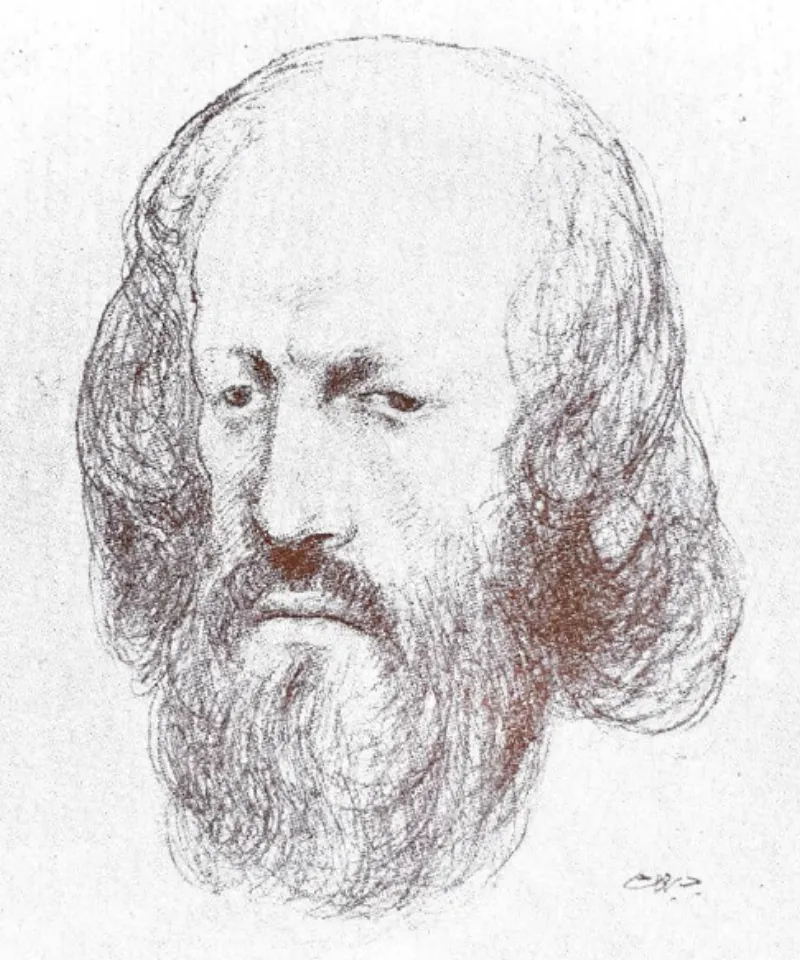
📷 Photo: Kahlil Gibran · Public domain · Wikimedia Commons