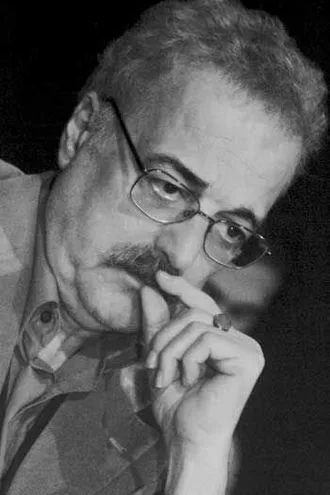
Alan Rickman
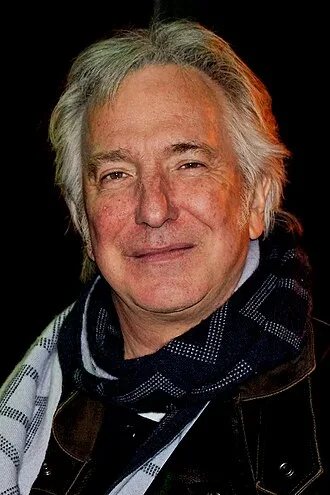
Rickman studied at the Royal Academy of Dramatic Art before becoming a member of the Royal Shakespeare Company where he began his career in theatre, performing in classical and modern plays. He made his film debut as Hans Gruber in Die Hard (1988). He won the BAFTA Award for Best Actor in a Supporting Role for his role as the Sheriff of Nottingham in Robin Hood: Prince of Thieves (1991).
He earned critical acclaim for Truly, Madly, Deeply (1991), An Awfully Big Adventure, Sense and Sensibility (both 1995), and Michael Collins (1996).
He went on to play Severus Snape in all eight films of the Harry Potter series (2001–2011) and took memorable roles in Quigley Down Under (1990), Dogma, Galaxy Quest (both 1999), Love Actually (2003), The Hitchhiker's Guide to the Galaxy (2005), Sweeney Todd: The Demon Barber of Fleet Street (2007), Alice in Wonderland (2010), its 2016 sequel, and Eye in the Sky (2015).
He directed the films The Winter Guest (1997) and A Little Chaos (2014). On television, he portrayed Grigori Rasputin in the HBO film Rasputin: Dark Servant of Destiny (1996) and Alfred Blalock in the HBO film Something the Lord Made (2004), the former of which won him a Primetime Emmy Award and a Golden Globe Award.
On stage, he made his Broadway debut starring as Le Vicomte de Valmont in the Christopher Hampton play Les Liaisons Dangereuses (1987) for which he was nominated for the Tony Award for Best Lead Actor in a Play. He starred as a newly married man in the revival of Nöel Coward's comedic play Private Lives (2002) on the West End and on Broadway, earning a nomination for the Laurence Olivier Award for Best Actor for the former.
For his role as an imperious professor in the Theresa Rebeck play Seminar (2011) he was nominated for the Drama League Award.
Early life and education
Alan Sidney Patrick Rickman was born on 21 February 1946 in Brentford, London, and grew up in Acton, London. His parents were housewife Margaret Doreen Rose (née Bartlett) and factory worker, house painter and decorator, and former Second World War aircraft fitter Bernard William Rickman. His mother was Welsh and his paternal grandmother was Irish.
Rickman said in 2015, "I was talking to Sharleen Spiteri about being a Celt, how you smell each other out, because my mother's family is Welsh. There's not a lot of English blood in me." His father was a Catholic and his mother a Methodist. He had two brothers, David and Michael, and a sister, Sheila.
Rickman was known for his deep tone of voice and languid delivery for which he would become famous. He said that a vocal coach told him he had a "spastic soft palate". When Rickman was eight years old, his father died of cancer, leaving his mother to raise him and his siblings mostly alone. According to the biographer Maureen Paton, the family was "rehoused by the council and moved to an Acton estate to the west of Wormwood Scrubs Prison, where his mother struggled to bring up four children on her own by working for the Post Office". Margaret Rickman married again in 1960, but divorced Rickman's stepfather after three years.
As a child, Rickman excelled at calligraphy and watercolour painting. Rickman was educated at West Acton First School followed by Derwentwater Primary School in Acton and then Latymer Upper School in London through the Direct Grant system, where he became involved in drama. Rickman later attended the Chelsea College of Art and Design from 1965 to 1968.
He then attended the Royal College of Art from 1968 to 1970. His training allowed him to work as a graphic designer for the Royal College of Art's inhouse magazine, ARK, and the Notting Hill Herald, which he considered a more stable occupation than acting; he later said that drama school "wasn't considered the sensible thing to do at 18".
Following graduation, Rickman and several friends opened a graphic design studio called Graphiti, but after three years of successful business, he decided that he was going to pursue acting professionally. He wrote to request an audition with RADA, which he attended from 1972 until 1974. While there, he supported himself by working as a dresser for Nigel Hawthorne and Ralph Richardson.
Career
1974–1988: Theatre roles and film debut
After graduating from RADA, Rickman worked extensively with British repertory and experimental theatre groups. He first worked at the Library Theatre, Manchester in a 1974 production of Babes in the Wood. He then joined the company of the newly opened Haymarket Theatre, Leicester from 1974–1975, acting in productions of Romeo and Juliet, Joseph and the Amazing Technicolor Dreamcoat and Guys and Dolls.
From there he moved to the Crucible Theatre, Sheffield in 1976 and then to Birmingham Repertory Theatre for 1976–1977. His repertory theatre productions included Chekhov's The Seagull and Snoo Wilson's The Grass Widow at the Royal Court Theatre; he also appeared three times at the Edinburgh International Festival.
He performed with the Court Drama Group in 1978, gaining roles in Romeo and Juliet and A View from the Bridge, among other plays. While working with the Royal Shakespeare Company (RSC), he was cast as Jaques in As You Like It, contributing an essay about his process to the RSC's book Players of Shakespeare 2.
He appeared in the 1981 BBC adaptation of Émile Zola's novel Thérèse Raquin, opposite Kate Nelligan and Brian Cox. He made a brief appearance in one episode of the BBC adaptation of John le Carré's Smiley's People (1982). His breakthrough role was in The Barchester Chronicles (1982), the BBC's adaptation of Trollope's first two Barchester novels, as the Reverend Obadiah Slope.
It shouldn't be a surprise that Alan Rickman is the only actor to make it onto this Greatest Villains list twice—he does bad deeds with such gusto. Legend has it he kept refusing the role of the Sheriff of Nottingham until it was agreed he could do whatever he liked with it—which, to Kevin Costner's rumoured chagrin, included stealing the whole damn show.
Every sneer, every eye-roll, every flourish of splenetic exasperation is a joy to behold. Whether he's cancelling Christmas or cutting your heart out with a spoon, Rickman's crowd-pleasing pantomime villainy is downright heroic.
Rickman was given the male lead, the Vicomte de Valmont, in the 1985 Royal Shakespeare Company production of Christopher Hampton's adaptation of Les Liaisons Dangereuses, directed by Howard Davies. After the RSC production transferred to the West End in 1986 and Broadway in 1987, Rickman received both a Tony Award nomination and a Drama Desk Award nomination for his performance.
In 1988, Rickman played the antagonist Hans Gruber in the action thriller Die Hard in what was his first feature film. His portrayal, starring opposite Bruce Willis, earned him critical acclaim and a spot on the AFI's 100 Years...100 Heroes & Villains list as the 46th-best villain in film history. Rickman later revealed that he almost did not take the role, for he did not think Die Hard was the kind of film he wanted to make.
1990–2000: Career breakthrough
In 1990, he played the Australian Elliott Marston opposite Tom Selleck in Quigley Down Under (1990). The following year, Rickman was cast as the Sheriff of Nottingham in Kevin Reynolds's film adaptation of Robin Hood: Prince of Thieves (1991). In the film, Rickman acted opposite Kevin Costner and Morgan Freeman. Entertainment Weekly proclaimed that while Robin Hood "left critics and movie goers underwhelmed, Rickman's gleefully wicked villain became the summer's most talked-about performance".
For his performance he received the BAFTA Award for Best Actor in a Supporting Role. Upon winning the award Rickman stated, "This will be a healthy reminder to me that subtlety isn't everything". Despite gaining acclaim within the media for his ability to portray villainous roles in films Rickman took issue with being typecast as a villain. During this decade he would portray a range of characters that would defy media perceptions.
Rickman soon started to play leading roles such as Interrogator, in the enigmatic film Closet Land (1991) alongside Madeleine Stowe; and he also was the romantic role of Jamie in the independent romance film Truly, Madly, Deeply (1991) which earned him another BAFTA Award nomination. The film, directed by Anthony Minghella and starring Rickman and Juliet Stevenson, proved to be a critical success.
Rickman was able to break out of the mould of the movie villain, with critic Roger Ebert noting, "The man is Rickman, who you will look at on the screen, and know you have seen somewhere, and rattle your memory all during the movie without making the connection that he was the villain in Die Hard." Rickman also starred in Stephen Poliakoff's Close My Eyes (1991) with Clive Owen and Saskia Reeves.
Jonathan Rosenbaum of The Chicago Reader praised the film and all three lead performances, calling them "edgy, powerful, and wholly convincing, with Rickman a particular standout." All three of Rickman's performances in Close My Eyes, Truly Madly Deeply and Robin Hood: Prince of Thieves would win him the Evening Standard British Film Award for Best Actor, and the same performances along with his work in Quigley Down Under would also win him the London Film Critics' Circle Award for Actor of the Year.
In 1995, he starred in Mike Newell's coming-of-age film An Awfully Big Adventure. That same year, he was cast as Colonel Brandon in Sense and Sensibility, Ang Lee's film adaptation of Jane Austen's novel. The film also starred Emma Thompson, Hugh Grant, and Kate Winslet. Thompson noted that Rickman could express the "extraordinary sweetness [of] his nature," as he had played "Machiavellian types so effectively" in other films.
For his performance, Rickman earned his third BAFTA Award for Best Actor in a Supporting Role nomination and his first Screen Actors Guild Award nomination. The following year he portrayed Éamon de Valera in the Neil Jordan period drama, Michael Collins starring Liam Neeson, Julia Roberts, and Stephen Rea. Rickman earned his fourth BAFTA Award nomination.
In 1996, Rickman starred as the "mad monk" Rasputin in the HBO television biopic Rasputin: Dark Servant of Destiny, a role for which he won a Primetime Emmy Award for Outstanding Lead Actor in a Limited or Anthology Series or Movie, a Screen Actors Guild Award for Outstanding Performance by a Male Actor in a Miniseries or Television Movie, and a Golden Globe Award for Best Actor – Miniseries or Television Film.
Rickman directed The Winter Guest at London's Almeida Theatre in 1995 and the film version of the same play, released in 1997, starring Emma Thompson and her real-life mother Phyllida Law. Rickman's stage performances in the 1990s include Antony and Cleopatra in 1998 as Mark Antony, with Helen Mirren as Cleopatra, in the Royal National Theatre's production at the Olivier Theatre in London, which ran from October to December 1998.
Rickman appeared in Victoria Wood with All the Trimmings (2000), a BBC One Christmas special with Victoria Wood, playing an aged colonel in the battle of Waterloo who is forced to break off his engagement to Honeysuckle Weeks' character.
During his career, Rickman played comedic roles, including as Alexander Dane/Dr. Lazarus in the cult classic sci-fi parody Galaxy Quest (1999) with Tim Allen, Sigourney Weaver, Sam Rockwell, and Tony Shalhoub. Rockwell said that Rickman "was very instrumental in making sure the script hit the dramatic notes, and everything had a strong logic and reason behind it". He also played the angel Metatron, the voice of God, in Kevin Smith's Dogma (also 1999).
2001–2011: Harry Potter and acclaim
In 2001, he first appeared as Severus Snape, the potions master, in Harry Potter and the Philosopher's Stone. His portrayal of the role throughout the Harry Potter series (2001–2011) was dark, but the character's motivations were not clear early on. In 2002, Rickman performed onstage in Noël Coward's romantic comedy Private Lives.
After its successful run at the Albery Theatre in the West End, it transferred to Broadway and ended in September 2002; he reunited with his Les Liaisons Dangereuses co-star Lindsay Duncan and director Howard Davies in the Olivier and Tony Award-winning production. Rickman also voiced the character of "King Philip" in the 2002 King of the Hill episode, "Joust Like a Woman".
In 2003, Rickman starred in the ensemble Christmas-themed romantic comedy Love Actually (2003) as Harry, the foolish husband of Emma Thompson's character. The film, written and directed by Richard Curtis, has been called "a modern classic" by The Independent. Rickman was nominated for a Primetime Emmy Award for his work as Dr.
Alfred Blalock in HBO's Something the Lord Made (2004). In 2005, he lent his voice to Marvin the Paranoid Android in science fiction comedy The Hitchhiker's Guide to the Galaxy (2005) starring Martin Freeman, Mos Def, Sam Rockwell, and Zooey Deschanel.
In early 2005, My Name is Rachel Corrie, a play composed from Rachel Corrie's journals and emails from Gaza and compiled by Rickman and journalist Katharine Viner, in a production directed by Rickman, premiered at the Royal Court Theatre in London and was later revived in October 2005. The West End production saw Rickman win the Theatregoers' Choice Awards for Best Director.
The play was to be transferred to the New York Theatre Workshop the following year, but when it was postponed indefinitely over the possibility of boycotts and protests from those who saw it as "anti-Israeli agit-prop", the British producers denounced the decision as censorship, and withdrew the show. Rickman called it "censorship born out of fear".
Harold Pinter, Vanessa Redgrave and Tony Kushner among others, criticised the decision to indefinitely delay the show. The one-woman play finally opened off-Broadway on 15 October 2006 for an initial run of 48 performances. Despite the adverse reaction from pro-Israel groups, overall, the play was very popular, especially in London. "I never imagined that the play would create such acute controversy," Rickman said.
He added, "Many Jews supported it. The New York producer was Jewish and we held a discussion after every performance. Both Israelis and Palestinians participated in the discussions and there was no shouting in the theatre. People simply listened to each other."
📚 Source: Wikipedia