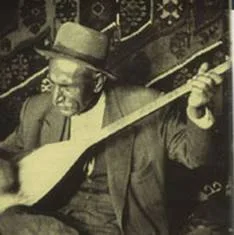
Veysel is considered one of the most prominent icons of Turkish folk music and literature. Among his most popular folk songs are Uzun İnce Bir Yoldayım (Turkish: I'm on a Long and Narrow Road); "Black Earth" (Kara Toprak); "Let My Friends Remember Me" (Dostlar Beni Hatırlasın) and "Your Beauty is Worth Nothing" (Güzelliğin On Para Etmez).
In 2022, Veysel was posthumously awarded a Presidential Culture and Arts Grand Award by the Turkish President Recep Tayyip Erdoğan, in the "loyalty" category. In 2023, on the 50th anniversary of his death, Veysel was recommended to UNESCO for a year of commemoration, backed by Turkey, Azerbaijan, Hungary, Kazakhstan, Kyrgyzstan, North Macedonia, Ukraine, and Uzbekistan. His 123rd birthday was commemorated in a Google Doodle on October 25, 2017.
Family
Veysel Şatıroğlu was born in Sivrialan, an Anatolian village in Sivas Province, in late 1894, the son of Gülizar Keçecigillerden and "Karaca" Ahmet Şatıroğlu, a farmer. He was his parents' fifth child. These included two elder sisters, both of whom died in infancy of smallpox; and two brothers, one of whom died in infancy, and the other in a childhood accident.
Only one brother, Ali, survived to adulthood. In 1896, Veysel's birth was followed by that of a younger sister, Elif.
His family were Alevis, whose ancestors migrated to Anatolia from Turkestan sometime during the 17-18th centuries. Initially settling in the Kars region of Anatolia, the family later moved to Divriği, eventually settling in Sivrialan when Veysel's grandfather Ali Şatıroğlu, or his great-grandfather İbrahim Şatıroğlu, migrated there from the village of Kaledibi.
Karaca Ahmet, Veysel's father, was orphaned at a young age, and grew up in Sivrialan as a shepherd and farmer.
The family surname was initially Ulu, although the descendants of Ahmet Karaca were known as the "Şatıroğulları", a nickname, since at least the time of Veysel's birth. The surname was legally changed in 1934 to Şatıroğlu, after the passage of the Turkish Surname Law in that same year.
Childhood: 1894–1906
Veysel's exact date of birth is disputed. It is typically given as 25 October, but the precise day is unknown; the best estimates suggest he was born in the autumn of 1894. He spent his entire childhood in his home village of Sivrialan, where his father's family, known as the Şatıroğulları, resided in four small houses overlooking the surrounding mountains.
Birth and naming
According to Veysel's mother, Gülizar, she gave birth to Veysel on the way home from milking sheep, in a nearby pasture known as Ayipınarı. Unable to return home in time, she delivered Veysel by the roadside and cut the umbilical cord herself, using a rock, then wrapped up the infant and walked back to Sivrialan (known as Söbüalan at the time).
As all but one of Gülizar and Ahmet's previous children had died of smallpox, their newborn son was taken to Mount Beserek, a sacred mountain located approximately 10 km (6.21 miles) from Sivrialan. The mountain is thought to have healing properties; according to local folklore, Mount Beserek was the site where the 6th century Islamic martyr Owais al-Qarani (Turkish: Veysel Karanî), found some camels he had previously lost in Syria.
Al-Qarani was martyred in the Battle of Siffin, where he had fought for another prominent Islamic figure, Ali ibn Abi Talib. In light of this, Ahmet and Gülizar named their newborn son Veysel, believing this name would compliment that of their older son, Ali Şatıroğlu.
Blindness
In later interviews, Veysel described his earliest childhood as being happy. In his own words, he recollected, "until the age of seven I ran and played and had fun like everybody else." Veysel had a fine voice from a young age, and from the age of 3 or 4 was frequently asked to sing.
Of his father, Karaca Ahmet, Veysel recalled:
— Âşık Veysel
Smallpox was prolific in the region, and struck Sivas in the winter of 1901. Veysel, aged 7, had received a new robe (an entari) from his mother, and went to a nearby house to show it to Muhsine, the wife of his maternal uncle (Veysel's memory of this event was unreliable; in other recollections, he stated that had merely gone outside to play).
It had recently rained in Sivrialan, and the road was saturated with mud and snow. On the way home, Veysel's foot slipped. He fell and bloodied his hand, and, after lying there for some time, got up and ran home in tears. It was discovered that he had developed a fever. Veysel was undressed and quickly put to bed. The next morning, he was unable to get up; it was soon discovered that Veysel too, had contracted smallpox.
Veysel was bedridden for three months. As the disease progressed, he developed a smallpox pustule in his left eye, which eventually caused a leakage that left him completely blind on that side. Veysel's right eye was spared, but quickly began to fail as well. He was left able only to perceive changes in light. By the time the pox eventually faded, Veysel was blind and scarred for the rest of his life, and needed to be led by the hand.
His first guide was his sister Elif, who would frequently lead her brother around the village, describing to him what she saw.
Of this period in his life, Veysel said:
Genç yaşımda felek vurdu başıma
Aldırdım elimden iki gözümü
Yeni değmiş idim yedi yaşıma
Kayıb ettim baharımı yazımı.
When I was young, fate struck me
I had both my eyes taken from my hand
I had just reached the age of seven
I lost my spring and my summer.
Extract from "Genç Yaşımda Felek Vurdu Başıma"
Date unknown
At this stage, there remained hope that Veysel would be able to regain the use of his right eye. There were ophthalmologists in nearby Akdağmadeni, 71 km (44.1 miles) from Sivrialan, whose main function was to perform cataract surgery. Some years after Veysel had first contracted smallpox, itinerant ophthalmologists (locally referred to as "swallow servants", Turkish: kırlangıç uşakları) arrived in Sivrialan and examined Veysel's right eye.
They informed Veysel's father, Karaca Ahmet, that cataract surgery would be able to restore the vision in that eye, but as they did not carry the necessary equipment, advised Ahmet to take Veysel to Sivas for surgery.
Conflicting accounts exist as to the sequence of events that followed. The most commonly cited version is the one recounted by Veysel in 1964, during an interview with TRT correspondent Rıdvan Çongur. In this recollection, Ahmet had planned to take Veysel to Akdağmadeni for surgery, but for one reason or another, was yet to make the trip.
One day, Veysel was with his mother Gülizar, out milking their cows. Ahmet came up behind them and called his son by name. Veysel, who had not realized his father was close by, turned around, and was accidentally pierced in the right eye by a cattle prod his father had been holding, thereby losing the remaining vision in that eye.
The second version of events also originates from Veysel. In this second recollection, first recounted in 1936 for the magazine Yedi Gün, Veysel was in the barn, feeding grass to one of the family's cows. The trip to Sivas was to take place in the next few days; Ahmet was poor, and had been saving up for the trip.
However, when the cow suddenly moved its head, it pierced Veysel's right eye with the tip of its horn. Veysel recollected the incident similarly in 1969 for the newspaper Milliyet; in this retelling, the accident occurred in 1906, when Veysel was already 12 years old. Veysel stated that the cow's horn gouged out his eye, and that he ran outside screaming, attracting the attention of his father and some of the other villagers.
Veysel understood from the adults' conversation that he would remain permanently blind in his right eye. According to Veysel, he and his father went to Sivas anyway, still hopeful that something could be done—there, Veysel was sat on a couch, and his right eye examined. A brief silence followed. Veysel, understanding that he would be blind for the rest of his life, began to weep.
The veracity of either version of events has not been proven. It is possible that the second story may not have been true, and may have been invented by Veysel to absolve his father of any possible blame for his blindness. However, this does not explain why Veysel related this story in 1936, but chose to default to the first version by as late as 1964.
The most probable explanation is that Veysel simply did not remember. He told both versions of the story in various interviews throughout his life, and sometimes even mixed up his eyes (for instance, he would point to his left instead of his right eye as the one blinded by smallpox). When asked by an interviewer whether he remembered the days before he had gone blind, Veysel replied, "I don't remember. No. I was too young."
Introduction to the saz
Veysel's blindness meant that he was unable to work a farm, one of the only professions in Sivrialan at the time. Unable to attend school, he never learned to read or write. Veysel's bitterness at being denied an education was lifelong, and he resigned himself to learning what he could of the alphabet and the surahs, from whatever schoolwork Veysel's brother Ali would recite aloud.
The newly blinded Veysel relied on the support of his brother Ali and sister Elif, who helped him to walk and provided him with constant support. However, Veysel struggled to come to terms with his blindness, and became increasingly withdrawn.
Veysel's situation was a source of constant worry for his father, Ahmet, who feared that his own passing would leave no one to take care of Veysel. The Emlek region, by which the area around Sivrialan was known, was at the time a popular place for itinerant bards and ashiks to come and perform their compositions. Ahmet, who was interested in poetry, read Veysel poems in an effort to console him.
In 1904 or 1905, Ahmet made a trip to the village of Ortaköy, 21 km from Şarkışla. At the Mustafa Kemal lodge in Ortaköy, Ahmet discussed his worries with one Hakkı Baba, who gave Ahmet a broken three-stringed saz, which Ahmet later gave to Veysel. Asking what the instrument was, Veysel was told that the saz was a gift to keep him entertained.
Veysel first took saz lessons from a neighbour, Molla Hüseyin, who also tuned and replaced any broken strings. However, whilst he enjoyed the saz's sound, Veysel initially found it too difficult to learn, and tried to throw the instrument aside. Ahmet, in contrast, was adamant that his son learn; Veysel, who could not plow, sow, or harvest, but who had a fine voice, could use the saz as a way to earn a living. In a quote recounted decades later by Veysel himself, Ahmet had told his son:
— Karaca Ahmet, Veysel's father
Though Veysel was initially reluctant, he understood his father's concerns, and he eventually began to learn the saz in earnest, also committing traditional folk songs and poems to memory, including the works of Yunus Emre, Pir Sultan Abdal, Karacaoğlan, Kemter Baba, Veli, Visali, Kul Abdal, Emrah, Tarsuslu Sıtkı, Şahan Ağa, and other great Alevi poets and ashiks of Anatolia. Veysel also listened to the works of other ashiks; his favourite was a friend and contemporary of his, Hıdır Dede, also from Sivrialan and about Veysel's age.
Early years: 1906–1931
From about the age of 8, Veysel's education was continued by his father's friend, Çamışıhlı Ali Ağa, also called Âşık Ali. Ali, who lived in abject poverty, earned his living as an itinerant saz teacher, and would frequently obtain lodgings by staying in students' homes across the Emlek region. He came to Sivrialan around the winter of 1902 to 1904, when Veysel was 8 or 10 years old.
At this time, Alevi religious gatherings and similar festivities were frequently held in Sivrialan, and Veysel often attended out of his love for music and conversation. At one such gathering, where Âşık Ali was present, the young Veysel was for unknown reasons expelled from the assembly with the invective, "get out, blind boy!" Such insults were common in Anatolian peasant villages, including Sivrialan; Veysel's nickname there was "Blind Veysel" (Turkish: Kör Veysel), and he was occasionally called "Blind Boy" (Turkish: Kör Oğlan) to his face, usually (though not always) as an insult, regardless of Veysel's personal feelings on the matter.
In one account, though very poorly attested, the reason for Veysel's expulsion was that he had, in his intrigue and his blindness, gotten too close to the speaker at the gathering, and his unkempt and smallpox-ravaged appearance had offended one of the villagers, who allegedly slapped him. Regardless of the true reason, Âşık Ali took pity on Veysel. Ali made a saz and gave it to Veysel, then spent the year by Veysel's side, teaching him the basics.
Though he initially struggled with the saz, and though he felt that both Molla Hüseyin and Ali Ağa had to put considerable effort into teaching him, Veysel eventually came to enjoy it once he had learned how to tune his instrument on his own. Having learned to play saz proficiently by the age of 20, Veysel's early years were spent playing the saz predominantly for his entertainment alone.
First World War and War of Independence
Veysel was 20 years old when the First World War broke out on 28 July 1914. Three months later, on 31 October 1914, the Ottoman Empire officially entered the war. In the ensuing mobilization, all men of eligible age (20–45) were conscripted to the front, including most of Veysel's peers and his older brother Ali; however Veysel, though a staunch nationalist and desperate to fight, was obliged to stay home with his parents and saz.
Veysel was devastated. He instantly fell into a deep depression that he self-described as one of the darkest periods of his life. Veysel was left behind yet again when the Turkish War of Independence broke out on 19 May 1919
Of this time in his life, Veysel reflected:
Of his state of mind during this time, he also noted:
To escape his sorrow, Veysel spent most of his time in the garden, sleeping under a pear tree. At night, he would climb into the treetops and sit there until morning. He began to carry his saz slung over his shoulder like a rifle, which his biographer and friend, Erdogan Alkan, speculated was homage to Veysel's ineligibility to fight; Veysel continued to carry his saz this way for the rest of his life. He also commemorated this period in his later poems.
With the end of the Turkish War of Independence in 1923, Ali returned home to Sivrialan, and Veysel was encouraged to pick up the saz again. Now of age and needing to support himself, this marked the first time that Veysel began to play the saz in a professional capacity; he started to earn a small living by playing in village cafes, and at weddings and holidays.
Veysel stayed mostly within Sivrialan and nearby villages, as the saz was still perceived to be a shameful instrument, especially in big cities. Reportedly, Veysel could not be seen with his instrument without having it confiscated and burned by the authorities.
First marriage
Memlekete destan oldum
Karım beni beğenmedi
Eşten oldum dosttan oldum
Yarim beni beğenmedi
Ne söylesem "deli" dedi
"Meyva vermez çalı" dedi
"Açma bana kolu" dedi
Sarım beni beğenmedi
I became a legend to my country
My wife didn't like me
I became a husband, a friend
My other half didn't like me
Whatever I said, she said, "crazy"
"The bush bears no fruit," she said
"Don't embrace me," she said
My love didn't like me
By the end of the War, Veysel's parents were very old. Veysel was by now 25 years old. Continuing to worry about their younger son's future, Veysel's parents arranged a marriage for him with Esma, the daughter of a relative living in the village. Veysel had two children by Esma; their firstborn, Ali Şatıroğlu, died aged just 10 days, when he reportedly suffocated while Esma was breastfeeding him. Their second child was a daughter, named Elif.
According to most accounts, the marriage was unhappy, although the precise reason is unclear. Veysel remained markedly silent on the issue, though he suggested his poems that Esma thought he was crazy, and was cold to him. It is possible that he also blamed her for the death of their son. Veysel once fell asleep with his infant daughter beside him, and woke up horrified, thinking that he might have suffocated her if he had rolled over in his sleep.
Conversely, Esma accused Veysel of being grumpy and baselessly suspicious, and even alleged that Veysel had beaten her. Their mutual acquaintance, Veysel Kaymak, believed that Veysel had been jealous of Esma for being beautiful. He would purportedly conduct bizarre tests to prove Esma's loyalty to him; in one instance, Veysel hid an apple under Esma's pillow, then demanded to know who had put it there; he would climb onto the roof and throw stones down the chimney, then study Esma's reaction.
They agreed only on one point—for, when asked what she thought of her husband, Esma stated, "he was crazy, crazy!"
Veysel's mother died on 24 February 1921, followed 8 months later by his father. The death of Gulizar hit Veysel especially hard; he would later compose a poem in her memory. This did not help the mood at home. Veysel and Esma's neighbour was a man named Hüseyin, the brother of a farmhand (ırgat) whom Veysel's brother Ali had hired after having a daughter of his own.
Esma, feeling harassed by her own husband, would allegedly wait until Veysel had left the house, before going to spend time with Hüseyin.
Veysel began to become suspicious that Esma was having an affair. He apparently warned Esma about Hüseyin several times, though Esma always reassured her husband that nothing had happened between them, and asked Veysel "how could he think of such a thing?"
Esma soon fell in love with Hüseyin. One day, when Veysel was sick in bed and Ali was out collecting milkweed, Esma ran away with Hüseyin, leaving Veysel and his six-month-old daughter behind. Veysel continued to care for his daughter, but the child died at the age of two. Esma and Hüseyin, ultimately growing disillusioned with their escape, eventually returned to Sivrialan, and continued to reside there alongside Veysel.
Veysel, on learning that Esma had returned, only asked if Esma was in need of anything, and would continue to make his relatives ask. Veysel later wrote a poem capturing his grief and anger towards Hüseyin, placing the blame on him for the death of Veysel's daughter.
According to a widespread story told about this time in Veysel's life, Veysel was fully aware that Esma intended to run away, but never let on that he knew. The story goes that during Esma and Hüseyin's escape, the lovers stopped to rest at a fountain near Bafra, in Samsun. Esma had been bothered by what she thought was a pebble in her shoe since leaving Sivrialan.
Removing her sock, Esma found money inside, Veysel having stashed it there so that she would not be in want. Whilst this story is often related and was believed by Veysel's children and grandchildren, it is probably apocryphal.
The death of Veysel's parents, the end of his marriage, and the deaths of his children, led Veysel to consider leaving Sivrialan for the first time. In 1928, he resolved to make for Adana with his friend Ibrahim. On the way, they stopped at the village of Karaçayır, 22 km from Sivas. Veysel played the saz for a man there.
Apparently deeply affected by the thought of Veysel's departure, the man, Deli Süleyman, begged Veysel not to leave, to such an extent that Veysel finally gave up the notion.
Second marriage
Having given up on Adana, Veysel began to make the journey back to Sivrialan. On the way, he passed through the Hafik District of Sivas. He bought a new saz for 9 lira in the village of Yalıncak, where he and his travelling companions were also swindled by gamblers. Yalıncak was notable for being the location of an important tomb, and Veysel, who had heard of the place from his father, wished to visit it.
He stayed a few nights in a local inn (tekke), known as the Yalıncak Baba Lodge. At the time of Veysel's visit, the lodge was owned by one Hamza Ertemür, of the nearby village of Karayaprak. The lodge was maintained by members of Hamza's family. This included his granddaughter Gülizar, a widow, who was in charge of the cleaning, and who also assisted Veysel.
He and his companions arrived on Nowruz day, when all the local lodges were closed and the local gendarmerie were on high alert; Gülizar, who opened the door to them, at first thought that Veysel's saz was a rifle. This marked Veysel's first time meeting Gülizar; however, Gülizar later recounted in interviews that she had had a dream in which she was visited by a 14th-century folk poet, who told her that she would be the one to spread Veysel's ashes. In other accounts, Gülizar purportedly had a dream in which she saw herself marrying Veysel.
After his stay in Yalıncak, Veysel returned to Sivrialan. Almost as soon as he had arrived there, Veysel dispatched a letter to the village where Gülizar lived, Karayaprak, bearing his proposal of marriage.
Both Gülizar and her father were initially hesitant to accept. This hesitance was entirely practical; Veysel's blindness meant that he could not mend fences, bring in the harvest, or perform other manual tasks. By her own admission, Gülizar was also hesitant to marry a blind man. Sivrialan was also very remote, about 136 km (83.9 miles) from Karayaprak on foot.
However, Gülizar's grandfather Hamza came to Veysel's defense, arguing that the proposal must be divine will, and therefore, should not be opposed. Despite the continued protests of Gülizar's father, Hamza forwarded a letter of acceptance to Sivrialan. Veysel sent his brother Ali's wife, Yeter, and his aunt's son, İbrahim, to Karayaprak to fetch Gülizar, who married Veysel in that same year, sometime around March 1928.
She took nothing with her to Sivrialan except for a sack of meat, signifying that Gülizar would bring only her person into the marriage; she was married without a dowry.
Gülizar and Veysel had seven children together, though their son, Hüseyin, died when he was a few months old. The marriage was happy, and lasted until Veysel's death. In a later conversation where her husband was present, Gülizar would note:
— Gülizar Şatıroğlu, Veysel's wife
Rise to fame: 1931–1935
Veysel's name first became known outside his local circle when he met Ahmet Kutsi Tecer in 1931. Tecer, himself a poet and a literature teacher in schools in Sivas and Ankara, recognized Veysel's skill with the saz, and was the key figure responsible for launching Veysel's name onto the national stage. In 1931, Tecer, alongside his colleagues Muzaffer Sarısözen and Vehbi Cem Aşkun, founded the Association for the Protection of Folk Poets, with Sivas' mayor, Osman Hikmet Işık, appointed as association president.
Sivas Folk Poets Festival
In the same year, 1931, Tecer's association organized the first Folk Poets Festival in Sivas, intended to showcase the work of local folk poets. There was some difficulty in finding minstrels to attend the event; it was a novelty, and folk poets at the time were not accustomed to performing in front of large audiences.
Tecer and his colleagues launched a search for minstrels across Sivas, including in Sivrialan, where a few representatives visited Veysel's house. Reportedly, Veysel was shy. The presence of state officials in his home made him worry that something would happen to him, and Veysel instructed Gülizar to say that he was not at home.
However, he was ultimately persuaded, and allegedly participated in the festival against the advice of the other villagers in Sivrialan.
The first Sivas Folk Poets Festival was launched on November 5, 1931, and lasted for three days. In total, 15 minstrels and folk poets were found to attend, including Veysel; most were also instrumentalists. Veysel sang from the repertoire he had learned from Çamışıhlı Ali Ağa. The festival was ultimately successful; Although Veysel did not perform his own poetry at the time, his performance attracted the intellectuals of urban Sivas, who were allegedly unaware of such a rich folk tradition among the local peasantry.
At the festival's conclusion, Veysel was offered 10 lira in payment. Veysel, however, rejected the money, despite being very poor. Veysel was recorded as saying: "You valued us and invited us here. We should really be giving it to you." He was finally compelled to take 5 lira.
Of his participation in the event, Veysel commented some years later: