Carl Sagan
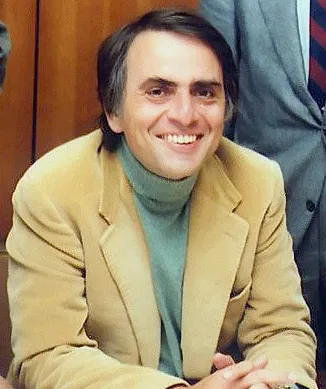
He co-wrote and narrated the 1980 documentary series Cosmos: A Personal Voyage, which has been seen by at least 500 million people in 60 countries and won two Emmy Awards and a Peabody Award. Cosmos, the companion volume, was the bestselling science book to date.
A lifelong science fiction fan, Sagan entered the genre with Contact, which was adapted as the film of the same name. He was a founding member and first president of the Planetary Society. He proposed the Pale Blue Dot photograph of Earth taken by Voyager 1.
He had a lifelong interest in the possibility of extraterrestrial life and is generally credited with contributions to the Arecibo message, with a much more significant role developing the Pioneer plaques and the Voyager Golden Record, universal messages that could potentially be understood by any intelligence that might find them.
He promoted skepticism and the scientific method, particularly in his penultimate book The Demon-Haunted World. He popularized a toolkit for critical thinking. He made famous the maxim "Extraordinary claims require extraordinary evidence." The phrase "Billions and billions" was attributed to him, although he never said it; he did use it as the title of his last book.
Sagan received numerous awards and honors, including the NASA Distinguished Public Service Medal and the National Academy of Sciences Public Welfare Medal. He married three times and had five children. After developing myelodysplasia, Sagan died of pneumonia at the age of 62 on December 20, 1996.
Early life
Childhood
Carl Edward Sagan was born on November 9, 1934, in the Bensonhurst neighborhood of New York City's Brooklyn borough. His mother, Rachel Molly Gruber (1906–1982), was a housewife from New York City; his father, Samuel Sagan (1905–1979), was a Ukrainian-born garment worker who had emigrated from Kamianets-Podilskyi (then in the Russian Empire).
Sagan was named in honor of his maternal grandmother, Chaiya Clara, who had died while giving birth to her second child; she was, in Sagan's words, "the mother she [Rachel] never knew." Sagan's family lived in a modest apartment in Bensonhurst. He later described his family as Reform Jews, one of the more liberal of Judaism's four main branches.
He and his sister agreed that their father was not especially religious, but that their mother "definitely believed in God, and was active in the temple [...] and served only kosher meat." During the worst years of the Great Depression, his father worked as a movie theater usher.
According to biographer Keay Davidson, Sagan traced his analytical inclinations to his mother, who had been extremely poor as a child in New York City during World War I and the 1920s, and whose later intellectual ambitions were sabotaged by her poverty, status as a woman and wife, and Jewish ethnicity. Davidson suggested she "worshipped her only son, Carl" because "he would fulfill her unfulfilled dreams." Sagan traced his sense of wonder to his father, who spent his free time giving apples to the poor or helping soothe tensions between workers and management within New York City's garment industry.
Sagan said: "My parents were not scientists. They knew almost nothing about science. But in introducing me simultaneously to skepticism and to wonder, they taught me the two uneasily cohabiting modes of thought that are central to the scientific method."
He described a defining moment in his development, when his parents took him to the 1939 New York World's Fair. He recalled his vivid memories of several exhibits there. One, Futurama, included a moving map, which, as he recalled, "showed beautiful highways and cloverleaves and little General Motors cars all carrying people to skyscrapers, buildings with lovely spires, flying buttresses—and it looked great!" Another involved a flashlight shining on a photoelectric cell, which created a crackling sound, and another showed how the sound from a tuning fork became a wave on an oscilloscope.
He saw an exhibit of the nascent medium of television. He later wrote: "Plainly, the world held wonders of a kind I had never guessed. How could a tone become a picture and light become a noise?" Sagan saw one of the fair's most publicized events: the burial at Flushing Meadows of a time capsule, which contained mementos from the 1930s to be recovered in the far future.
Davidson wrote that this "thrilled Carl." As an adult, Sagan and his colleagues would create similar time capsules to be sent out into space.
During World War II, Sagan's parents worried about the fate of their European relatives, but he was generally unaware of the details of the ongoing war. He wrote, "Sure, we had relatives who were caught up in the Holocaust. Hitler was not a popular fellow in our household... but on the other hand, I was fairly insulated from the horrors of the war." His sister, Carol, said that their mother "above all wanted to protect Carl... she had an extraordinarily difficult time dealing with World War II and the Holocaust."
He wondered what the stars were, but no one could give him a clear answer. He recalled:
As soon as I was old enough, my parents gave me my very first library card. I think the library was on 85th Street, an alien land. Immediately, I asked the librarian for something on stars. She returned with a picture book displaying portraits of men and women with names like Clark Gable and Jean Harlow. I complained, and for some reason then obscure to me, she smiled and found another book—the right kind of book.
I opened it breathlessly and read until I found it. The book said something astonishing, a very big thought. It said that the stars were suns, but very far away. The Sun was a star, but close up... I was innocent of the notion of the inverse square law for light propagation. I had not the ghost of a chance of calculating the distance to the stars.
But I could tell that if the stars were suns, they had to be very far away—farther away than 85th Street, farther away than Manhattan, farther away, probably, than New Jersey. The Cosmos was much bigger than I had guessed.
He said: "The scale of the universe suddenly opened up to me. It was a kind of religious experience. There was a magnificence to it, a grandeur, a scale which has never left me. Never ever left me." At age six or seven, he and a close friend took trips to the American Museum of Natural History. They were impressed by the displays of dinosaur fossils and nature dioramas and by the Hayden Planetarium.
Sagan's parents nurtured his growing interest in science, buying him chemistry sets and reading matter. Per biographer Ray Spangenburg, Sagan's desire to understand the Cosmos became a "driving force in his life, a continual spark to his intellect, and a quest that would never be forgotten." His fascination with outer space deepened after reading Edgar Rice Burroughs's John Carter of Mars books.
In 1947, he discovered Astounding Science Fiction, which introduced him to more hard science fiction speculations: "Each month I eagerly awaited the arrival of Astounding. I read Verne and Wells, read, cover‐to‐cover, the first two science‐fiction anthologies that I was able to find, devised scorecards, similar to those I was fond of making for baseball, on the quality of the stories I read. Many ranked high in asking interesting questions but low in answering them."
Education
Sagan attended David A. Boody Junior High School, in his native Bensonhurst and had his bar mitzvah when he turned 13. In 1948, when he was 14, his father's work took the family to Rahway, New Jersey, where he attended Rahway High School. He was a straight-A student but was bored because his classes did not challenge him and his teachers did not inspire him.
His teachers realized this and tried to convince his parents to send him to a private school, with an administrator telling them, "This kid ought to go to a school for gifted children, he has something really remarkable." However, his parents could not afford to do so. Sagan became president of the school's chemistry club, and set up his own laboratory at home.
He taught himself about molecules by making cardboard cutouts to help him visualize how they were formed: "I found that about as interesting as doing [chemical] experiments." He was mostly interested in astronomy, studying it in his spare time. In his junior year of high school, he discovered that professional astronomers were paid for doing something he always enjoyed. "That was a splendid day—when I began to suspect that if I tried hard I could do astronomy full-time."
Before finishing high school, Sagan entered an essay writing contest in which he explored the idea that human contact with advanced extraterrestrials might be as disastrous for people on Earth as Native Americans' first contact with Europeans had been for Native Americans. The subject was considered controversial, but his rhetorical skill won over the judges and they awarded him first prize.
When he was about to graduate from high school, his classmates voted him "most likely to succeed" and put him in line to be valedictorian. In 1950, Sagan wrote the essay "Space, Time, and the Poet" for his high school newspaper. In it, he mused on man's place in the universe as expressed by poets like T. S. Eliot and Alfred, Lord Tennyson and "the work containing perhaps the greatest poetry—the Bible." He graduated from Rahway High School in 1951.
He attended the University of Chicago as it was one of the few colleges he had applied to that would accept a 16 year old. Robert M. Hutchins, its chancellor, had recently retooled the College of the University of Chicago into an "ideal meritocracy" built on Great Books, Socratic dialogue, comprehensive examinations, and early entrance to college.
He joined the Ryerson Astronomical Society. He wrote "College was the fulfillment of my dreams. I found teachers who not only understood science, but were actually able to explain it. … I was a physics student in a department orbiting around Enrico Fermi; I discovered what true mathematical elegance is from Subrahmanyan Chandrasekhar; I was given the chance to talk chemistry with Harold Urey; over summers I was apprenticed in biology to H.
J. Muller at Indiana University; and I learned planetary astronomy from its only full-time practitioner at the time, G. P. Kuiper." The Miller-Urey experiment, conducted in 1952, sparked his interest in the origin of life. Under Urey, he wrote "Radiation and the Origin of the Gene." He recalled that "science was presented as an integral part of the gorgeous tapestry of human knowledge.
It was considered unthinkable for an aspiring physicist not to know Plato, Aristotle, Bach, Shakespeare, Gibbon, Malinowski and Freud—among many others."
He was awarded a Bachelor of Liberal Arts with general and special honors in what he quipped was "nothing." In 1955, he earned a Bachelor of Science in physics. He went on to do graduate work at the University of Chicago, earning a Master of Science in physics in 1956 and a Doctor of Philosophy in astronomy and astrophysics in 1960.
His doctoral thesis, under the direction of Kuiper, was "Physical Studies of the Planets". During his graduate studies, he spent summers working with Kuiper, as well as chemist Melvin Calvin and physicist George Gamow. He credited Kuiper with teaching him back-of-the-envelope calculations: "A possible explanation to a problem occurs to you, you pull out an old envelope, appeal to your knowledge of fundamental physics, scribble a few approximate equations on the envelope, and see if your answer comes anywhere near explaining your problem. If not, you look for a different explanation. It cut through nonsense like a knife through butter."
In 1958, Sagan and Kuiper worked on the classified military Project A119, a secret United States Air Force plan to detonate a nuclear warhead on the Moon and document its effects. Sagan had a Top Secret clearance at the Air Force and a Secret clearance with NASA. In 1999, an article published in the journal Nature revealed that Sagan had included the classified titles of two Project A119 papers in his 1959 application for a scholarship to University of California, Berkeley. A follow-up letter to the journal by project leader Leonard Reiffel confirmed Sagan's security leak.
Career and research
From 1960 to 1962, Sagan was a Miller Fellow at the University of California, Berkeley. Meanwhile, he published an article in 1961 in the journal Science on the atmosphere of Venus, while also working with NASA's Mariner 2 team, and served as a "Planetary Sciences Consultant" to the RAND Corporation.
After the publication of Sagan's Science article, in 1961, Harvard University astronomers Fred Whipple and Donald Menzel offered Sagan the opportunity to give a colloquium at Harvard and subsequently offered him a lecturer position at the institution. Sagan instead asked to be made an assistant professor, and eventually Whipple and Menzel were able to convince Harvard to offer Sagan the assistant professor position he requested.
Sagan lectured, performed research, and advised graduate students at the institution from 1963 until 1968, as well as working at the Smithsonian Astrophysical Observatory, also located in Cambridge, Massachusetts.
In 1968, Sagan was denied academic tenure at Harvard. He later indicated that the decision was very unexpected. The denial has been blamed on several factors, including that he focused his interests too broadly across a number of areas (while the norm in academia is to become a renowned expert in a narrow specialty), and perhaps because of his well-publicized scientific advocacy, which some scientists perceived as borrowing the ideas of others for little more than self-promotion.
An advisor from his years as an undergraduate student, Harold Urey, wrote a letter to the tenure committee recommending strongly against tenure for Sagan.
Long before the ill-fated tenure process, Cornell University astronomer Thomas Gold had courted Sagan to move to Ithaca, New York, and join the recently hired astronomer Frank Drake among the faculty at Cornell. Following the denial of tenure from Harvard, Sagan accepted Gold's offer and remained a faculty member at Cornell for nearly 30 years until his death in 1996.
Unlike Harvard, the smaller and more laid-back astronomy department at Cornell welcomed Sagan's growing celebrity status. Following two years as an associate professor, Sagan became a full professor at Cornell in 1970 and directed the Laboratory for Planetary Studies there. From 1972 to 1981, he was associate director of the Center for Radiophysics and Space Research (CRSR) at Cornell.
In 1976, he became the David Duncan Professor of Astronomy and Space Sciences, a position he held for the remainder of his life.
Sagan was associated with the U.S. space program from its inception. From the 1950s onward, he worked as an advisor to NASA, where one of his duties included briefing the Apollo astronauts before their flights to the Moon. Sagan contributed to many of the robotic spacecraft missions that explored the Solar System, arranging experiments on many of the expeditions.
He often challenged the decisions to fund the Space Shuttle and the International Space Station at the expense of further robotic missions. Sagan assembled the first physical message that was sent into space: a gold-plated plaque, attached to the space probe Pioneer 10, launched in 1972. Pioneer 11, also carrying another copy of the plaque, was launched the following year.
He continued to refine his designs. He contributed to the Voyager Golden Record, a sample of the sights and sounds of Earth sent with the Voyager space probes in 1977. Among much else, it features music by Bach, Beethoven and Chuck Berry.
Scientific achievements
Former student David Morrison described Sagan as "an 'idea person' and a master of intuitive physical arguments and 'back of the envelope' calculations", and Gerard Kuiper said that "Some persons work best in specializing on a major program in the laboratory; others are best in liaison between sciences. Dr. Sagan belongs in the latter group."
Sagan's contributions were central to the discovery of the high surface temperatures of the planet Venus. In the early 1960s no one knew for certain the basic conditions of Venus' surface, and Sagan listed the possibilities in a report later depicted for popularization in a Time Life book Planets. His own view was that Venus was dry and very hot as opposed to the balmy paradise others had imagined.
He had investigated radio waves from Venus and concluded that there was a surface temperature of 500 °C (900 °F). As a visiting scientist to NASA's Jet Propulsion Laboratory, he contributed to the first Mariner missions to Venus, working on the design and management of the project. Mariner 2 confirmed his conclusions on the surface conditions of Venus in 1962.
Sagan was among[clarification needed] the first to hypothesize that Saturn's moon Titan might possess oceans of liquid compounds on its surface and that Jupiter's moon Europa might possess subsurface oceans of water.
This would make Europa potentially habitable. Europa's subsurface ocean of water was later indirectly confirmed by the spacecraft Galileo. The mystery of Titan's reddish haze was also solved with Sagan's help. The reddish haze was revealed to be due to complex organic molecules constantly raining down onto Titan's surface.
Sagan further contributed insights regarding the atmospheres of Venus and Jupiter, as well as seasonal changes on Mars. He also perceived climate change as a growing, man-made danger and likened it to the natural development of Venus into a hot, life-hostile planet through a kind of runaway greenhouse effect. He testified to the US Congress in 1985 that the greenhouse effect would change the Earth's climate system.
Sagan and his Cornell colleague Edwin Ernest Salpeter speculated about life in Jupiter's clouds, given the planet's dense atmospheric composition rich in organic molecules. He studied the observed color variations on Mars' surface and concluded that they were not seasonal or vegetational changes as most believed,[clarification needed] but shifts in surface dust caused by windstorms.
He argued in favor of the hypothesis, which has since been accepted, that the high surface temperatures of Venus are the result of the greenhouse effect.
Sagan is also known for his research on the possibilities of extraterrestrial life, including experimental demonstration of the production of amino acids from basic chemicals by radiation.
As of 2017[update], Sagan is the most cited SETI scientist and one of the most cited planetary scientists.
He edited Icarus from 1975 to 1979. In 1980, he cofounded the Planetary Society.
Science popularization
Sagan wrote the Encyclopædia Britannica entry on Life, later updated by his first wife, the biologist Lynn Margulis. Sagan's first popular science book was The Cosmic Connection. He introduced the Cosmic Calendar in The Dragons of Eden, which won the 1978 Pulitzer Prize for General Nonfiction. He delivered the 1977 Royal Institution Christmas Lectures on The Planets.
📚 Source: Wikipedia