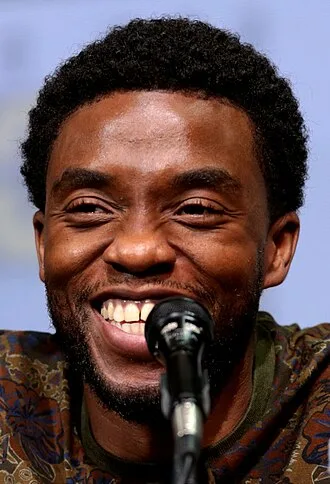
Born in South Carolina, Boseman studied directing at Howard University and began his career in theatre. Boseman won a Drama League Directing Fellowship and an acting AUDELCO, along with receiving a Jeff Award nomination for his 2005 play Deep Azure. Transitioning to the screen, his first major role was as a series regular on the NBC drama Persons Unknown (2010) and he landed his breakthrough role as baseball player Jackie Robinson in 42 (2013).
He continued to portray historical figures, starring as singer James Brown in Get on Up (2014) and as Thurgood Marshall in Marshall (2017).
Boseman achieved international fame for playing the Marvel Comics superhero T'Challa (Black Panther) in the Marvel Cinematic Universe (MCU) from 2016 to 2019. He appeared in four MCU films, including Black Panther (2018). As the first Black actor to headline an MCU film, he was also named in the 2018 Time 100.
Boseman's final performance as the character in the Disney+ anthology series What If...? (2021) earned him a posthumous Primetime Emmy Award for Outstanding Character Voice-Over Performance.
In 2016, Boseman was diagnosed with colon cancer. He kept his condition private, continuing to act until his death from the illness in 2020. For his final film role, the drama Ma Rainey's Black Bottom (2020), he received the Golden Globe and Screen Actors Guild awards for Best Actor, along with a posthumous nomination for an Oscar in the same category.
Life and career
Early years and education
Chadwick Aaron Boseman was born on November 29, 1976, in Anderson, South Carolina, where he grew up. His mother, Carolyn, was a nurse. His father, Leroy worked at a textile factory and managed an upholstery business. In his youth, Boseman practiced martial arts, and continued this training as an adult. As a child, he wanted to become an architect.
According to Boseman, DNA testing indicated that some of his ancestors were Jola people from Guinea-Bissau, Krio people and Limba people from Sierra Leone, and Yoruba people from Nigeria.
Boseman graduated from T. L. Hanna High School in 1995, where he played on the basketball team. In his junior year, he wrote his first play, Crossroads, and staged it at the school after a classmate was shot and killed. He competed in Speech and Debate in the National Speech and Debate Association at T. L. Hanna.
He placed eighth in Original Oratory at the 1995 National Tournament. He was recruited to play basketball at college but chose the arts instead, attending college at Howard University in Washington, D.C., and graduating in 2000 with a Bachelor of Fine Arts in directing. While at Howard, he worked in an African American–oriented bookstore near the university, which friend Vanessa German said was important and inspirational to him; he drew on his experience there for his play Hieroglyphic Graffiti.
His teachers at Howard included Al Freeman Jr. and Phylicia Rashad, who became a mentor. Rashad helped raise funds, notably from her friend and prominent actor Denzel Washington, so that Boseman and other classmates could attend the Oxford Summer Program of the British American Drama Academy at Balliol College, Oxford, in England, to which they had been accepted.
Boseman wanted to write and direct, and initially began studying acting to learn how to relate to actors. He attended the program in 1998, and he developed an appreciation for the playwriting of William Shakespeare; additionally, he studied the works of various dramatists, including Samuel Beckett and Harold Pinter. He also traveled to Africa for the first time while at college, working in Ghana with his professor Mike Malone "to preserve and celebrate rituals with performances on a proscenium stage"; he said it was "one of the most significant learning experiences of [his] life".
After he returned to the U.S., he took additional course work in film studies, graduating from New York City's Digital Film Academy.
2000–2007: Theater, Deep Azure, and early television
Boseman lived in Brooklyn, New York City, at the start of his career. In 2000, he was named a Drama League Directing Fellow. He directed productions including George C. Wolfe's The Colored Museum (Wolfe would later direct Boseman in his final role) and a staging of Amiri Baraka's Dutchman. He worked as the drama instructor in the Schomburg Junior Scholars Program, housed at the Schomburg Center for Research in Black Culture in Harlem between 2002 and 2009.
He rose to prominence as a playwright and stage actor in 2002, performing in multiple productions and winning an AUDELCO award in 2002 for his part in Ron Milner's Urban Transitions. As a member of the National Shakespeare Company of New York, he played Romeo in Romeo and Juliet and Malcolm in Macbeth.
He directed and wrote plays as part of the Hip-hop theater movement; his works included Rhyme Deferred (co-written with Howard classmate Kamilah Forbes), in which he also performed, and Hieroglyphic Graffiti. Rhyme Deferred was commissioned for a national tour, as well as featuring in The Fire This Time anthology of works, while Hieroglyphic Graffiti was produced at a variety of locations, including the National Black Theatre Festival in 2001.
Combining modern African-American culture and Egyptian deities, it is set in Washington, D.C., and was picked up by the New York Hip-Hop Theatre Festival and Tennessee State University's summer stock theatre program in 2002. It was also the Kuntu Repertory Theatre's 2002–03 season launch production. At the 2002 Hip-Hop Theatre Festival, Boseman also gave a one-man show called "Red Clay and Carved Concrete".
In 2003, Boseman was cast in his first television role, an episode of Third Watch, and began playing Reggie Montgomery in the daytime soap opera All My Children. He was fired from All My Children after voicing concerns to producers about racist stereotypes in the script; the role was subsequently re-cast, with Boseman's future Black Panther co-star Michael B.
Jordan taking the part. Boseman had wanted to work around the stereotypes of the character, feeling that being in a soap opera would give him more room for improvisation as the writers often do not initially plan a full story; his (then-future) agent said that when Boseman was given the second script and learned that his character's parents were a drug addict and an absent father, Boseman confronted the creators.
He reflected on the experience in his 2018 commencement address to Howard University, saying that it "seemed to be wrapped up in assumptions about us as black folks [and he] would have to make something out of nothing." His other early television work included episodes of the series Law & Order, Cold Case, CSI: NY, and ER.
Boseman's best-known play, Deep Azure, was commissioned in 2004 by the Congo Square Theatre Company in Chicago. It was nominated for a 2006 Jeff Award for Best New Work. Boseman said at the time that Deep Azure was "a fusion and progression of [his] previous plays", which he did not feel fit wholly in the Hip Hop theater genre.
The play – about police brutality, a daring subject in 2004, and largely delivered in rhyme – was workshopped at the Apollo Theater in New York. Drama critic Chris Jones in the Chicago Tribune highly praised the work. In 2008, Boseman turned Deep Azure into a screenplay. Michael Greene, who would become his agent, picked it up and contacted Boseman when Tessa Thompson and Omari Hardwick expressed an interest in playing the lead roles, prompting Boseman's move to Los Angeles.
He also directed, wrote, and produced the short film Blood Over a Broken Pawn in 2007, which was honored at the 2008 Hollywood Black Film Festival.
2008–2015: Breakthrough with 42 and Get on Up
In 2008, Boseman moved to Los Angeles to pursue his film and acting career. He was cast in a recurring role on the television series Lincoln Heights as Nathaniel Ray Taylor, an army veteran with PTSD who was later revealed to be the son of the main character before re-enlisting. He also appeared in his first feature film in 2008, The Express: The Ernie Davis Story, as running back Floyd Little.
He landed his first regular role in the 2010 television series Persons Unknown as the Marine Graham McNair. The show received mediocre reviews that felt the characters were all archetypes with little development. In July 2013, Boseman's second short film as director, Heaven, premiered at the HollyShorts Film Festival.
Boseman's breakthrough role came in 2013 with the film 42, in which he portrayed the lead role of baseball legend Jackie Robinson. Boseman had been directing an off-Broadway play in the East Village when he auditioned for the role, and was considering giving up acting to pursue directing full-time. About twenty-five other actors had been seriously considered for the role, but director Brian Helgeland liked Boseman's bravery in choosing to read the most difficult scene, in which Robinson goes down a stadium tunnel and breaks a bat in anger, and cast him after he had auditioned twice.
Part of the audition process involved playing baseball; Boseman had been involved with Little League as a child but was primarily a basketball player growing up, saying that in this part the casting directors likely noticed his athleticism rather than specifically baseball skills. Robinson's widow, Rachel Robinson, commented that Boseman's performance was like seeing her husband again.
To replicate Robinson's mannerisms, Boseman trained for five months with professional baseball coaches who "would tape [his] practices every few weeks, and they would basically split-screen [his technique] with [Robinson's]" to allow him to compare. After having portrayed football player Little in The Express, Boseman was encouraged by stunt coordinator Allan Graf to approach running bases in the same way, as Robinson had also been a college football player.
Upon taking the role, Boseman first spoke with Rachel Robinson, which he said was of great help in discovering the character. The same year, Boseman also starred in the independent film The Kill Hole, which was released in theaters a few weeks before 42.
Critics, even those who viewed the film negatively, felt that Boseman's being a relatively unknown actor was a benefit when playing an icon and an athlete; Mick LaSalle of San Francisco Chronicle wrote that "as [...] played by Chadwick Boseman, Robinson is a hero we can recognize", and Mary Pols for Time said that "Boseman is not a hugely close physical match to Robinson, except for perhaps in the power he conveys, but he's a great choice to play the ball player". The Guardian's Mike McCahill noted that "Boseman hits his key scenes out of the park", but felt the film would not interest people who are not baseball fans, with Dana Stevens of Slate suggesting that the film made black history "squeaky-clean" and did both Robinson and Boseman's performance as him a disservice.
In 2014, Boseman starred in another sporting film, Draft Day, as fictional football player Vontae Mack. He had workshopped the Tupac Shakur jukebox musical Holler If Ya Hear Me in 2013, but did not continue to Broadway with it in order to take the role of James Brown in 2014's Get on Up. As Brown, Boseman did some singing and all of his own dancing, working with choreographer Aakomon Jones for five to eight hours a day over two months in preparation.
Producer Mick Jagger also directed him on interacting with audiences when performing live music. He had not wanted to take a role in another biopic so soon after playing an icon in Robinson, saying he "wasn't looking to do it again for another 15, 20 years", but was sought out as director Tate Taylor's only choice. Co-star Dan Aykroyd, who had known Brown, praised Boseman's performance, saying that it was neither replication nor impression and that he "did not have to squint sitting across from [Boseman] to imagine that [he] was talking to [Brown]".
Boseman also stayed in character between filming on set; Taylor said this was not a method acting approach, and more a necessity due to Boseman's holding his vocal cords unnaturally to imitate Brown's southern drawl.
His performance was praised as the highlight of a generally well received movie, with the Rotten Tomatoes critical consensus reading: "With an unforgettable Chadwick Boseman in the starring role, Get On Up offers the Godfather of Soul a fittingly dynamic homage." Among the critics was Time's Richard Corliss (hyperbolically) saying that Boseman "deserves a Pulitzer, a Nobel and instant election to the Rock and Roll Hall of Fame." Eulogizing Boseman, Donald Clarke of The Irish Times said that "Get on Up tested every weapon in the actor's arsenal [and his] performance confirmed that, like a star from Hollywood's golden age, Chadwick Boseman could do it all and do it all with style."
Boseman had sold a thriller screenplay to Universal Pictures in 2014, which he continued to collaborate on with creative partner Logan Coles and planned to star in, and told The Guardian that he still wanted to be a director but would explore his acting career first, adding that "maybe it'll be easier if you're a successful actor".
In 2016, he starred as Thoth, a deity from Egyptian mythology, in Gods of Egypt. Boseman was one of the few actors of color featured in the film, which had drawn criticism for using a predominantly white cast to portray Egyptian characters. Agreeing with the criticism, Boseman said this had motivated him to accept the role, to ensure one of the film's African characters would be played by someone of African descent.
Boseman's own casting was criticized for falling under the "Magical Negro" stereotype. The Independent reported that Boseman shook his head while telling GQ in an interview that "people don't make $140 million movies starring black and brown people". It was his first largely CGI film, and he expressed that he preferred acting alongside people than with blue screens and prop stand-ins.
The film was heavily criticized; Jordan Hoffman for The Guardian said that it lacks story or interesting characters, but "Boseman makes for nice comic relief as the witty Thoth", with Will Leitch of The New Republic saying that his then-upcoming Marvel Studios role may have to work "to make you forget he was ever in this movie".
Perri Nemiroff for Collider said that Boseman shines as "the only cast member who really seems to understand the movie he's in".
2016–2019: Marvel Cinematic Universe, Marshall and 21 Bridges
In 2016, Boseman began portraying the Marvel Comics character T'Challa / Black Panther in the Marvel Cinematic Universe. Captain America: Civil War was his first film in a five-picture deal with Marvel Entertainment. He did not audition for the role, instead having a "discussion about what [Marvel] wanted to do and how [he] saw it and what [he] wanted to do." While working on Civil War, Boseman learned some Xhosa from John Kani, who played his father, and insisted on using the language for the character.
Boseman also developed a Wakandan accent himself, and used it during the entire production "whether he was on camera or not". When asked by journalist Ryan Gilbey if he felt pressure not to "screw up" the beloved comics character, Boseman responded by saying: "It's more positive than that. It's more like: 'Seize it. Enjoy it.'" He told the Associated Press, though, that he more identified with the Black Panther's nemesis, Killmonger, knowing that his roots to his African past had been severed.
Producer Kevin Feige explained that the Black Panther was included in Civil War "because [they] needed a third party. [It] needed fresh eyes [of a character] who wasn't embedded with the Avengers and who has a very different point of view than either Tony or Steve." Boseman's performance in Civil War was highly praised, though critics acknowledged the character's inclusion was largely to set up his upcoming headlining movie.
We know what it's like to be told there isn't a screen for you to be featured on, a stage for you to be featured on. [...] We know what it's like to be beneath and not above. And that is what we went to work with every day. We knew that we could create a world that exemplified a world we wanted to see. We knew that we had something to give.
Boseman returned as the Black Panther in Black Panther (2018), directed by Ryan Coogler, which focused on the character and his home country of Wakanda in Africa. The film opened to great anticipation, becoming one of the highest-grossing films. The role earned Boseman a spot on the 2018 Time 100 as one of the world's most influential people, with Sean Combs writing his entry.
It is seen as a landmark in being the first mega-budget movie to have a predominantly black cast and director, as well as the first superhero film to be nominated for an Academy Award for Best Picture. The film received universal acclaim and Boseman was praised; Matthew Norman for the Evening Standard said that he "brings a measure of sub-Shakespearean gravitas to T'Challa's struggle to bear the weight of his crown"; Richard Lawson and Sight & Sound's Kelli Weston also noted the strength of gravitas Boseman gave to the performance.
Weston added that he, "despite having the more thankless role [out of T'Challa and Killmonger], carries the film with a quiet dignity one might rightfully expect of a man raised to be king." Todd McCarthy and The Village Voice's Kristen Yoonsoo Kim saw that while Boseman played his serious character well, the cast was full of charismatic scene stealers.
Peter Travers gave much praise to Boseman as the lead, and said that he "digs so deep into T'Challa that you can feel his nerve endings"; LaSalle wrote that "Boseman commands every moment of this film, radiating probity and purpose, and it's only later on that you realize that, with another actor, this wouldn't have been a sure thing."
He reprised the role in both Avengers: Infinity War and Avengers: Endgame, which were released in 2018 and 2019, respectively. Both films were the highest grossing of the year they were released, with Endgame going on to become the highest-grossing film of all time. Infinity War was filmed at the same time as Black Panther, and Boseman and other actors playing Wakandan characters improvised chanting scenes in the former that originated in the latter.
Boseman's last physical appearance as Black Panther was in Endgame, at Tony Stark's funeral; he voiced alternate versions of T'Challa in the 2021 Disney+ animated series What If...?.