Maradona was seen as an advanced playmaker who operated in the classic number 10 position. He was known for his vision, passing, ball control, and dribbling skill, and was known as a free kick specialist. His small stature gave him a low centre of gravity and allowed him to manoeuvre better than most other players. His presence and leadership on the field had a great effect on his team's performance, and he was given the nickname El Pibe de Oro ("The Golden Boy").
Maradona played for Argentinos Juniors, Boca Juniors, Barcelona, Napoli, Sevilla and Newell's Old Boys during his club career. He led Napoli to their first Serie A league title, and their second three years later; he was later banned from the club for taking cocaine. He was the first player to set the world record transfer fee twice: in 1982 when he transferred to Barcelona for £5 million, and in 1984 when he moved to Napoli for £6.9 million.
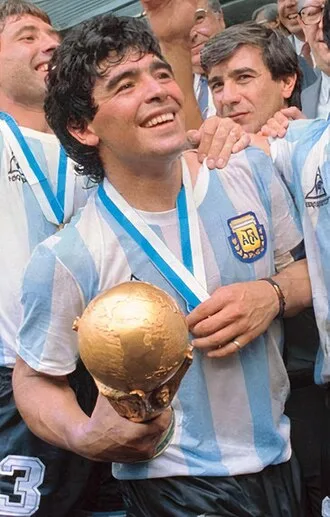
In his international career with Argentina, Maradona earned 91 caps and scored 34 goals. He played in four editions of the FIFA World Cup, including the 1986 World Cup, where he led Argentina to victory as captain and won the Golden Ball as the tournament's best player. In the 1986 World Cup quarter final, he scored both goals in a 2–1 victory over England.
His first goal was an unpenalized handling foul known as the "Hand of God", while his second goal came after a 60-metre (66 yd) dribble past five England players; it was voted "Goal of the Century" by FIFA.com voters in 2002.
Maradona became the manager of the Argentina national team in November 2008, and departed after the 2010 World Cup. He coached the United Arab Emirates (UAE) club Al Wasl during the 2011–12 season, and was the chairman of the Belarusian club Dynamo Brest for several months in 2018. He also coached the UAE club Fujairah (2017–2018), the Mexican club Dorados (2018–2019) and the Argentine club Gimnasia de La Plata (2019–2020). Maradona died on 25 November 2020.
Early life
Maradona was born on 30 October 1960, at the Policlínico Evita Hospital in Lanús, Buenos Aires Province, to a poor Roman Catholic family. He was raised in Villa Fiorito, a shantytown on the southern outskirts of Buenos Aires. His father, also named Diego Maradona, worked at a chemicals factory. His mother, Dalma Salvadora Franco, was of Italian and Croatian descent.
Maradona's parents grew up in Esquina in the north-east province of Corrientes, and moved to Buenos Aires in the 1950s. Maradona's two younger brothers, Hugo and Raúl, both became professional footballers. He also had four older sisters.
Maradona received his first football as a gift at age three and quickly became devoted to the game. At age eight, he was spotted by a talent scout while he was playing at Estrella Roja, his local club. In March 1969, Maradona was recommended to Los Cebollitas (The Little Onions), the junior team of Buenos Aires's Argentinos Juniors club, by his friend Gregorio Carrizo, who had already been recruited by coach Francis Gregorio Cornejo.
Cornejo later remarked that the eight-year-old Maradona played football like an adult. Maradona became a star for the Cebollitas, and as a 12-year-old ball boy he entertained spectators with his ball skills during the halftime breaks of Argentinos Juniors' first division games. During 1973 and 1974, Maradona led the Cebollitas to two Evita Tournament victories and 141 undefeated games in a row, playing alongside Adrian Domenech and Claudio Rodríguez on what is regarded as the best youth team in the history of Argentine football.
Maradona named Brazilian playmaker Rivellino and Manchester United winger George Best among his inspirations growing up.
Club career
Argentinos Juniors
On 20 October 1976, Maradona made his professional debut for Argentinos Juniors, ten days before his 16th birthday. He became the youngest player in the history of the Argentine Primera División, and entered the match against Talleres de Córdoba wearing the number 16 jersey. A few minutes into the match, Maradona kicked the ball through the legs of Juan Domingo Cabrera, a nutmeg that would become symbolic of his talent.
After the game, Maradona said: "That day I felt I had held the sky in my hands." Thirty years later, Cabrera recalled Maradona's debut: "I was on the right side of the field and went to press him, but he didn't give me a chance. He made the nutmeg and when I turned around, he was far away from me."
Maradona scored his first two goals as a professional against the Marplatense club San Lorenzo on 14 November 1976, two weeks after turning 16. He made 11 appearances in his debut season. During the 1977 season, he scored 19 goals in 49 matches, and began to attract the attention of other South American clubs. In the 1978 season, he scored 26 goals in 35 matches; to the surprise of many, he was not selected for the 1978 World Cup by coach César Luis Menotti.
In 1979, Maradona scored 26 goals in 26 games, and finished as the top scorer in both the Metropolitan and Nacional tournaments. In 1980, he scored 43 goals in 45 appearances and was the top scorer during four consecutive tournaments. In total, Maradona spent five years at Argentinos Juniors, scoring 115 goals in 167 appearances.
Boca Juniors
Maradona completed a US$4-million transfer to the Argentine club Boca Juniors in February 1981. He had received offers from other clubs, including River Plate, which offered to make him their highest paid player. However, River ultimately dropped their bid due to their large payroll and desire to retain Daniel Passarella and Ubaldo Fillol.
Maradona made his debut for Boca on 22 February against Talleres de Córdoba, scoring twice in a 4–1 win. On 10 April, he played his first Superclásico against River Plate at La Bombonera stadium. Boca defeated River 3–0 with Maradona scoring once. Despite the distrustful relationship between Maradona and Boca Juniors manager Silvio Marzolini, Boca won the 1981 league title.
Barcelona
In 1982, Maradona transferred to Barcelona for a then-world record fee of £5 million ($7.6 million). According to Barcelona player Lobo Carrasco, Maradona’s teammates were so amazed by his ball control that they simply stood by and watched him dribble during an early training session. During the 1982–83 season, under coach César Luis Menotti, Barcelona won the Copa del Rey and the Copa de la Liga, defeating their longtime rivals Real Madrid in both tournaments.
In the final of the Copa del Rey, Maradona assisted Víctor Muñoz's goal in a 2–1 win. In the first leg of the Copa de la Liga finals at Estadio Santiago Bernabéu in Madrid, he assisted Carrasco's goal and then scored one himself as the game ended in a 2–2 draw. Maradona became the first Barcelona player to receive a standing ovation at the Bernabéu.
Three days later, Barcelona won the second leg against Real Madrid 2–1, with Maradona scoring from a penalty kick. In September 1983, a tackle by Andoni Goikoetxea of Athletic Bilbao caused a fracture in Maradona's left ankle.
During the 1984 Copa del Rey Final against Athletic Bilbao in Madrid, Bilbao fans taunted Maradona with racist insults related to his father's Indigenous ancestry. After receiving another rough tackle from Goikoetxea and being confronted by Bilbao's Miguel Sola after Barcelona lost 1–0, Maradona headbutted Sola. He then elbowed a Bilbao player in the face and kneed another in the head, knocking him unconscious.
Goikoetxea kicked Maradona in the chest, and a brawl ensued between the Barcelona and Bilbao squads. The brawl played out in front of King Juan Carlos of Spain and 100,000 spectators in the stadium, with more than half of Spain watching on television. Spectators began throwing objects at players, coaches and photographers, and sixty people were injured.
It was the final Barcelona game for Maradona, who was known for his disputes with Barcelona executives, particularly club president Josep Lluís Núñez. Following the brawl, Maradona was transferred to the Italian club Napoli for £6.9 million ($10.48 million), another world record fee at the time. During Maradona's two seasons at Barcelona, he scored 38 goals in 58 appearances.
Napoli
On 5 July 1984, Maradona was presented as a Napoli player in front of 75,000 spectators at the Stadio San Paolo in Naples, Italy. Sports journalist David Goldblatt wrote that Napoli fans viewed Maradona as a "saviour". A local newspaper wrote that although Naples lacked a "mayor, houses, schools, buses, employment and sanitation, none of this matters because we have Maradona".
Prior to Maradona's arrival, Italian football was dominated by teams from the north and centre of the country, such as AC Milan, Juventus, Inter Milan and Roma, and no team in the south of the Italian Peninsula had ever won a league title. When Maradona joined Napoli, the club was facing relegation from the top-tier Serie A league.
Maradona soon inherited the captain's armband from Napoli veteran defender Giuseppe Bruscolotti, and quickly became an adored star among the club's fans; in his time there he elevated the team to the most successful era in its history.[citation needed] Maradona played for Napoli at a period when north–south tensions in Italy were at a peak due to a variety of issues, notably the economic differences between the two.
Led by Maradona, Napoli won their first ever Serie A Championship in 1986–87. Goldblatt described the celebrations in Naples as "a round-the-clock carnival which ran for over a week". Murals of Maradona were painted on the city's ancient buildings, and newborn children were named after him. The same year, Napoli won the 1987 Coppa Italia final 4–0 on aggregate against Atalanta, with Maradona assisting Ciro Muro's goal in a 3–0 home victory in the first leg.
In total, Maradona scored seven goals in ten matches during the competition. Shortly before the 1986 World Cup, he appeared for Tottenham Hotspur in a testimonial match for Osvaldo Ardiles against Internazionale.
The following season, the team's prolific attacking trio, formed by Maradona, Bruno Giordano, and Careca, was later dubbed the "Ma-Gi-Ca" (magical) front-line. Despite the team's failing to defend their league title, losing out to AC Milan after a collapse in the final four matches, Maradona was the Serie A top scorer in the 1987–88 season with 15 goals, and was the all-time leading goalscorer for Napoli, with 115 goals, until his record was broken by Marek Hamšík in 2017.
He was also the top scorer for that season's Coppa Italia, scoring six goals, despite being eliminated in the quarter-finals by Torino, with Maradona's two goals in the second leg not enough to prevent the elimination. In the 1988–89 season, Napoli finished runner-up in the league and in the Coppa Italia, losing on aggregate to Sampdoria in the final; in the first leg, Maradona assisted Alessandro Renica's goal in a 1–0 home win, but Napoli were defeated 4–0 in the second leg.
However the team avenged these runner-up finishes with the UEFA Cup title, won over two legs in the final against Stuttgart. During the second leg of the quarterfinals against rivals Juventus, Maradona scored a penalty, and Napoli eventually qualified to the next round after extra time. During the first leg of the finals, Maradona scored from a penalty in a 2–1 home victory and later assisted Careca's match-winning goal, while in the second leg on 17 May—a 3–3 away draw—he assisted Ciro Ferrara's goal with a header.
Napoli would win their second league title in 1989–90, with Maradona setting-up Marco Baroni's goal in a 1–0 home over Lazio on the final match-day, which saw them clinch the title; the team later won the 1990 Italian Supercup the following season, beating rivals Juventus 5–1, with Maradona setting up Massimo Crippa's goal. When asked who was the toughest player he ever faced, AC Milan central defender Franco Baresi stated it was Maradona, a view shared by his Milan teammate Paolo Maldini.
Although Maradona was successful on the field during his time in Italy, his personal problems increased. His cocaine use continued, and he received US$70,000 in fines from his club for missing games and practices, ostensibly because of "stress". He faced a scandal there regarding an illegitimate son, and he was also the object of some suspicion over an alleged friendship with the Camorra crime syndicate.
He also faced intense backlash and harassment from some local fans after the 1990 World Cup, in which he and Argentina beat Italy in a semi-final match at the San Paolo stadium.
In 2000, the number 10 jersey of Napoli was officially retired, but in 2011, Maradona stated that he wanted Ezequiel Lavezzi to use it. In a poll on Il Mattino, 54% of fans voted to keep the shirt retired, and the change ultimately did not occur. On 4 December 2020, nine days after Maradona's death, Napoli's home stadium was renamed Stadio Diego Armando Maradona.
Late career
After serving a 15-month ban for failing a drug test for cocaine, Maradona left Napoli in 1992. Despite interest from Real Madrid and Marseille, he signed for Sevilla, where he stayed for one year. In 1993, he played for Newell's Old Boys and in 1995 he returned to Boca Juniors for two years. In 1996, he played in a friendly match for Toronto Italia alongside his brother Raul, against the Canadian National Soccer League All-Stars.
In 2000, Maradona captained Bayern Munich against the German national team in a farewell exhibition game for Lothar Matthäus. Maradona was himself given a testimonial match on 10 November 2001, played between an all-star World XI team and the Argentina national team at La Bombonera. Maradona scored twice from penalty kicks during his team's 6–3 victory.
International career
Debut at age 16
Maradona made his full international debut at age 16, against Hungary, on 27 February 1977, only four months after his professional debut for Argentinos Juniors.
He was left off the Argentine squad for the 1978 World Cup on home soil by coach César Luis Menotti who felt he was too young at age 17. On 3 November 1978, just a few days after turning 18, Maradona played for the U20 Argentina team in a friendly match against Franz Beckenbauer's New York Cosmos, scoring twice in a 2–1 win.
1979 World Youth Championship and Copa América
At age 18, Maradona played the 1979 FIFA World Youth Championship in Japan and emerged as the star of the tournament, shining in Argentina's 3–1 final win over the Soviet Union, scoring a total of six goals in six appearances in the tournament. On 2 June 1979, Maradona scored his first senior international goal in a 3–1 win against Scotland at Hampden Park.
He went on to play for Argentina in two 1979 Copa América ties during August 1979, a 2–1 loss against Brazil and a 3–0 win over Bolivia in which he scored his side's third goal. Speaking thirty years later on the impact of Maradona's performances in 1979, FIFA President Sepp Blatter stated, "Everyone has an opinion on Diego Armando Maradona, and that's been the case since his playing days.
My most vivid recollection is of this incredibly gifted kid at the second FIFA U-20 World Cup in Japan in 1979. He left everyone open-mouthed every time he got on the ball." Maradona and his compatriot Lionel Messi are the only players to win the Golden Ball at both the FIFA U-20 World Cup and FIFA World Cup. Maradona did so in 1979 and 1986, which Messi emulated in 2005 and 2014 (and again in 2022).
Maradona appeared at the 1979 Copa América, where Argentina had a poor performance, being knocked out in the first round. Maradona exited the tournament having scored once in a 3–0 victory against Bolivia.
1982 FIFA World Cup
Maradona played his first World Cup tournament in 1982 in his new country of residence, Spain. Argentina played Belgium in the opening game of the 1982 Cup at the Camp Nou in Barcelona. Maradona did not perform to expectations, as Argentina, the defending champions, lost 1–0. Although the team convincingly beat both Hungary and El Salvador in Alicante to progress to the second round, there were internal tensions within the team, with the younger, less experienced players at odds with the older, more experienced players.
With a team that also included such players as Mario Kempes, Osvaldo Ardiles, Ramón Díaz, Daniel Bertoni, Alberto Tarantini, Ubaldo Fillol and Daniel Passarella, the Argentine side was defeated in the second round by Brazil and by eventual winners Italy. The Italian match is renowned for Maradona being aggressively man-marked by Claudio Gentile, as Italy beat Argentina at the Sarrià Stadium in Barcelona, 2–1.
Maradona played in all five matches without being substituted, scoring twice against Hungary. He was fouled repeatedly in all five games and particularly in the last one against Brazil at the Sarrià, a game that was blighted by poor officiating and violent fouls. With Argentina already down 3–0 to Brazil, Maradona's temper eventually got the better of him and he was sent off with five minutes remaining for a serious retaliatory foul against Batista.
1986 FIFA World Cup
Maradona captained Argentina to victory at the 1986 World Cup in Mexico. He played every minute of every Argentina game, scoring five goals and serving five assists. His first three assists came in Argentina's opening match, a 3–1 win over South Korea. His first goal of the tournament came in a 1–1 draw against Italy in the second group match.
In the final group match, Maradona assisted Jorge Burruchaga's goal in a 2–0 win over Bulgaria. Argentina defeated Uruguay 1–0 in the first knockout round, a match that Maradona described as his best performance of the tournament.
Argentina's quarter-final match against England was played four years after the Falklands War, a conflict between Argentina and the United Kingdom. Argentina won the match 2–1, with Maradona scoring two goals. He scored the first goal by striking the ball with his hand. After the match, Maradona said the goal was scored "a little with the head of Maradona and a little with the hand of God".
The goal, which had been allowed to stand by the referee, became known as the "Hand of God". In 2005, Maradona admitted that he had hit the ball with his hand on purpose, that his head did not touch the ball, and that he immediately knew the goal was illegitimate.