Dustin Hoffman
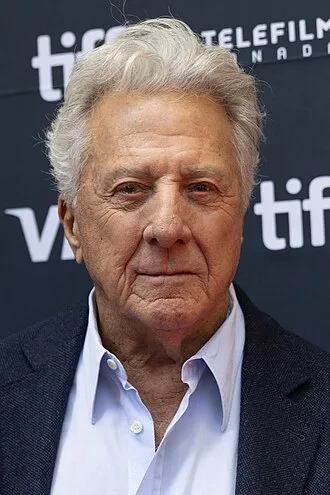
Hoffman studied at the Los Angeles Conservatory of Music before he decided to go into acting, for which he trained at the Pasadena Playhouse. He made his film debut with the black comedy The Tiger Makes Out (1967). He went on to receive two Academy Awards for Best Actor playing a man going through a divorce in Kramer vs.
Kramer (1979) and an autistic savant in Rain Man (1988). He was Oscar-nominated for The Graduate (1967), Midnight Cowboy (1969), Lenny (1974), Tootsie (1982), and Wag the Dog (1997). Other notable roles include in Little Big Man (1970), Straw Dogs (1971), Papillon (1973), Marathon Man (1976), All the President's Men (1976), Ishtar (1987), Dick Tracy (1990), Hook (1991), and Chef (2014).
In the 21st century, Hoffman mostly transitioned to supporting roles in films such as Finding Neverland (2004), I Heart Huckabees (2004), and Stranger than Fiction (2006), as well as Meet the Fockers (2004) and its sequel Little Fockers (2010), The Meyerowitz Stories (2017), and Megalopolis (2024).
Hoffman has voiced roles in The Tale of Despereaux (2008) and the Kung Fu Panda film series (2008–present). In 2012, he made his directorial debut with Quartet.
Hoffman made his Broadway debut in the 1961 play A Cook for Mr. General. He subsequently starred as Willy Loman in the 1984 revival of Death of a Salesman and reprised the role a year later in a television film, earning a Primetime Emmy Award for Outstanding Actor in a Limited Series or Movie. In 1989, he received a Tony Award for Best Actor in a Play nomination for his role as Shylock in The Merchant of Venice.
He has received three Drama Desk Awards, for his performances in Eh? (1967), Jimmy Shine (1969), and Death of a Salesman (1984), respectively.
Early life and education
Dustin Lee Hoffman was born in Los Angeles, California on August 8, 1937. He is the younger of two sons of Harry Hoffman (1907–1990) and Lillian (née Gold; 1909–1982). His father worked as a prop supervisor (set decorator) at Columbia Pictures before becoming a furniture salesman.
Hoffman was named after stage and silent screen actor Dustin Farnum. He has an elder brother Ronald, who is a lawyer and economist. Hoffman is Jewish, from an Ashkenazi Jewish family of immigrants from Kiev, Russian Empire, and Iași, Romania. The family's surname was spelled Гойхман (Goikhman) in Russia.
His upbringing was nonreligious, and he has said, "I don't have any memory of celebrating holidays growing up that were Jewish", and that he had "realized" he was Jewish at around the age of 10.
Hoffman graduated from Los Angeles High School in 1955 and enrolled at Santa Monica College with the intention of studying medicine. But he decided to become an actor, and left in the following year to join the Pasadena Playhouse, although when he told his family about his career goal, his Aunt Pearl warned him, "You can't be an actor.
You are not good-looking enough." He also studied with Lee Strasberg and has stated that he did not study with either Sanford Meisner or Stella Adler.
Hoffman initially hoped to become a classical pianist, having studied piano during much of his youth and in college. While at Santa Monica College, he also took an acting class, which he assumed would be easy, and "caught the acting bug". He recalls: "I just was not gifted in music. I did not have an ear." Once his aspirations shifted to acting, he spent the following ten years doing odd jobs, being unemployed, and struggling to get any available acting roles, a lifestyle he was later to portray in the comedy film Tootsie. Hoffman composed a song called "Shooting the Breeze", alongside Bette Midler who wrote the words.
Career
1960–1966: Early theatre roles
Hoffman's first acting role was at the Pasadena Playhouse, alongside future Academy Award–winner Gene Hackman. After two years there, Hackman headed for New York City, with Hoffman soon following. Hoffman, Hackman, and Robert Duvall lived together in the 1960s, whilst all three of them focused on finding acting jobs.
Hackman remembers, "The idea that any of us would do well in films simply didn't occur to us. We just wanted to work". Hoffman's appearance—Duvall described him as Barbra Streisand in drag—and small size made him uncastable, Vanity Fair later wrote. During this period, Hoffman got occasional television bit parts, including commercials but, needing income, he briefly left acting in order to teach.
Hoffman studied at the Actors Studio and became a dedicated method actor. In 1960, Hoffman was cast in a role in an off-Broadway production and followed with a bit part in his Broadway debut in production, A Cook for Mr. General (1961). In 1962, he appeared in Rabbit Run Theatre's summer stock production of Write Me a Murder in Madison, Ohio and served as an assistant director to Ulu Grosbard on The Days and Nights of BeeBee Fenstermaker at off-Broadway's Sheridan Square Playhouse.
In 1964, Hoffman appeared in Three Men on a Horse at Princeton's McCarter Theatre and in 1965, in off-Broadway's Harry, Noon and Night with Joel Grey. On June 23, 1965, he played Mendy in a practice run of Philip Roth's abandoned off-Broadway play The Nice Jewish Boy, directed by Gene Saks and co-starring Melinda Dillon.
Grosbard and Hoffman reunited for a 1965 recording of Death of a Salesman starring Lee J. Cobb and Mildred Dunnock, with Hoffman playing Bernard. He was assistant director for Grosbard's 1965 off-Broadway production of A View from the Bridge starring Robert Duvall and Jon Voight, and in late 1965 stage-managed and appeared in Grosbard's The Subject Was Roses on Broadway.
Hoffman's "sharply outlined and vividly colored" performance in off-Broadway's The Journey of the Fifth Horse in April 1966 was followed by another critical success in the play Eh?, by Henry Livings, which had its U.S. premiere at the Circle in the Square Theatre on October 16, 1966. Sidney W. Pink, a producer and 3D-film pioneer, discovered Hoffman in one of his off-Broadway roles and cast him in Madigan's Millions.
Through the early and mid-1960s, Hoffman made appearances in television shows and films, including Naked City, The Defenders, and Hallmark Hall of Fame.
Hoffman starred in the 1966 off-Broadway play Eh?, for which he received a Drama Desk Award. He made his film debut in The Tiger Makes Out alongside Eli Wallach in 1967. That sane year, immediately after wrapping up principal filming on The Tiger Makes Out, Hoffman travelled from New York City to Fargo, North Dakota, where he directed productions of William Gibson's Two for the Seesaw and William Saroyan's The Time of Your Life for the Fargo-Moorhead Community Theatre.
The $1,000 he received for the eight-week contract was all he had to hold him over until the funds from the film materialized.[citation needed]
1967–1969: The Graduate and breakthrough
Director Mike Nichols auditioned Hoffman in 1966 for a lead role in the Broadway musical The Apple Tree but rejected him because he could not sing well enough, and gave Alan Alda the part. However, Nichols was so impressed with Hoffman's overall audition that he cast him as the male lead in the film The Graduate (1967).
The role was that of Benjamin Braddock, a recent college graduate who has an affair with Mrs. Robinson, the wife of his father's law partner. It was Hoffman's first major role; he received an Academy Award nomination for it, but lost to Rod Steiger for In the Heat of the Night.
Although David Zeitlin joked in Life magazine that "if Dustin Hoffman's face were his fortune, he'd be committed to a life of poverty", The Graduate was a gigantic box office hit for Embassy Pictures, making Hoffman a major new star at the same time. The film received near-unanimous good reviews. Time magazine called Hoffman "a symbol of youth" who represented "a new breed of actors".
The film's screenwriter, Buck Henry, notes that Hoffman's character made conventional good looks no longer necessary on screen, "A whole generation changed its idea of what guys should look like. ... I think Dustin's physical being brought a sort of social and visual change, in the same way people first thought of Bogart.
They called him ugly". Hoffman's success amazed friends from his early years as an actor, who told him "You were the last one I expected to make it". Biographer Jeff Lenburg wrote that "newspapers across the country were deluged with thousands of letters from fans", with one example published in The New York Times: "I identified with Ben. ...
I thought of him as a spiritual brother. He was confused about his future and about his place in the world, as I am. It's a film one digs, rather than understands intellectually".
Turner Classic Movies critic Rob Nixon notes that Hoffman represented "a new generation of actors". He credits Hoffman with breaking "the mold of the traditional movie star and brought to their roles a new candor, ethnicity, and eagerness to dive deep into complex, even unlikable characters." Nixon expands on the significance of the film to Hoffman's career: "In The Graduate, he created a lasting resonance as Ben Braddock that made him an overnight sensation and set him on the road to becoming one of our biggest stars and most respected actors." Hoffman, however, mostly credits director Mike Nichols for taking a great risk in giving him, a relative unknown, the starring role: "I don't know of another instance of a director at the height of his powers who would take a chance and cast someone like me in that part. It took tremendous courage."
Critic Sam Kashner observed strong similarities between Hoffman's character and that of Nichols when he previously acted with Elaine May in the comedy team of Nichols and May. "Just close your eyes and you'll hear a Mike Nichols—Elaine May routine in any number of scenes." Buck Henry also noticed that "Dustin picked up all these Nichols habits, which he used in the character.
Those little noises he makes are straight from Mike", he says. After completing The Graduate Hoffman turned down most of the film roles offered to him, preferring to go back to New York and continue performing in live theater. He returned to Broadway to appear in the title role of the musical Jimmy Shine.
Hoffman won a Drama Desk Award for Outstanding Performance. "I was a theater person. That's how my friends were, too, Gene Hackman and Bobby Duvall. I wasn't going to be a movie star. I wasn't going to sell out. We wanted to be really good actors. I told them, "I'm going out to make this movie. Don't worry, I'm coming right back."
Hoffman was paid $20,000 for his role in The Graduate, but netted just $4,000 after taxes and living expenses. After spending that money, Hoffman filed for New York State unemployment benefits, receiving $55 per week while living in a two-room apartment in the West Village of Manhattan. He was offered the leading role in Midnight Cowboy (1969), which he accepted partly to prove many critics were wrong about his acting range and the variety of characters he could portray.
Peter Biskind wrote, "it was the very contrast between his preppy character in The Graduate, and Ratso Rizzo" that appealed to Hoffman. 'I had become troubled,' recalls Hoffman, 'by the reviews that I read of The Graduate, that I was not a character actor, which I like to think of myself as. It hurt me. Some of the stuff in the press was brutal.'" Critics assumed that director Mike Nichols got lucky by finding a typical actor with average acting ability to play the part of Benjamin Braddock.
John Schlesinger, who would direct Midnight Cowboy and was seeking Hoffman lead actors, held that same impression. Hoffman's performance as a button-down college graduate and track star was so convincing to Schlesinger, "he seemed unable to comprehend the fact that he was acting", notes Biskind. To help the director, whom he had never met, overcome that false impression, Hoffman met him in Times Square dressed as a homeless person, wearing a dirty raincoat, his hair slicked back and with an unshaven face.
Schlesinger was sold, admitting, "I've only seen you in the context of The Graduate, but you'll do quite well." Midnight Cowboy premiered in theaters across the United States in May 1969. For his acting, Hoffman received his second Oscar nomination and the film won Best Picture. In 1994, Hoffman described the film which was deemed "culturally, historically, or aesthetically significant" by the Library of Congress and selected for preservation in the United States National Film Registry. Biskind considers Hoffman's acting a major accomplishment:
Midnight Cowboy makes us a gift of one of the landmark performances of movie history: Dustin Hoffman's Ratso Rizzo, with Jon Voight's Joe Buck a close second. From a cesspool of dark, foul, even taboo material, ... it rescues a true humanism that need not hide its name.
Also in 1969, Hoffman co-starred with Mia Farrow in Peter Yates's romantic drama film John and Mary. He received a 1970 British Academy Film Award for Best Actor for his performance in the film, although the film received mixed reviews. He was also nominated for a Golden Globe Award for Best Actor in a Musical or Comedy Motion Picture The film was made soon after the success of Farrow's performance in Roman Polanski's Rosemary's Baby (1968), and Hoffman's performance in The Graduate, which prompted their being hailed on the cover of the February 27, 1969, Time magazine as stars of their generation.
1970–1979: Film stardom and acclaim
This was followed by his role in Little Big Man (1970), where Jack Crabb, his character, ages from teenager to a 121-year-old man. The film was widely praised by critics, but was overlooked for an award except for a supporting nomination for Chief Dan George. Hoffman continued to appear in major films over the next few years. Who Is Harry Kellerman and Why Is He Saying Those Terrible Things About Me? (1971), Straw Dogs (also 1971), and Papillon (1973).
He returned to Broadway in 1974, directing All Over Town. Hoffman next starred in Lenny (1974), for which he was again nominated for Best Actor. Lenny was based on the life of stand-up comedian Lenny Bruce, who died at the age of 40, and was known for his open, free-style and critical form of comedy which integrated politics, religion, sex, and vulgarity.
Expectations were high that Hoffman would win an Oscar for his portrayal, especially after his similar role in Midnight Cowboy. Film critic Katharine Lowry speculates that director Bob Fosse "never gave him a chance" to go far enough into developing the character. "We never understand what, besides the drugs he injected, made him tick like a time bomb", she says.
However, notes author Paul Gardner, "directing Lenny, his most ambitious project, exhausted Fosse emotionally and physically. It turned his life inside out", with shooting days often lasting 10 to 12 hours: "The Lenny Bruce project, based on Julian Barry's play, had gone through two studios and three scripts, and was a problem child, like Lenny himself.
But Fosse wanted to do it, and he wanted Dustin Hoffman". Hoffman initially turned the part down, saying: "I didn't think the script was strong enough and I wasn't sure I was the one to play the role." While considering the part, he read Lenny Bruce's autobiography and looked at films with Bruce performing stand-up to live audiences.
In the same interview with Playboy he recounted: "I began to feel an affinity with him, a realization that there was a lot of Lenny Bruce in me. My wife felt it too ... I realized that I'd have to make use of my own spontaneity because he was so spontaneous. And I admired his guts ... That intimacy is what an actor tries to get ...
It occurred to me that if I had known him, I would have wanted us to be friends ... and he was a provocateur, and I love to provoke." Movie critic Judith Crist gave Hoffman credit for the ultimate success of the film:
What is important is that Bruce's routines are so artfully reconstructed, the juice of his creativity so carefully strained, that the claim to genius is justified. And for that Dustin Hoffman deserves full credit, vanishing into the Bruce persona to simply stunning effectiveness,… Hoffman captures the restlessness, the velocity of a man's mouth straining to keep pace with a jet-propelled intelligence…
Lenny was nominated for six Academy Awards, including Best Picture, Best Director, Best Actor, Best Actress, Best Adapted Screenplay, and Best Cinematography.
All the President's Men (1976) was made less than two years after the Watergate scandal, and starred Hoffman and Robert Redford as the real-life journalists, Carl Bernstein and Bob Woodward, respectively. Based on actual events, Hoffman and Redford play Washington Post reporters who uncover a break-in at the Watergate Hotel and end up investigating a political scandal that reaches all the way to the presidency.
The film, as earlier ones, had Hoffman take on a dramatically different character than his previous one (as Lenny Bruce), although both men, Bruce and Bernstein, set their faces against abuses of institutional power, and the tendency for society to ignore such abuses. Author James Morrison compares the two roles: "As Lenny Bruce in Lenny (1974), Hoffman plays a martyr to the cause of establishment oppression, while in All the President's Men, he plays a reporter exposing presidential malfeasance."
Vincent Canby of The New York Times described the film as "a spellbinding detective story". "The strength of the movie", he added, was "the virtually day-to-day record of the way Bernstein and Woodward conducted their investigations." The characters portrayed by Hoffman and Redford shared the rank of No. 27 Hero on AFI's 100 Years... 100 Heroes and Villains list, while Entertainment Weekly ranked All the President's Men as one of the 25 "Powerful Political Thrillers".
Hoffman next starred in Marathon Man (1976), a film based on William Goldman's novel of the same name, opposite Laurence Olivier and Roy Scheider. Its director, John Schlesinger also directed Hoffman in Midnight Cowboy in 1969. Described as "Schlesinger's thriller", by author Gene D. Phillips, Hoffman plays the hero, Babe Levy, a part-time long-distance runner and graduate student, who suddenly finds himself being pursued by a fugitive Nazi.
To put himself in the mindset of someone under severe emotional distress, Hoffman did not sleep for days at a time and let his body become disheveled and unhealthy. Olivier was alarmed when Hoffman turned up on set for the dental torture scene. Hoffman explained what he had done, and Olivier replied: "My dear boy, have you ever tried simply acting? It's much easier."
Goldman describes his inspiration for the novel: "What if someone close to you was something totally different from what you thought? In the story, Hoffman thinks his brother (Roy Scheider) is a businessman where the reality is that the man is a spy, who has been involved with the Nazi, Szell." However, Hoffman remembers a serious disagreement he had with Goldman, who also wrote the screenplay, about how the story ends:
📚 Source: Wikipedia