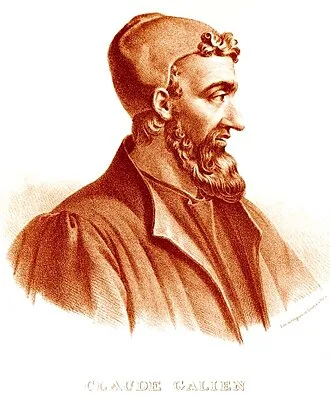
The son of Aelius Nicon, a wealthy Greek architect with scholarly interests, Galen received a comprehensive education that prepared him for a successful career as a physician and philosopher. Born in the ancient city of Pergamon (present-day Bergama, Turkey), Galen traveled extensively, exposing himself to a wide variety of medical theories and discoveries before settling in Rome, where he served prominent members of Roman society and eventually was given the position of personal physician to several emperors.
Galen's understanding of anatomy and medicine was principally influenced by the contemporary theory of the four humors: black bile, yellow bile, blood, and phlegm, as first advanced by the author of On the Nature of Man in the Hippocratic corpus. Galen's views dominated and influenced Western medical science for more than 1,300 years.
His anatomical reports were based mainly on the dissection of Barbary apes. However, while dissections and vivisections on humans were practiced in Alexandria by Herophilus and Erasistratus in the 3rd century BCE under Ptolemaic permission, by Galen's time these procedures were strictly forbidden in the Roman Empire. As Galen discovered that the facial expressions of the Barbary apes were particularly vivid, Galen switched to pigs for his research to avoid prosecution.
Aristotle had used pigs centuries earlier for his study of anatomy and physiology. Galen, like others, reasoned that animal anatomy had a strong consilience with that of humans. Galen would encourage his students to go look at dead gladiators or bodies that washed up in order to get better acquainted with the human body.
Galen's theory of the physiology of the circulatory system remained unchallenged until c. 1242, when Ibn al-Nafis published his book Sharh tashrih al-qanun li' Ibn Sina (Commentary on Anatomy in Avicenna's Canon), in which he reported his discovery of pulmonary circulation. His anatomical reports remained uncontested until 1543, when printed descriptions and illustrations of human dissections were published in the seminal work De humani corporis fabrica by Andreas Vesalius, where Galen's physiological theory was accommodated to these new observations.
Galen saw himself as both a physician and a philosopher, as he wrote in his treatise titled That the Best Physician Is Also a Philosopher. Galen was very interested in the debate between the rationalist and empiricist medical sects, and his use of direct observation, dissection, and vivisection represents a complex middle ground between the extremes of those two viewpoints.
Many of his works have been preserved or translated from the original Greek, although many were destroyed and some credited to him are believed to be spurious. Although there is some debate over the date of his death, he was no younger than seventy when he died.
Biography
Galen's Greek name Γαληνός (Galēnós) comes from the adjective γαληνός (galēnós) 'calm'. Galen's Latin name (Aelius or Claudius) implies he had Roman citizenship.
Galen describes his early life in On the affections of the mind. He was born in September 129 CE. His father, Aelius Nicon, was a wealthy patrician, an architect and builder, with eclectic interests including philosophy, mathematics, logic, astronomy, agriculture and literature. Galen describes his father as a "highly amiable, just, good and benevolent man".
At that time Pergamon (modern-day Bergama, Turkey) was a major cultural and intellectual centre, noted for its library, second only to that in Alexandria, as well as being the site of a large temple to the healing god Asclepius. The city attracted both Stoic and Platonic philosophers, to whom Galen was exposed at the age of 14.
His studies also took in each of the principal philosophical systems of the time, including Aristotelian and Epicurean. His father had planned a traditional career for Galen in philosophy or politics and took care to expose him to literary and philosophical influences. However, Galen states that in around 145 his father had a dream in which the god Asclepius appeared and commanded Nicon to send his son to study medicine.
Medical education
Following his earlier liberal education, Galen at age 16 began his studies at the prestigious local healing temple or asclepeion as a θεραπευτής (therapeutes, or attendant) for four years. There he came under the influence of men like Aeschrion of Pergamon, Stratonicus and Satyrus. Asclepiea functioned as spas or sanitoria to which the sick would come to seek the ministrations of the priesthood.
Romans frequented the temple at Pergamon in search of medical relief from illness and disease. It was also the haunt of notable people such as the historian Claudius Charax, the orator Aelius Aristides, the sophist Polemo, and the consul Cuspius Rufinus.
Galen's father died in 148, leaving Galen independently wealthy at the age of 19. He then followed the advice he found in Hippocrates' teaching and traveled and studied widely including such destinations as Smyrna (now İzmir), Corinth, Crete, Cilicia (now Çukurova), Cyprus, and finally the great medical school of Alexandria, exposing himself to the various schools of thought in medicine.
In 157, aged 28, he returned to Pergamon as physician to the gladiators of the High Priest of Asia, one of the most influential and wealthy men in Asia. Galen claims that the High Priest chose him over other physicians after he eviscerated an ape and challenged other physicians to repair the damage. When they refused, Galen performed the surgery himself and in so doing won the favor of the High Priest of Asia.
Over his four years there, he learned the importance of diet, fitness, hygiene, and preventive measures, as well as living anatomy, and the treatment of fractures and severe trauma, referring to their wounds as "windows into the body". Only five deaths among the gladiators occurred while he held the post, compared to sixty in his predecessor's time, a result that is in general ascribed to the attention he paid to their wounds. At the same time he pursued studies in theoretical medicine and philosophy.
Rome
Galen went to Rome in 162 and made his mark as a practicing physician. His public demonstrations and impatience with alternative views on medicine brought him into conflict with other doctors practicing in the city. When the Peripatetic philosopher Eudemus became ill with quartan fever, Galen felt obliged to treat him "since he was my teacher and I happened to live nearby".
He wrote: "I return to the case of Eudemus. He was thoroughly attacked by the three attacks of quartan ague, and the doctors had given him up, as it was now mid-winter." Some Roman physicians criticized Galen for his use of the prognosis in his treatment of Eudemus. This practice conflicted with the then-current standard of care, which relied upon divination and mysticism.
Galen retaliated against his detractors by defending his own methods. Garcia-Ballester quotes Galen as saying: "In order to diagnose, one must observe and reason." This was the basis of his criticism of the doctors who proceeded alogos and askeptos.
However, Eudemus warned Galen that engaging in conflict with these physicians could lead to his assassination. "Eudemus said this, and more to the same effect; he added that if they were not able to harm me by unscrupulous conduct they would proceed to attempts at poisoning. Among other things he told me that, some ten years before, a young man had come to the city and had given, like me practical demonstrations of the resources of our art; this young man was put to death by poison, together with two servants who accompanied him." When Galen's animosity with the Roman medical practitioners became serious, he feared he might be exiled or poisoned, so he left the city.
Rome was engaged in foreign wars in 161; Marcus Aurelius and his then co-Emperor and adoptive brother Lucius Verus were in the north fighting the Marcomanni. During the autumn of 169 when Roman troops were returning to Aquileia, a great plague, most likely one of the first appearances of smallpox (then referred to as the Antonine Plague) in the Mediterranean world, broke out, and the emperor summoned Galen back to Rome.
He was ordered to accompany Marcus and Verus to Germany as the court physician. The following spring Marcus was persuaded to release Galen after receiving a report that Asclepius was against the project. He was left behind to act as physician to the imperial heir Commodus. It was here in court that Galen wrote extensively on medical subjects.
Ironically, Lucius Verus died in 169, and Marcus Aurelius himself died in 180, both victims of the plague.
Galen was the physician to Commodus for much of the emperor's life and treated his common illnesses. According to Dio Cassius 72.14.3–4, in about 189, under Commodus' reign, a pestilence occurred which at its height killed 2,000 people a day in Rome. This was most likely the same plague (the so-called "Antonine Plague" and most likely smallpox) that struck Rome during Marcus Aurelius' reign.
Galen was also physician to Septimius Severus during his reign in Rome. He complimented Severus and Caracalla on keeping a supply of drugs for their friends and mentioned three cases in which they had been of use in 198.
The Antonine Plague
The Antonine Plague was named after Marcus Aurelius' family name of Antoninus. It was also known as the Plague of Galen and held an important place in medicinal history because of its association with Galen. He had first-hand knowledge of the disease, and was present in Rome when it first struck in 166, and was also present in the winter of 168–69 during an outbreak among troops stationed at Aquileia.
He had experience with the epidemic, referring to it as very long lasting, and described its symptoms and his treatment of it. His references to the plague are scattered and brief. Galen was not trying to present a description of the disease so that it could be recognized in future generations; he was more interested in the treatment and physical effects of the disease.
For example, in his writings about a young man afflicted with the plague, he concentrated on the treatment of internal and external ulcerations. According to Niebuhr, "this pestilence must have raged with incredible fury; it carried off innumerable victims. The ancient world never recovered from the blow inflicted upon it by the plague that visited it in the reign of M.
Aurelius." The mortality rate of the plague was 7–10 percent; the outbreak in 165–168 would have caused approximately 3.5 to 5 million deaths. Otto Seeck believes that over half the population of the empire perished. J. F. Gilliam believes that the Antonine plague probably caused more deaths than any other epidemic during the empire before the mid-3rd century.
Although Galen's description is incomplete, it is sufficient to enable a firm identification of the disease as related to smallpox.
Galen notes that the exanthema covered the victim's entire body and was usually black. The exanthem became rough and scabby where there was no ulceration. He states that those who were going to survive developed a black exanthem. According to Galen, it was black because of a remnant of blood putrefied in a fever blister that was pustular.
His writings state that raised blisters were present in the Antonine plague, usually in the form of a blistery rash. Galen states that the skin rash was close to the one Thucydides described. Galen describes symptoms of the alimentary tract via a patient's diarrhea and stools. If the stool was very black, the patient died.
He says that the amount of black stools varied. It depended on the severity of the intestinal lesions. He observes that in cases where the stool was not black, the black exanthema appeared. Galen describes the symptoms of fever, vomiting, fetid breath, catarrh, cough, and ulceration of the larynx and trachea.
Later years
Galen continued to work and write in his final years, finishing treatises on drugs and remedies as well as his compendium of diagnostics and therapeutics, which would have much influence as a medical text both in the Latin Middle Ages and Medieval Islam.
The 11th-century Suda lexicon states that Galen died at the age of 70, which would place his death in about the year 199. However, there is a reference in Galen's treatise "On Theriac to Piso" (which may, however, be spurious) to events of 204. There are also statements in Arabic sources that he died in Sicily at age 87, after 17 years studying medicine and 70 practicing it, which would mean he died about 216.
According to these sources, the tomb of Galenus in Palermo was still well preserved in the tenth century. Nutton believes that "On Theriac to Piso" is genuine, that the Arabic sources are correct, and that the Suda has erroneously interpreted the 70 years of Galen's career in the Arabic tradition as referring to his whole lifespan. Boudon-Millot more or less concurs and favors a date of 216.
Medicine
Galen contributed a substantial amount to the understanding of pathology. Under the Hippocratic bodily humors theory, differences in human moods come as a consequence of imbalances in one of the four bodily fluids: blood, yellow bile, black bile, and phlegm. Galen promoted this theory and the typology of human temperaments.
In Galen's view, an imbalance of each humor corresponded with a particular human temperament (blood – sanguine, black bile – melancholic, yellow bile – choleric, and phlegm – phlegmatic). Thus, individuals with sanguine temperaments are extroverted and social; choleric people have energy, passion, and charisma; melancholics are creative, kind, and considerate; and phlegmatic temperaments are characterised by dependability, kindness, and affection.
Galen was also a skilled surgeon, operating on human patients. Many of his procedures and techniques would not be used again for centuries, such as the procedures he performed on brains and eyes. His surgical experiments included ligating the arteries of living animals. Although many 20th-century historians have claimed that Galen believed the lens to be in the exact center of the eye, Galen actually understood that the crystalline lens is located in the anterior aspect of the human eye.
At first reluctantly but then with increasing vigor, Galen promoted Hippocratic teaching, including venesection and bloodletting, then unknown in Rome. This was sharply criticized by the Erasistrateans, who predicted dire outcomes, believing that it was not blood but pneuma that flowed in the veins. Galen, however, staunchly defended venesection in his three books on the subject and in his demonstrations and public disputations.
Galen's work on anatomy remained largely unsurpassed and unchallenged up until the 16th century in Europe. In the middle of the 16th century, the anatomist Andreas Vesalius challenged the anatomical knowledge of Galen by conducting dissections on human cadavers. These investigations allowed Vesalius to refute aspects of Galen's theories regarding anatomy.
Anatomy
Galen's interest in human anatomy ran afoul of Roman law that prohibited the dissection of human cadavers since roughly 150 BC. Because of this restriction, Galen performed anatomical dissections on living (vivisection) and dead animals, mostly focusing on primates. Galen believed that the anatomical structures of these animals closely mirrored those of humans.
Galen clarified the anatomy of the trachea and was the first to demonstrate that the larynx generates the voice. In one experiment, Galen used bellows to inflate the lungs of a dead animal. Galen's research on physiology was largely influenced by previous works of philosophers Plato and Aristotle, as well as from the physician Hippocrates.
He was one of the first people to use experiments as a method of research for his medical findings. Doing so allowed him to explore various parts of the body and its functions.
Among Galen's major contributions to medicine was his work on the circulatory system. He was the first to recognize that there are distinct differences between venous (dark) and arterial (bright) blood. In addition to these discoveries, Galen postulated much more about the nature of the circulatory system. He believed that blood originated in the liver, which follows the teachings of Hippocrates.
The liver converted nutrients gathered from ingested food into blood to be used in the circulatory system. The blood created in the liver would eventually flow unidirectionally into the right ventricle of the heart via the great vein. Galen also proposed a theory on how blood receives air from the lungs to be distributed throughout the body.
He declared that the venous artery carried air from the lungs into the left ventricle of the heart to mix with created blood from the liver. This same venous artery allowed for an exchange of waste products from the blood back into the lungs to be exhaled. In order to receive air from the lungs in the left ventricle, the new blood needed to get there from the right ventricle.
Thus, Galen asserted that there are small holes in the septum dividing the left and right sides of the heart; these holes allowed the blood to pass through easily to receive air and exchange the aforementioned waste products. Although his anatomical experiments on animal models led him to a more complete understanding of the circulatory system, nervous system, respiratory system, and other structures, his work contained scientific errors.
Galen believed the circulatory system to consist of two separate one-way systems of distribution, rather than a single unified system of circulation. He believed venous blood to be generated in the liver, from where it was distributed and consumed by all organs of the body. He posited that arterial blood originated in the heart, from where it was distributed and consumed by all organs of the body.
The blood was then regenerated in either the liver or the heart, completing the cycle. Galen also believed in the existence of a group of blood vessels he called the rete mirabile in the carotid sinus. Both of these theories of the circulation of blood were later (beginning with works of Ibn al-Nafis published c. 1242) shown to be incorrect.
Galen was also a pioneer in research about the human spine. His dissections and vivisections of animals led to key observations that helped him accurately describe the human spine, spinal cord, and vertebral column. Galen also played a major role in the discoveries of the central nervous system. He was also able to describe the nerves that emerge from the spine, which is integral to his research about the nervous system.
Galen went on to be the first physician to study what happens when the spinal cord is transected on multiple different levels. He worked with pigs and studied their neuroanatomy by severing different nerves either totally or partially to see how it affected the body. He even dealt with diseases affecting the spinal cord and nerves.
In his work De motu musculorum, Galen explained the difference between motor and sensory nerves, discussed the concept of muscle tone, and explained the difference between agonists and antagonists.
Galen's work on animals led to some inaccuracies, most notably his anatomy of the uterus which largely resembled a dog's. Though incorrect in his studies of human reproduction and reproductive anatomy, he came very close to identifying the ovaries as analogous to the male testes. Reproduction was a controversial topic in Galen's lifetime, as there was much debate over if the male was solely responsible for the seed, or if the woman was also responsible.
Through his vivisection practices, Galen also proved that the voice was controlled by the brain. One of the most famous experiments that he recreated in public was the squealing pig: Galen would cut open a pig, and while it was squealing he would tie off the recurrent laryngeal nerve, or vocal cords, showing they controlled the making of sound.
He used the same method to tie off the ureters to prove his theories of kidney and bladder function. Galen believed the human body had three interconnected systems that allowed it to work. The first system that he theorized consisted of the brain and the nerves, responsible for thought and sensation. The second theorized system was the heart and the arteries, which Galen believed to be responsible for providing life-giving energy.
The last theorized system was the liver and veins, which Galen theorized were responsible for nutrition and growth. Galen also theorized that the liver was the source of venous blood.
Localization of function
One of Galen's major works, On the Doctrines of Hippocrates and Plato, sought to demonstrate the unity of the two subjects and their views. Using their theories, combined with Aristotle's, Galen developed a tripartite soul consisting of similar aspects. He used the same terms as Plato, referring to the three parts as rational, spiritual, and appetitive.
Each corresponded to a localized area of the body. The rational soul was in the brain, the spiritual soul was in the heart, and the appetitive soul was in the liver. Galen was the first scientist and philosopher to assign specific parts of the soul to locations in the body because of his extensive background in medicine, an experimental defence of the cephalocentric hypothesis against Stoic cardiocentrism.
This idea is now referred to as localization of function. Galen's assignments were revolutionary for the time period, which set the precedent for future localization theories.
Galen believed each part of this tripartite soul controlled specific functions within the body and that the soul, as a whole, contributed to the health of the body, strengthening the "natural functioning capacity of the organ or organs in question". The rational soul controlled higher level cognitive functioning in an organism, for example, making choices or perceiving the world and sending those signals to the brain.
He also listed "imagination, memory, recollection, knowledge, thought, consideration, voluntary motion, and sensation" as being found within the rational soul. The functions of "growing or being alive" resided in the spirited soul. The spirited soul also contained our passions, such as anger. These passions were considered to be even stronger than regular emotions, and, as a consequence, more dangerous.
The third part of the soul, or the appetitive spirit, controlled the living forces in our body, most importantly blood. The appetitive spirit also regulated the pleasures of the body and was moved by feelings of enjoyment. This third part of the soul is the animalistic, or more natural, side of the soul; it deals with the natural urges of the body and survival instincts.
Galen proposed that when the soul is moved by too much enjoyment, it reaches states of "incontinence" and "licentiousness", the inability to willfully cease enjoyment, which was a negative consequence of too much pleasure.
In order to unite his theories about the soul and how it operated within the body, he adapted the theory of the pneuma, which he used to explain how the soul operated within its assigned organs, and how those organs, in turn, interacted together. Galen then distinguished the vital pneuma, in the arterial system, from the psychic pneuma, in the brain and nervous system.
Galen placed the vital pneuma in the heart and the psychic pneuma (spiritus animalis) within the brain. He conducted many anatomical studies on animals, most famously an ox, to study the transition from vital to psychic pneuma. Although highly criticized for comparing animal anatomy to human anatomy, Galen was convinced that his knowledge was abundant enough in both anatomies to base one on the other.
In his treatise On the usefulness of the parts of the body, Galen argued that the perfect suitability of each part of the body to its function indicated the role of an intelligent creator. His creationism was anticipated by the anatomical examples of Socrates and Empedocles.
Philosophy
Although the main focus of his work was on medicine, anatomy, and physiology, Galen also wrote about logic and philosophy. His writings were influenced by earlier Greek and Roman thinkers, including Plato, Aristotle, the Stoics, and the Pyrrhonists. Galen was concerned to combine philosophical thought with medical practice, as in his brief work That the Best Physician is also a Philosopher he took aspects from each group and combined them with his original thought.
He regarded medicine as an interdisciplinary field that was best practiced by utilizing theory, observation, and experimentation in conjunction.
Galen combined his observations of his dissections with Plato's theory about the soul. Plato believed that the body and the soul were separate entities, rivaling the Stoics. Plato proclaimed that the soul is immortal, so it must exist before one is born, beyond the human body. This influenced Galen's thinking that the soul had to be acquired because the soul does not always reside within the human body.
Plato's influence in Galen's model showed itself most prominently in what Galen dubbed arterial blood, which is a mixture of nutritious blood from the liver and the vital spirit (the soul) which was attained from the lungs. The vital spirit within this medium was necessary for the body to function and eventually completely absorbed.
This process was then repeated indefinitely, according to Galen, so that the body could be replenished with the soul, or the vital spirit.