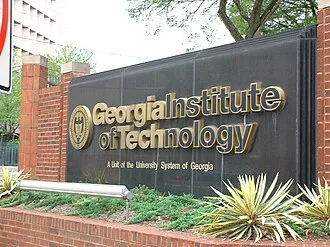
The school was founded as the Georgia School of Technology as part of New South efforts to build an industrial economy in the Southern United States after the Civil War. Initially, it offered only a degree in mechanical engineering. By 1901, its curriculum had expanded to include electrical, civil, and chemical engineering.
In 1948, the school changed its name to reflect its evolution from a trade school to a technical institute and research university. Georgia Tech is organized into seven colleges with about 30 departments and academic units. It emphasizes the academic fields of science and technology. Georgia Tech's $5.8 billion economic impact for fiscal year 2024 led all public institutions in the state.
Georgia Tech fields eight men's and seven women's sports teams; these compete in NCAA Division I athletics and have won five national championships. The university is a member of the Atlantic Coast Conference.
History
Establishment
The idea of a technology school in Georgia was introduced in 1865 during the Reconstruction period. Two former Confederate officers, Major John Fletcher Hanson (an industrialist) and Nathaniel Edwin Harris (a politician and eventually governor of Georgia), who had become prominent citizens in the town of Macon, Georgia, after the Civil War, believed that the South needed to improve its technology to compete with the North's industrialization.
Many Southerners at this time agreed with this idea, known as the New South Creed. Because the American South of that era was mainly populated by agricultural workers and technical developments lagged, they proposed establishing a technology school.
In 1882, the Georgia State Legislature authorized a committee, led by Harris, to visit the Northeast to learn how technology schools worked. They were impressed by the polytechnic educational models developed at the Massachusetts Institute of Technology and the Worcester County Free Institute of Industrial Science (now Worcester Polytechnic Institute).
The committee recommended adapting the Worcester model, which stressed a combination of "theory and practice," the "practice" component including student employment and production of consumer items to generate revenue for the school.
On October 13, 1885, Georgia Governor Henry D. McDaniel signed the bill to create and fund the new school. In 1887, Atlanta pioneer Richard Peters donated to the state 4 acres (1.6 ha) of the site of a failed garden suburb called Peters Park. The site was bounded on the south by North Avenue and on the west by Cherry Street.
He then sold five adjoining acres of land to the state for US$10,000, (equivalent to $360,000 in 2025). This land was near Atlanta's northern city limits at the time of its founding, although the city has since expanded beyond it. A historical marker on the large hill in Central Campus says that the site occupied by the school's first buildings once held fortifications to protect Atlanta during the Atlanta campaign of the American Civil War.
The surrender of the city took place in 1864 on what today is the southwestern boundary of the Georgia Tech campus.
Early years
The Georgia School of Technology opened in the fall of 1888 with two buildings. One building (now Tech Tower, an administrative headquarters) had classrooms to teach students. The second building featured a shop and had a foundry, forge, boiler room, and engine room. It was designed for students to work and produce goods to sell and fund the school.
The two buildings were equal in size to show the importance of teaching both the mind and the hands, though, at the time, there was some disagreement as to whether the machine shop should have been used to turn a profit.
Georgia Tech's Evening School of Commerce began holding classes in 1912. The evening school admitted its first female student in 1917, although the state legislature did not officially authorize attendance by women until 1920. Annie T. Wise became the first female graduate in 1919 and was Georgia Tech's first female faculty member the following year.
In 1931, the Board of Regents transferred control of the Evening School of Commerce to the University of Georgia (UGA) and moved the civil and electrical engineering courses at UGA to Georgia Tech. Georgia Tech replaced the commerce school with what later became the College of Business. The commerce school would later split from UGA and eventually became Georgia State University.
In 1934, the Engineering Experiment Station (later known as the Georgia Tech Research Institute) was founded by W. Harry Vaughan with an initial budget of $5,000 (equivalent to $120,336 in 2025) and 13 part-time faculty. In the 1940s, President Blake Van Leer focused on making Georgia Tech the "MIT of the South." He lobbied government and businesses for funds for new facilities.
The Research Building was expanded, and a $300,000 (equivalent to $4,000,000 in 2025) Westinghouse A-C network calculator was given to Georgia Tech by Georgia Power in 1947. A new gymnasium, new textile and architecture buildings, and a $2 million library was completed.
Modern history
Founded as the Georgia School of Technology, Georgia Tech assumed its present name in 1948 to reflect a growing focus on advanced technological and scientific research.
During President Blake Ragsdale Van Leer's tenure, Georgia Tech expanded its campus with new facilities, added new engineering courses, and became the largest engineering institute in the South and the third largest in the United States. The first Georgia Tech Ph.D. was awarded in 1950 in electrical engineering. Van Leer also admitted the first female students to regular classes in 1952 and began steps toward racial integration.
He stood up to Georgia governor Marvin Griffin's demand to bar Bobby Grier from participating in the 1956 Sugar Bowl game between Georgia Tech and Grier's University of Pittsburgh. After Van Leer's death, his wife, Ella Lillian Wall Van Leer, bought a house on campus and opened it to female students. She also set up the first sorority on campus along with a Society of Women Engineers chapter.
In 1968, women could enroll in all programs at Georgia Tech. Industrial Management was the last program to open to women. The first women's dorm, Fulmer Hall, opened in 1969. Rena Faye Smith, appointed as a research assistant in 1969 by R.A. Young in X-ray diffraction, became the first female faculty member (research) in the School of Physics.
She went on to earn a Ph.D. at Georgia State University and taught physics and instructional technology at Black Hills State University from 1997 to 2005 as Rena Faye Norby. She served as a Fulbright Scholar in Russia in 2004–2005. By Spring 2009, women constituted 30.3% of the undergraduates and 25.3% of the graduate students.
In 1959, a meeting of 2,741 students voted by an overwhelming majority to endorse integration of qualified applicants, regardless of race. In September 1961, nine months after the University of Georgia's violent integration, Ralph A. Long Jr., Lawrence Williams, and Ford C. Greene enrolled at Georgia Tech, becoming the first African American students at Georgia Tech.
Ronald Yancey enrolled the next year and in 1965 became the university's first African American graduate. Georgia Tech became the first university in the Deep South to desegregate without a court order. In the 1967–68 academic year, 28 students out of 7,526 were Black. In 1968, William Peace became the first Black instructor, and Marle Carter became the first Black member of the homecoming court.
In 1964, Calvin Huey became the first Black player to play at Grant Field when he took the field for Navy. The first Black person to play for Georgia Tech was Eddie McAshan in 1970.
In 1988, President John Patrick Crecine oversaw a restructuring of the university. Georgia Tech had three colleges at that point: the College of Engineering, the College of Management, and the College of Sciences and Liberal Arts. Crecine reorganized the latter two into the College of Computing; the College of Sciences; and the Ivan Allen College of Management, Policy, and International Affairs.
Crecine never asked for input regarding the changes and, consequently, many faculty members disliked his top-down management style; despite this, the changes passed by a slim margin. Crecine was also instrumental in securing the 1996 Summer Olympics for Atlanta. A large amount of construction occurred on campus, since Georgia Tech served as the Olympic Village.
The Undergraduate Living Center, Fourth Street Apartments, Sixth Street Apartments, Eighth Street Apartments, Hemphill Apartments (now named Crecine Apartments), and Center Street Apartments were built to house athletes and journalists. The Georgia Tech Aquatic Center was built for swimming events, and the Alexander Memorial Coliseum was renovated.
The Institute also built the Kessler Campanile and fountain to serve as a landmark and symbol of the university on television broadcasts.
In 1994, G. Wayne Clough became the first Georgia Tech alumnus to serve as the president of the institution. He was in office during the 1996 Summer Olympics. In 1998, he separated the Ivan Allen College of Management, Policy, and International Affairs into the Ivan Allen College of Liberal Arts and returned the College of Management to "College" status (Crecine, the previous president, had demoted Management from "College" to "School" status as part of a controversial 1990 reorganization plan).
His tenure focused on a dramatic expansion of the Institute, a revamped Undergraduate Research Opportunities Program, and the creation of an International Plan. On March 15, 2008, he was appointed secretary of the Smithsonian Institution, effective July 1, 2008. Gary Schuster, Georgia Tech's provost and executive vice president for Academic Affairs, was named interim president, effective July 1, 2008.
On April 1, 2009, G. P. "Bud" Peterson, previously the chancellor of the University of Colorado at Boulder, became the 11th president of Georgia Tech. On April 20, 2010, Georgia Tech was invited to join the Association of American Universities, the first new member institution in nine years. In 2014, Georgia Tech launched the first "massive open online degree" in computer science by partnering with Udacity and AT&T.
A complete degree through that program cost students $7,000 at the time. It eventually expanded this program with its online master's in analytics in January 2017, as well as providing the option for advanced credits with a MicroMasters in collaboration with edX. Georgia Tech now offers 13 master's programs.
On January 7, 2019, President G.P. Bud Peterson announced his intention to retire. Ángel Cabrera, Georgia Tech alumnus and former president of George Mason University, was named his successor on June 13, 2019. Cabrera took office on September 3, 2019.
Campus sections
Georgia Tech's East Campus and Central Campus as seen from an elevated point near Peachtree Street and North Avenue.The Georgia Tech campus is located in Midtown, an area slightly north of downtown Atlanta. The campus offers a mix of tall buildings and greenery. More than 15,000 trees cover nearly 30 percent of the campus. The university has been tree campus-certified since 2008 and a Certified ArbNet Level II Arboretum since 2016. The campus is served by two stations on the MARTA rail system, Midtown and North Avenue.
The campus is organized into four main parts: West Campus, East Campus, Central Campus, and Technology Square. West Campus and East Campus are both occupied primarily by residence halls, while Central Campus is reserved primarily for teaching and research buildings.
West Campus
West Campus is occupied primarily by apartments and coed undergraduate dormitories. Apartments include Crecine, Center Street, Sixth Street, Maulding, Graduate Living Center, Eighth Street, Nelson Shell, and Zbar, while dorms include Bud and Val Peterson, Freeman, Montag, Fitten, Folk, Caldwell, Armstrong, Hefner, Fulmer, and Woodruff suites.
The Campus Recreation Center (formerly the Student Athletic Complex); a volleyball court; a large, low natural green area known as the Burger Bowl; and a flat artificial green area known as the Roe Stamps (formerly SAC) Fields are all located on the west side of the campus. In 2017, West Village, a multipurpose facility featuring dining options, meeting space, School of Music classrooms, and offices on West Campus, opened.
The Robert C. Williams Museum of Papermaking is located on West Campus. Also within walking distance of West Campus are several late-night eateries. West Campus was home to a convenience store, West Side Market, which closed following the opening of West Village in the fall of 2017. Because of limited space, all auto travel proceeds via a network of one-way streets that connects West Campus to Ferst Drive, the main road of the campus.
Woodruff Dining Hall, or "Woody's," was the West Campus dining hall before closing after the opening of West Village. It connected the Woodruff North and Woodruff South undergraduate dorms.[citation needed]
East Campus
East Campus houses all of the fraternities and sororities as well as most of the undergraduate first-year dormitories. East Campus abuts the Downtown Connector, granting residents quick access to Midtown and its businesses (for example, The Varsity) via a number of bridges over the highway. Georgia Tech football's home, Bobby Dodd Stadium, is located on East Campus, as is Georgia Tech basketball's home, McCamish Pavilion (formerly Alexander Memorial Coliseum).
North Avenue Dining Hall is the main dining hall for East Campus. Brittain Dining Hall, a dining hall on East Campus that closed in 2024, was modeled after a medieval church, complete with carved columns and stained glass windows showing symbolic figures. The main road leading from East Campus to Central Campus is a steep, ascending incline commonly known as "Freshman Hill" (in reference to the large number of first-year student dorms nearby).
On March 8, 2007, the former Georgia State University Village apartments (also the former site of the 1996 Olympic Village) were transferred to Georgia Tech. Renamed North Avenue Apartments by the Institute, they began housing students in the fall semester of 2007.
Central Campus
Central Campus is home to the majority of the academic, research, and administrative buildings. The Central Campus includes, among others: the Clough Undergraduate Learning Commons; the Howey Physics Building; the Boggs Chemistry Building; the College of Computing Building; the Klaus Advanced Computing Building; the John and Joyce Caddell Building; the Skiles Classroom Building, which houses the School of Mathematics and the School of Literature, Media, and Communication; the D.M.
Smith Building, which houses the Jimmy and Rosalynn Carter School of Public Policy; the Krone Engineered Biosystems Building; and the Ford Environmental Science and Technology Building. In 2005, the School of Modern Languages returned to the Swann Building, a 100-year-old former dormitory that now houses some of the most technologically-equipped classrooms on campus.
Georgia Tech's administrative buildings, such as Tech Tower and the Bursar's Office, are also located on the Central Campus. The campus library, the John Lewis Student Center (formerly the Fred B. Wenn Building), and the Smithgall Student Services Building ("Flag Building") are also located on Central Campus too. The Student Center provides a variety of recreational and social functions for students, including: a computer lab, a game room ("Tech Rec"), a post office, a music venue, two movie theaters, dining options, a reflection space, plus meeting rooms for various clubs and organizations.
The Kessler Campanile (which is referred to by students as "The Shaft") is located next to the eastern entrance of the Student Center. The former Hightower Textile Engineering building was demolished in 2002 to create Yellow Jacket Park. More greenspace now occupies the area around the Kessler Campanile for a more aesthetically pleasing look, in accordance with the official Campus Master Plan.
In August 2011, the G. Wayne Clough Undergraduate Learning Commons opened next to the library and occupies part of Tech Green (formerly Yellow Jacket Park).
Technology Square
Technology Square, also known as "Tech Square," is located across the Downtown Connector and embedded in the city east of campus. Opened in August 2003 at a cost of $179 million, the district helped revive the area and has sparked a wider revitalization of the Midtown area. Connected by the Fifth Street Bridge, it is a pedestrian-friendly area comprising Georgia Tech facilities and retail locations.
One complex contains the Scheller College of Business Building, holding classrooms and office space for the Ernest Scheller Jr. College of Business, as well as the Georgia Tech Hotel and Conference Center and the Georgia Tech Global Learning Center.
Another part of Tech Square, the privately owned Centergy One complex, contains the Technology Square Research Building (TSRB), holding faculty and graduate student offices for the College of Computing and the School of Electrical and Computer Engineering, as well as the GVU Center, a multidisciplinary technology research center. The Advanced Technology Development Center (ATDC), Georgia Tech's science and business incubator, is also headquartered in Centergy One.
Other Georgia Tech-affiliated buildings in the area host the Center for Quality Growth and Regional Development, the Georgia Tech Enterprise Innovation Institute, the Advanced Technology Development Center, VentureLab, the Georgia Electronics Design Center and the CODA building (a mixed-use development). Technology Square also hosts a variety of restaurants and businesses, including the headquarters of notable consulting companies like Accenture, a Barnes & Noble Georgia Tech bookstore, and a Georgia Tech-themed Waffle House.
Science Square
Science Square is a mixed‐use development dedicated to life sciences and biomedical research. It is located southwest of Georgia Tech's main campus, serving as a link between Georgia Tech and Atlanta's rapidly evolving Westside community. Opened in April 2024, the district spans 18 acres and features over 1.8 million square feet of laboratory and office space, 500 residential units, and 25,000 square feet of retail area.
Due to eventually connect to the main campus by a pedestrian bridge, Science Square is the starting point for a multi-phase project designed to attract industry research partners. One of its central components is Science Square Labs, a 13-story tower designed to accommodate wet and dry laboratories for academia, industry, and startups.
Satellite campuses
In 1999, Georgia Tech began offering local degree programs to engineering students in Southeast Georgia and in 2003 established a physical campus in Savannah, Georgia. Until 2013, Georgia Tech Savannah offered undergraduate and graduate programs in engineering in conjunction with Georgia Southern University, South Georgia State College, Armstrong Atlantic State University (now Georgia Southern University–Armstrong Campus), and Savannah State University.
Georgia Tech also collaborated with the National University of Singapore to set up the Logistics Institute–Asia Pacific in Singapore. The campus is home to the regional offices of the Georgia Tech Enterprise Innovation Institute, the Savannah Advanced Technology Development Center, and the Georgia Logistics Innovation Center.
Georgia Tech also operates a campus in Metz, in northeastern France, known as Georgia Tech Europe (GTE). Opened in October 1990, it offers master's-level courses in Electrical and Computer Engineering, Computer Science, and Mechanical Engineering and Ph.D. coursework in electrical and computer engineering and mechanical engineering.
Georgia Tech Europe was the defendant in a lawsuit pertaining to the language used in advertisements, which was a violation of the Toubon Law.
Georgia Tech and Tianjin University cooperatively operated a campus in Shenzhen, Guangdong, China — Georgia Tech Shenzhen Institute, Tianjin University. Launched in 2014, it offered undergraduate and graduate programs in electrical and computer engineering, analytics, computer science, environmental engineering, and industrial design.
Admission and degree requirements at Georgia Tech were the same as those in Atlanta. In September 2024, Georgia Tech announced that it was ending its partnership with Tianjin University following U.S. congressional scrutiny of potential ties to the People's Liberation Army.